

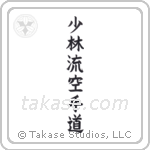
少林流空手道 shōrinryū karatedō Shorin-Ryu Karate-Do
少林流空手道 (shōrinryū karatedō), Shōrin-ryū karate-dō, writes the name of a school of karate with the characters of the Shaolin temple. Funakoshi Gichin 船越義珍 wrote the school's name in these characters in 1924, two years after writing it 昭林流. This study follows the name through its other spellings, 昭林, 照林 and 小林, and the Shaolin origin the tradition tells.
Abstract
少林流空手道 writes the name of a school of karate with the characters of the Shaolin temple, 少林寺, whose name Japanese reads shōrin. In Funakoshi Gichin 船越義珍's first book, of 1922, the art is two schools, 昭靈流 and 昭林流; in an appendix of his of 1924 the second is 少林流, which he suspects is short for the Shaolin-temple school, and that appendix is the oldest item in which the full-text search of the National Diet Library's Digital Collections finds 少林流. The precepts of Itosu Ankō 糸洲安恒, in the library's text of a plate of Itosu's papers printed in 1938, write the two schools 昭林流 and 昭靈流; a manual of 1940 quotes the same precepts from a book of Mabuni Kenwa's, in print by October 1934, with 少林流, puts the change of character after 1923, and calls the division into two schools of unknown basis. The same sound is written 照林 in an essay of 1930 and 小林 from 1927 to 1939 for one of the two schools of the two-school account, which the encyclopedia of 1939 sets at Shuri; the Japanese Wikipedia dates Chibana Chōshin 知花朝信's naming of his 小林流 to 1933; the Shaolin origin is the tradition's, and the Japanese Wikipedia notes that the existence of neither of the two schools is confirmed even in China.
Overview
The sense. A proper name, the name of a style of karate; other styles' names share or nearly share its sound (The words). JMdict gives 少林流, read しょうりんりゅう, as (Shorin-ryu) Okinawa school of karate [1].
The words. 少林 shōrin is the Shaolin temple of China, 少林寺, on Mount Song in Henan, where by the story Bodhidharma sat nine years facing a wall; the 日本国語大辞典 gives its old spelling in kana as セウリン [2]. The Japanese Wikipedia lists 少林流 with 松林流 and 少林寺流 as styles of the same or a similar sound as Chibana's 小林流, which is sometimes read コバヤシリュウ, kobayashi-ryū, to tell it from them [3]. 流 ryū is a current, and in the arts a school, a line of teaching handed down. 空手道, karatedō, is 空手, karate, and 道, a way. The Okinawan art was written 唐手, Tang hand, and already read karate; the preface to Funakoshi's first book, of 1922, writes 空手術, the art of the empty hand [4]; the spelling spread in Tokyo from about 1929, when the karate club at Keiō University, with Funakoshi as its teacher, took 空 in the sense of the Heart Sutra's emptiness [5]; and a roundtable held by an Okinawan newspaper in 1936 proposed that the name be unified as 空手 [6]. As an ordinary word, 空手 is empty-handed, cited from sermons of 1586–99 [7].
The text in English. The modified Hepburn is shōrinryū karatedō.
The historical record
1922, Funakoshi, 『唐手 琉球拳法』. Funakoshi's first book, published by 武侠社 when the Okinawan teacher wrote his name 富名腰義珍, has in its chapter What is karate a section headed 二 流儀, the schools [8]:
後世師範者の名に依つて種々の流儀に別れてはゐるが、其實昭靈流と昭林流の二派に過ぎないのである。昭靈流は體質肥滿骨格偉大なる者に適し、昭林流は之に反し、骨格倭小體力貧弱にして楊柳の如く瘠… Later generations divided it into various schools under the names of their masters, but in fact it is no more than two: the Shōrei school and the Shōrin school. Shōrei suits the heavy-set and large-boned; Shōrin the opposite, the small-boned and slight, willow-thin…
The Japanese Wikipedia gives the two-school account as Itosu's, reads 昭霊流 as the Naha line and 昭林流 as the Shuri line, and adds that the existence of neither school is confirmed even in China [5]. Its list of the oldest school names begins not with a style of the 1930s but with Motobu Chōki 本部朝基's 日本傳流兵法本部拳法, named in the Taishō era [5].
Itosu's precepts. Itosu Ankō set down precepts on karate that the Japanese Wikipedia dates to 1908 and transcribes, its preamble opening that karate did not come out of 儒仏道, Confucianism, Buddhism and Daoism, and that of old two schools, 昭林流 and 昭霊流, came from China, each with its strengths, to be kept as they are and not embellished [9]. Among the plates of 『空手道大観』, edited by Nakasone Genwa 仲宗根源和 in 1938, is one of Itosu's papers (遺稿), held by Hanashiro Chōmo 花城長茂; the National Diet Library serves the book only to readers in Japan, and in the library's text of that plate the preamble writes the two schools 昭林流 and 昭靈流 [10]. A plate from the same book, on Wikimedia Commons, shows the later precepts in manuscript under that caption [11]. A manual by Mabuni Kenwa 摩文仁賢和 and Nakasone, in a printing of 1940, quotes the same preamble from a section of Mabuni's 『護身術空手拳法』, and in the library's text the quotation reads 往古少林流、昭靈流と云ふ二派, with 少 [12]; Mabuni's book of October 1934 refers its readers to it as 拙著, my book, and advertises it [13]. In the library's text, the manuscript writes 昭 and Mabuni's book, as the manual quotes it, 少.
1924, Funakoshi writes 少林流. Tokyo City's collection of materials for citizens' physical education prints Funakoshi's appendix What is karate, and under 流儀, schools [14]:
大別して少林流、昭靈流の二派とす。顧ふに少林流のは少林寺流の略にて昭靈流は昭靈寺流の略ならんかと疑はる、サモなくは、後人技巧の上より靈肉一致と云ふ意味から名命した名前ではなからうか。後世師匠の名を採りて、色々の流儀があるやうだが、元々この二流に過ぎない Broadly there are two schools, Shōrin and Shōrei. On reflection, I suspect Shōrin is short for the Shaolin-temple school and Shōrei for a Shōrei-temple school; if not, they may be names later men gave, from their technique, in the sense of the union of spirit and flesh. There seem to be various schools that took their masters' names, but originally there are only these two.
In two years the first character has moved from 昭 to 少, the Shaolin temple's own. The city's series of books on social education reprints the appendix in 1925 [15].
1926, Funakoshi again, and a novel. In the magazine 『雄弁』 of February 1926, an article by Funakoshi, Ryūkyū karate that anyone can do, says, in the library's text, that the schools come down in the end to two, 昭靈流 and 少林流 [16]. A popular book of famous matches, of the same year, describing a karate man's stance in a bout before an audience, calls it 唐手に於ける少林流、ピンアン四段, the Shōrin school of karate, Pinan fourth level [17].
1927 to 1939, 小林流. A women's magazine of December 1927, in the library's text, says that karate divides into two schools, 照靈流 and 小林流, and quotes of 小林流 that it is a quick art suited to the small-boned and weak [18]. An encyclopedia of 1934, under 唐手術, ends its entry [19]:
主なる流派に昭靈流・小林流の二派がある。 Its main schools are two, Shōrei-ryū and 小林流.
The entry prints no reading beside 小林流. The Keiō karate club, in a volume of 1936, marks its Pinan and other forms (小林流), while its text divides the art into 昭靈流 and 少林流 [20]. An encyclopedia of 1939, under the heading When was karate brought over?, prints the reading せうりんりう, shōrinryū, beside the characters [21]:
那覇を中心に派生した昭靈流、首里を中心に派生したものが小林流である。 What grew out from Naha was Shōrei-ryū, and what grew out from Shuri is Shōrin-ryū.
In the magazine and the two encyclopedias, 小林流 is one of the two schools of the two-school account, the one the encyclopedia of 1939 sets at Shuri, not the school of one man. The Japanese Wikipedia says that Chibana, a pupil of Itosu, named his school 小林流 in 1933, and founded the Okinawa Shōrin-ryū Karate-dō Association in 1948; it gives no reference at the sentence [3].
1930, 照林. Kosugi Hōan 小杉放庵, in an essay on karate printed in 『文藝春秋』 in June 1930 and collected in his 『工房小閑』 of 1934, writes the two schools 照林流 and 昭靈流, and adds, in the library's text of the book, that he privately thinks this 照林 may mean the Chinese Shaolin school, 少林流, he has written of above [22][23].
1932, an Okinawan guide. Shimabukuro Gen'ichirō 島袋源一郎's guide to Okinawa, in its chapter on customs, under 流儀 [24]:
唐手は大別して明靈流と少林流の二派に分れるが前者は體質肥滿、骨格偉大な人に適し、基本姿勢は可なるも、敏活を缺くの嫌あり後者は體軀倭少、瘠せ形の人に適し機敏なるに反し、基本姿勢に缺陷がある。 Karate divides broadly into two schools, the 明靈 school and Shōrin; the former suits the heavy and large-boned, sound in stance but wanting quickness, the latter the small and slight, quick but defective in stance.
It runs close to Funakoshi's sentences of 1922, with 明靈 for his 昭靈 and 少林 for his 昭林. The guide's edition of 1937 has the same opening clause, to 基本姿勢は, in the library's text [25].
1940, the manual's doubt. The manual of Mabuni and Nakasone has a section headed 少林流と昭靈流は疑問, Shōrin-ryū and Shōrei-ryū are doubtful, under which its contents list the division into the two as of unknown basis (根據不明). In the library's text it says that 昭林流 is now written 少林流, and that this was after 1923 (大正十二年より後), and quotes an opinion (御意見) that 昭林流 and a 邵靈寺流 are heard to have come over of old, but that it doubts the forms extant now can be divided between the two [12].
The count. The full-text search of the National Diet Library's Digital Collections finds 少林流 in 253 items. Read oldest first, the first is the appendix of 1924 and the twenty-second is of March 1941; in the snippets of those twenty-two, sixteen are in writing on karate, three on Chinese boxing, among them a book on China of 1940, where 外家とは則ち少林流であつて, the external school is the Shaolin school, names a Chinese tradition, and three on neither [26].
1956, Funakoshi. In his memoir of 1956 Funakoshi writes, in the library's text, that at first Okinawa too was divided, it is said (というが), into two schools, 少林流 and 昭霊流 [27]. In the memoir's English of 1975, by the match of the sentences around it, the passage reads Formerly, the two Chinese schools of boxing were associated with two Okinawan schools, Shōrin-ryū and Shōrei-ryū, but what precise relationship existed among them is, of course, long lost in the mists of time: the it is said is gone, and the English Shōrin cannot show which of the sound's spellings is meant [28].
What is not a source. The Shaolin temple is the tradition's origin, not one the sources read here document. The appendix of 1924, after quoting 露伴學人 that boxing takes Shaolin as its ancestor, and that the fiction and miscellanies since the Ming tell much of the marvels of Shaolin boxing, writes, in a sentence that ends in a suspicion about when boxing reached Ryūkyū (慶長以後ならんかと疑はる, I suspect it was after the Keichō era): 拳法の遠源は少林寺に始まりて、元、禪より出で, the distant source of boxing begins at the Shaolin temple, and comes originally from Zen [14]. The Japanese Wikipedia notes that the existence of neither 昭林 nor 昭霊 as a school is confirmed even in China [5], and the manual of 1940 calls the two-school division of unknown basis [12].
Today. The name is written in English Shorin-ryu. On Okinawa it names a living style: Sōken Hōhan, back from Argentina in 1952, called his style Matsumura Orthodox Shorin-ryu, by Bishop's account choosing the Chinese characters for Shaolin to write Shorin [29]. A rendering should keep 流 as -ryū, the school's own spelling of its name, and keep the name a name. Shaolin school is what its characters spell.
A reading
In the books the library's full-text search reaches, 少林流 is in print from 1924, when Funakoshi wrote it two years after he first wrote the sound with 昭; Itosu's papers, in the library's text of a plate of 1938, write 昭 too, and the manual of 1940 puts the change of character after 1923. For fifteen years after it, writers and printers set the same sound with 照 and 小 as well, and its partner 昭靈 with 照 and 明; of them all, 少 is the one that names a temple. The Shaolin temple in it is a claim of descent that the tradition makes and the documents do not bear out: Funakoshi offered an alternative to it in 1924, the union of spirit and flesh, the manual of 1940 calls the two-school division of unknown basis, and in 1956 Funakoshi gives the two schools as something said. I read 少林流 as a name for a lineage, the Shuri line, given the most famous temple in the history of Chinese boxing as its ancestor. The turn of the story is one character in Itosu's preamble, and I have read it only in the library's text of the plate and in a transcription, not in the plate itself.
Notes
- The spellings, as each source prints them: Itosu's papers, in the library's text of the plate of 1938, 昭林流 and 昭靈流; Funakoshi 1922, 昭靈流 and 昭林流; 1924 and 1926, 少林流 and 昭靈流; the magazine of 1927, 照靈流 and 小林流; Kosugi 1930, 照林流 and 昭靈流; Shimabukuro 1932, 明靈流 and 少林流; the encyclopedias of 1934 and 1939, 昭靈流 and 小林流; the Keiō volume of 1936, 昭靈流 and 少林流 in its text and 小林流 on its forms; the manual of 1940, 少林流 in its quotation of the precepts from Mabuni's book, 昭林流 and 昭靈流 in its own account of the common view, and 昭林流 and 邵靈寺流 in the opinion it quotes. The 1924 appendix prints 名命, as quoted.
Sources not seen
The plate of Itosu's preamble in 仲宗根源和 編著『空手道大観』, 東京図書, 1938 (https://dl.ndl.go.jp/pid/1104139), served by the National Diet Library only to readers in Japan. It would settle the character Itosu wrote.
摩文仁賢和『攻防自在 護身術空手拳法』, 1934. The items to 1940 in which the Digital Collections' full-text search finds its title are advertisements and citations of it. It would show the form in which Mabuni first printed the precepts.
The pages of 『雄弁』 of February 1926 (https://dl.ndl.go.jp/pid/11006764), 『主婦の友』 of December 1927 (https://dl.ndl.go.jp/pid/10340818) and 『文藝春秋』 of June 1930 (https://dl.ndl.go.jp/pid/3197600), and of 摩文仁・仲宗根『攻防拳法 空手道入門』 (https://dl.ndl.go.jp/pid/3456304) and 船越義珍『空手道一路』 (https://dl.ndl.go.jp/pid/2481607), served only to readers in Japan. They would let the passages read here in snippets be read whole, at the page.
A reader with access to any of these is invited to write to Takase Studios at Tim@Takase.com.
References
- 少林流 しょうりんりゅう, JMdict, at jisho.org. https://jisho.org/search/少林流
- 「少林寺」, デジタル大辞泉 and 精選版日本国語大辞典, at kotobank. https://kotobank.jp/word/少林寺-79990
- 「小林流 (空手道)」, the Japanese Wikipedia, revision 93655270. https://ja.wikipedia.org/wiki/小林流_(空手道)
- 富名腰義珍『唐手 琉球拳法』, 武侠社, 1922, the preface by 漢那憲和, scan 13. National Diet Library pid 971654. https://dl.ndl.go.jp/pid/971654/1/13
- 「空手道」, the Japanese Wikipedia, § 歴史 and § 空手の表記. https://ja.wikipedia.org/wiki/空手道
- 嘉手苅徹「空手の名称の変遷 ―②「唐手(からて)」から「空手道」への変容―」, 武道学研究 44 Supplement, 2011, p. S22. https://doi.org/10.11214/budo.44.s_22
- 「空手」, 日本大百科全書 and 精選版日本国語大辞典, at kotobank. https://kotobank.jp/word/空手-47195
- 富名腰義珍『唐手 琉球拳法』, 武侠社, 1922, 唐手とは何ぞや, § 二 流儀, p. 5, scan 30. National Diet Library pid 971654. https://dl.ndl.go.jp/pid/971654/1/30
- 「糸洲安恒」, the Japanese Wikipedia, § 晩年 and § 糸洲十訓(唐手心得十ヶ条), revision 109578069. https://ja.wikipedia.org/wiki/糸洲安恒
- 仲宗根源和 編著『空手道大観』, 東京図書, Tokyo, 1938, the plates: 糸洲安恒先生の遺稿 (花城長茂先生蔵), snippet view, National Diet Library pid 1104139. https://dl.ndl.go.jp/pid/1104139
- File:Itosu Ten Precepts.jpg, Wikimedia Commons, from 『空手道大観』, 1938. https://commons.wikimedia.org/wiki/File:Itosu_Ten_Precepts.jpg
- 摩文仁賢和・仲宗根源和『攻防拳法 空手道入門 別名、空手術教範』, seventh printing, 京文社書店, Tokyo, March 1940, snippet view, National Diet Library pid 3456304. https://dl.ndl.go.jp/pid/3456304
- 摩文仁賢和『攻防自在 空手拳法 十八の研究』 (空手研究叢書 第二篇), 空手研究社 興武館, Tokyo, October 1934, snippet view, National Diet Library pid 1915276 (https://dl.ndl.go.jp/pid/1915276); and a facsimile, the colophon (昭和九年十月二十五日發行) and the advertisements at the end, Internet Archive MabuniSeipaiStudy1934. https://archive.org/details/MabuniSeipaiStudy1934
- 東京市 編『市民体育資料』, 東京市, 1924, 富名腰義珍, 附録 唐手とは何ぞや, pp. 126–127, scan 63. National Diet Library pid 1915291. https://dl.ndl.go.jp/pid/1915291/1/63
- 東京市 編『東京市社会教育叢書』 第5輯 市民体育資料, 東京市, 1925. National Diet Library pid 970009. https://dl.ndl.go.jp/pid/970009
- 『雄弁』 17 (2), 大日本雄弁会講談社, February 1926, 「誰にも出來る琉球の唐手」, by 富名越義珍 in the library's text, snippet view, National Diet Library pid 11006764. https://dl.ndl.go.jp/pid/11006764
- 鳴弦楼主人『名人達人決死の大試合』, 大日本雄弁会, 1926, 琉球特有の武技唐手, p. 157, scan 87. National Diet Library pid 1018991. https://dl.ndl.go.jp/pid/1018991/1/87
- 『主婦の友』, December 1927, snippet view, National Diet Library pid 10340818. https://dl.ndl.go.jp/pid/10340818
- 三省堂百科辞書編輯部 編『新修百科辞典』, 三省堂, 1934, からてじゅつ (唐手術), p. 517, scan 551. National Diet Library pid 1234138. https://dl.ndl.go.jp/pid/1234138/1/551
- 慶応義塾体育会空手部 編『空手道集成』 第1巻, 1936, snippet view, National Diet Library pid 1144879. https://dl.ndl.go.jp/pid/1144879
- 国民常識普及会 編『最新常識百科事典』, 国民図書協会出版部, 1939, 武道, 唐手術はいつ傳へられたか, p. 682, scan 361. National Diet Library pid 1262562. https://dl.ndl.go.jp/pid/1262562/1/361
- 小杉放庵「唐手傳」, 『文藝春秋』 8 (6), June 1930, snippet view, National Diet Library pid 3197600. https://dl.ndl.go.jp/pid/3197600
- 小杉放庵『工房小閑』, 竹村書房, 1934, 唐手傳, snippet view, National Diet Library pid 1233038. https://dl.ndl.go.jp/pid/1233038
- 島袋源一郎『沖縄案内』, 1932, 第十五章 風俗, p. 328, scan 225. National Diet Library pid 1170658. https://dl.ndl.go.jp/pid/1170658/1/225
- 島袋源一郎『沖縄案内』, 1937. National Diet Library pid 1908935. https://dl.ndl.go.jp/pid/1908935
- National Diet Library Digital Collections, full-text search on 少林流, oldest first, 11 October 2026: 253 items; the oldest 東京市『市民体育資料』 (1924), pid 1915291. https://dl.ndl.go.jp/search/searchResult?keyword=少林流&fulltext=true&sortKey=ISSUED_ASC
- 船越義珍『空手道一路』, 産業経済新聞社, 1956, snippet view, National Diet Library pid 2481607. https://dl.ndl.go.jp/pid/2481607
- Gichin Funakoshi, Karate-dō: My Way of Life, Kodansha International, Tokyo, 1975, the paperback of 1981, chapter 1, "No Weapons", § "Karate-dō Is One", p. 38.
- Mark Bishop, Okinawan Karate: Teachers, Styles and Secret Techniques, second edition, A & C Black, London, 1999, "Matsumura Orthodox Shorin-ryu", p. 58.