

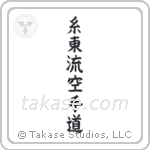
糸東流空手道 shitōryū karatedō Shito-Ryu Karate-Do
糸東流空手道 (shitōryū karatedō), Shitō-ryū karate-dō, joins the first characters of the surnames of Mabuni Kenwa 摩文仁賢和's two teachers. The dates given for the naming run from 1934 to 1939. This study finds his own book of October 1934 calling him a master of 剛柔流, and his publisher's journal that year reporting it settled that he would take the name 糸東流.
Abstract
糸東流空手道 names the karate of Mabuni Kenwa 摩文仁賢和 (1889–1952): 糸 and 東 are the first characters of the surnames of his two Okinawan teachers, Itosu Ankō 糸洲安恒 of the Shuri line and Higaonna Kanryō 東恩納寛量 of the Naha line, read shi and tō, and 流 is a school. The dates given for the naming run from 1934 to 1939; his book of October 1934 styles him a master of 剛柔流 and, in its first chapter, speaks of my school without naming it. The oldest item in which the full-text search of the National Diet Library's Digital Collections finds 糸東流 is the first number of his publisher's journal, 『空手研究』, of 1934: it still counts him with Miyagi Chōjun as a master of 剛柔流 karate, and reports it settled that he would take the name 糸東流 from the first characters of his two teachers' names; Fujiwara Ryōzō, writing in 1982 on papers Mabuni left (遺稿), found lately, holds that he still called his school 摩文仁流 in 1938 and 糸東流 only after his notice to the Butokukai in 1939. By 1940 he and his co-author print 剛柔流 and 糸東流 as the only two schools whose masters named them, in April 1941 the Butokukai's register of ranks, as a collector transcribes some of its entries, lists him under 糸東流, and his friend Konishi Yasuhiro, who sets the name 半硬流, half-hard school, against Mabuni's in 1952, writes in 1956 that Mabuni at first called himself so.
Overview
The sense. A proper name, the name of a style of karate. The 世界大百科事典's article on karate mentions it among the styles of the Shuri line (首里手系), with 松濤館流 and 和道流, apart from 剛柔流 of the Naha line [1]; the Japanese Wikipedia counts it among the four great styles, with 松濤館流, 剛柔流 and 和道流, and as a style of both the Shuri and the Naha lines [2].
The words. Read as words, 糸 thread and 東 east say nothing: the name is made of initials. A chronology of 2004 co-written by Mabuni Kenzō 摩文仁賢三 says it was 糸洲、東恩納の二人の頭名字から命名, named from the initial characters of the surnames of the two men, Itosu and Higaonna [3]. Neither teacher's name reads the characters the way the style name does: 糸 is ito in Itosu and 東 is higa in Higaonna, and in the style name they take their Sino-Japanese readings, shi and tō [4]. 流 ryū is a current, and in the arts a school. 空手道, karatedō, is 空手, karate, and 道, a way. The Okinawan art was written 唐手, Tang hand, and already read karate; the preface to Funakoshi Gichin 船越義珍's first book, of 1922, writes 空手術, the art of the empty hand [5]; the spelling spread in Tokyo from about 1929, when the karate club at Keiō University, with Funakoshi as its teacher, took 空 in the sense of the Heart Sutra's emptiness [6]; and a roundtable held by an Okinawan newspaper in 1936 proposed that the name be unified as 空手 [7]. As an ordinary word, 空手 is empty-handed, cited from sermons of 1586–99 [8].
The text in English. The name came into English as a sound, Shito-ryu; Parker's book of 1963 carries it, the oldest English print among the results saved here from the Internet Archive's full-text index [9]. The modified Hepburn is shitōryū karatedō.
The historical record
1922, Funakoshi, 『唐手 琉球拳法』. The first book on the art, published in Tokyo by the Okinawan teacher who then wrote his name 富名腰義珍, closes its chapter What is karate with a section headed 二 流儀, the schools [10]:
後世師範者の名に依つて種々の流儀に別れてはゐるが、其實昭靈流と昭林流の二派に過ぎないのである。昭靈流は體質肥滿骨格偉大なる者に適し、昭林流は之に反し、骨格倭小體力貧弱にして楊柳の如く瘠… Later generations divided it into various schools under the names of their masters, but in fact it is no more than two: the Shōrei school and the Shōrin school. Shōrei suits the heavy-set and large-boned; Shōrin the opposite, the small-boned and slight, willow-thin…
The Japanese Wikipedia gives the two-school account as Itosu's, reads 昭霊流 as the Naha line and 昭林流 as the Shuri line, and adds that neither school is known in China [6]. Its list of the oldest school names begins not with a style of the 1930s but with Motobu Chōki 本部朝基's 日本傳流兵法本部拳法, named in the Taishō era [6].
1902 to 1908, the two teachers. Mabuni, born in Shuri in 1889, entered the teaching of Itosu, a master of the Shuri line, at thirteen, and of Higaonna, a master of the Naha line, at nineteen, by one biography [11]; another has Itosu from 1903 and Higaonna from 1908 [12].
October 1934, his own book. Mabuni's 『攻防自在 空手拳法 十八の研究』, dated 25 October 1934, styles him in its advertisements 日本拳法 空手術教授 剛柔流 拳法師範, professor of karate-jutsu, master of the Gōjū-ryū fist method; its first chapter opens 我が流派に於ては, in my school, and names no school [13]. In the library's text of its pages it also advertises a volume titled with 摩文仁流 and 女子護身術, self-defense for women [13].
1934, his publisher's journal. The first number of 『空手研究』, Karate Research, from his publisher, 空手研究社, is dated 1934 in the National Diet Library's record and December 1934 in another library's record that the library's catalogue search carries [14][15]. The library serves it only to readers in Japan; its full-text search shows the text of one page of it in snippets, with the reading glosses printed beside the characters run into the line [14]. On that page Mabuni stands with Miyagi Chōjun 宮城長順, then abroad, as the two great masters of 剛柔流 karate; he trains his pupils first in the orthodox school of Itosu and, past a certain level, in Higaonna's school alongside it; and, considering his present position, and in memory of the great kindness of his two teachers, it has been settled that he will take the name 糸東流 from the 頭字, first characters, of the two great masters, one from each [14]. In the search's text that sentence's subject is cut to …仁師範, master …-ni; the lines on either side name 摩文仁師範, Master Mabuni [14]. The next sentence announces that the publisher has asked him to set down the orthodox Itosu school as a course of lessons for self-study [14]. Read oldest first, this journal is the first of the 581 items in which the search finds 糸東流 [16].
1934 to 1939, the dates for the name. The Japanese Wikipedia says that in 1934 he opened a dōjō in Osaka named 養秀館 and took the name 糸東流, and that 糸東流 was registered with the 大日本武徳会 in 1939 [2]; the WEB秘伝 biography gives the dōjō and the name in 1934 [11]. The chronology of 2004 enters the name under 1935 and again under 1939, the second time with the registration [3]. On the page or entry read, none of the three cites a document of the year it gives for the name. The journal above is one, for 1934; for the registration of 1939 the Japanese Wikipedia cites the transcription of the register of 1941 below [2]. Fujiwara Ryōzō 藤原稜三, in the karate sections he wrote for the 『日本武道大系』 of 1982, puts the name later: papers Mabuni left (遺稿), found lately, he writes, show that when Mabuni drafted his 攻防拳法空手道 in 1938 he called his school not 糸東流 but 摩文仁流, so that he called it 糸東流 only after the notice of his school's name that he filed with the Butokukai in 1939 [17]. In a dialogue printed in 1986 Fujiwara recalled finding, in the spring of 1949 at the house of Konishi Yasuhiro 小西康裕, a note said to be in Mabuni's hand reading 摩文仁流, and Konishi answering yes when he asked whether it was the earlier name of 糸東流 [18].
1940, the manual. A manual by Mabuni and Nakasone Genwa 仲宗根源和, 『攻防拳法 空手道入門』, in a seventh printing of March 1940 that the library serves only to readers in Japan, has a section on the two schools, 剛柔流 and 糸東流. Its snippets say that most school names were given by others, and that 剛柔流, Miyagi's, and 糸東流, Mabuni's, were the only two whose masters took their names themselves [19].
April 1941, the register. The Butokukai's register of ranks of April 1941 is known from a collector's transcription of some of its karate entries, which lists 摩文仁賢和(糸東流) among the holders of the rank 錬士, beside 富名腰義珍(松濤館流) and 大塚博紀(和道流) [20]. The register's edition of 1937, on p. 296, the page read, lists one karate 錬士, 稲垣虎吉, with the year of his rank, his birth and his address and no school; on that page no living holder of any art is given one [21].
December 1943, Funakoshi. Funakoshi's 『空手入門』, in the Portuguese of its English translation: Pelo que é do meu conhecimento, os únicos estilos que nos chegaram do passado são o Goju-ryu do Mestre Miyagi e o Shito-ryu do Mestre Mabuni, as far as I know, the only styles that have come down to us from the past are the Gōjū-ryū of Master Miyagi and the Shitō-ryū of Master Mabuni [22]. A book of 1962 by Wakamatsu Reikichi 若松礼吉 quotes the passage in Japanese, dating it by the book's December 1943, and in the library's text of its page the speaker, Funakoshi by the match with the Portuguese, speaks of 古くから私の知っている流名, the school names I have known from of old, and names only two, Miyagi's 剛柔流 and Mabuni's 糸東流 [23]. The Portuguese, from the English, makes the names he had long known into the only styles that have come down from the past.
1952 to 1996, 半硬流. The oldest item in which the Digital Collections' full-text search finds 半硬流, half-hard school, is a karate manual of 1952 by Konishi Yasuhiro, whose note on its author sets arts against men's names, and sets 半硬流, 剛柔流 and 糸東流 karate against the name of his ally and friend (盟友) Mabuni Kenwa [24][25]. In a book of 1956 Konishi calls him the late Mabuni Kenwa, who at first called himself 半硬流, and says that he later took the name 糸東流 from the first characters of the names of the two masters (両拳聖) [26]. A book of 1962 writes 糸東流 (at first 半硬流) [23]. Each is read in the library's text of its pages, which the library serves only to readers in Japan. Japanese books give the name to the Gōjū story too: a compilation of 1970 edited by Wataya Kiyoshi 綿谷雪 has 半硬流 at a martial-arts tournament, the place read as Kyoto, and then a formal name read as 剛柔流, in a window of the library's text damaged at both and naming no one [27], and a survey of Okinawan karate of 1996 tells that Shinzato Jin'an 新里仁安, asked his school's name at the tournament for the enthronement in 1929, answered 半硬流 [28]. In English the name Hankō-ryū, half-hard style, is first in print, among the English books read here, in Toguchi Seikichi's of 1976, as Shinzato's answer for the school Miyagi then named 剛柔流 [29]; Bishop's, of 1999, gives it to Mabuni on the word of Kanyei Uechi, who by Bishop's account introduced Mabuni's Shitō-ryū to Okinawa, and whom Bishop distinguishes from the Uechi-ryū master of that name [4].
What is not a source. The National Diet Library's next-generation full-text search, which reads only the books the library serves to everyone, finds 糸東流 in none of them [30]; the Japanese witnesses above that the library serves only in Japan are found by its Digital Collections' full-text search: on 糸東流 for 1934 and 1940 [16], on 半硬流 for 1952 to 1996 [24], and on 摩文仁流 for Fujiwara's books of 1982 and 1986 [31].
Today. The name is written in English Shito-ryu. A rendering should keep 流 as -ryū, the school's own spelling of its name, and keep the name a name. Thread-east school is what the characters say and not what the name means; the school of Itosu and Higaonna is what it means.
A reading
The characters are the easy part: two teachers' initials, read in the sound a reader of Chinese characters would give them, and a school. What the name records is a lineage, the Shuri line and the Naha line in one man, the two lines the Japanese Wikipedia reads into the two schools Funakoshi wrote of in 1922; the 世界大百科事典 sets the style with the Shuri line, and the name itself says both. The date was the hard part. In October 1934 Mabuni's own book called him a master of 剛柔流 and in its first chapter wrote my school without naming it; in the same year his publisher's journal, still counting him a master of 剛柔流 beside Miyagi, reported it settled that he would take the name 糸東流. I read the name as taken in 1934, as a name for what he was already teaching, Itosu's school first and Higaonna's after it, by a man who in that year stood under both names. The papers Fujiwara cites, which by his account show Mabuni calling the school 摩文仁流 in 1938, I have not seen [17]; it would cut against the journal only if the journal's announcement was not acted on, and the manual of 1940 and Funakoshi in 1943, who counts 糸東流 among the names he had known from of old, read more easily if the name was in use before the registration [19][23]. I have read the journal only in the library's text of its page, not the page itself, and the registration of 1939, the date the later tellings share, I have not seen.
Sources not seen
『大日本武徳會範士教士錬士名鑑』, 長島孝有 編, 大日本武徳会本部雑誌部, April 1941 (National Diet Library Search, https://ndlsearch.ndl.go.jp/books/R100000136-I1970867909771177689). It would settle the date of Mabuni's rank and the form in which the register prints 糸東流.
The page of 『空手研究』 第1輯 that names 糸東流, 空手研究社, 1934 (https://dl.ndl.go.jp/pid/1027727), served by the National Diet Library only to readers in Japan, and reprinted by 榕樹書林 in 2003 (National Diet Library Search, https://ndlsearch.ndl.go.jp/books/R100000136-I1971149384788151977). It would let the passage be read whole, at the page, with its heading, and settle the month.
摩文仁賢和・仲宗根源和『空手道入門 別名・空手独習の手引』, 空手研究社興武館, October 1935 (National Diet Library Search, https://ndlsearch.ndl.go.jp/books/R100000001-I47111104048372), and its enlarged edition 『空手道入門 別名・空手術教範』, 京文社書店, March 1938 (https://ndlsearch.ndl.go.jp/books/R100000136-I1971993809776267844), whose seventh printing of 1940 is reference 19; reprinted by 榕樹社 in 1996 (https://ndlsearch.ndl.go.jp/books/R100000002-I000002538988). They would show whether the section 剛柔流と糸東流 was in print before 1940, and so test Fujiwara's 摩文仁流 of 1938.
The manuscripts Fujiwara cites for 1938, and the pages of the 『日本武道大系』 that cite them. They would show what the manuscripts are and what they say.
小西康裕『図解空手入門』, 1952, and 『空手上達法』, 1956, at the page (https://dl.ndl.go.jp/pid/2461495, https://dl.ndl.go.jp/pid/2480268), served only to readers in Japan. They would let Konishi's sentences on 半硬流 be read whole, with what stands around them.
船越義珍『空手入門』, 国防武道協会, December 1943 (CiNii Books, NCID BC11034068). The Japanese of the passage quoted here in Portuguese is known here only from its quotation in the book of 1962, in the library's text of its page; the book would settle Funakoshi's own wording.
A reader with access to any of these is invited to write to Takase Studios at Tim@Takase.com.
References
- 「糸東流」, 世界大百科事典 (旧版), in the article 空手, at kotobank. https://kotobank.jp/word/糸東流-1332267
- 「糸東流」, the Japanese Wikipedia, § 歴史. https://ja.wikipedia.org/wiki/糸東流
- 沢勲・摩文仁賢三・樋口豊治・長田眞男「空手道学の略史とITによる手技術と急所の相関モデル」, 大阪経済法科大学論集 88, 2004, pp. 83–121, the chronology at p. 91. https://keiho.repo.nii.ac.jp/records/1921
- Mark Bishop, Okinawan Karate: Teachers, Styles and Secret Techniques, second edition, A & C Black, London, 1999, pp. 105–107; the first edition was of 1989 (the edition page).
- 富名腰義珍『唐手 琉球拳法』, 武侠社, 1922, the preface by 漢那憲和, scan 13. National Diet Library pid 971654. https://dl.ndl.go.jp/pid/971654/1/13
- 「空手道」, the Japanese Wikipedia, § 歴史 and § 空手の表記. https://ja.wikipedia.org/wiki/空手道
- 嘉手苅徹「空手の名称の変遷 ―②「唐手(からて)」から「空手道」への変容―」, 武道学研究 44 Supplement, 2011, p. S22. https://doi.org/10.11214/budo.44.s_22
- 「空手」, 日本大百科全書 and 精選版日本国語大辞典, at kotobank. https://kotobank.jp/word/空手-47195
- Edmund K. Parker, Secrets of Chinese Karate, Prentice-Hall, Englewood Cliffs, 1963, p. 55, read in the Internet Archive's full-text index. https://archive.org/details/secretsofchinese00park
- 富名腰義珍『唐手 琉球拳法』, 武侠社, 1922, 唐手とは何ぞや, § 二 流儀, pp. 4–5, scan 30. National Diet Library pid 971654. https://dl.ndl.go.jp/pid/971654/1/30
- 「摩文仁賢和 Mabuni Kenwa – 糸東流空手道」, WEB秘伝 (BAB Japan). https://webhiden.jp/master/mabuni_kenwa/
- Andreas Quast, essay on the manuscripts, § Mabuni Kenwa (A), in Patrick McCarthy, Bubishi: The Classic Manual of Combat, revised and expanded edition, Tuttle, Rutland, Vermont, 2016.
- 摩文仁賢和『攻防自在 空手拳法 十八の研究』 (空手研究叢書 第二篇), 空手研究社 興武館, Tokyo, 1934, a facsimile: the preface, p. 11; the contents, pp. 16–17; chapter 1, p. 19; the colophon and the advertisements at the end. Internet Archive MabuniSeipaiStudy1934. https://archive.org/details/MabuniSeipaiStudy1934 The library's copy, catalogued as 『功防自在空手拳法十八の研究』, snippet view, National Diet Library pid 1915276. https://dl.ndl.go.jp/pid/1915276
- 空手研究社 編『空手研究』 第1輯, 空手研究社 興武館, Tokyo, 1934, snippet view, National Diet Library pid 1027727. https://dl.ndl.go.jp/pid/1027727
- 『空手研究』, 空手研究社興武館, 1934.12, the record at National Diet Library Search. https://ndlsearch.ndl.go.jp/books/R100000136-I1970867909849643658
- National Diet Library Digital Collections, full-text search on 糸東流, oldest first, 11 October 2026: 581 items; the oldest 『空手研究』 第1輯 (1934), pid 1027727. https://dl.ndl.go.jp/search/searchResult?keyword=糸東流&fulltext=true&sortKey=ISSUED_ASC
- 藤原稜三, the sections on the history of karate and its masters, in 今村嘉雄ほか 編『日本武道大系』 第8巻, 同朋舎出版, Kyoto, August 1982, snippet view, National Diet Library pid 12141092. https://dl.ndl.go.jp/pid/12141092
- 儀間真謹・藤原稜三 編『近代空手道の歴史を語る 対談』, ベースボール・マガジン社, Tokyo, October 1986, snippet view, National Diet Library pid 12144507. https://dl.ndl.go.jp/pid/12144507
- 摩文仁賢和・仲宗根源和『攻防拳法 空手道入門 別名、空手術教範』, seventh printing, 京文社書店, Tokyo, March 1940, snippet view, National Diet Library pid 3456304. https://dl.ndl.go.jp/pid/3456304
- 「大日本武徳會武道範士教士錬士名鑑」, 「まるふじ文庫」の収集武道書 (Yahoo! ブログ), 25 November 2016, transcribing 『大日本武徳會範士教士錬士名鑑』 of April 1941, at the Wayback Machine. https://web.archive.org/web/20161226055045/http://blogs.yahoo.co.jp/marufujibunko2015/27817398.html
- 『武道範士教士錬士名鑑』 昭和12年, 大日本武徳会本部雑誌部, 1937, p. 296, scan 160. National Diet Library pid 1055514. https://dl.ndl.go.jp/pid/1055514/1/160
- Gichin Funakoshi, Karatê-Do Nyumon, Editora Cultrix, São Paulo, 1988, the Portuguese of the English of Kodansha International, 1988, p. 30.
- 若松礼吉『空手道 拳法』, 不昧堂書店, Tokyo, 1962, snippet view, National Diet Library pid 2497746. https://dl.ndl.go.jp/pid/2497746
- National Diet Library Digital Collections, full-text search on 半硬流, oldest first, 11 October 2026: 17 items; the oldest 小西康裕『図解空手入門』 (1952), pid 2461495. https://dl.ndl.go.jp/search/searchResult?keyword=半硬流&fulltext=true&sortKey=ISSUED_ASC
- 小西康裕『図解空手入門』, 川津書店, Tokyo, 1952, the note on the author, snippet view, National Diet Library pid 2461495. https://dl.ndl.go.jp/pid/2461495
- 小西康裕『空手上達法』, 川津書店, Tokyo, 1956, snippet view, National Diet Library pid 2480268. https://dl.ndl.go.jp/pid/2480268
- 綿谷雪 編『古武道文献集』 1 (武芸流派大事典補訂稿), 武芸帖社, 1970, snippet view, National Diet Library pid 13331523. https://dl.ndl.go.jp/pid/13331523
- 高宮城繁ほか 編著『沖縄空手道概説 武道空手の諸相』, 沖縄空手道協会北谷道場, August 1996, snippet view, National Diet Library pid 13898273. https://dl.ndl.go.jp/pid/13898273
- Seikichi Toguchi, Okinawan Goju-Ryu: Fundamentals of Shorei-Kan Karate, Ohara Publications, Burbank, 1976, "The Origin of Goju-Ryu". https://archive.org/details/okinawan-goju-ryu-fundamentals-of-shorei-kan-karate
- National Diet Library next-generation full-text search on 糸東流, searched again 11 October 2026: none. https://lab.ndl.go.jp/dl/api/book/search?searchfield=contentonly&keyword=糸東流
- National Diet Library Digital Collections, full-text search on 摩文仁流, oldest first, 11 October 2026: 10 items; the oldest Mabuni's book of 1934, pid 1915276. https://dl.ndl.go.jp/search/searchResult?keyword=摩文仁流&fulltext=true&sortKey=ISSUED_ASC