

森羅万象 shinra banshō All of Creation
森羅万象 (shinra banshō) is everything that exists, the whole of the universe. It began as a Chinese Buddhist phrase, and Dōgen wrote it in Japanese in 1243. This study follows it through the missionaries' word for God's creation to the English all of creation.
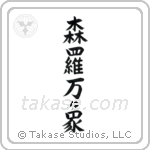
Abstract
森羅万象, shinra banshō, is everything that exists in the universe, all things and all phenomena. Among the texts the CBETA canon dates, the four characters in this order are first in a Tiantai commentary of the late sixth century; the Chan masters used the phrase in both orders, and the earliest Japanese use the national dictionary gives, and the earliest a search of the Taishō canon's Japanese volumes at SAT returns, is Dōgen's, in a chapter dated 1243. The Jesuits took the word in 1603 for God's creation, Japanese books of 1639 and 1646 print it in kana with the Buddhist reading manzō, and the reading moved from there through banshō and banzō to the banshō the dictionaries head today. The European dictionaries carried the creation sense from Collado's Latin of 1632 through Hepburn's God created all things of 1867 to Corwin's all of creation of 1968; the translators of the Zen books render it instead as myriad forms in profuse array, which keeps the ranks of 羅 that the dictionary line leaves out.
Overview
The sense. A Buddhist term that became an ordinary word; the dictionaries tag it a four-character compound and give it no special register. Everything that exists in the universe, all things and all phenomena: 宇宙に存在する一切のもの。あらゆる事物・現象 in the 大辞泉, and in the national dictionary 宇宙間に数限りなく存在するいっさいの物事, all the things that exist without number in the universe [1]. Its neighbors, by the 大辞泉's list, are 自然, 天然, 造化 and 大自然, nature and creation [1].
The words. 森 is a mass of trees and 羅 a net or a row, to stand in ranks; 森羅 is things ranged without number, as trees stand in a forest. 万象 is the ten thousand forms, every shape a thing takes. The four-character dictionary explains it in those terms: 「森」は木の多いこと、「羅」は連なることで、「森羅」は無数に並び連なることをいいます [1]. 羅 is also silk gauze and 象 also the elephant, but those are not the senses in this word.
The text in English. Two lines. The dictionary line begins with the missionaries: the Dominican Diego Collado's Latin dictionary of 1632 sets tènchi xinra mànzŏ under heaven and earth and every creature [2], the French translation of the Jesuits' dictionary renders the word toute la création [3], Hepburn's dictionary of 1867 glosses it All things with the sentence God created all things [4], and Corwin's dictionary of idioms of 1968 gives all of creation; all nature [5]. The translators' line begins with the Zen books: Thomas and J. C. Cleary's Blue Cliff Record of 1977 renders the 碧巌録's 萬象森羅 myriad forms in profuse array [6][7], and Victor Sōgen Hori and Kazuaki Tanahashi keep the array [8][9]. The first line is the missionaries' creation; the second keeps the 羅, the ranks, that the first leaves out.
The historical record
Sui dynasty, 智顗, 『觀音玄義』. Among the texts the CBETA canon dates, the four characters in the order sold are first in a commentary on the Kannon chapter of the Lotus Sutra by 智顗 (538–597), the Tiantai master, as taken down by his disciple 灌頂: 別教觀假名之法森羅萬象, the Separate Teaching contemplates the provisional dharmas, the ranged ten thousand forms, and must tell them apart to lead and benefit beings [10]. The word is in Tiantai scholarship before the Chan texts below.
Died 713, 永嘉玄覺, 『証道歌』. The Song of Enlightenment attributed to 永嘉玄覺, who died in 713, has the phrase in the reverse order, in a line about the mirror of the mind: clear, unobstructed, its light fills worlds as many as the sands; the ten thousand forms, ranged, appear reflected in it; one round radiance, neither inside nor out [11].
1125, 『碧巌録』. The koan collection of 1125 uses the phrase in both orders, more than once in each, and once quotes an older line, 森羅及萬象、皆是一法之所印, the ranged forms and the ten thousand things are all the seal of the one dharma [7]. That line is from a 法句經 of the Dunhuang manuscripts, not the Dhammapada of the same title, which the Taishō canon places among its doubtful sutras (疑似部); its own text reads 參羅及萬像 [12]. The 楞伽師資記, a Tang history of the Chan lineage compiled by 淨覺, quotes it under that title, 法句經云 [13].
1620, 宏智正覺's verse, in a Japanese printing. A verse by 宏智正覺 (1091–1157) that begins 森羅萬象許崢嶸, the ranged ten thousand forms, so tall and sheer, was printed in Japan in 1620 in an abridgment of the Yuan anthology 『禪林類聚』, introduced as 天童覺頌云, the verse of 天童覺, the name under which the encyclopedia enters him [14][15].
1231 and 1243, Dōgen. In Japanese, the first use the national dictionary gives, and the earliest a search of the Taishō canon's Japanese volumes at SAT returns, is Dōgen's. His 『辨道話』, dated 1231 in its colophon, has the reverse order, 萬象森羅 [16]. The 法性 chapter of the 『正法眼蔵』, dated in its colophon to the tenth month of 1243 at Kippō-ji in Echizen [16], has both orders in one passage, here in the typeset of 1885: カノ法性ハイマノ万象森羅ニアラスト邪計スルナリ … コノ森羅万象ト法性ト、ハルカニ同異ノ論ヲ超越セリ, they falsely reckon that the dharma-nature is not the ranged ten thousand forms of now … this 森羅万象 and the dharma-nature are far beyond any argument of same and different [17]. The national dictionary enters Dōgen's use under the reading shinra manzō, the Buddhist pronunciation of both 万 and 象 [1].
About 1366 and 1428, 『閻浮集』 and Zeami. The national dictionary's first Japanese examples for 万象 itself are a poem of about 1366 mourning the Zen master 雪村, in the collection 『閻浮集』, 万象森羅尽挙哀, the ranged ten thousand forms all raise the cry of mourning, and the 『拾玉得花』 of 1428, 万象(マンザウ)・森羅 [18], a treatise Zeami wrote for his son-in-law 金春禅竹 [19].
1330 to 1333, 清拙正澄 at Engaku-ji. 清拙正澄 (1274–1339), a Chinese master who came to Japan in 1326 [20], preached a sermon for 上元, the full moon of the first month, in the record of his years at Engaku-ji in Kamakura, a section that opens in 1330 and is followed by one that opens in 1333 [21]. The sermon turns on the word: 日月星辰是灯、山河大地是灯、森羅万象是灯、草木叢林是灯。若到衲僧分上、世灯不是灯、心燈不是燈、日月星辰山河大地不是灯、森羅万象草木叢林不是燈、直待十方世界黒漆漆地去, sun, moon and stars are lamps; mountains, rivers and the great earth are lamps; the ranged ten thousand forms are lamps; grass, trees and forests are lamps. But when it comes to the monk's part, the world's lamps are not lamps and the mind's lamp is not a lamp; sun, moon and stars, mountains, rivers and the great earth are not lamps; the ranged ten thousand forms, grass, trees and forests are not lamps; wait until the worlds of the ten directions go pitch-black [21].
1603, the Jesuits. The Jesuits' Japanese–Portuguese dictionary, printed at Nagasaki in 1603, records the sentence ヲンアルジ デウス xinra manzǒuo ツクリ タマウ, Our Lord Deus made the shinra manzō, a Christian creation in a Buddhist word [1]. Its French translation of 1868 gives the entry whole: Chinra manzô, シンラ マンザウ, toute la création. Wonarouji Deus chinra manzôno tsoucouri tamô, Dieu notre Seigneur a créé toutes choses [3].
1639 and 1646, the word in kana. Japanese books printed in kana give it the same reading. The anti-Christian 『吉利支丹物語』, printed at Kyoto in 1639 [22], reports the missionaries' claim and calls it nonsense: 第一にしんらまんざう人ちく。さうもく日月ことくつくりたまふといふたわ事をはさしおひて, setting aside first the nonsense that he made the shinra manzō, men and beasts, grass and trees, sun and moon [23]. A printing of 1646 of the war tale 『曽我物語』 uses it in a Pure Land passage: しんらまんざうせんが大ぢ。みだにもれたる事なし, the ranged ten thousand forms, mountains, rivers and the great earth: none is left outside Amida [24].
1778 and 1790, the word in the world. A comic novel of 1778 uses it, with the reading シンラバンシャウ, shinra banshō, of the man who has the measure of everything and so may become a true connoisseur of the pleasure quarters [1]. A haikai treatise by 鼻中庵三力, its postface dated 1783 and its printing 1790, writes 月は千江万池に印すといへども唯一つ也。心も亦森羅萬象に轉ずといへども二ッはなし, the moon prints itself on a thousand rivers and ten thousand ponds and yet is one; the mind too turns with the ranged ten thousand forms, and yet they are not two, with ザウ, zō, beside 象 [25].
The 1780s, the pen name. 森羅万象 was also the pen name of 森島中良, a scholar of Dutch learning and a writer of comic fiction, a pupil of 平賀源内, whose books appeared from the 1780s [1].
1889 and 1890, 『言海』. Ōtsuki Fumihiko's dictionary uses the word in its prefatory matter, dated January 1889, for its own scope: 宇宙三才、森羅萬象ノ事事物物ノ語, the words for every thing of the universe and of heaven, earth and man, the ranged ten thousand forms [26]. When its third volume reached the word in 1890, it headed it しんら-まん-ざう, shinra manzō, and defined it 天地ノ間ニ、萬物ノ、種種ノ有樣ニテ、數限リモナク存在スル狀ヲイフ語, a word for the state in which the ten thousand things exist between heaven and earth, in every kind of form and without number [26].
Today. In modern Japanese the word is plain and secular. A novelist in 1951 used it of the Book of Changes explaining all things; another in 1970 of light making the whole of heaven and earth [1]; and four prime ministers have reached for it in the Diet, from Nakasone in 1985 to Abe on 6 February 2019, who said 「総理なので森羅万象すべて担当している」, I am the prime minister, so I am in charge of everything there is, and 森羅万象 trended on Twitter [27]. It also stands inside another piece of calligraphy: the Japanese encyclopedia explains that the whisker strokes of the Nichiren daimoku show the title's light reaching 森羅万象 [28]. The dictionaries at kotobank head the word shinra banshō and give shinra manzō and shinra banzō as other readings [1].
The word in English
1632, Diego Collado. The Dominican's Latin dictionary, printed in Rome, sets the word under Cælum, & terra, & omnis creatura, heaven and earth and every creature: tènchi xinra mànzŏ [2]. His book of confession, printed in Rome the same year, puts it in the answer to what Deus is: tènchi xìnra mànzô vo tçucùri, he made heaven and earth and the shinra manzō [29]. The creation sense in the European languages begins here and in the Jesuits' sentence.
1867 to 1888, James Curtis Hepburn. Hepburn's first edition heads the word SHIN-RA-BAN-SHŌ, シンラバンシヤウ, and glosses it All things, with one example, the missionaries' sentence again: Kami wa — wo tszkuri-tamō, God created all things [4]. The second edition of 1872 keeps the gloss and the sentence and spells the romaji BAN-ZŌ, while its kana still reads バンシヤウ [30]; the fourth of 1888 has SHINRA-BANZŌ, シンラバンザウ, in both [31].
1896, Frank Brinkley. Brinkley's dictionary heads it Shinra-manzō, しんらまんざう, and gives two senses, The many and varied forms of matter in the universe; all things and Many and various; multifarious, with no sentence about God [32].
1942 to 2013, the twentieth-century dictionaries and after. Kenkyūsha's dictionary has shinra-banshō: Everything in nature; the universe; creation, with the example 森羅萬象一として奇ならざるはなし, All nature is a miracle [33]. Corwin's dictionary of idiomatic equivalents has shinra banshō, printed 森ら万象, all of creation; all nature [5]. The Kodansha Kanji Dictionary of 2013 enters it under 森 in the sense in close rows as trees in a forest, and glosses it all creation, Nature [34].
1977 to 2013, the translators of the Zen books. In the 碧巌録 a line of 圓明's sends the mountains and rivers up to the solitary heights and 萬象森羅 down through the precipices [7]; the Clearys render the phrase myriad forms in profuse array [6]. Hori's book of capping phrases of 2003 gives a line on banzō shinra as The 'ten thousand things' all spill forth in teeming array [8], and Tanahashi's glossary to the 正法眼蔵 explains 萬象森羅 as literally, myriad forms, many arraying [9]. EDRDG's online dictionary keeps the dictionary line: all things in nature; the whole creation [35].
A reading
The word was never shut in the monastery. Japanese print reached it in Buddhist books and Christian ones at once, and the books of the seventeenth century, for and against the missionaries, read it the same way, shinra manzō. Its history in Japan is a history of readings: manzō, the Buddhist pronunciation, from the dictionary's entry for Dōgen through the Jesuits, the kana prints, the 言海 and Brinkley; banshō in a comic novel of 1778 and Hepburn's first edition; banzō in his later ones; and banshō in every twentieth-century dictionary read for this study. In English it has two lives. The dictionary line, from Collado's omnis creatura to Corwin's all of creation, is right about what the word covers, everything there is. The translators' myriad forms in profuse array is right about how the word sees it: forms standing in ranks, each in its place, like trees in a forest. All of creation is a good English for the word as Japanese uses it now, and it is not a modern gloss: it is the line the missionaries began in 1632 and Corwin printed word for word in 1968. What it leaves out is the 羅, the ranks, which the Zen translators keep.
Notes
- The national dictionary dates the 法性 chapter 1231–53, the span of the whole 『正法眼蔵』; the chapter's own colophon reads 寛元元年癸卯孟冬, the tenth month of 1243, and the text dated 1231, 『辨道話』, has only 萬象森羅 [1][16].
- The 1885 typeset of the 『正法眼蔵』 and the 清拙 manuscript write 万; the prints of 1620 and 1790, the Taishō text and the 言海 write 萬 [17][21][14][25][16][26]. In the manuscript the first 羅 of the sermon is written in an abbreviated hand form and the second in full [21].
- The 碧巌録 quotes the 法句經's line as 森羅及萬象; the 法句經 and the 楞伽師資記 write 參羅及萬像 [7][12][13].
- The 1790 print's ruby on 萬 is not resolved at the scan; that on 象 reads ザウ [25].
- The 『吉利支丹物語』 uses the word a second time, two scans earlier, where the second kana is not resolved at the scan; that passage is not quoted [23].
- Hepburn's third edition of 1886 was not seen; the reading moves from the first edition of 1867 to the second of 1872 and the fourth of 1888 [4][30][31].
Sources not seen
The Vocabulario da Lingoa de Iapam, Nagasaki, 1603–1604, the Jesuits' dictionary itself; its entry is read here in the national dictionary's quotation [1] and the French translation of 1868 [3], and no free facsimile has been located by the author. It would settle the Portuguese gloss as printed. Its Japanese translation, 『邦訳日葡辞書』, 岩波書店, 1980, is in print only.
清原宣賢『中庸抄』, 笑雲清三『四河入海』, 『徒然草文段抄』 (1667), 『理気弁論』 (1709) and 『数学夜話』 (1761), Edo books in which the National Diet Library's full-text index finds the word; not read at the line. They would settle how the word was used between Dōgen and the comic novel of 1778 outside the Zen books.
A printing of 1663 of the 『曽我物語』 and 『くわんをん經註しやく』 of 1678, which print the word in kana; found by the National Diet Library's full-text search and not read at the scan.
A column on 森羅万象 in JapanKnowledge's 日本語、どうでしょう?, reported by a search at an address that opened a different column; behind a subscription.
A reader with access to any of these is invited to write to Takase Studios at Tim@Takase.com.
References
- 「森羅万象」, デジタル大辞泉・精選版日本国語大辞典・四字熟語を知る辞典, and the biographical entries for 森羅万象 (森島中良), at kotobank. https://kotobank.jp/word/森羅万象-18412
- Diego Collado, Dictionarium sive thesauri linguae Iaponicae compendium, Rome, 1632, p. 16, s.v. Cælum. Internet Archive bub_gb_DxfRZ9zyxw4C. https://archive.org/details/bub_gb_DxfRZ9zyxw4C
- Léon Pagès, Dictionnaire japonais-français, traduit du dictionnaire japonais-portugais composé par les missionnaires de la Compagnie de Jésus, Paris, 1868, p. 158, s.v. Chinra manzô. Internet Archive dictionnairejap00japagoog. https://archive.org/details/dictionnairejap00japagoog
- James Curtis Hepburn, A Japanese and English Dictionary; with an English and Japanese Index, American Presbyterian Mission Press, Shanghai, 1867, p. 410, s.v. SHIN-RA-BAN-SHŌ. Internet Archive ajapaneseandeng00hepbgoog. https://archive.org/details/ajapaneseandeng00hepbgoog
- Charles Corwin, A Dictionary of Japanese and English Idiomatic Equivalents, Kodansha International, Tokyo, 1968, p. 220, s.v. shinra banshō.
- Thomas Cleary and J. C. Cleary, trans., The Blue Cliff Record, Shambhala, Boulder, 1977, p. 126, the Nineteenth Case.
- 圜悟克勤『碧巌録』, 1125, at CBETA (T48n2003), juan 2, p0154c14–15, p0159a25 and p0159c18–20. https://cbdata.dila.edu.tw/stable/juans?work=T2003&juan=2
- Victor Sōgen Hori, Zen Sand: The Book of Capping Phrases for Kōan Practice, University of Hawai'i Press, Honolulu, 2003, entry 14.290.
- Kazuaki Tanahashi, editor, Treasury of the True Dharma Eye: Zen Master Dogen's Shobo Genzo, Shambhala, 2013, the glossary, s.v. phenomena, all (read in an ebook edition without printed page numbers).
- 智顗說・灌頂記『觀音玄義』, at CBETA (T34n1726), juan 1, p0879b08. https://cbdata.dila.edu.tw/stable/juans?work=T1726&juan=1
- 永嘉玄覺『証道歌』, at CBETA (T48n2014), p0396a25–27. https://cbdata.dila.edu.tw/stable/juans?work=T2014&juan=1
- 『法句經』 (佛說法句經), Dunhuang manuscript, Taishō 疑似部, at CBETA (T85n2901), p1435a23. https://cbdata.dila.edu.tw/stable/juans?work=T2901&juan=1
- 淨覺集『楞伽師資記』, at CBETA (T85n2837), p1283a28–29. https://cbdata.dila.edu.tw/stable/juans?work=T2837&juan=1
- 『禪林抜類聚』 (an abridgment of 善俊・智境・道泰等編『禪林類聚』), 1620, National Diet Library pid 10303875, scan 39. https://dl.ndl.go.jp/pid/10303875/1/39
- 「天童正覚」 (宏智正覚), 日本大百科全書, at kotobank. https://kotobank.jp/word/天童正覚
- 道元『正法眼藏』, 辨道話 (T82n2582, p0019c29; colophon p0022b18, 寛喜辛卯中秋日) and 法性 (p0201c29–p0202a03; colophon p0202c22–24), at the SAT Daizōkyō Text Database. https://21dzk.l.u-tokyo.ac.jp/SAT/T2582_.82.0201c29:0202a03.cit
- 道元著・大内青巒校『正法眼蔵』, 1885, National Diet Library pid 823075, scan 272. https://dl.ndl.go.jp/pid/823075/1/272
- 「万象」, 精選版日本国語大辞典 (ばんしょう; まんぞう), at kotobank. https://kotobank.jp/word/万象
- 「拾玉得花」, 世界大百科事典(旧版), the mentions under 世阿弥 and 金春禅竹, at kotobank. https://kotobank.jp/word/拾玉得花
- 「清拙正澄」, デジタル大辞泉・精選版日本国語大辞典, at kotobank. https://kotobank.jp/word/清拙正澄
- 清拙正澄『清拙和尚語録』, manuscript, National Diet Library pid 2537749, scan 50 (the section headings at scans 37 and 56). https://dl.ndl.go.jp/pid/2537749/1/50
- 「吉利支丹物語」, 改訂新版 世界大百科事典・ブリタニカ国際大百科事典, at kotobank. https://kotobank.jp/word/吉利支丹物語
- 『吉利支丹物語』, 1639, National Diet Library pid 2533346, scan 26. https://dl.ndl.go.jp/pid/2533346/1/26
- 『曽我物語』, 1646, National Diet Library pid 1287981, scan 23. https://dl.ndl.go.jp/pid/1287981/1/23
- 鼻中庵三力『俳諧第一義集』, postface 1783, printed 1790, National Diet Library pid 2568263, scan 8 (postface scan 27, colophon scan 28). https://dl.ndl.go.jp/pid/2568263/1/8
- 大槻文彥『言海』, 1889–1891, National Diet Library pid 992954, scan 9 (prefatory matter, January 1889) and scan 313 (the third volume, 1890, p. 479; colophon scan 639). https://dl.ndl.go.jp/pid/992954/1/313
- dragoner, "森羅万象", Yahoo ニュース エキスパート, 6 February 2019. https://news.yahoo.co.jp/expert/articles/1c6816fbe745d735367dc29399edea0d3ffc5f2a
- 「南無妙法蓮華経」, 日本大百科全書 (中尾尭), at kotobank. https://kotobank.jp/word/南無妙法蓮華経-108527
- Diego Collado, Niffon no cotŏbani yô confesion, vo mŏsu yŏ, Rome, 1632, p. 6. Internet Archive bub_gb_P0GGMAeoEeAC. https://archive.org/details/bub_gb_P0GGMAeoEeAC
- James Curtis Hepburn, 『和英語林集成』, second edition, American Presbyterian Mission Press, Shanghai, 1872, s.v. SHIN-RA-BAN-ZŌ, National Diet Library pid 993689, scan 253. https://dl.ndl.go.jp/pid/993689/1/253
- James Curtis Hepburn, A Japanese-English and English-Japanese Dictionary, fourth edition, Z. P. Maruya, Tokyo, 1888, p. 574, s.v. SHINRA-BANZŌ. Internet Archive japaneseenglishe00hepbuoft. https://archive.org/details/japaneseenglishe00hepbuoft
- F. Brinkley, F. Nanjō and Y. Iwasaki, An Unabridged Japanese-English Dictionary, Sanseidō, Tokyo, 1896, pp. 1283–1284, s.v. Shinra-manzō. Internet Archive cu31924082117288. https://archive.org/details/cu31924082117288
- Takenobu Yoshitarō, ed., Kenkyusha's New Japanese-English Dictionary, American edition, Harvard University Press, 1942, photolithographed from the printing of 1939, s.v. shinra-banshō.
- Jack Halpern, ed., The Kodansha Kanji Dictionary, Kodansha USA, 2013, entry 3123 森, ❶b, s.v. 森羅万象.
- EDRDG, 「森羅万象」, at jisho.org. https://jisho.org/search/森羅万象