

色即是空 · shikisoku zekū · Form is emptiness
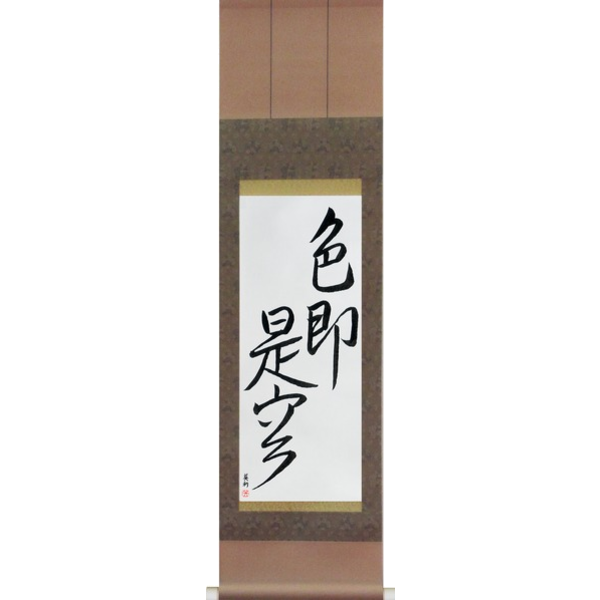
Sold as All is Vanity · Read shikisoku zekū; the catalogue writes shikisoku zekuu, the same sounds · Oldest witness the Heart Sutra in Chinese, in the translation attributed to Kumārajīva and in Xuanzang's of 649; in Japan on record from 984 · Sense everything that has form has no fixed, independent nature of its own; and, in the half of the line the scroll does not carry, emptiness is nowhere else than in form.
The words
Four characters, and the sutra gives them as the first half of a pair: 色即是空、空即是色. 色, shiki, is the Sanskrit rūpa, form or matter, the first of the five aggregates the sutra names in its next clause, 受想行識; it is not color, and not the erotic sense the Japanese word also carries, though Edo writers played on that one. 即, soku, and 是, ze, together are the copula of identity: is precisely, is none other than, not leads to. 空, kū, is śūnyatā, emptiness: the absence in anything of a nature that stands on its own, which the sutra spells out in its next line, 諸法空相,不生不滅,不垢不淨, all things have the mark of emptiness; they do not arise or cease, are not defiled or pure. It is not nothingness, and the second half of the pair is the proof, because 空即是色 says that emptiness is not somewhere other than form. A 1908 commentary on the Noh glosses the two words for a Japanese reader in the plainest terms the tradition allows, 色とは萬物を有りと見る事。空とは萬物を無しと悟る事, shiki is to see all things as existing; kū is to awaken to all things as not existing, and that gloss already tilts toward negation in a way the sutra does not. The reading is settled: the 1908 edition writes しきそくぜくう beside the line, the 1749 puppet play spells it out in kana, and the modern dictionaries agree. The design writes 即 where the 1910 dictionary printed 卽, the modern form of one character and not a variant. The scroll carries the first half of the pair alone, and that is the received Japanese form: the Noh brushes it alone, the puppet theater and the dictionaries head with it. The English on the page is looked at below; it is the one thing about the design that is not the sutra's.
A history, from the earliest witness
Fifth century, by attribution. 摩訶般若波羅蜜大明呪經, the shorter Heart Sutra in the translation attributed to Kumārajīva. 舍利弗!非色異空,非空異色。色即是空,空即是色。受、想、行、識亦如是, Śāriputra, form is not other than emptiness, emptiness is not other than form; form is emptiness, emptiness is form; and so with sensation, perception, volition and consciousness. The four characters are already exactly these. [CBETA, Taishō volume 8, number 250, page 847c, lines 13 to 14, at the column; text; the attribution is the canon's, and the sutra's date rests on it]
649. 般若波羅蜜多心經, Xuanzang's translation. 舍利子!色不異空,空不異色,色即是空,空即是色;受、想、行、識,亦復如是. The clause before differs from the older translation by a word; the four characters do not. This is the text chanted in every Japanese school, and every Japanese witness below descends from it. [CBETA, Taishō volume 8, number 251, page 848c, lines 7 to 8, at the column; text]
Died 514, as transmitted in 1004. 寶誌, the 誌公和尚 of the proverb books, in the 景德傳燈錄. Not the sutra but the verse Japanese readers learned to say with it, from the 十四科頌: 迷時以空為色。悟即以色為空。迷悟本無差別。色空究竟還同。愚人喚南作北。智者達無西東, deluded, one takes emptiness for form; awakened, one takes form for emptiness. Delusion and awakening are at bottom no different; form and emptiness come out the same in the end. The fool calls south north; the wise man understands there is no west or east. The 1910 proverb dictionary prints two clauses more, 欲覓如來妙理、常在一念之中, if you would find the Buddha's wondrous principle, it is always within one thought. [CBETA, Taishō volume 51, number 2076, fascicle 29, page 451c, lines 20 to 21, at the column; text; the two further clauses by eye in 藤井 1910, below]
984 to 985. 源信's 往生要集. The first Japanese citation the 精選版日本国語大辞典 gives, from its fourth great chapter, and quoted by the dictionary as 色即是空故、謂之真如実相, because form is emptiness, it is called true suchness, the real aspect. The text was not opened; the quotation is the dictionary's. [kotobank.jp/word/色即是空, the 日国 entry; text; the 往生要集 itself not in CBETA's stable corpus and not opened]
Heian attribution, Edo print. 高野大師心經, the Heart Sutra in the tradition of 空海's own hand. 色不異空 空不異色 色即是空 空即是色. It is here as the line in the form Japanese devotion copied, not as a dated witness; the print is Edo and the attribution is the tradition's. [4]
1283. 無住's 沙石集. The line as a slogan on which schools were reconciled: 華厳ノ師モ色即是空ナレバ清辨ノ義立チ、空即是色ナレバ護法ノ宗成ストイヘリ, the Kegon master said that since form is emptiness, 清辨's position stands, and since emptiness is form, 護法's school is established. Each half of the pair is one school's doctrine, and the master held both. [6]
About 1430. The Noh play 山姥, the mountain crone's sermon. The line the dictionaries take as the play's, and the one that shows what it does in Japanese: 邪正一如と見る時は、色即是空其まゝに、佛法あれば世法あり、煩惱あれば菩提あり、佛あれば衆生あり、衆生あれば山姥もあり、柳は綠、花は紅の色々, when you see wrong and right as one, form is emptiness just as it is; where there is the Buddha's law there is the world's law; where there are passions there is enlightenment; where there is a Buddha there are living beings; where there are living beings there is the mountain crone too; the willow is green, the flowers are red, each in its color. The play uses the sutra line to affirm the world, not to renounce it, and the whole turn rides on 其まゝに, just as it is. The 1908 edition writes the kanji 其; the 1910 dictionary quoting the same line writes そのまゝに in kana, and the 日国 at kotobank そのままに. [7]
1749. The puppet play 源平布引瀧. しきそくぜくう、くうそくぜしきと繪にも書く, form is emptiness, emptiness is form, as they write it even on pictures: the pair as a saying, spelled in kana, in the Edo theater. [as quoted in the 俚諺大辞典 of 1933, pid 1766149, scan 220, OCR, at one remove]
The Meiji translation of the Bible, read in a 1904 printing. Not a witness to the sutra, but the one place the sutra and the page's English title genuinely touch, and they touch only in Japanese. Ecclesiastes 1:2 reads 傳道者言く、空の空、空の空なる哉、都て空なり, with the furigana くうのくう: the translators rendered the Hebrew hebel, the breath that the King James calls vanity, with 空, the sutra's own character. The full-text search finds the sentence quoted in over a hundred public-domain books. A Japanese reader has had kū no kū and shiki soku ze kū sharing one character ever since. [旧新約全書, 米国聖書会社, 1904 printing of the 明治元訳, pid 825439, scan 462, by eye; text at lab.ndl.go.jp/dl/api/page/825439_462, whose OCR layer garbles 哉 and 都て]
1908. 大和田建樹's commentary in the 謡曲評釈. The gloss quoted above, 色とは萬物を有りと見る事。空とは萬物を無しと悟る事 (the OCR reads 見るま for the first 見る事). [7]
1909. 池田蘆洲's 故事熟語辞典. The meaning given entirely through 寶誌's verse: 迷ふ時は空を以て色と爲し、悟る時は色を以て空と爲す、色空本來同一體にして差別なきをいふ。色は本と空より生じ、空は色に依りて現はる, deluded, one takes emptiness as form; awakened, one takes form as emptiness; it says that form and emptiness are originally one body without distinction; form arises from emptiness, and emptiness appears by way of form. [11]
1910. 藤井乙男's 諺語大辞典. Two entries. 【色卽是空、空卽是色】〔般若心經〕色不異空、空不異色、色即是空、空即是色。誌公和尚頌、迷時以空爲色 … 常在一念之中: the sutra address, the whole of 寶誌's verse, and nothing else, no Western equivalent. 藤井 hangs an English proverb on nearly everything in his book; here he hangs none. His second entry, 【佛法アレバ世法アリ】, quotes the Noh line. [pid 862766, koma 251, page 468, read by eye on the day of writing; koma 597, in the supplement, by eye; text at lab.ndl.go.jp/dl/api/page/862766_251]
Today. 精選版日本国語大辞典: 物質的な存在はその真相、その当体において空であり、執着される何ものもないということ。→空即是色, that material existence is, in its true aspect and in its very substance, empty, and there is nothing to be attached to; see 空即是色. The 四字熟語を知る辞典 quotes 坂口安吾 in 1953. Not one of the four dictionaries on the page offers vanity. [kotobank.jp/word/色即是空; text]
The sense across time
The line has meant one thing in Buddhist use from Xuanzang to kotobank: form has no self-nature, and, in the half the scroll leaves off, emptiness has no existence apart from form. What changes is the temperature. 寶誌's verse makes it a lesson about delusion, with the fool who calls south north. 無住 makes it a formula on which two schools can both be right. The Noh makes it an affirmation: because form is emptiness just as it is, the mountain crone exists, and the willow is green. The 1908 commentary's flat gloss, to see things as existing against to awaken to them as not existing, is where the Japanese popular sense starts to lean toward negation, and the modern dictionaries lean the same way with nothing to be attached to. None of them reaches the Preacher's verdict that everything is futile; that reading arrives from outside the tradition, and the next two sections say how.
What is not a source
寶誌's verse is the tradition's commentary, attached to the line by the proverb dictionaries; it is a pairing, not an origin, and the sutra is older. The Kegon master's reconciliation in the 沙石集 is a use, not a source. Ecclesiastes 1:2, Vanity of vanities, saith the Preacher, vanity of vanities; all is vanity, in the Vulgate vanitas vanitatum, et omnia vanitas, is not a source, a parallel or a translation: the Preacher's claim is that everything under the sun is fleeting and profitless, a verdict on the world; the sutra's is a statement about how the world exists, and its second half, that emptiness is form, is exactly what all is vanity cannot say. The two lines share a character in Japanese because the Meiji translators chose 空 for hebel; they share nothing in English. The four characters in Japanese Zen use, as a 禅語 on a tea-room scroll, are the sutra's line quoted, not a separate text. [Ecclesiastes at en.wikisource.org, Bible (King James), and the Vulgate at biblegateway.com, both read through a fetch summarizer]
The text in English
No Japanese-English dictionary of the Meiji or Taishō period carries the line: it is absent from Hepburn's dictionary of 1872, from 井上 in 1909, ロイド in 1907, 斎藤 in 1918, 新渡戸's proverb book of 1911, 上田's romanized dictionary of 1915 and the rest of the bilingual shelf swept in the archive. The English lineage is the sinologists' and the Buddhologists'. 1894. F. Max Müller, in Buddhist Mahāyāna Texts, Sacred Books of the East volume XLIX, part II, page 153. O Sāriputra, form here is emptiness, and emptiness indeed is form. Emptiness is not different from form, form is not different from emptiness. What is form that is emptiness, what is emptiness that is form. The larger sutra at page 148 begins the same way. Form is emptiness is the equation every later English keeps. [archive.org, buddhistmahy02cowe, text layer, confirmed at the lines by the reader; a printed book, checkable by a reader who holds it or the scan] 1935, D. T. Suzuki; 1958, Edward Conze. Both keep form is emptiness. Neither was opened; the two copies reachable online refused the fetcher, and they are named here as the lineage's next two steps, not as witnesses read. Today. The EDRDG dictionary, which the site's own dictionary carries, gives three glosses in this order: form is emptiness; matter is void; all is vanity. The page's three English renderings are those three glosses, and the product title is the third of them. The catalogue's own explanation is nearly right: it gives form is emptiness first as the precise sense and treats the other two as consequences. What a rendering must keep: form, not matter or color; emptiness, not void or nothing; and the identity, is, which the whole line is about.
A reading
The design and the reading are sound, and the explanation under it is nearly right. The title is the defect, and it is a real one. All is Vanity is a dictionary's third gloss promoted to a product name, and it sells the sutra as Ecclesiastes: a Buddhist line of affirmation under the Preacher's verdict of futility. The two are not the same claim, and the sutra's own next four characters are the proof. What I would put on the page is the sutra's title, Form is Emptiness; the pair with its second half, so the buyer sees the line the scroll carries is half of a sentence and knows the other half; the Noh's just as it is, which shows what a Japanese ear does with the line; and 寶誌's fool calling south north. If vanity is kept anywhere, keep it with its true story, which is a good one: the Meiji Bible chose the sutra's character for vanity of vanities, so in Japanese the two lines have shared a word for over a century, and in English they never have. Signed, 典, 2026-09-05.
How this was read
By eye: the 1908 Noh edition at the line and the 1910 proverb dictionary at both entries, all re-read on the day of writing; the Meiji Bible at the verse. By text at the address: the two Chinese translations and 寶誌's verse at CBETA's stable columns; the four kotobank dictionaries, with the 日国's own words quoted above; the EDRDG entry; Müller in the archive.org text layer; the 1909 dictionary, the 1933 dictionary, the 1908 commentary and the Edo printings of the 沙石集 and the 高野大師心經 by OCR, the last two from the search return without a leaf opened, so their addresses are a pid and not a page; the King James and the Vulgate through a fetch summarizer. Not opened: the Sanskrit; the 往生要集 itself; Suzuki and Conze; 空海's 秘鍵 and 法藏's 略疏 in their Edo printings, which the archive holds; the Hebrew. Every address in this history is a text address except the leaves named by eye, and each of those has a page-API text address beside it; Müller is a printed book, checkable by the scan. The full apparatus, with every address, is in the account.
References
- 摩訶般若波羅蜜大明呪經 (attributed 鳩摩羅什) (5th c. (attribution)) — CBETA T08n0250_p0847c13–14, at the column
- 般若波羅蜜多心經 (玄奘譯) (649) — CBETA T08n0251_p0848c07–08, at the column — the text every Japanese witness below descends from
- Sanskrit (Conze's text) () — recall, not opened
- 高野大師心經 (the 弘法大師真蹟 tradition, an Edo reproduction) (Edo print of a Heian attribution) — pid 2533720 (OCR) ↩
- 往生要集 (源信) (984–985) — 精選版 日国 初出; not opened
- 沙石集 (無住) (1283) — pids 2568298 · 2551169, Edo printings (OCR) ↩
- 謡曲 山姥 (c. 1430) — 『謡曲評釈』1908 pid 876568 scans 74–75, by eye, furigana しきそくぜくう; 日国 cites the play; 藤井 1910 koma 597 quotes it ↩
- 源平布引瀧 (joruri) (1749) — 俚諺大辞典 1933 scan 220 (OCR), at one remove
- 誌公和尚 十四科頌 (寶誌, d. 514, as transmitted) (in 景德傳燈錄 1004) — CBETA T51n2076_p0451c20–21, at the column; quoted by 藤井 1910 and 俚諺大辞典 1933
- 諺語大辞典 (藤井) (1910) — koma 251, by eye
- 故事熟語辞典 (池田) (1909) — pid 862864 scan 249 (OCR) ↩
- EDRDG (gokanji) (2026) — new.gokanji.com/word/色即是空
- The catalogue and both live pages (2026) — cultural_works.csv:350