

能ある鷹は爪を隠す · nō aru taka wa tsume o kakusu · The hawk with skill hides its talons
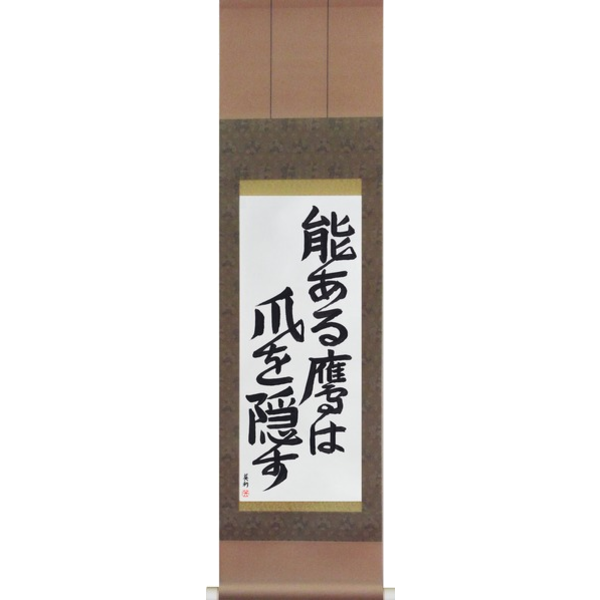
Sold as The Hawk with Talent Hides its Talons · Read nō aru taka wa tsume o kakusu · Oldest witness the oldest proverb list in Japanese, a six-leaf manuscript of sayings from the 1580s and 90s · Sense the truly able do not show it off; the hawk does not raise its talons to threaten.
The words
能, nō, is ability, skill; the dictionaries gloss the subject as 本当に力のあるもの, one who really has the power. 鷹, taka, is the hawk of falconry, the hunting bird of the court and the warrior houses, the bird of another proverb that does not pick at the ear of grain even when starving. 爪, tsume, is the talons. 隠す, kakusu, is to hide, and the ことわざを知る辞典 is exact about what the hiding is: 鷹が「爪を隠す」というのは、爪がまったく見えないように隠すということではなく、むやみに爪を立てて相手を威嚇しない意です, not that the talons cannot be seen, but that the bird does not raise them needlessly to threaten. The oldest witness writes the line without を, 爪かくす; a novel of 1841 writes 能有鷹; the 1910 dictionary prints 匿ス for the same word. デジタル大辞泉 warns that 脳ある鷹, the hawk with brains, is an error, and the error is common enough to be listed. The same proverb has a second animal: 鼠とる猫は爪をかくす, the cat that catches mice hides its claws, and the dictionaries have cross-referenced the two for three hundred years.
A history, from the earliest witness
1472. 一条兼良, 花鳥余情, a commentary on the Tale of Genji. The idiom before the proverb, in another sense: explaining why the young 薫 will not take up the koto, the commentator writes 爪かくすははちたる心也, to hide one's nails is a gesture of shame. The 日国 gives this as the first attestation of 爪を隠す; it shows the phrase older than the proverb and meaning something else. [1]
The 1580s to 1590s. 北條氏直時分諺留, Proverbs noted down from the time of Hōjō Ujinao, a six-leaf manuscript. The oldest collection of proverbs in Japanese, a list of sayings current in the last years of the Odawara Hōjō, whose lord died in 1591. Among them: 能ある鷹は爪かくす, standing between 人を思ふは身を思ふ人をにくむは身をにくむ, to care for another is to care for oneself, to hate another is to hate oneself, and 慾のくまたか爪をさく, the greedy eagle tears its own talons: the able hawk that hides its talons and the greedy one that ruins them, side by side as one lesson. The manuscript itself is not digitized; 藤井乙男 found the 1773 copy in the University of Tokyo library, printed his transcription in 1929, and the line is read there. [藤井乙男, 諺の研究, 1929, pid 1452761, scan 123, page 232, by eye; text at lab.ndl.go.jp/dl/api/page/1452761_123; the 日国 dates the list 1599頃]
1638. 毛吹草, the first printed proverb collection. The cat form: 鼠とる猫は爪をかくす. From here to the end of the eighteenth century the prose writers reach for the cat as often as the hawk. [read in 藤井's 1929 excerpt, pid 1452761, scan 131, page 243, by eye; the 1645 print not opened]
1734. 最明寺殿教訓百首, a moral commentary on a hundred teaching poems. The hawk, called a proverb outright: ことわざにも能ある鷹は爪をかくすといへり, as the proverb too says, the hawk with skill hides its talons, glossing a poem against the man who wears a knowing face; the commentary reads the proverb as modesty about knowledge, carrying even what you know well as if you did not. [8]
1777. 平賀源内, 放屁論後篇. The cat, turned against the respectable: 世間の爲に骨を折れば世上で山師と譏れども。鼠捕る猫は爪をかくす。我よりおとなしく人物臭き面な奴に。却て山師はいくらも有り, break your back for the world and the world calls you a swindler; but the cat that catches mice hides its claws, and among the meek, respectable-looking men there are swindlers enough. [9]
1811. 平田篤胤, 志都能石屋. The nativist scholar quotes 源内's thought and turns the proverb inside out: 今時世上ニ目ガ無ケレバ。能アル鷹モ。オトナシウ爪ヲ秘セバ。腐鳥カト思ツテ。タハケドモガ。茶ニシタリ馬鹿ニスル故。謙退辞譲ハ間ニ合ハズ, in a world without eyes, if the able hawk keeps its talons quietly hidden, fools take it for a rotten bird and mock it, so modesty and deference do not serve, and a little big talk is needed. [11]
1814 onward. 曲亭馬琴, 南総里見八犬伝. A warrior declines to boast of subduing a bull, and the narrator gives him the proverb as a 鄙語, a countryman's saying, in praise: 能ある鷹は爪を隠す。といふ鄙語も. [13]
1841. 為永春水, 春色梅美婦禰. 能有鷹は爪を隠すとむかしから言通り, as they have said since old times. [pid 10303582, OCR]
1910. 藤井乙男, 諺語大辞典. The cat is the main entry and the hawk the cross-reference. Under the cat he assembles the Chinese images the Meiji dictionaries name, and closes with a Dutch proverb: When cats are mousing they won't mew. Under the hawk: 【能アル鷹ハ爪ヲ匿ス】鼠トル猫、能アル猫ハともいふ, with the 1590s list as its source and 老子's 知者不言、言者不知 as its parallel. [16]
Today. The 日国: 本当に力のあるものは、みだりにそれをひけらかすようなことはしないというたとえ, a figure for the truly capable not flaunting it, with the 1590s list as first attestation. The ことわざを知る辞典 adds the reverse edge: 裏を返すと、たいした能力のない者にかぎって … 力を誇示したりする, turned over, it says that only those of little ability show off their strength, so the proverb praises the modest and criticizes the braggart in one breath. Its examples run from 中里介山's 大菩薩峠 to 開高健 in 1976. [kotobank.jp/word/能ある鷹は爪を隠す-596149; text]
The sense across time
One sense, held steady for four centuries: real ability does not display itself. The witnesses differ only in what they do with it. The 1734 commentary makes it modesty about knowledge; 源内 makes it a warning that the quiet ones are the swindlers; 篤胤 objects that in a blind world the quiet hawk is taken for a dead one; 馬琴 makes it praise. The modern dictionary keeps both edges, praise of the modest and reproach of the braggart, and reads 隠す as not threatening rather than concealing.
What is not a source
No Chinese source is claimed for the sentence, and none is needed. What the Meiji dictionaries set beside it is a Chinese image, a maxim of war from the 淮南子: 夫飛鳥之摯也,俯其首;猛獸之攫也,匿其爪;虎豹不外其爪,而噬不見齒, when a bird of prey strikes it lowers its head; when a beast seizes it hides its claws; the tiger and leopard do not show their claws, and what bites does not show its teeth. A Han moral collection, the 說苑, has the gentleman guards his mouth, the peacock its feathers, the tiger its claws. 老子's those who know do not speak and the good merchant who hides his stock as if he had none from the 史記 are the parallels the dictionaries of 1901 reach for. These are pairings, not origins; the Japanese proverb is a Japanese sentence about a hawk. The Meiji claim that 能 was originally the name of a bear-like beast is a folk etymology and is recorded here as one. [zh.wikisource.org/wiki/淮南子/兵略訓, ctext.org/shuo-yuan/za-yan/zh, ctext.org/dao-de-jing/zh, zh.wikisource.org/wiki/史記/卷063; text]
The text in English
Hepburn's dictionary of 1872 lists the cat form, unglossed, and has nothing under the hawk. The hawk enters the bilingual dictionaries in 1907, and the first four render it four ways. 1907, ロイド, 和英新辞典: If you cannot bite, never show your teeth. 1908, 和田垣: A clever person conceals his skill. 1909 and 1911, 井上十吉: A sagacious hawk hides his claws. 1909, 和英大辞林: A clever hawk conceals its talons; still waters run deep. 1910, 渡部, 和英引用辞典: Who knows most, says least, marked as an Italian proverb, the equation the house page uses. 1918, 斎藤秀三郎: filed under still waters run deep. [pids 903157, 903158, 1869465, 870153, 870204, 870190, 1681530, OCR]
1965. Daniel Crump Buchanan, Japanese Proverbs and Sayings, University of Oklahoma Press, page 77, in the chapter Discipline. Nō aru taka tsume wo kakusu: "The wise hawk conceals his talons." That is, a truly wise person does not make show of his resources and ability. English parallels: Who knows most says least. Still waters run deep. Cats hide their claws. The earliest English proverb book on the shelf to carry it; his romaji drops the は, and his third parallel is the cat, the one English rendering that keeps the two animals together. [read by page image; a printed book, checkable only by a reader who holds it] 1987. David Galef, Even Monkeys Fall from Trees, Tuttle, number 72, page 158. A clever hawk hides its claws, and in his list of equivalents He who knows most speaks least: 1909 and 1910 restated. This is the book the house page cites. [ISBN and ASIN not collected; the 2015 EPUB text layer] 1996. Guy Zona, Even Withered Trees Give Prosperity to the Mountain, Simon and Schuster, page 47. It is a wise falcon that hides its claws, the one rendering to change the bird. 2004. Edward Trimnell, Tigers, Devils, and Fools, Beechmont Crest, page 109. The skillful hawk hides its claws. A person of true ability doesn't flaunt his skills. Today. JMdict: a wise man keeps some of his talents in reserve; one shouldn't show off; the person who knows most often says least; a skilled hawk hides its talons. The house title, The Hawk with Talent Hides its Talons, is the literal of 1909 with 能 as talent, and it is the best of the set: talent keeps 能, talons keeps 爪, and the English has stood still for a century. What a rendering must keep is the bird and the restraint; the proverb is about not threatening, not about concealment.
A reading
The design, the reading and the title are sound, and the two English equations on the page are the tradition's own, from 1909 and 1910. What the page lacks is any Japanese ground: its whole explanation is two English dictionaries quoted, one through an affiliate link. The proverb deserves better, because it has one of the best pedigrees in the catalogue: it stands in the oldest proverb list in Japanese, in 源内, 篤胤 and 馬琴, and carries a Chinese image the dictionaries have named for two centuries. The page should say it is in that list of about 1590, give one Edo sentence, and say in one clause that the cat and the hawk are one proverb with two animals, because a customer who has met the cat will otherwise think the page has the wrong bird. My own reading: the proverb is about not threatening, not about hiding, as the ことわざを知る辞典 has it; and 篤胤's objection, that in a world without eyes the quiet hawk is taken for a dead one, is the honest limit of the advice and worth a sentence on a page sold to people choosing a motto. Signed, 典, 2026-09-05.
How this was read
By eye: the 1929 leaf carrying the 1590s list, re-read on the day of writing; the 1929 毛吹草 excerpt; the 1910 dictionary at both entries; 源内 in the 1909 typeset; 篤胤; 馬琴; the 1472 and 1734 leaves at the characters; Buchanan at the page. By text at the address: three kotobank entries; the eight leaves above at the National Diet Library's page API; the Meiji and Shōwa dictionaries and the bilingual shelf by OCR; the 淮南子, 說苑, 老子 and 史記 passages at Wikisource and ctext; the four later English proverb books in their text layers. Not opened: the 1590s manuscript itself, in either of its two copies; 毛吹草 at its own leaf; the novels of 1702 to 1841 at the page beyond the OCR; the Chinese inscription by 李尤 that the 1910 dictionary quotes; the second 說苑 line the dictionary quotes, which was not found in the text. Every address in this history is a text address except Buchanan and the two English paperbacks read in text layers, which a reader checks by holding the book. The full apparatus, with every address, is in the account.
References
- 花鳥余情 (一条兼良), a gloss on 竹河 (1472) — pid 2551185 koma 57, leaf opened, characters by eye, sentence by OCR; the 日国's 初出 for 爪を隠す ↩
- 北條氏直時分諺留 (compiler unknown; copied 安永2 = 1773 by 多賀常政) (the 1580s–90s; the 日国 dates it 1599頃) — 藤井 1929 p. 231, by eye; the manuscript itself not seen (not digitized)
- 毛吹草 巻二 世話付合 (重頼 編) (1638) — 藤井 1929 p. 243 by eye; 俚言集覧 by OCR; the leaf not hunted
- 浮世咄 三 (Edo, date not determined) — 藤井 1910, reported
- 東海道敵討 (都の錦) (1702) — by OCR
- 御入部伽羅女 (1710) — by OCR
- 頼朝三代鎌倉記 (自笑) (1712) — by OCR
- 最明寺殿教訓百首 (三近子 校) (1734) — pid 2554678 koma 19, leaf opened, the column by eye, the prose by OCR ↩
- 放屁論後篇 (平賀源内) (1777; read in the 1909 typeset) — pid 1882565 koma 21, by eye ↩
- 椿説弓張月 (馬琴) (1807) — by OCR
- 志都能石屋 (平田篤胤) (1811) — pid 2557351 koma 9, by eye ↩
- 客者評判記 (式亭三馬) (1811) — by OCR
- 南総里見八犬伝 (馬琴) (1814–) — pid 2551626 koma 13, by eye ↩
- 春色梅美婦禰 (為永春水) (1841) — by OCR
- 俚言集覧 (了阿; 1900 printing) (early 19th c.) — pid 991571 scans 11, 17, by OCR
- 諺語大辞典 (藤井) (1910) — pid 862766 scans 402, 405, by eye ↩
- The catalogue and both live pages (2026) — cultural_works.csv:361