

水に流す · mizu ni nagasu · Let it drift away on the water
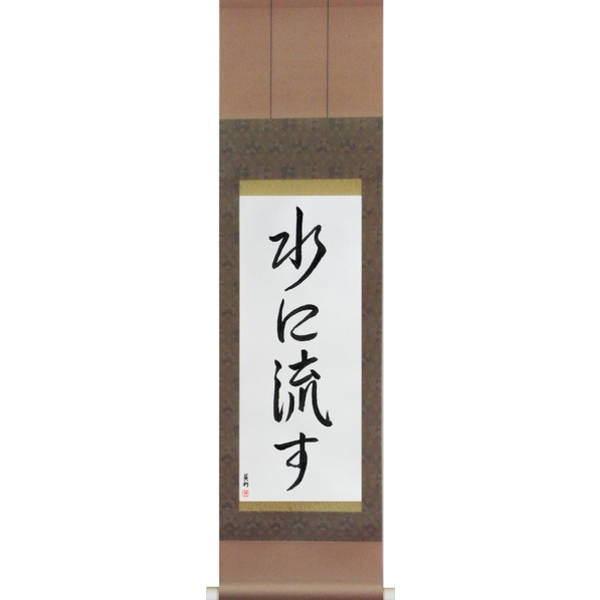
Sold as Forgive and Forget · Read mizu ni nagasu · Oldest witness a taunt in a kabuki play of 1874, said to the two men in Japanese story who never forgave; the phrase grew out of an older one, 水にする, make water of it, on record from the early 1600s · Sense treat a past wrong as if it had never been; set the grudge adrift and let the river take it.
The words
Three words. 水, mizu, is water; に, ni, marks where the thing goes; 流す, nagasu, is the transitive verb: not to flow but to set adrift, to let the current carry off. What is set adrift is the past. The dictionaries name it as 過去にあったこと, what happened, 恨み, a grudge, いざこざ, a quarrel, わだかまり, the knot left in the heart; in every stage witness it is a 恨み or 遺恨, an old grievance. 精選版日本国語大辞典: 過去にあったことを、すべてなかったこととする。過ぎ去ったことをとがめないことにする, to make everything that happened as if it had not; to hold nothing against what is past. デジタル大辞泉: 過去のいざこざなどを、すべてなかったことにする, with the example これまでのわだかまりを水に流す. The page's literal, let it flow in the water, is fair; on or down the water is nearer, since the verb sets a thing adrift and does not submerge it. [kotobank.jp/word/水に流す, text]
Why water. The modern Japanese explanations guess that flowing water carries things off and purifies, and the older witnesses say it literally. At the purification rite, the 祓, a paper figure called a 形代 is rubbed on the body to take its 罪・けがれ・災い, its sins, defilements and misfortunes, and then 川や海に流す, is set adrift on a river or the sea; an Edo almanac describes it at the summer rite, 神前に紙にて小き形代を拵是にて骸を撫ひて水に流すなり, and an 1891 encyclopedia traces the floated doll to the Tale of Genji and the girls' festival dolls that still go down the river at 流し雛. The idiom's water is that water: the Japanese does not say forget, it says send it down the river, and the river is the one the year's defilement went down. [kotobank.jp/word/形代 and /流し雛, text; dl.ndl.go.jp/pid/2561076 koma 34 and pid 898057 koma 132, OCR]
Behind 水に流す stands a shorter phrase, 水にする, make water of it, which meant waste, bring to nothing in the 甲陽軍鑑 of the early 1600s, 跡の勝利を水にせぬやうに, so as not to make water of the victory that follows, and forgive by 1806. The two senses share a picture: what goes into the water is gone. The idiom kept the second sense and let the first go to its parent. [kotobank.jp/word/水にする, text; dl.ndl.go.jp/pid/1240963 koma 271, OCR]
The reading is mizu ni nagasu, and the wording has never varied.
A history, from the earliest witness
Early 1600s. 甲陽軍鑑, the Takeda military chronicle. 跡の勝利を水にせぬやうにさへあれば、末代迄名は殘る者也 (so the 1935 typeset; kotobank prints あとの勝利 … 末代まで名は残る者也), so long as you do not make water of the victory to come, your name will last to the end of time. The parent phrase, in its parent sense, waste. The dictionary gives it as the first attestation of 水にする. [kotobank.jp/word/水にする, text; dl.ndl.go.jp/pid/1240963 koma 271, a 1935 typeset, OCR]
1651. 松永貞徳, in the haikai anthology 崑山集. 名月を水になしたる雨夜哉, a rainy night that made water of the harvest moon: the sister phrase 水になす, again waste. [kotobank.jp/word/水になす, text; not opened at the leaf]
1806. 酩酊気質, a comic book of drunkards. すっぱりと水にしてお前ッちに遣りやせう, I'll make clean water of it and hand it over to you: the first time the dictionaries find 水にする meaning forgive, a generation before the full idiom. [kotobank.jp/word/水にする, text; not opened at the leaf]
1874. 河竹黙阿弥, 夜討曾我狩場曙, a kabuki play about the Soga brothers' vendetta, act two. The first recorded 水に流す, and it is said as a sneer. The brothers, who have spent their lives waiting to avenge their father on 工藤祐経, have come in rags to the enemy's house, and 祐経's men lecture them. One says their grudge misreads the situation and their father's house would be better rebuilt by begging 祐経's patronage; another that his own lands were restored by such begging and not knowing greed is folly; then, in one sentence passed from mouth to mouth: 喜藏 こりや成景殿の言はるゝ通り、身貧に暮らしてこれ迄に、無駄に月日を送るより、 權平 多年の恨みさつぱりと、水に流して折々は、お鬚の塵をとりぐに、 源八 兄弟揃つて尻尾を振り、お臺所へお廻りなされい、鹽鰹の頭ぐらゐはくれてもやらう, as he says, rather than waste more months and years in poverty, wash the old grudge clean down the river and come now and then to pick the dust off our lord's beard; wag your tails together, come round to the kitchen door, and you may get a salt-bonito head. The line that became Japanese for forgive and forget is first spoken, mockingly, to the two men in the whole story who never let a grudge go. [dl.ndl.go.jp/pid/1884454 koma 168, the 1925 collected edition, page 298, by eye at width 3600; lab.ndl.go.jp/dl/api/page/1884454_168, text; the same page in a second scan set, pid 982073 koma 169, OCR]
1881. 黙阿弥, 極付幡随長兵衛. 深き遺恨を水に流し懇意を結ぶと仰せあるゆゑ (the OCR reads ゆる), since you said you would wash the deep grudge down the river and make friends: the same playwright uses the phrase straight, seven years later, and again it is a trap, since the friendship offered is a plot to kill. [dl.ndl.go.jp/pid/1884529 koma 276, OCR]
1888. 宇田川文海, 汝所好, a novel. 溪泉の水に流して、行末長く見捨て下さるな「雨降て地固るとは此事ぢや (the OCR reads とと), wash it down the valley stream and do not forsake me in the years to come: this is what they mean by "after rain the ground hardens". The earliest use in the archive's books, and it says two of this catalogue's proverbs in one breath. [dl.ndl.go.jp/pid/886950 koma 69, OCR]
1888 to 1899. The Tokyo stage, storytellers and songs. 三遊亭円朝's stories, 是迄の事は水に流して此後は, let what is past go down the river, and from now on; an 1889 song, 主ゆゑならば水に流して胸のうち; 石橋忍月 in 1894, 平生の怨みはサラリと今水に流して; the stage scripts of 1896, 此塲のいさかひも宮戶川の水に流して … 丸く納まる一家の因み, this quarrel too down the Miyato river, and the house is reconciled; 1897, 恨みを水に流して負るが勝, grudge down the river, losing is winning. Every witness is Tokyo popular literature, and the phrase is already the stock line for a quarrel settled. [dl.ndl.go.jp pids 891299, 891398, 855836, 887783, 876839, 876845, 876852, 885614, OCR]
1889 to 1933. The dictionaries. 大槻文彦's 言海 of 1889, the first modern dictionary, has no 水に流す. 山田美妙's 日本大辞書 of 1893 explains 水 as nothing through the phrase, 水ニ流ストノ義カラ皆無, and the 帝国大辞典 of 1896 copies it. The 俗諺辞林 of 1901 gives the occasion: 從來纏絡したる葛藤の和解したる時などにいふ (the OCR reads 発來), said when a long entanglement is reconciled. The 俚諺辞典 of 1906 gives two senses side by side, to forget an old ill-feeling and simply to forget the past altogether. 藤井乙男's great proverb dictionary of 1910 files 【水ニ流ス】從來の感情を忘却し去ること and, alone among its neighbors, gives no source. 上田萬年 in 1915: 旣往の事はすべて心にとめない, keep nothing of the past in mind. 中野's 俚諺大辞典 of 1933 repeats 藤井. [dl.ndl.go.jp pids 992954 (the 言海, absence), 902835 koma 663, 2387590 koma 657, 863228 koma 185, 900343 koma 251, 862766 koma 496 by eye, 1900620 koma 317, 1453041 koma 454; OCR except where marked]
Today. The two dictionary glosses quoted under The words; the 日国's first attestation is the 1874 play, and the 大辞泉 gives none. The National Diet Library's public-domain books carry the phrase in its three common forms in over a thousand books, most of them literal, a paper figure, a lantern or a body floated on water. [kotobank.jp/word/水に流す, text; lab.ndl.go.jp full-text search: 水に流す 141 books, 水に流し 519, 水に流して 418, 水ニ流ス 15, derived 2026-09-03 and re-derived unchanged 2026-09-05]
The sense across time
The phrase moves from waste to forgive inside one picture. Its parent 水にする means bring to nothing in the 1600s and forgive by 1806, and 水に流す is born in the second sense and keeps it. What changes after 1874 is the frame. 黙阿弥 twice uses it as a trap, a reconciliation offered by men who mean harm. The 1901 dictionary hears an occasion, the moment two parties make up. The 1906 dictionary hears two things, forgiving an old wrong and simply letting the past go. 上田 in 1915 hears a rule of conduct, and 竹原 in 1946 files it under the English idea of bygones. No source reads it as forgetting: the Japanese verb is set adrift, an act done to the grudge, not a lapse of memory.
What is not a source
The purification rite is what the phrase's water means, not a text it comes from; no witness quotes the 祓 when it says 水に流す. The Chinese idiom that looks the same is a false friend. The Japanese-Chinese dictionary of 1908 renders 水ニ流ス as 付之東流, consign it to the eastward river; but in Chinese that idiom means lost, wasted, come to nothing, the sense of the Japanese parent and not of the idiom, as when a magistrate throws his cap of office into the water in 比目魚, the novel made from 李漁's play of that name (chapter 10 of the novel at the address; the play itself not opened). Same river, and what floats away is a hope in Chinese and a grievance in Japanese. The Confucian sentence for forgiving the past is another line altogether: 既往不咎, do not blame what is past, from the Analects, which the 1946 dictionary and Buchanan in 1965 pair with the same English. And forgive and forget itself has its famous English instance in Lear, Pray you now, forget and forgive, seen here in a search snippet only. [dl.ndl.go.jp/pid/1087757 koma 393, OCR; zh.wikisource.org, 比目魚 and 論語/八佾第三, text]
The text in English
Hepburn's dictionary of 1872 has 水 and its compounds and no idiom, which fits a phrase the Japanese sources date to the 1870s. [dl.ndl.go.jp/pid/993689 koma 175, OCR]
1909. 英和双解熟語大辞典, an English-Japanese phrase dictionary. To forget and forgive. 忘れ且つ赦す, 水に流す. The first equation found: the English phrase glossed literally and then given its Japanese idiom. [dl.ndl.go.jp/pid/990169 koma 136, OCR]
1918. 斎藤秀三郎, 熟語本位英和中辞典. To forgive and forget, 水に流して了ふ; to cast behind one's back, 水に流して了ふ; what has happened shall be buried in oblivion, 是迄の事は水に流して了ふ. Three English idioms, one Japanese. [dl.ndl.go.jp/pid/1681530, OCR]
1946. 竹原常太, スタンダード和英大辞典. 済ンダ事ハ水ニ流シテ了へ, Let bygones be bygones; and the same English under 既往ハ追ハズ, with 済ンダコトハ仕方カナイ (so the OCR's カ), What is done is done, beside them. [dl.ndl.go.jp/pid/1126792 komas 237, 311, 502, OCR]
1965. Daniel Crump Buchanan, Japanese Proverbs and Sayings, University of Oklahoma Press, page 178, chapter PRACTICALITY. Not under this headword but under a longer form: Mukashi no koto wa mizu ni nagase: "Let the things of long ago drift away on the water." That is, do not hold tenaciously to ways and ideas that are no further use. English parallel: Let bygones be bygones. His literal is good, drift away on the water; his reading is the parent's sense, let go of what is useless, and not the reconciliation every Japanese witness carries. The same English stands under 既往は咎めず on page 109, glossed Let us forgive and forget faults committed against us, and under a grudge proverb on page 146 with Forgive and forget. So both of the page's equations were in print in English by 1965, for three different Japanese sayings. [Library of Congress Catalog Card Number 65-24192; text layer and PDF page; a printed book, checkable by a reader who holds it]
The 2012 Galef collection does not carry the phrase, and water under the bridge, the page's other equation, is on no Japanese-English shelf to 1946; it is the twentieth century's, and this history does not date it.
Today. JMdict: to forgive and forget; to let bygones be bygones; to sweep under the carpet; to wipe the slate clean. The house title, Forgive and Forget, is the 1909 equation, a century old and sound. What a rendering must keep: the grudge as the thing acted on, so forgive before forget; the river, which is a rite and not a metaphor; and no suggestion that the line is ancient.
A reading
The page is right and empty: a literal, two equations, nothing under them. What the sources add, in the order I would add it: the phrase is Meiji, and its first recorded use is a sneer at the Soga brothers, which is the best sentence a page about forgive and forget in Japanese could carry; the water is the purification's water, the river that takes the paper figure and the year's defilement, and that is why Japanese says set it adrift where English says forget; the Chinese idiom that looks the same means the opposite; and the English equations have dates, 1909 and 1946, so the title is old and good. I would change nothing on the page and add three clauses. My own reading is that 黙阿弥 knew exactly what he was doing: he gave the line first to men who use it as bait, twice, and the language took it from them anyway, which is how a phrase for reconciliation should be tested. Signed, 典, 2026-09-05.
How this was read
By eye: the 1874 play at page 298 of the 1925 collected edition, re-read at width 3600 on the day of writing with all six speakers of the taunt; 藤井's 1910 dictionary at the ミヅ leaf. By text at the address: the kotobank entries for the idiom, its two parent phrases, the paper figure and the festival dolls; the Analects and 李漁 at Wikisource; the National Diet Library's page API for the two leaves; the OCR layer of the archive for the 1881 play, the novels, storytellers, songs and scripts of 1888 to 1899, the thirteen dictionaries of 1889 to 1946, the Takeda chronicle in its 1935 typeset, the almanac and the encyclopedia on the rite, Hepburn, and the counts; the text layer and PDF of Buchanan 1965 at three pages; the text layer of Galef 2012, which does not carry the phrase. Every archive address was re-opened by a reader before writing and the OCR quoted raw, and every one agreed with the account. Not opened: the 1806 comic book and the 1651 anthology at their leaves, cited from the dictionary; the Tale of Genji at the passage on the floated doll; the origin of the Chinese idiom, earlier than 1661; Lear at the play page; the Oxford English Dictionary for the three English phrases. The printed book checks only for a reader who holds it. The account beneath this history carries every address, the raw OCR beside each reading, and the page-image addresses for the leaves read by eye.
References
Each witness is cited in the account above, at the frame or entry where it was read. A linked list follows when the record for this text is completed.