

地震雷火事親父 · jishin kaminari kaji oyaji · Earthquakes, thunder, fires, fathers
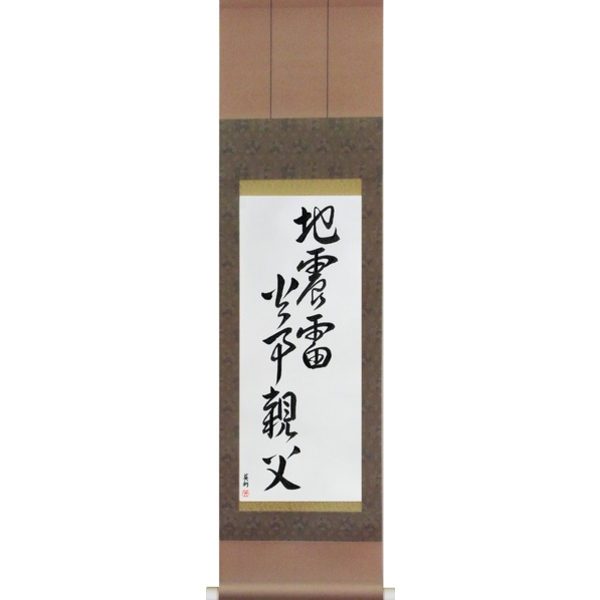
Sold as Earthquakes, Thunderbolts, Fires, Fathers · Read jishin kaminari kaji oyaji · Oldest witness a comic book of 1814, where the four are already a list anyone knows; behind them, a farewell verse of 1728 with no father in it · Sense the fearsome things of this world, in descending order, with the father as the joke at the end.
The words
Four nouns with nothing between them. 地震, jishin, earthquake; 雷, kaminari, thunder, the clap and the bolt together; 火事, kaji, a fire that burns buildings; 親父, oyaji, one's father said familiarly, and by extension any older man in charge, the master of a house or a shop. The Edo prints write the readings ぢしん and くわじ beside the characters, the older spellings. The proverb dictionary of 1910 files the line among the sayings that stack bare nouns and among those ordered by size and weight, like 一富士二鷹三茄子. The ことわざを知る辞典 hears why it sticks: 雷 and 火事 share an initial ka, 火事 and 親父 rhyme on -ji, and the father, who is no disaster, lands last as the surprise. The order is the point the English gets wrong, below: the Japanese dictionaries read the list from the most fearsome down.
A history, from the earliest witness
1728. 清水如水's farewell verse, as recorded in the 江戸名所図会 (printed 1834 to 1836). On the third day of the new year an old man of Asakusa wrote 公事喧嘩地震雷火事晦日飢饉煩なき国へゆく, to a land without lawsuits, brawls, earthquakes, thunder, fires, month-ends, famine or sickness I go, and died two days later after shaving, bathing and praying. Five Edo records carry the verse with small differences. It is the oldest run of 地震雷火事 found: a list of the sudden and unavoidable things of this world, not yet a proverb, and with no father in it. [1]
1800. 故花菴備忘録, a secretary's notebook, a saying given to the shogun 秀忠. 士には常々三の心得あるへし第一気違ひ喧嘩第二に地震雷鳴第三に火事, a samurai should always keep three things in mind: first a madman's brawl, second earthquake and thunder, third fire, because they come without warning. The same three as a maxim, retold in a boys' reader of 1908. No witness earlier than 1800 was found for it. [2]
1814. 春廿三夜待, a comic book by 岡山鳥 with pictures by 国貞. The four together, and already a list anyone knows: 此外地震雷火事親父おふくろなどの来らぬときのまじない哥, besides these, charm-verses for when earthquakes, thunder, fires, father and mother do not come, with the readings ぢしん, かみなり, くわじ, おやぢ beside the characters. The earliest print found with all four. [3]
1820. うしろめん益身鏡, a comic book by 晋米斎玉粒. The thunder god complains that he has been ぢしんかみなりなどゝおやぢのれつにいれて, put in the same row as earthquakes and fathers. The proverb known well enough to be joked about from inside. [4]
1822. あと見よ蘓和歌, a book of teaching verses by 藤本常丸. こはきもの地震雷火事親父あとみよそわか油断主人も, fearsome things: earthquake, thunder, fire, father; look behind you; a careless master too. [5]
1831. 尾張童遊集, a record of Nagoya children's games and chants by 小寺玉晁. The four as a children's chant; the ことわざを知る辞典 names this the oldest source. The book is not in the digital library and was not opened. [kotobank.jp/word/地震雷火事親父-519561; text]
1855. A broadsheet after the 安政 earthquake. A parody deity, 落涙山非常明王, whose image 地震雷火事親父を倶足し奉る本尊なり, is furnished with earthquake, thunder, fire and father, each described as a manifestation that punishes greed and idleness. The proverb made into a god. [8]
1891 to 1928. The proverb dictionaries. 金諺一万集 (1891), 古今俚諺類聚 (1893), 俗諺辞林 (1901), 俚諺辞典 (1906) and 金言名句辞典 (1928) all carry it, glossed 怖しき者 or 懼るべきものを集めたるなり, the fearsome things gathered. 藤井乙男's 諺語大辞典 of 1910 has the entry with two words and no source: 【地震雷火事親父】恐るべきもの. [藤井, pid 862766, koma 330, by eye; text at lab.ndl.go.jp/dl/api/page/862766_330; the others by OCR at the pids in the account]
1900. 斎藤緑雨, わすれ貝. The joke turned inside out: 諺に曰く地震雷火事親父と、是れたゞ危險の度を示したるに過ぎず。苦痛の量よりすれば、親父火事雷地震也, the proverb says earthquake, thunder, fire, father, but that only ranks the danger; by the quantity of pain, it runs father, fire, thunder, earthquake. [pid 889322, scan 184, OCR]
1911. 勝海舟, as reported in 和魂の跡. The old statesman retires the proverb: the world has tamed all four, the father a relic of the Tenpō years, thunder made to run errands by telegraph and telephone, fire by the brigades. [pid 758725, scan 148, OCR]
1933. 太宰治, 思ひ出. 地震雷火事親爺、それ以上に怖い戦争が起ったなら, earthquake, thunder, fire, father, and a war more frightening than any of them. This is the 精選版日本国語大辞典's first citation, two hundred years after the 1728 verse and a century and more after the comic books. [kotobank.jp/word/地震雷火事親父-519561; text]
Today. デジタル大辞泉: 世間でたいへん恐ろしいとされているものを、その順に並べていう言葉, the things the world holds most fearsome, named in that order. The ことわざを知る辞典: おおむね恐ろしい順に並んでいる, arranged roughly from the most fearsome down, and it records, and doubts, a minority reading of 親父 as the village headman. [the same address]
The sense across time
The sense is a list, and the list has not changed since 1814. What has changed is the last word's weight. In the Edo books the father is the comic surprise after three disasters; by 1900 a satirist can reverse the order for a laugh; by 1911 a statesman can say all four are tamed; by 1933 a novelist adds war as a fifth. The Japanese dictionaries, from 1891 to today, read the order downward from the earthquake. The reading that makes the father the most fearsome of the four is an English one, below.
What is not a source
A story circulates that 親父 was once おおやまじ, a great wind, corrupted from 大山嵐 into the father. It has no witness of any kind. The digital library's pre-1868 books have no such word; its modern books use 大山颪 only in a folk song and as a place name; no dictionary from 1891 to 1928 mentions it; and a prefectural library asked about it in 2005 found the reference works silent and the claim only in a 2005 book reprinting an autumn-2004 newspaper column, which quotes a weather official as there is also a theory that. It is a modern guess, and a page should say so in one clause before a customer brings it. The 秀忠 maxim is a legend with no witness before 1800. [crd.ndl.go.jp/reference/entry/index.php?page=ref_view&id=1000022726; text]
The text in English
No English for the proverb exists before the war. Hepburn (1872) has nothing; 斎藤 (1918) uses the words only, under fear; the 1946 Standard has the word for earthquake and no proverb. A Japanese-Chinese dictionary of 1925 glosses it in ordinals, 第一地動、第二雷神、第三失火、第四父親, which keeps the Japanese order. 1965. Daniel Crump Buchanan, Japanese Proverbs and Sayings, University of Oklahoma Press, page 96, under the heading Parents. Jishin, kaminari, kaji, oyaji: "Earthquake, thunder, fire, father." These four things named in ascending order of severity were proverbially feared by the Japanese. Prior to World War II and especially during the feudal period, the father as head of the house had almost complete control of the family and all in it. The page quotes him word for word. His ascending order is his reading alone: the Japanese dictionaries read the order the other way, and he files the proverb under parents, which is where his reading comes from. [read by page image; a printed book, checkable by a reader who holds it] 1987. David Galef, Even Monkeys Fall from Trees, Tuttle, number 48. Earthquakes, thunderbolts, fires, fathers, and in his list of English equivalents Fear those greater than yourself. His four words are the house title to the letter. [the 2015 EPUB text layer, which carries the numbered rendering and the equivalents list; ISBN and ASIN not collected] 2004. Edward Trimnell, Tigers, Devils, and Fools, Beechmont Crest, page 66. Earthquakes, thunder, fires, and fathers all deserve your fear. (The last one might depend on the particular nature of your childhood.) These proverbs remind us that it is wise to fear some things. By fearing what is more powerful than you, you may save yourself from injury. He says nothing about the order. Not in Galef's second book (2000) or in Zona (1996). Today. JMdict: things to fear: earthquakes, thunder, fires and, most of all, fathers, which follows Buchanan's direction. The house title is the bare list, and it is the best of these, because it does what the Japanese does and lets the last word land on its own. What a rendering must keep is the order, downward, and the joke.
A reading
The design, the reading and the title are sound; the page is thin. Two English paperbacks are its whole ground, and one of them is quoted for the one thing the Japanese dictionaries contradict: the order runs from the most fearsome down, and the father is the joke at the end, rhymed to 火事, not the peak of severity. The page should say that, with 緑雨's inversion if it wants a smile. What the sources give that the page does not: that the four are Edo popular speech, in print by 1814 and a children's chant by 1831; that behind them stands a run of three sudden things, in a samurai maxim and in a 1728 farewell verse whose author died two days after writing it; and that the 1855 earthquake turned the proverb into a god. One clause should retire the typhoon story before a customer brings it. My own reading: the proverb is a joke that stayed true, and the 1728 verse is what it was before it was funny. Signed, 典, 2026-09-05.
How this was read
By eye: the 1814 leaf, re-read on the day of writing; the 1728 verse in the 江戸名所図会; the 1820, 1822 and 1855 leaves; 藤井's 1910 entry; Buchanan at the page. By text at the address: the kotobank entry with its three dictionaries; the six leaves above at the National Diet Library's page API; the 1800 notebook, the Meiji dictionaries, 緑雨, the 勝海舟 anecdote and the bilingual shelf by OCR; the two library reference answers on the typhoon story; the four English proverb books in their text layers. Not opened: 尾張童遊集 of 1831, which is not in the digital library; a manuscript variant reported to read 地震雷火事風親父, with wind, at its leaf; 太宰's and 中谷宇吉郎's pages; the 2004 newspaper. Every address in this history is a text address except Buchanan's page, which a reader checks by holding the book. The full apparatus, with every address, is in the account.
References
- 清水如水's farewell verse, as recorded in 江戸名所図会 (and in 武蔵志料, 管見雑録, 鶯宿雑記, 香袋 1868, 墓所一覽遺編) (1728 (享保13, 正月三日); the 図会 printed 1834–36) — pid 2559041 koma 5, by eye ↩
- 故花菴備忘録 (三木維清), a saying of 秀忠 (1800) — pid 11446267 scan 34, by OCR ↩
- 春廿三夜待 (岡山鳥, 国貞 画; a 合巻) (1814) — pid 8942983 koma 26, by eye; the earliest print found with the four ↩
- うしろめん益身鏡 (晋米斎玉粒; a 合巻) (1820) — pid 10300976 koma 12, by eye ↩
- あと見よ蘓和歌 (藤本常丸; 教訓 verses) (1822) — pid 2533915 koma 9, by eye ↩
- 尾張童遊集 (小寺玉晁; children's games and chants of Nagoya) (1831) — reported; not on the lab
- 柳荒美談 後編 巻19 (a 実録 of the 伊賀越 vendetta, manuscript, undated Edo; Meiji prints) (Edo; print 1891) — pid 880252 scan 135, by OCR
- The 落涙山非常明王 broadsheet, in 江戸大地震之絵図 (1855 (the 安政 earthquake, 十月二日夜)) — pid 1302055 koma 1, by eye ↩
- 無花果艸紙 (an いろは proverb list) (1882) — pid 2541082 koma 100
- 金諺一万集 · ことわざ草 · 古今俚諺類聚 · 俗諺辞林 · 俚諺辞典 · 藤井 1910 · 金言名句辞典 (1891–1928) — by OCR; 藤井 by eye
- 太宰治『思ひ出』 (1933) — the 日国's 初出
- The catalogue and both live pages (2026) — cultural_works.csv:363