

一期一会 · ichigo ichie · One lifetime, one meeting
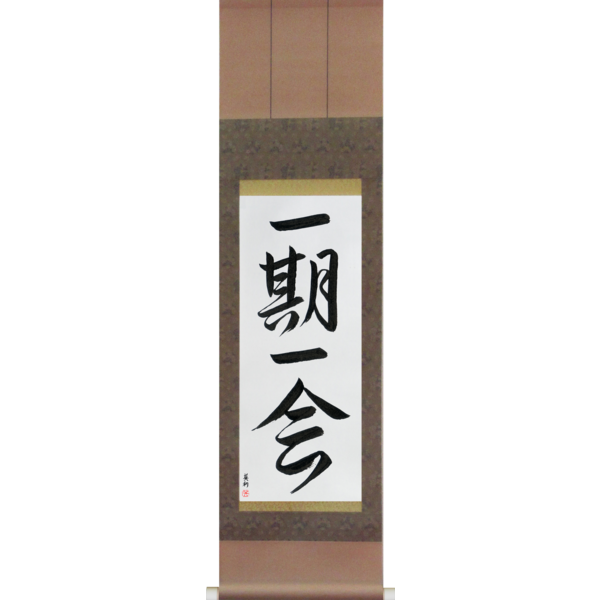
Sold as Each Moment Only Once · Read ichigo ichie · Oldest witness a sentence in the tea record of Rikyū's disciple 山上宗二, written in 1588 by every reference; the four characters themselves are a nineteenth-century lord's coinage, in print from 1917 · Sense this gathering will not come again, so host and guest spare nothing; widened today to any meeting that happens once.
The words
一期, ichigo, is one lifetime, from birth to death, a Buddhist term: Hepburn's dictionary of 1872 has ICHI-GO 一期 n. Whole life, and a Buddhist dictionary of 1933 quotes 蓮如's まぼろしの如くなる一期なり, a lifetime like an illusion. It does not mean once in a lifetime, which is what the house page says it means; that is the sense of the whole idiom, or of the older phrase 一期に一度. 一会, ichie, is one meeting, one gathering, and in tea one 茶会. The reading was not always settled: school glosses of the late 1920s give イチゴイチヱ, イチゴイックワイ and イチゴイツクワイ, because 会 has two readings; the 1936 edition of the coiner's own book prints いちごいちゑ beside the characters, and every dictionary since reads ichie. The design's romaji is right. Every witness before 1946 writes 會; the design writes 会.
A history, from the earliest witness
Fourteenth century. 一期に一度 in the war tales. Before there was a tea room the phrase once in a lifetime was ordinary Japanese: in the 曽我物語 a warrior pleads その上一期に一度の大事をこそと存じ候うて, knowing this to be the one great matter of a lifetime; in the 義経記 a crowd calls a spectacle 一期に一度の大事. [1]
1588. 山上宗二記, the tea record of Rikyū's disciple, the section on the guest's conduct. 常の茶湯なりとも路地へはゐるから立迄一期に一度の参会の様に亭主を … 畏るべき也, even at an ordinary tea, from entering the roji until you leave, hold the host in awe as if it were the one gathering of a lifetime. The medieval phrase applied to the walk from the garden gate to the tea room. In a 1902 typeset the passage is headed as what 紹鷗 taught, with Rikyū's dislikes noted beside it; it is not Rikyū's sentence at any address opened. [2][3]
About 1845. 井伊直弼, 茶湯一会集, the preface. The lord of Hikone, who would be killed at the Sakurada Gate in 1860, coins the word and glosses it in one sentence: 抑茶湯の交會は、一期一會といひて、たとへば幾度おなじ主客交會するとも、今日の會にふたゝびかへらざる事を思へば、實に我一世一度の會なり, the meeting of host and guests at tea is called one lifetime, one meeting: however many times the same host and guests may meet, today's gathering will not come again, and it is truly the one meeting of my life. So the host spares nothing, and the guest, knowing the same, slights nothing the host devised. 是を一期一會といふ, this is what is called ichigo ichie. Later in the book comes 獨座觀念: after the guests leave, the host does not clear up but returns to the hearth, sits alone, and considers that today's one meeting is over and will not return. [9]
1889. 大槻文彦, 言海. The everyday phrase the lord glossed his coinage with: 一世一代〔一世一度ノ訛カ〕生涯ノ中ニテ此度ヲ限リトスルコト, once in a lifetime. [6]
1910. 藤井乙男, 諺語大辞典. The word is not there. The イチゴ run has 一期末代 and no 一期一會; nor is the word in any of nineteen bilingual and proverb dictionaries from 1872 to 1948. [pid 862766, scan 50, by eye; text at lab.ndl.go.jp/dl/api/page/862766_50]
1917. 釈悟庵, 禅林清話. The first book in the public-domain corpus to print the four characters, seventy years after they were coined: 茶の湯の極致は一期一會に獨座觀念とにあるのぢや (the OCR reads 獨住觀金), the height of tea lies in ichigo ichie and in sitting alone in contemplation, grounded in the Buddhist instant that arises and perishes. [pid 944170, scans 98 to 100, OCR]
1920 to 1923. The word spreads. A tea writer sets it beside the Lotus Sutra's 難値難遇, hard to meet, hard to encounter (奥田正造, 茶味, 1920); a moral lecturer says 井伊大老が一期一會と云つたのは、そこのことである (姉崎正治, 1920); a playwright gives it to a Zen priest bidding 井伊 farewell before the Sakurada Gate: 茶の湯も一期一會なら、お互さまも一期一會、逢へば別れる、別れゝば逢ふ (中村吉蔵, 1920); and 相馬御風 sets it beside 芭蕉's saying that yesterday's hokku is today's death poem (1923). [9]
1927 to 1934. The school readers. The word enters the readers with a gloss, which is how a word becomes everyone's: 一生に一たび相會ふこと (1927), 一生涯にたつた一度の會といふ意。一期は人間の一生涯 (1928). The count of public-domain books carrying it, by five-year span: one in 1915 to 1919, seven in 1920 to 1924, nine, nine, thirty-three in 1935 to 1939, forty-one in 1940 to 1944. [pid 1266817, scan 151, by eye; pid 1456753, scan 55, by eye; the counts from the saved search of 2026-09-03]
Today. 精選版日本国語大辞典: 一生に一度会うこと。また、一生に一度限りであること, with 井伊's preface as first citation. デジタル大辞泉: the tea sense first, then 転じて一生に一度しかない出会い. 共同通信's entry says the idea 千利休の考えといわれている, is said to be Rikyū's, which is the tradition, not a source. [kotobank.jp/word/一期一会; text]
The sense across time
Three layers, three ages. The medieval phrase means once in a lifetime and nothing more. 宗二's sentence makes it a discipline of attention for the length of one tea. 井伊's word makes the discipline mutual, host and guest each knowing the day will not return, and adds the host alone at the hearth afterward. The twentieth century widened it past tea to any meeting that happens once, and the dictionaries now carry both. The house page's reminds us to value each and every moment is the widened sense; 井伊's is narrower and sharper, and it is the one the sources hold.
What is not a source
Sen no Rikyū. The scroll page says the concept dates to him, and the tradition says so; the earliest attestation is his disciple's book, in a section headed as another master's teaching, and the four characters are a lord's, written two and a half centuries after Rikyū's death. A page may give Rikyū's name as the tradition; it may not give it as fact. The 南方録, which the 日本大百科全書 sets between 宗二 and 井伊 with the phrase 一座一会, was not opened and is not in the digital library. 一世一度 and 一世一代 are the everyday kin; 難値難遇 is the sutra phrase a tea writer paired with it in 1920.
The text in English
Okakura's Book of Tea (1906) does not have the word; its nearest thought is Rikyū's last tea. No bilingual dictionary from Hepburn 1872 to 1948 has it. The rendering the scroll page quotes, one time, one meeting, is from Paul Varley and Kumakura Isao, editors, Tea in Japan: Essays on the History of Chanoyu, University of Hawaii Press, 1989, which translates 井伊's preface whole; the page carries that translation and names the book but not its editors. [not opened; lending only] JMdict: once-in-a-lifetime encounter; uniquely precious experience; one lifetime, one meeting. The English Wikipedia lists for this time only, once in a lifetime, one time, one meeting. The house title, Each Moment Only Once, is a paraphrase in the once in a lifetime line, fair as English. What a rendering must keep is that 一期 is a lifetime and 一会 a meeting, and that the word was made for two people in a small room, not for a moment in general.
A reading
The design is sound, the reading is sound, and the title is a fair paraphrase of a word whose received sense has widened past tea. The pages are wrong in two places and thin in a third. 一期 is one lifetime, not once in a lifetime: the page builds the word from its parts and mislabels the first. Dates back to Sen no Rikyū is the legend as fact. And the scroll page's best material, the 1989 translation of 井伊's preface, hangs from in their book with nobody named. The story the page could tell is better than the one it tells: a phrase from the war tales, Rikyū's school applying it to the walk from the garden gate to the tea room, and 井伊直弼, who would die at the Sakurada Gate, folding the sentence into four characters in his tea manual and describing what the host does after the guests leave, alone at the hearth with one kettle. The word was his, print did not take it up for seventy years, and the schoolbooks of the 1920s still argued its reading. Every sentence of that is at an address above. Signed, 典, 2026-09-05.
How this was read
By eye: 井伊's preface in the 1936 edition, re-read on the day of writing; the 宗二記 manuscript at the four characters; 藤井's 1910 leaf; two school glosses. By text at the address: the kotobank entry with its five dictionaries; the five leaves above at the National Diet Library's page API; the 1902 typeset, the 1917 to 1923 witnesses, 言海 and nineteen bilingual and proverb dictionaries by OCR; the saved search counted by five-year span; Okakura at archive.org. Not opened: 井伊's autograph and a dated witness for the book; a critical edition of 山上宗二記, so the verb of the sentence stands unresolved; the 南方録; the 1600 義経記 leaf; Sadler, Suzuki, and Varley and Kumakura, all lending only. Every address in this history is a text address except the manuscript, which also has one. The full apparatus, with every address, is in the account.
References
- 曽我物語 · 義経記 (軍記, 14th c.), modern printings; a 1600 printed 義経記 in the lab's highlight (1600 (print) · 1911–1913 (editions)) — pids 877589 scan 60 · 1913524 scan 139 (OCR); pid 2574947 (1600) highlight only ↩
- 山上宗二記, 茶湯者覚悟十体, 客人振りの事 — the NDL manuscript 『宗二之記』 (undated 写本 (the work is dated 1588 in every reference; recall, not verified here)) — pid 2538367 canvas 46 ↩
- The same, typeset in a Meiji encyclopedia (1902 (2nd printing 1908)) — pid 1805636 scan 376 (OCR); pid 898061 scan 487 ↩
- The same, as the reference books read it today (2026) — kotobank; reported
- 一世一度 in Edo prose (1695 →) — lab highlights, 31 classical books; not opened
- 言海 (1889) — pid 992954 scan 105 (OCR) ↩
- 井伊直弼『茶湯一会集』, preface — quoted in 東都茶会記 (with kana), 光あれ, 愚庵和尚 (1920 · 1920 · 1923) — pids 1183138 scan 12 · 961752 scan 66 · 977969 scan 43 (OCR)
- The same, the 1936 edition (奥田正造 編) (1936) — pid 1185983 scan 6 = p. 1, by eye
- 井伊, the 獨座觀念 section (1923 (quoted) · 1936) — pid 977969 scan 43; pid 1185983 scan 56 (OCR) ↩
- The catalogue and both live pages (2026) — cultural_works.csv:351