

努力に勝る天才なし · doryoku ni masaru tensai nashi · There is no genius that outranks effort
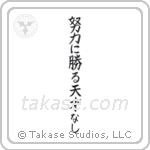
Sold as Hard Work Trumps Natural Ability · Read doryoku ni masaru tensai nashi · Oldest witness a career manual of 1936, which is also the first book to call the sentence old; the idea behind it arrives in Japanese print in 1909, labeled foreign · Sense talent is real and effort outranks it.
The words
努力, doryoku, is effort. The word is ancient and was rare: the 精選版日本国語大辞典 finds it in a text of about 760 and then not in the dictionaries of the middle ages at all, and says it came into general use only after the Meiji Restoration, when the 哲学字彙 of 1881 chose it as the Japanese for the English effort. So the first word of the sentence is, in its modern currency, a translation word. 勝る, masaru, is to surpass, to outweigh, and it is the verb the sentence turns on: not genius is effort but there is no genius that outweighs effort, a ranking, not an identity. 天才, tensai, is genius or natural gift; this word is old and common, in a preface of 827 and in the 太閤記 of 1625. なし is the classical there is none, and it is the one archaic element in an otherwise modern sentence; the sentence is dressed as a proverb. The 1936 book that first prints it writes the reading まさ beside 勝, which is the reading the catalogue gives.
A history, from the earliest witness
What the proverb dictionaries hold, and do not. 藤井乙男's 諺語大辞典 of 1910, the largest dictionary of Japanese proverbs of its age, does not contain the word 天才 anywhere in its twelve hundred pages, and has 努力 only inside quotations of a Chinese poem. 中野吉平's 俚諺大辞典 of 1933 has no 勝る天才. What the old proverbs say about talent is the opposite of this sentence: 六歲ノ神童、十六歲ノ才子、二十歲ノ凡人, a prodigy at six, a talent at sixteen, an ordinary man at twenty; 才智ハ身ノ仇, wit is one's own enemy; and from the Analects, 上智と下愚とは移らず, neither the highest wisdom nor the lowest folly can be moved. The tradition had proverbs about effort too, 瓦も磨けば玉となる, even a roof tile, polished, becomes a jewel, but it never set effort against genius, because that was not a question it was asking. [藤井 1910, National Diet Library pid 862766, the ド run at koma 363 read by eye and the whole OCR searched; text at lab.ndl.go.jp/dl/api/page/862766_363; 中野 1933, pid 1453041, OCR]
1909. 樋口銅牛, 俳諧新研究, page 352. The idea arrives, and arrives labeled: 天才は努力の結果であるとは西洋の某文學家の主張であるさうな, that genius is the result of effort is, so they say, the contention of a certain Western literary man. Foreign, anonymous, and hedged twice. In the same breath he reaches for a Japanese equivalent, the Confucian 帆足萬里 teaching that Zhuangzi's prose was made not in one breath but by 鍛鍊, by training. [pid 875384, by eye; koma 190, derived s38 from the archive's OCR; text at lab.ndl.go.jp/dl/api/page/875384_190]
1910. Two self-help anthologies. The same year as 藤井's dictionary, 立志論 prints 天才とは細心の極致なり。カーライル, genius is the extreme of care, Carlyle, and 百傑スケッチ 金言対照 prints 天才は大事業を起す而して之が完成するには唯働くを要するのみ, genius begins great works; to finish them needs only labor, credited to Joubert, with Cornell, Macaulay and Stephenson filed as exemplars of effort. Edison had been a stock figure in Japanese school and self-help books since the 1890s. The proverb dictionary and the maxim anthology stood on the same shelf in the same year, and only one of them had met this idea. [pid 758506 koma 22 and pid 758181 koma 56, OCR; text at lab.ndl.go.jp/dl/api/page/758506_22 and /758181_56]
1918 to 1944. The sentence circulates with no fixed author. 天才は努力である is given to Flaubert in 1918; 天才は努力なり is a truth in 1922 and a certain philosopher's saying in 1932; 天才は努力の別名なり, genius is another name for effort, papers a student's wall in 宇野浩二's story of 1928; 賀川豊彦 in 1932 gives Edison's line as 九分九厘 sweat and 五厘 inspiration; a banker's maxim book of 1930 has 努力は天才を產み; a book of 1941 says even Beethoven said effort makes genius. Six attributions for one sentence in a quarter century. A dictionary of maxims of 1928 that marks its Western proverbs 西諺 carries three hundred and eighty-three of them, two about genius, and not this one. [fourteen books, pids in the account, OCR; 賀川, pid 1216478, by eye]
1935. 実際的家庭教育, the dissent. 天才は學んで達せられる範圍を脫してゐる … 天才は努力だけでは到底達し得ぬ, genius lies beyond what learning can reach; effort alone will never arrive at it. The sharpest reading in the record, and it came before the sentence had fixed. [pid 1442173, koma 52, OCR; text at lab.ndl.go.jp/dl/api/page/1442173_52]
1936. 加藤直士, 就職より立身へ, chapter two, 努力と忍耐が何より大切, page 8. The earliest witness to the exact sentence: 昔から『努力に勝る天才なし』といつて、如何なる天分も才能も努力が之に伴はなければ決して眞價を發揮することは出來ぬものと極まつてゐる, from of old they say there is no genius that outranks effort: it is settled that no gift or talent shows its true worth unless effort goes with it. The first book to print the sentence is also the first to call it old. Then the worked example: the student who hates mathematics, encouraged by a teacher, turns the hours he spends on his strong subjects to it, and 性來嫌ひであつた數學が終には好きになつて、立派に自分の一弱點に打ち勝つことが出來る, the mathematics he hated by nature he comes to like, and he handsomely beats his one weak point. [pid 1255440, koma 13, by eye; text at lab.ndl.go.jp/dl/api/page/1255440_13]
1939, printed 1942. A will. The second and last witness before 1945 is a letter. 永田善男, a police official in Manchukuo, wrote to his children before a punitive expedition from which he did not return: 强く正しい人間に成る樣努めよ。努力に勝る天才なしと言ふ事を記憶して置きなさい, strive to become a strong and upright person; remember the saying that there is no genius that outranks effort. The volume that prints it is a memorial book for colonial officials killed in Manchukuo. It is the evidence of what the sentence had become by 1939: ordinary enough to be the thing a father hands a child in place of himself. [満洲建設烈士遺芳録, 1942, pid 1042940, koma 137, by eye; text at lab.ndl.go.jp/dl/api/page/1042940_137]
1944. 世阿弥十六部集評釈. A commentary on Zeami reads the imported maxim back into a treatise of the 1400s: 「天才は努力する者なり」といふ語が眞理を持つて來る, the saying that the genius is the one who makes the effort comes to hold true. The domestication is complete. [pid 1125601, koma 242, OCR; text at lab.ndl.go.jp/dl/api/page/1125601_242]
Today. kotobank has no headword for the sentence in any of its dictionaries; the search returns only the three words. The archive of seven thousand nine hundred and eighty-five public-domain books holds the exact sentence in two, both quoted above, and no variant of it. [kotobank.jp/word/努力に勝る天才なし returns not found, 2026-09-05; counts re-derived 2026-09-05]
The sense across time
The sense is one and has not moved: a gift is real, and effort outranks it. What moved is the shape. For thirty years the Japanese sentence was 天才は努力なり in a dozen phrasings, genius is effort, an equation that redefines genius; the fixed form of 1936 is stronger, because it concedes that genius exists and ranks it second. The only dissent in the record, 1935, is the honest limit of the claim: effort takes you a long way, and genius is not at the end of that road.
What is not a source
The Western lines behind the idea are named in the Japanese books and none of them is this sentence: Carlyle's genius is an infinite capacity for taking pains, Joubert, Buffon's patience, Edison's one percent inspiration, and the attributions to Flaubert and Beethoven, whose footing was not checked. None of them was opened in English for this history, and the English original of the Japanese sentence, if there is one, has not been found at an address. Zeami's 習力 and 帆足萬里's remark about Zhuangzi are Japanese thoughts that the sentence was later attached to, not sources.
The text in English
The bilingual dictionaries from Hepburn 1872 to 1946 carry no rendering of the sentence, which is what one expects of a sentence nine years old in 1945. The English proverb books were opened and none has it: not Buchanan (1965), Galef (1987, 2000), Zona (1996) or Trimnell (2004). Galef's second book has the nearest thing, a different proverb about genius, 大器晩成, genius matures late. JMdict has the three words and no entry for the sentence. So the house rendering stands alone. Today. The house title, Hard Work Trumps Natural Ability, is a good one: natural ability is the better rendering of 天才 in this sentence than genius, and it is what the 1936 author meant when he unpacked the proverb as 天分も才能も, gift and talent alike. The page's literal, there is no genius that surpasses effort, is exact. What a rendering must keep is the ranking: this is not genius is effort but nothing you were born with outranks what you do.
A reading
Every gloss on the page is right and so is the reading; the one clause I would not write is it is a Japanese proverb, because on a page selling calligraphy it will be read as this is old, and it is not. It is younger than the electric light it was used to praise. It is the sentence Japan made in the 1930s, out of thirty years of repeating a Western commonplace under a rotating cast of authors, when it decided the cult of genius was answerable, and the answer was that effort outranks the gift. That is a better thing to hang on a wall than an old Japanese proverb, and it is true. The one word the page leaves unglossed is the verb, 勝る, and it is the word that carries the whole claim. Signed, 典, 2026-09-05.
How this was read
By eye: the 1936 leaf, re-read on the day of writing; the 1942 leaf; 藤井's 1910 dictionary at the ド run; 樋口's 1909 page; 賀川's 1932 chapter. By text at the address: the two kotobank entries for the words, whole; the 1936 and 1942 pages at the National Diet Library's page API and in the archive's OCR; 中野 1933, the 1928 maxim dictionary, the fourteen books of 1910 to 1944 and the bilingual shelf by OCR; the five English proverb books in their text layers. Not opened: the 哲学字彙 of 1881 at its leaf; any of the Western lines in English; 帆足萬里's own writing; the 1909 and 1932 witnesses at a page-API address, since their koma numbers were not recorded; the National Diet Library's full corpus beyond the archive, so the 1936 date is a first attestation of the archive, not of the language. Every other address in this history is a text address a reader's AI can open. The full apparatus, with every address, is in the account.
References
Each witness is cited in the account above, at the frame or entry where it was read. A linked list follows when the record for this text is completed.