

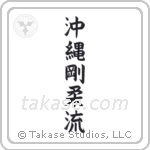
沖縄剛柔流 okinawa gōjūryū Okinawa Goju-Ryu
沖縄剛柔流 (okinawa gōjūryū) is 剛柔流, the karate of Miyagi Chōjun 宮城長順's line, hard and soft, with Okinawa set before it. How he came to name 剛柔流 is a story told with different years and places. With Okinawa in front, the National Diet Library's full-text search finds it first in a magazine of 1957.
Abstract
沖縄剛柔流 is 剛柔流, the karate of Miyagi Chōjun 宮城長順's line, with 沖縄, Okinawa, set before it: 剛柔, hard and soft, and 流, a school. How Miyagi came to name 剛柔流 is told as a story whose date and place the witnesses do not agree on: his senior pupil, asked at a demonstration on the mainland what his school was called, could not answer, and Miyagi named it from a line of a boxing manual handed down in Okinawa, 法剛柔呑吐, the method is hard and soft, swallowing and spitting; the tellings put the demonstration in 1930, in Tokyo or in Kyoto, or in 1937. Miyagi's own paper titled 剛柔流拳法 is dated to 1931 by the Japanese Wikipedia and to 1932 by a study of 2016, and the National Diet Library's full-text search finds 剛柔流 as the name of a karate first in 1934. With Okinawa set before it, the same search finds the name first in a magazine of 1957; in books of 1972, of a master and beside dōjō addresses in Tokyo; and from 1975 as the name of an association whose teacher, and by 1977 its president, was Miyazato Eiichi 宮里栄一 of Naha, and whose own page dates its founding to October 1969.
Overview
The sense. A proper name: the style of karate 剛柔流, with the name of the island set before it. 沖縄剛柔流 has no word page at kotobank, and jisho.org's words search finds no entry for it. For 剛柔流, the older edition of the 世界大百科事典, in its article on karate, names Miyagi as its founder [1], and the Japanese Wikipedia counts it among the three great styles of Okinawa [2].
The words. 沖縄 Okinawa. 剛 gō, hard, unbending, and 柔 jū, soft, yielding, a pair of opposites; 流 ryū is a current, and in the arts a school, a line of teaching handed down.
The text in English. 剛柔流 is in English print as a sound, Goju-ryu, by 1963 [3], and with the island before it in the titles of two books from Miyagi's line: Toguchi Seikichi's of 1976, Okinawan Goju-Ryu [4], and Higaonna Morio's of 1985, Traditional Karate-do: Okinawa Goju Ryu [5]. The modified Hepburn is okinawa gōjūryū.
The historical record
1922, Funakoshi Gichin 船越義珍, 『唐手 琉球拳法』. The first book on the art, published in Tokyo by the Okinawan teacher who then wrote his name 富名腰義珍, closes its chapter What is karate with a section headed 二 流儀, the schools [6]:
後世師範者の名に依つて種々の流儀に別れてはゐるが、其實昭靈流と昭林流の二派に過ぎないのである。昭靈流は體質肥滿骨格偉大なる者に適し、昭林流は之に反し、骨格倭小體力貧弱にして楊柳の如く瘠… Later generations divided it into various schools under the names of their masters, but in fact it is no more than two: the Shōrei school and the Shōrin school. Shōrei suits the heavy-set and large-boned; Shōrin the opposite, the small-boned and slight, willow-thin…
The Japanese Wikipedia gives the two-school account as Itosu Ankō 糸洲安恒's, reads 昭霊流 as the Naha line and 昭林流 as the Shuri line, and adds that neither school is known in China [7]. Its list of the oldest school names begins not with a style of the 1930s but with Motobu Chōki 本部朝基's 日本傳流兵法本部拳法, named in the Taishō era [7].
The naming, as a story. The Japanese Wikipedia tells that Miyagi's senior pupil Shinzato Jin'an 新里仁安, asked at a demonstration in November 1930 what his school was called, could not answer, and that Miyagi, hearing of it, named his school from the line 法剛柔呑吐 in the 拳之大要八句, the eight maxims of the fist; its article on the school marks the story as needing a source [8], and its life of Miyagi tells it with no such mark [9]. Its life of Miyagi adds that the column for Shinzato's school in the demonstration's program is blank, and that the demonstration, often placed at the Meiji Shrine, was held on 3 and 4 November at the Hibiya Public Hall, citing the program and two reports in the 東京日日新聞 [9]; its article on the school notes an older telling that put the question at the enthronement tournament of 1929, which it marks as the wrong event [8]. The 日本大百科全書, in its article on karate by 小山正辰 (2019), tells it at the 明治神宮奉納演武大会 of 1930, with the maxims as 拳法八句 [10]. In English, Toguchi sets it in Kyoto in 1929, at a national convention to which Higaonna Kanryō 東恩納寛量 asked Miyagi to go in his place, though his own book dates Higaonna's death to 1910, and has Shinzato improvise a name, hanko-ryu (half-hard style) [4]; Higaonna places the question at the All Japan Martial Arts Tournament which was held to celebrate the Coronation Ceremony of Hirohito in 1930, put by a master of kobudo [5]; Andreas Quast places it at a national budō meeting in May 1930, with the makeshift answer Hango-ryu, and notes that his sources disagree, one placing the demonstration at the Butokuden in Kyoto and others at the Meiji Shrine in Tokyo, one reference work giving both May and November 1930 [11]; and Bishop sets it at the Dai Nippon Butokukai in 1937, so the story goes [12]. The Japanese Wikipedia records that Miyagi himself demonstrated at the Butokukai's festival in May 1937 and was given the title of 教士 there [9]. The tellings agree on the pupil, the question and the maxim, and disagree on the year (1929, 1930, 1937), the place and the improvised name, which is what a story handed down looks like.
1931 or 1932, Miyagi's paper. The Japanese Wikipedia dates the name to August 1931, when Miyagi wrote a work titled 『剛柔流拳法』, of which a draft copy survives at the Okinawa Prefectural Karate Museum; it calls it the first document to carry the name [8][9]. Higaonna also gives 1931 [5]. 嘉手苅徹, in a study of 2016, cites the same work as 宮城長順:剛柔流拳法,手書き論文,1932 年, a handwritten paper, 1932, among the evidence that schools were arising in the early 1930s [13]; and the Japanese Wikipedia's own list of Miyagi's papers gives it as 1932 [9].
1933, the Butokukai (reported). Higaonna writes that in 1933 the art of Miyagi Sensei was formally registered as "Goju Ryu" at the Butoku-kai [5]; the Japanese Wikipedia says that Miyagi was admitted to the Butokukai in 1933 [9]. The study has not seen the registration in a witness of its own.
1934, the name in print. Mabuni Kenwa 摩文仁賢和, the founder of 糸東流, published three books in 1934, and the advertisements at the end of the third, among them one for his own dōjō, style him 日本拳法 空手術教授 剛柔流 拳法師範, professor of karate-jutsu, master of the Gōjū-ryū fist method [14][15]. Both men had learned the Naha line from Higaonna Kanryō [11]. The full-text search of the National Diet Library's Digital Collections, which reaches books the library serves only inside Japan, finds 剛柔流 in 1,988 items; read oldest first, the earlier ones are the Book of Changes and the 三元 cosmology described below, and the first that is karate is the advertisement in Mabuni's book of 1934 [16]. In the same year a journal from his publisher, 空手研究社, named Mabuni and Miyagi, then abroad, together as the two great masters of 剛柔流 空手拳法; the search shows it as a snippet only [17].
1940, two names their bearers took. A book of 1940 by Mabuni and Nakasone Genwa 仲宗根源和 says, in a snippet whose text the search's reading of the page breaks up, that most school names were given by others, and that 剛柔流 and 糸東流 were the only two whose masters named them themselves [18].
1941, the Okinawan history. Shimabukuro Gen'ichirō 島袋源一郎's 『琉球百話』, in a chapter on the origin of karate, names Miyagi as the authority of the Gōjū-ryū in the prefecture [19]:
空手も首里流と那覇流とは、多少趣きが違つてゐたといはれてゐるが、此の東恩納先生の高弟が今本縣に於ける權成者たる剛柔流の宮城長順氏であり糸洲先生の流を承けた人々も首里に多い。 Karate too, it is said, differed somewhat between the Shuri and Naha schools; the senior pupil of this Master Higaonna is Mr. Miyagi Chōjun of the Gōjū-ryū, the authority in this prefecture today, and those who received Master Itosu's school are many in Shuri.
The page prints 權成者, which is not a word; the sense is 權威者, an authority, and the English renders that.
The National Diet Library's next-generation full-text search, which reaches only its books in the public domain, finds 剛柔流 in 16 books, dated 1526 to 1941, and this is the one that uses it of karate; the others are a Ming commentary on the Book of Changes and a cosmology of three elements, 剛, 柔 and 流, hard, soft and fluid, found in two Meiji treatises on beriberi, the collected works of Soejima Taneomi 副島種臣, a Shintō text of 1920 and the writings of the Ōmoto religion [20].
1943, Funakoshi on the schools. In his 『空手道入門』, published in December 1943 and read here in a Portuguese translation of 1988, Funakoshi writes: Pelo que é do meu conhecimento, os únicos estilos que nos chegaram do passado são o Goju-ryu do Mestre Miyagi e o Shito-ryu do Mestre Mabuni, as far as I know, the only styles that have come down to us from the past are Master Miyagi's Gōjū-ryū and Master Mabuni's Shitō-ryū [21].
The first school name (a claim). 小山正辰 wrote in an abstract of 1998 that 日本空手道最初の流名「剛柔流」は、宮城長順が名乗ったものである, Gōjū-ryū, the first school name in Japanese karate, is the one Miyagi Chōjun took [22], and his article on karate in the 日本大百科全書 (2019) calls it 日本空手界初の流派, the first school of Japanese karate [10]; Higaonna writes that Miyagi Sensei was the first master among the different schools of karate to name his art [5]. The abstract and the article are one author's. The Japanese Wikipedia's article on karate lists Motobu's 日本傳流兵法本部拳法 among the oldest school names, from the Taishō era [7], and records Funakoshi entering the 1930 demonstration under 昭霊流少林派 [9]. The claim is the tradition's, and it holds only of a name a master took for his own karate as a school.
1964, one of four. When the All Japan Karatedo Federation was formed in 1964, 剛柔流 was one of the four great styles of the mainland whose bodies made it up, with 松濤館流, 糸東流 and 和道流 [7]. The Japanese Wikipedia counts it also among the three great styles of Okinawa, with 上地流 and 小林流 [2]; 小山 notes it is the only one counted among the four great styles in both [22].
1954 to 1982, Okinawa before the name. The English page of the Okinawa Goju-ryu Karatedo Kyokai, read in the Internet Archive's copy of March 2025, writes that in April 1954, at a general meeting of the then Okinawa Goju-kai, Miyazato Eiichi 宮里栄一 was recognized as Miyagi's successor; that he opened the Jundokan in Naha in 1957; and that In October 1969, on the suggestion of Eiichi Miyasato sensei, the Okinawa Goju-ryu Karatedo Association was inaugurated with Eiichi Miyasato as first president [23]. The National Diet Library's Digital Collections full-text search finds 沖縄剛柔流 in 190 items, and the ones read here are read as the search's snippets [24]. Read oldest first:
- 1957. The first is the magazine 平凡 of April 1957, in a passage of dialogue in which a speaker, asked whether what he used was karate, says おれのは沖縄剛柔流さ, mine's Okinawa Gōjū-ryū [24].
- 1972. Next come two books. One calls Higa Seikō 比嘉世幸 a great master of 沖縄剛柔流. The other prints the name beside dōjō addresses in Tokyo's Arakawa and Setagaya wards [24].
- 1975 and 1977. In 1975 a book by Nagamine Shōshin 長嶺将真 credits material to Miyazato Eiichi, teacher of the 沖繩剛柔流協会, so written with the older form of 縄. In 1977 a survey of Okinawan karate names Miyazato as president of the 沖縄剛柔流空手道協会, and names Yagi Meitoku 八木明徳 as president of another Gōjū body, the 全沖縄空手道剛柔会 [24].
- 1978 to 1982, Tokyo and beyond the island. The name was not the island's alone. The Nippon Budōkan's yearbooks for 1978 to 1980 list a dōjō named 代々木本部道場, the Yoyogi headquarters dōjō, at an address in Sendagaya, Shibuya, Tokyo, under Higaonna Morio 東恩納盛男, as 剛柔会・沖縄剛柔流. A reference work of 1982 names the Gōjū-ryū bodies 剛柔会, 剛柔館, 剛柔連盟 and 正剛会, and adds that besides them 沖縄剛柔流 carries on its own activity, its core formed by the alumni association of Ritsumeikan University [24].
Higaonna's own book of 1981 is titled 『沖縄剛柔流空手道』 [24]. In English, Bishop's directory of 1999 lists Miyazato's body as Okinawa Goju-ryu Karate-do Kyokai (Okinawan Goju-ryu Karate-do Association) and Yagi's as Zen Okinawa Karate-do Goju-ryu Gojukai [12].
What is not a source. The 拳之大要八句 are a passage of the 武備志, the boxing manual handed down in Okinawa, a copy of which Mabuni reproduced in his book of 1934 [14][25]; it is not Mao Yuanyi's treatise on the art of war of 1621, which McCarthy sets apart as the other of the two Bubishi [25]. That Miyagi took his school's name from it is the tradition's account, which the Japanese Wikipedia marks as needing a source [8].
The name in English
1976, Toguchi Seikichi. Toguchi, a pupil of Miyagi, tells the naming in English, with the pupil's improvised answer: Mr. Shinsato groped for an impromptu name and dubbed his style, hanko-ryu (half-hard style). When Mr. Shinsato returned to Master Miyagi, he told him of the hastily chosen name. The master, finding it quite reasonable, quoted from the Chinese Eight Poems of the Fists … and so Naha-te formally took the name of Goju-Ryu [4]. The Japanese Wikipedia's telling gives no half-hard name, and the program it cites leaves the school blank [9]. Japanese books give the name too: a compilation of 1970 edited by Wataya Kiyoshi 綿谷雪 has 半硬流 at a martial-arts tournament, the place read as Kyoto, and then a formal name read as 剛柔流, in a window of the library's text damaged at both [26], and a survey of Okinawan karate of 1996 tells that Shinzato Jin'an, asked his school's name at the tournament for the enthronement in 1929, answered 半硬流, and that Miyagi afterwards, on 法剛柔呑吐, one of the eight maxims of the fist in the Okinawan 武備志, … (the window breaks off before its verb) [27]. Both are read in the library's text of their pages, which the library serves only to readers in Japan; the 1970 snippet does not carry the sentence's subject.
1985 and 1999. Higaonna's manual dates the naming to 1931 in one chapter and tells the 1930 story in another [5]; Bishop's survey of Okinawan karate moves the story to 1937 [12].
Today. The name is written in English Okinawa Goju-ryu [23][12], Okinawan Goju-Ryu [4] or Okinawa Goju Ryu [5]. A rendering should keep 流 as -ryū, the school's own spelling of its name, and keep the name a name. Okinawa's hard-soft school is what it says.
A reading
The name is a pair of opposites and a school, and every witness agrees on the words. The date of 剛柔流 is where they part. The 1931 of the Japanese Wikipedia and of Higaonna rests on a paper known from a draft copy, which I have not seen, and a study that cites the same paper gives 1932; the story of the pupil and the question is told with different years, places and improvised names, and the program it cites leaves his school blank, which tells against an answer on that day rather than for one. The first 剛柔流 I can put a date and a page to is in the advertisements of Mabuni's books of 1934, where a man who would later found his own school calls himself its master, and the same year's journal names Miyagi beside him. That is the name in use by 1934, in the hands of two teachers who shared a teacher. The 武備志 line explains the words well and is the tradition's; I read it as the likeliest source of a name made from a manual both men knew, and I mark it as a reading, not a finding. Okinawa set before the name is younger than the name, and the witnesses read here do not show who first set it there: a speaker in a magazine of 1957, an association that dates itself to 1969 and is in print, with Miyazato as its teacher, by 1975, and dōjō in Tokyo from 1972. I read 沖縄 as a claim of where the line comes from rather than of where it is taught, since the name is carried by dōjō in Tokyo, and in 1982 by a university's alumni; that too is a reading.
Sources not seen
『明治神宮鎮座十年祭 奉納武道形大會要覧』, 1930, the program the Japanese Wikipedia cites for Shinzato's blank school. It would settle what the program recorded.
宮城長順『剛柔流拳法』, 1931 or 1932, a draft copy of which the Japanese Wikipedia places at the Okinawa Prefectural Karate Museum (沖縄県空手博物館). It would settle whether the name stands in the paper, in what words, and its date.
高宮城繁・新里勝彦・仲本政博編『沖縄空手古武道事典』, 柏書房, 2008, pp. 158, 164, 447, 531–532, which Quast cites for both dates of the demonstration. It would show what the reference work's two dates rest on.
The 1934 journal 『空手研究』, Mabuni and Nakasone's book of 1940, and the books and serials of 1957 to 1982 that carry 沖縄剛柔流, Higaonna's 『沖縄剛柔流空手道』 (1981) among them: the National Diet Library serves their pages only inside Japan, and the study read them as the full-text search's snippets. They would show who first set Okinawa before the name.
The Okinawa Goju-ryu Karatedo Kyokai's page as it stands today: its address did not resolve on 10 October 2026, and the study read the Internet Archive's copy of March 2025.
A reader with access to any of these is invited to write to Takase Studios at Tim@Takase.com.
References
- 「剛柔流」, 世界大百科事典 (旧版), in the article 空手, at kotobank. https://kotobank.jp/word/剛柔流-1313948
- 「小林流 (空手道)」, the Japanese Wikipedia. https://ja.wikipedia.org/wiki/小林流_(空手道)
- Edmund K. Parker, Secrets of Chinese Karate, Prentice-Hall, Englewood Cliffs, 1963, p. 55, read in the Internet Archive's full-text index. https://archive.org/details/secretsofchinese00park
- Seikichi Toguchi, Okinawan Goju-Ryu: Fundamentals of Shorei-Kan Karate, Ohara Publications, Burbank, 1976, "The Origin of Goju-Ryu". https://archive.org/details/okinawan-goju-ryu-fundamentals-of-shorei-kan-karate
- Morio Higaonna, Traditional Karate-do: Okinawa Goju Ryu, vol. 1, The Fundamental Techniques, Minato Research, Tokyo, 1985, pp. 19 and 28.
- 富名腰義珍『唐手 琉球拳法』, 武侠社, 1922, 唐手とは何ぞや, § 二 流儀, pp. 4–5, scan 30. National Diet Library pid 971654. https://dl.ndl.go.jp/pid/971654/1/30
- 「空手道」, the Japanese Wikipedia, § 歴史 and § 空手の表記. https://ja.wikipedia.org/wiki/空手道
- 「剛柔流」, the Japanese Wikipedia. https://ja.wikipedia.org/wiki/剛柔流
- 「宮城長順」, the Japanese Wikipedia, with its reference to 『明治神宮鎮座十年祭 奉納武道形大會要覧』 (1930). https://ja.wikipedia.org/wiki/宮城長順
- 「空手」, 日本大百科全書, the article by 小山正辰, at kotobank. https://kotobank.jp/word/空手-47195
- Andreas Quast, essay on the manuscripts, § Miyagi Chojun with notes 46–48, and § Mabuni Kenwa (A), in Patrick McCarthy, Bubishi: The Classic Manual of Combat, revised and expanded edition, Tuttle, Rutland, Vermont, 2016.
- Mark Bishop, Okinawan Karate: Teachers, Styles and Secret Techniques, second edition, A & C Black, London, 1999, pp. 28 and 164.
- 嘉手苅徹「近代における空手道(唐手)の型の創造に関する一考察:船越義珍の著作における「型の構成」を手がかりにして」, 武道学研究 49(2), 2016, pp. 121–136: p. 130 and note 91, p. 136. https://doi.org/10.11214/budo.49.121
- 摩文仁賢和『攻防自在 空手拳法 十八の研究』 (空手研究叢書 第二篇), 空手研究社 興武館, Tokyo, 1934, a facsimile: the preface, p. 11; the contents, pp. 16–17; chapter 1, p. 19; the colophon and the advertisements at the end. Internet Archive MabuniSeipaiStudy1934. https://archive.org/details/MabuniSeipaiStudy1934
- 「摩文仁賢和」, the Japanese Wikipedia. https://ja.wikipedia.org/wiki/摩文仁賢和
- 摩文仁賢和『攻防自在 空手拳法 十八の研究』, 1934, the advertisements, snippet view, National Diet Library pid 1915276. https://dl.ndl.go.jp/pid/1915276
- 空手研究社編『空手研究』 第1輯, 1934, snippet view, National Diet Library pid 1027727. https://dl.ndl.go.jp/pid/1027727
- 摩文仁賢和・仲宗根源和『攻防拳法 空手道入門』, 1940, snippet view, National Diet Library pid 3456304. https://dl.ndl.go.jp/pid/3456304
- 島袋源一郎『琉球百話』, 沖縄書籍, 1941, 五三 空手道の起原と其の沿革, pp. 147–148, scans 91–92. National Diet Library pid 1052000. https://dl.ndl.go.jp/pid/1052000/1/92
- National Diet Library next-generation full-text search on 剛柔流, searched again 26 September 2026: 16 books, dated 1526 to 1941. https://lab.ndl.go.jp/dl/api/book/search?searchfield=contentonly&keyword=剛柔流
- Gichin Funakoshi, Karatê-dô Nyumon, Editora Cultrix, São Paulo, copyright 1988, a Portuguese translation of 『空手道入門』 (December 1943), p. 30.
- 小山正辰「空手道剛柔流の歴史について―大正・昭和初期の宮城長順―」, 武道学研究 31 Supplement, 1998, p. 52. https://doi.org/10.11214/budo1968.31.supplement_52
- Okinawa Goju-ryu Karatedo Kyokai, "History", English page, read in the Internet Archive's copy of 12 March 2025. https://web.archive.org/web/20250312154908/https://ogkk.jp/history_en.html
- National Diet Library Digital Collections, full-text search on 沖縄剛柔流, oldest first, 10 October 2026: 190 items; snippets of 『平凡』 13(6), 1957・4, pid 12895832; 笠尾恭二『中国拳法伝』 (1972), pid 12148147; 大塚忠彦『空手入門』 (1972), pid 12909982; 長嶺将真『史実と伝統を守る沖縄の空手道』 (1975), pid 12148764; 『精説沖縄空手道 : その歴史と技法』 (1977), pid 12141812; 日本武道館編『日本武道年鑑』 昭和53年度版, 昭和54年度版, 昭和55年度版 (1978–1980), pids 12119266, 12123405, 12122705; 今村嘉雄ほか編『日本武道大系』 第8巻 (1982), pid 12141092; and the record of 東恩納盛男『沖縄剛柔流空手道』 (1981), pid 14883568. https://dl.ndl.go.jp/search/searchResult?keyword=沖縄剛柔流&fulltext=true&sortKey=ISSUED_ASC
- Patrick McCarthy, The Bible of Karate: Bubishi, Tuttle, Rutland, Vermont, 1995, "The Impact of the Bubishi on Modern Karate-do".
- 綿谷雪 編『古武道文献集』 1 (武芸流派大事典補訂稿), 武芸帖社, 1970, snippet view, National Diet Library pid 13331523. https://dl.ndl.go.jp/pid/13331523
- 高宮城繁ほか 編著『沖縄空手道概説 武道空手の諸相』, 沖縄空手道協会北谷道場, August 1996, snippet view, National Diet Library pid 13898273. https://dl.ndl.go.jp/pid/13898273