宮本武蔵 miyamoto musashi Miyamoto Musashi
宮本武蔵 (miyamoto musashi), a swordsman and painter's name, followed through his letters, a book of 1666, the revenge tales and the novel into English.

Abstract
宮本武蔵 (Miyamoto Musashi) is the name of the swordsman and painter Miyamoto Musashi 宮本武蔵 (about 1584–1645), and it is made of two names that were not his own to begin with: 宮本, a surname the biography of 1909 takes from the village his family lived in and ブリタニカ from his mother's house, and 武蔵, the name of a province used as a personal name, without the governorship it would imply. The two letters in his own hand carry 宮本武蔵, the Hosokawa house of Kumamoto wrote him so in the 1640s and his adopted son signed himself Miyamoto, while his book on strategy and his son's stele write Shinmen and the letters printed as his carry both surnames; the earliest printed book known to name him, in 1666, glosses the characters みやもとむさし and calls him a master of the painter's brush, in a Buddhist tale of how his nerve failed him before his lord. The Edo tales of his revenge and the plays drawn from them made him the avenger of a murdered father and, by 1862, the adopted son of a man named Miyamoto, a story a biographical dictionary of 1891 took for his life and the first English print of the name, in 1875, translated. The reading Takezō is first reported in 1909, and Yoshikawa Eiji 吉川英治's novel of 1935–39 made the re-reading of 武蔵 as Musashi a scene.
Overview
The sense. A personal name, the family name first. The dictionaries head it みやもと‐むさし and define the man: デジタル大辞泉 《江戸初期の剣術家。播磨あるいは美作の人。名は玄信。号、二天。…水墨画にも長じた。著「五輪書」》, a swordsman of the early Edo period, from Harima or Mimasaka; his name 玄信, his art name 二天; … he also excelled at ink painting; author of the 五輪書; 精選版 日本国語大辞典 adds 《名は玄信のほか、政名、義恒などが伝わる》, besides 玄信, the names 政名 and 義恒 are handed down, and 《絵画や彫刻にもすぐれ》, he also excelled at painting and carving; the ブリタニカ entry calls him 《江戸時代初期の剣客,画家》, a swordsman and painter of the early Edo period [1]. A name has no senses to lay beside an English word's. What it carries is a person, and which person an English reader has met under it has changed with the century: the avenger of a revenge story in 1875, a painter in 1879, the inventor of a two-sword style in 1909, the author of a book on strategy from 1974, the hero of a novel from 1981.
The words. 宮本 is a surname, and three accounts of it stand in the sources. The first is a village: the memorial society's biography of 1909 says he 《父の氏を受けて新免と稱し、又在名により宮本ともいへり》, took his father's surname and was called Shinmen, and from the name of his village was also called Miyamoto, and quotes a report that a village headman is said to have sent up in 1689, that father and son settled as masterless samurai in 宮本村 and 《遂に落付て在名を以て宮本を氏とせし》, at last settled there and took Miyamoto, the village's name, as their surname [2]. Which village is disputed, one in Mimasaka or one in Harima, as the dictionaries say [1]. The Japanese Wikipedia traces the Mimasaka account to a gazetteer of 1815 and a book of 1892, judges the 平田家系図 that supports it to be late and of low credibility, and takes Harima, the province his own book names as his birthplace, for the current mainstream [3]. The second is his mother's house: ブリタニカ 《母の家を継ぎ,宮本武蔵義恒または玄信 (政名?) と名のった》, he succeeded to his mother's house and called himself Miyamoto Musashi Yoshitsune or Harunobu (Masana?) [1]. The third is the revenge plays', an adoptive father named Miyamoto, and it is fiction (§ The historical record). 山川 adds 《名字は「新免」も用いた》, he also used the surname Shinmen [1]. His adopted son, Miyamoto Iori 宮本伊織, bore the surname in his own letters, as § The historical record shows below. 武蔵 is a common name, 通称 (百官名) in the Japanese Wikipedia's words [3]: the name of a province, taken as a personal name. The 1909 book, correcting his own school's habit of writing 武藏守, governor of Musashi, says 《決してその國守に任ぜられたるにはあらざることは、碑文位牌等に守の字無きにて知るべし》, that he was never appointed governor of the province is known from the absence of 守 on the stele and the mortuary tablet [2]; his book on strategy nevertheless signs 新免武蔵守藤原玄信 [3]. The reading is musashi, glossed beside the characters in 1666 [4]. The reading Takezō for the same two characters is reported from 1909 on, with no source named [2][5], and in Yoshikawa's novel it is the hero's name as a youth, until a monk tells him to read his name Musashi [6]. The typeset witnesses before the Second World War write 武藏; 武蔵 is the post-war form of the same character, and the design writes 蔵.
The text in English. A personal name has no entry in the Meiji bilingual dictionaries, and the name came into English another way: in a Tokyo monthly's translation of the revenge story in 1875 [7], in a lecture on painting in 1879 [8], in a missionary's retelling of the story in parts from 1887 [9], and in Nitobe's Bushido in 1900 [10]. Most books in English before 1955 kept the Japanese order, Miyamoto Musashi; books that turned every Japanese name to Western order wrote Musashi Miyamoto, as Ōkuma Shigenobu's history did in 1909 [11] and as Joseph L. Anderson and Donald Richie's history of Japanese film did in 1959 for the film of 1954, which went to America as Samurai [12]. The book on strategy was first translated into English in 1974 [13] and the novel in 1981 [14]. JMnedict gives 宮本武蔵 みやもとむさし, Miyamoto Musashi (1584-1645) [15]. The English Wikipedia lists among his other names Shinmen Takezō [16], a combination that comes from the novel, whose young hero is 新免無二斎の子武蔵(たけぞう), Takezō, son of Shinmen Munisai, in ニッポニカ's summary [1]; Shinmen is the surname of his treatises, and Takezō the reading first reported in 1909.
The historical record
1638, a letter in his own hand, to Arima Naozumi. One of the two letters that the Japanese Wikipedia and the city of Yatsushiro accept as written by him [3][17]. He writes from the siege of Hara castle in the Shimabara campaign that he too was struck by a stone and cannot stand, 《拙者も石にあたり すねたちかね申故》, and Yoshikawa Eiji, to whom it was shown in 1950, transcribes its close as 《辰刻玄信》, with 《宮本武蔵》 on the line below [18].
1640, a statement to the Hosokawa house, as the 1909 biography prints it. A 口上書 of 寛永十七年二月, the second month of 1640, closing 宮本武藏 and addressed to Sakazaki Naizen 坂崎内膳, through whom it went to the lord [2]. It is the text the chronicle 二天記 gives as his, sent through Sakazaki as intermediary [19], and its original is not known here. The house's own magistrate's diary, which the book quotes, pays 宮本武藏 his allowance that August [2]. This is the name the domain used for him.
1640, a letter in his own hand, to Nagaoka Okinaga. The other autograph, dated the eighteenth of the seventh month and put in 1640 by the city that holds it: he writes to the house's chief elder that he has come and will call on him. The city's transcription gives the close as 《七月十八日 玄信(花押)》 and, beyond a splice in the paper, 《宮本武蔵 二天》, then the address 《長岡佐渡守様》 [17]. Both letters in his hand close with 玄信 and carry 宮本武蔵.
1641–43, two letters as Tokitsu prints them. A letter to Terao of the Owari house, commending the adopted son Yoemon to whom he had taught his art for many years, is signed Miyamoto Musashi Genshin; a letter to the new lord, Hosokawa Mitsuhisa, saying that he will go up to Mount Iwato to set down at the lord's command the strategy he has worked on all his life, is signed Shinmen Musashi Genshin. Kenji Tokitsu prints both in English from modern Japanese editions, the second with the date the eighth of the tenth month [20]. Two letters on his art, one signed with each surname.
1643–45, his book on strategy. The 五輪書 names its author 新免武蔵守藤原玄信, and it survives in copies only [3]. In his book on his art he is Shinmen, and 武蔵守.
1644–45, his adopted son's letters. Miyamoto Iori 宮本伊織 writes to Nagaoka Shikibu of the Hosokawa house in the eleventh month, thanking him for his care of his sick father, and after the death to Nagaoka Kenmotsu, thanking him for the funeral and the tomb; each letter is signed Miyamoto Iori, as Tokitsu prints them in summary [20]. The Japanese Wikipedia puts the illness, and letters between the house and Iori about it, in the eleventh month of 1644 [3]. The surname was in his household's use in his lifetime.
1645, his letter to three elders of the house, as the 1909 biography prints it. Dated the thirteenth of the fourth month, with no year, which the book places in 1645 [2]. He writes of his art and of the illness that ends it: 《拙者一人の儀は古今之名人に候へば、奧意相傳へ可申候處、手足少も叶不申候》, I alone being a master of past and present, I should have handed on the inner meaning, but my hands and feet will no longer serve me at all, and signs 宮本武藏玄信 [2]. The surname and the common name, then his given name, on a letter about his art; its original is not known here.
1645, the sheet of precepts 独行道. The third writing the Japanese Wikipedia accepts as in his own hand, given to his disciple Terao Magonojō 寺尾孫之丞 on the twelfth of the fifth month, a week before his death; the colophon reads 《新免武藏 玄信(花押)》 [3][21]. The same article notes that the colophon is in a hand other than the text's [3], so the Shinmen here is his only if the colophon is.
1654, the stele at Kokura. Raised by his adopted son Iori nine years after his death, it is titled 新免武蔵玄信二天居士碑, and his grave at Kumamoto is inscribed 新免武蔵居士 [3]. The monuments write Shinmen.
1666, 恵中 Echū, 海上物語, a book of moral tales. The earliest printed book known to name him. Among stories told aboard a ship, the second volume brings in 《此前宮本武蔵と云兵法者あり》, some time ago there was a master of arms called Miyamoto Musashi, the characters glossed みやもとむさし; he fought sixty-odd bouts from the age of sixteen and won them all, and he defeats a challenger the book calls 無双権之助 [4]. The book tells what follows as a lesson. Though he was such a master, he lacked the strength of Buddhist practice, and 《臆する所あり》, there was that in him which flinched; and he was also 《畫筆の名人》, a master of the painter's brush, glossed ぐハひつ [4]. His lord ordered a Daruma from him, it came out poorly, and he rose at night, said the picture had failed because he had not brought his art of arms into it, and painted it again, splendidly; asked by his pupils, he said he had been cowed before his superior, whereas in his art, sword in hand, there is neither self nor other and no high or low. An old man in the book draws the moral: the master of arms is in meditation only while he holds the sword, and the Buddhist at all times [4][22]. The colophon reads 寛文六丙午年弥生上旬, the first third of the third month of 1666 [4].
1670, the same book retitled 海上問答. The catalogue records 海上問答 as a retitled edition [4]; its third volume carries the passage, 《宮本武蔵といふ兵法者有》 and 《畫筆の名人》, and an illustration of the bout whose cartouches read みやもとむさし and むさう権之助 [22].
1716, 日夏繁高 Hinatsu Shigetaka, 本朝武芸小伝, lives of the masters of arms. 《宮本武藏政名者播州人、赤松庶流新免氏也》, Miyamoto Musashi Masana was a man of Harima, of the Shinmen, a branch line of the Akamatsu [23]. The given name 政名 enters here; his own school's papers do not use it [3].
1737, the kabuki 敵討巌流島. First staged at Osaka in the summer of 元文2, and filed by the dictionary of kabuki titles, with the plays that followed it, under the common title 宮本武蔵 [1]. Its hero is not yet named Miyamoto: the roles are 月本武蔵之助 and 佐々木巖流, and the plot is a son's revenge on the man who killed his father [3]. A note copied into the manuscript miscellany 燕石十種 gives the same role name for the Ganryū-jima play staged at Osaka in the 元文 years, 《月本武蔵之助》 [24]. The plays of his revenge, the Japanese Wikipedia says, all draw on the 実録本, Edo tales in manuscript in which Musashi kills Sasaki Ganryū, the murderer of his real father Yoshioka Tarōzaemon 吉岡太郎左衛門, and which reached print in 1803 as the illustrated novel 絵本二島英雄記 [3]. The revenge plot is the tales' and the stage's together.
1815 to 1865, the stage and the prints: 宮本無三四. A booklet of 1815 on the actor Shikan 芝翫 lists his roles, among them 《英勇記に宮本無三四》, Miyamoto Musashi in the 英勇記 [25]; Kuniyoshi 国芳's print of 1852 is titled 三勇士・宮本無三四 [26]; Yoshitoshi 芳年's of 1865, 和漢百物語 宮本無三四 [27]. The spelling 無三四 keeps the sound and drops the province. The script of 敵討巌流嶋 in 1862 gives the avenger the surname by adoption: the murdered fencer's son 友次郎 《熊本の家中宮本武右衛門が養子と成て実父の無念を晴さんと宮本無三四と名乗り》, became the adopted son of Miyamoto Buemon of the Kumamoto house and, to avenge his real father, took the name Miyamoto Musashi [28].
1889, 大槻文彦 Ōtsuki Fumihiko, 言海, a dictionary. It defines 二刀流 as a school that uses 《大小ノ二刀ヲ、左右ノ手ニテ》, the long and the short sword, one in each hand, and 《宮本無三四ニ始マルト云フ》, said to begin with Miyamoto Musashi, in the stage's spelling [29].
1891, 大日本人名辞書, a biographical dictionary. Headed ミヤモト ムサシ 宮本武藏, with the note 《武藏一に無三四に作る》, 武藏 is also written 無三四; it gives him the boyhood name 七之助, then 《後友次郎と改め最後に武藏とす》, later changed to 友次郎, and last to 武藏, and makes him 《加藤淸正の臣宮本武藏衞門の養子》, the adopted son of 宮本武藏衞門, a retainer of Katō Kiyomasa [30]. The name 友次郎 and the adoptive father are the 1862 play's, and 七之助 is the avenger's boyhood name in the revenge tale the Tokyo monthly translated in 1875 (§ The name in English); the dictionary has taken the tales and the stage for the record.
1899, 勝海舟 Katsu Kaishū, in a Zen anthology. 《宮本武藏といふ人は、大層な人物であつたらしい、劍法に熟達して居つた事は勿論の話だが、それのみならず書畫にも堪能だと見えて、書いたものゝ中に神品ともいふべきのが澤山ある》, this Miyamoto Musashi seems to have been a great man; that he was a master of the sword goes without saying, but he seems to have been accomplished at calligraphy and painting as well, and among the things he brushed there are many one could call divine [31].
1909, the memorial society's biography. The book that sets the documents against the plays gives the surname from the village, the common name without the governorship, and the reading: 《武藏の幼名はもとはタケゾウと唱へしを、後にムサシと改唱したりといふ》, it is said that 武藏, his name as a boy, was first pronounced Takezō and later changed to Musashi [2]. It is the earliest known statement of the reading, and it is reported, といふ.
1915, 沼波瓊音 Nunami Keion, in a book of reminiscence. 《普通宮本武藏と云ふのはこの產地を呼ぶのであります》, the usual "Miyamoto Musashi" names him by this birthplace, and 《武藏と云ふ名ももとは『たけざう』であつたのを、後に『むさし』と云ふやうになつたと申します。自ら改唱したのか、人が云ひ出したのか判然しませぬ》, they say the name 武藏 too was first "Takezō" and later came to be said "Musashi"; whether he changed the reading himself or others began it is not clear [5].
1935–39, 吉川英治 Yoshikawa Eiji, 宮本武蔵, a novel serialized in the 朝日新聞 [1]. The lord of Himeji gives the young hero his surname, 《以後は、姓も宮本と名乗るがよかろう》, from now on call yourself Miyamoto, and the monk Takuan 沢庵 his reading: 《名も、武蔵(たけぞう)よりは、武蔵(むさし)と訓まれたほうがよい》, your name, too, had better be read Musashi than Takezō [6]. The novel turned the 1909 tradition into the hero's rebirth, and 山川 says it 《青年剣豪の武蔵像を一般に定着させた》, fixed the image of Musashi as a young swordsman in the public mind [1]. In the essay he published beside the novel in 1939 and enlarged after 1950, Yoshikawa set out the surnames as 《宮本氏(地名ヨリ)》, Miyamoto, from a place name, and 《新免氏(父無二斎ノ旧主ヨリ許サレタルモノ)》, Shinmen, allowed by his father Munisai's former lord, and wrote that Shinmen 《晩年まで用いてはいたらしいが、その旧主から拝領の姓として重んじていたらしく、平常は宮本を通称としていた》, he seems to have used to the end of his life, but to have honored as a surname granted by that former lord, going by Miyamoto day to day [18].
What is not a source. The boyhood names 七之助 and 友次郎, the adoptive father Miyamoto Buemon and the murdered father of the revenge plot are the tales' and the stage's, and the dictionary of 1891 is their first witness in a reference book, not a record of the man. The given name 政名 is first found in 1716. The reading Takezō has no known witness older than 1909, and the 1909 book names none.
The name in English
1875, The Far East, Tokyo. An article headed Miyamoto Musashi. Translated from the Japanese. tells the revenge story: the boy Hichinosuke, son of the fencer Yoshioka Tarozayemon, is taken in by Miyamoto Buzayemon, takes the name, and at last calls out to his father's murderer, Sasaki Ganriu: Hark ye! I am Yoshioka's second son, and at this day Miyamoto Buzayemon's adopted son. My name is Miyamoto Musashi [7]. The earliest English print of the name known, and it is the revenge tale's Musashi: the murdered father Yoshioka is the 実録本's, and the adoptive father Miyamoto the 1862 play's.
1879, W. Anderson, a paper on Japanese art read to the Asiatic Society of Japan. Among the famous men who painted as amateurs, beside generals, emperors and priests, the swordsman Miyamoto Musashi [8]. The painter reaches English four years after the avenger.
1887, Walter Dening, Japan in Days of Yore. The notice of the series announces its third and fourth volumes: The Life of Miyamoto Musashi, in addition to being a history of fencing, is one of the most remarkable vendetta stories that have been handed down to us [9].
1900, Nitobe Inazō, Bushido, the Soul of Japan. On the end of the vendetta under the criminal code: The knight errantry of Miyamoto Musashi is now a tale of the past [10]. Still the revenge play's man.
1909, Ōkuma Shigenobu, Fifty Years of New Japan. About the same time Musashi Miyamoto invented the two-sworded style [11]. The book puts Japanese names in Western order, and here the name turns round.
1959, Joseph L. Anderson and Donald Richie, The Japanese Film. Musashi Miyamoto (Miyamoto Musashi), released in America as Samurai [12]: the film of 1954 went abroad under another title, and the book gives its name in Western order with the Japanese title beside it.
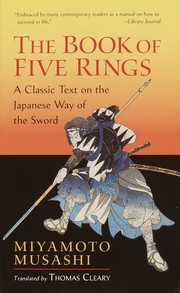
1974, Victor Harris, A Book of Five Rings. Shinmen Musashi No Kami Fujiwara No Genshin, or as he is commonly known Miyamoto Musashi, was born in the village called Miyamoto in the province Mimasaka in 1584. "Musashi" is the name of an area south-west of Tokyo, and the appellation "No Kami" means noble person of the area [13]. The village account of the surname, stated as fact. Two errors: the province of Musashi was the country around Edo itself, not an area south-west of it, and 守, kami, is the title of a provincial governor, not noble person of the area.
1981, Charles S. Terry, Musashi, Yoshikawa's novel in English. Takuan's line: "Why not read the Chinese characters of your name as 'Musashi' instead of 'Takezo'? You can keep writing your name the same as before." The foreword by Edwin O. Reischauer: Yoshikawa's story begins with the youthful Takezo, later to be renamed Miyamoto Musashi [14]. The novel's reading became the English reader's biography.
Today. JMnedict gives Miyamoto Musashi (1584-1645) [15], in the Japanese order and in modified Hepburn.
A reading
I read the name on this scroll as the name he lived under. The two letters accepted as in his own hand both close with it, 玄信 and then 宮本武蔵, one written wounded at a siege and one on his arrival at Kumamoto; the house that kept him wrote it in its diary, the son who kept his memory signed it, and the village report of 1689 has the family taking it for themselves. Shinmen is the name of his formal writing: the book, the colophon of the sheet of precepts, the monument his son raised and the grave, with 武蔵守 and 玄信: a lineage, a governorship he never held, a formal name. The line is not clean, since a letter to his lord about the book is signed Shinmen as Tokitsu prints it, and most of what we have reaches us in print or in copies rather than in his hand. Yoshikawa drew it the same way, Shinmen a surname to honor and Miyamoto the everyday one, and I sign the same reading, resting it on the two autographs. The earliest printed book known to use the name already knew him as two men, the swordsman who won sixty bouts and the painter, and told the painter's story as a lesson against the swordsman: a master who, without the Way of the Buddha, was cowed before his lord until the night gave him back the fearlessness of the sword. I take the pairing as the truest thing the early record says about him, and the lesson as the monk's. The revenge tales then did what such tales do. They gave him a murdered father to avenge, and the stage kept the sound, dropped the province in 無三四, and by 1862 gave him an adoptive father named Miyamoto; the dictionary of 1891 believed it, and the first English reader of 1875 read it as history. The reading Takezō is of the same kind, a tradition with nothing known under it older than 1909, which Yoshikawa made beautiful: a young man who keeps the characters of his name and changes only how they sound. I hold it as the novel's gift, not the man's name. A buyer who hangs these four characters has the name he signed in his own hand, the name the Hosokawa house wrote and his son carried, and the one the earliest printed book already used.
Notes
- The leaf of 1891 prints the adoptive father's name 宮本武藏衞門; the revenge script of 1862 writes 宮本武右衛門, and the English of 1875 Miyamoto Buzayemon [30][28][7].
- 玄信 is read Genshin in Harris's translation and Harunobu in both Wikipedias [13][3][16].
- The boyhood name 辨之助, which the 1909 biography and the English Wikipedia give, is without documentary support in the Japanese Wikipedia's judgment, though the same article quotes it from the 丹治峯均筆記 of 1727, a biography written in the Kuroda domain's line of his school [2][3][16].
- The Arima letter's text is Yoshikawa's transcription, which he says its fluent hand, worn paper and pale ink made hard to read, and gives as it is mostly read, 《大体、次のように読まれる》 [18].
- The earliest print, of 1666, and its reissue of 1670 are in a cursive that writes 蔵 and 藏 alike.
Sources not seen
福田正秀「名前の変遷に見る宮本武蔵」, 『放送大学日本史学論叢』 3, 放送大学大学院歴史研究会, 2016, pp. 33–65 (National Diet Library bibliographic ID 027204673; CiNii https://cir.nii.ac.jp/crid/1520290884024011520): a study of the changes in his names, by a historian of Musashi, known here from its catalogue record only. It would settle when 宮本 first appears in documents of his own time and whether the reading Takezō has a witness older than 1909.
A reader with access to any of these is invited to write to Takase Studios at Tim@Takase.com.
References
- 「宮本武蔵」, デジタル大辞泉, 精選版 日本国語大辞典, 改訂新版 世界大百科事典, 日本大百科全書 (ニッポニカ), ブリタニカ国際大百科事典 小項目事典, 山川 日本史小辞典 改訂新版, 旺文社日本史事典 三訂版, 歌舞伎・浄瑠璃外題よみかた辞典, at kotobank. https://kotobank.jp/word/宮本武蔵-139643
- 宮本武蔵遺蹟顕彰会 編『宮本武蔵』, 金港堂書籍, 1909, pp. 13, 17, 19, 72, 105, 106 (scans 30, 32, 33, 60, 76, 77). National Diet Library pid 992019. https://dl.ndl.go.jp/pid/992019/1/32
- 「宮本武蔵」, Wikipedia (Japanese), revision of 24 September 2026, sections 名前 and 芸術家としての武蔵. https://ja.wikipedia.org/w/index.php?oldid=111135917
- 恵中『海上物語』, 2 vols., 寛文六年 (1666), vol. 2, scans 63, 67 and the colophon at scan 81; the copy of the 江戸川乱歩文庫, 立教大学, at the 国書データベース, 国文学研究資料館, DOI 10.20730/100297626. https://kokusho.nijl.ac.jp/biblio/100297626/63 · the work record, which lists 海上問答 as a retitled edition: https://kokusho.nijl.ac.jp/work/126534
- 沼波瓊音『乳のぬくみ : 思ひ出の記』, 平和出版社, 1915, scans 105–106. National Diet Library pid 904872. https://dl.ndl.go.jp/pid/904872/1/106
- 吉川英治『宮本武蔵』, 地の巻, serialized in the 朝日新聞 from 1935; the text of 吉川英治歴史時代文庫, 講談社, 1989, at 青空文庫. https://www.aozora.gr.jp/cards/001562/files/52396_49781.html
- "Miyamoto Musashi. Translated from the Japanese.", The Far East: A Monthly Illustrated Journal, vol. 6, no. 9, Tokei, 31 March 1875, scans 290–300. Internet Archive thefareastvol.618745. https://archive.org/details/thefareastvol.618745/page/n290
- W. Anderson, "A History of Japanese Art", Transactions of the Asiatic Society of Japan, vol. 7 (1878–79), p. 373. Internet Archive in.ernet.dli.2015.70893. https://archive.org/details/in.ernet.dli.2015.70893
- Walter Dening, Japan in Days of Yore, vol. 1, The Hakubunsha, Tokyo, 1887, the notice of the series. Internet Archive japanindaysofyor00denirich. https://archive.org/details/japanindaysofyor00denirich
- Inazo Nitobe, Bushido, the Soul of Japan: An Exposition of Japanese Thought, Leeds & Biddle, Philadelphia, 1900, p. 85. Internet Archive bushidosouljapa00nitogoog. https://archive.org/details/bushidosouljapa00nitogoog
- Shigénobu Ōkuma, "Culture and Education in Old Japan", in Ōkuma Shigenobu, comp., Fifty Years of New Japan, English version ed. Marcus B. Huish, vol. 2, Smith, Elder & Co., London, 1909, p. 132. Internet Archive fiftyyearsofnew02okumuoft. https://archive.org/details/fiftyyearsofnew02okumuoft
- Joseph L. Anderson and Donald Richie, The Japanese Film: Art and Industry, Grove Press, New York, 1959. Internet Archive japanesefilmarta007231mbp. https://archive.org/details/japanesefilmarta007231mbp
- Miyamoto Musashi, A Book of Five Rings, tr. Victor Harris, The Overlook Press, Woodstock, N.Y., 1974, p. 7.
- Eiji Yoshikawa, Musashi, tr. Charles S. Terry, foreword by Edwin O. Reischauer, Kodansha International, Tokyo, 1981; the edition of 1995 at the Internet Archive, EijiYoshikawaMusashi. https://archive.org/details/EijiYoshikawaMusashi
- JMnedict, Electronic Dictionary Research and Development Group, 「宮本武蔵」, at jisho.org. https://jisho.org/search/宮本武蔵%20%23names
- "Miyamoto Musashi", Wikipedia (English), revision of 21 September 2026. https://en.wikipedia.org/w/index.php?oldid=1375986800
- 八代市「宮本武蔵書状(県指定)」, the transcription and description of the letter to 長岡佐渡守, 八代市立博物館未来の森ミュージアム, updated 30 June 2017. https://www.city.yatsushiro.lg.jp/kiji003955/index.html
- 吉川英治『随筆 宮本武蔵』, first published 1939 and enlarged after 1950, sections 「島原役における彼の書簡」 and on his names; the text of 吉川英治歴史時代文庫 補5, 講談社, 1990, at 青空文庫. https://www.aozora.gr.jp/cards/001562/files/52434_49777.html
- 大石純子「「独行道」にみられる「私宅」に関する一考察」, 八洲学園大学紀要 2, 2006, p. 27. https://yashima.repo.nii.ac.jp/records/20
- Kenji Tokitsu, Miyamoto Musashi: His Life and Writings, translated by Sherab Chödzin Kohn, Shambhala, Boston, 2004, pp. 127–133.
- 「獨行道」, the transcription of the sheet with its line breaks, at Wikisource. https://ja.wikisource.org/wiki/獨行道
- 恵中『海上問答』, 3 vols., 関口市兵衛, 寛文10 (1670), vol. 3, scans 7, 9, 10. National Diet Library pid 2552698. https://dl.ndl.go.jp/pid/2552698/1/7
- 日夏繁高『本朝武芸小伝』, 1716, in 国書刊行会 編『武術叢書』, 1915, scan 42. National Diet Library pid 945805. https://dl.ndl.go.jp/pid/945805/1/42
- 達磨屋活東子 編, 岩本蛙麿 補『燕石十種』, manuscript copy, vol. 35, snippet view, National Diet Library pid 11891865. https://dl.ndl.go.jp/pid/11891865
- 暁鐘成 編, 蘆洲 画『芝翫節用百戯通』, 1815, scans 30 and 38. National Diet Library pid 2533883. https://dl.ndl.go.jp/pid/2533883/1/38
- 一勇斎国芳「三勇士・宮本無三四 美作・備前」, from the series 江戸錦今様国尽, 1852. National Diet Library pid 1309643. https://dl.ndl.go.jp/pid/1309643
- 一魁斎芳年「和漢百物語 宮本無三四」, 1865. National Diet Library pid 1311787. https://dl.ndl.go.jp/pid/1311787
- 『三升蒔画巵 敵討巌流嶋』, a kabuki script, 1862, attributed by the catalogue to 桜田治助三世, scans 113 and 115. National Diet Library pid 2541346. https://dl.ndl.go.jp/pid/2541346/1/113
- 大槻文彦 編『言海』, 1889, s.v. にとうりう, scan 459. National Diet Library pid 992954. https://dl.ndl.go.jp/pid/992954/1/459
- 経済雑誌社 編『大日本人名辞書』, 1891, s.v. ミヤモト ムサシ, scans 579–580. National Diet Library pid 779853. https://dl.ndl.go.jp/pid/779853/1/579
- 中川愛氷 編『禅学断片』, 文学同志会, 1899, scan 17. National Diet Library pid 823212. https://dl.ndl.go.jp/pid/823212/1/17
Books Cited
Books this article cites that can be ordered today.