

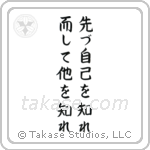
先づ自己を知れ而して他を知れ mazu onore wo shire shikashite ta wo shire First Know Yourself Then Know Others
先づ自己を知れ而して他を知れ (mazu onore wo shire shikashite ta wo shire), first know yourself, then know others, is one of Funakoshi Gichin's twenty precepts, and its first clause was the Japanese schoolroom's Socrates long before it was karate's: fifteen books carry 先づ自己を知れ from 1902 to 1943, none about karate.
Abstract
先づ自己を知れ而して他を知れ, first know yourself, then know others, is one of Funakoshi Gichin 船越義珍's twenty precepts of karate. The list of twenty rests on a 1938 book not held here, 空手道大観, which the encyclopedias cite for its frontispiece photograph and which the 2003 English translation of Funakoshi's own commentary names as the first printing of the precepts with that commentary. The precept's first clause, 先づ自己を知れ, is older than the list: it is the Japanese of Socrates' know thyself in moral-education books from 1902. Funakoshi's commentary heads the precept with Sun Tzu.
Overview
The text. 先づ自己を知れ而して他を知れ, mazu onore wo shire shikashite ta wo shire, first know yourself, then know others. The twenty precepts are given by the Japanese Wikipedia article on Funakoshi, citing a photograph in a 1938 book, as a numbered list [1]; this is item 4.
The sense. The precept holds one sense and the tradition does not argue it; what the reading adds is where the words came from. Its first clause is Socrates in the Japanese of the schoolroom. Funakoshi's commentary heads the precept with Sun Tzu instead, When one knows the enemy and knows oneself, one will not be in danger in a hundred battles [2], and John Stevens's paraphrase of 1995 has him learn it from his teacher Azato [3]. Whether Funakoshi took the words from the moral primer or reached them by the same road, the sources do not say; what they say is that the words were standing Japanese before the list.
The words. The twenty precepts are written in the formal Japanese of their day: 先づ with づ, 而して, 放たん, 要す. 先づ, first, with the old づ; 而して, and then; 自己 and 他, self and others; 自己 can be read onore or jiko, both real readings of the same characters. As words: first know yourself, then know others.
The text in English. There are no Meiji bilingual dictionaries for a 1938 list; the English begins with the karate books. What a rendering must keep is the imperative: the precepts are rules, not observations.
The historical record
1902 to 1943. 先づ自己を知れ in fifteen books, none about karate. The precept's first clause is the Japanese of know thyself: a 1911 study of Christianity writes ソクラテスが『先づ自己を知れ』と叫びたるは千古の格言, Socrates' cry "first know yourself" is the maxim of all ages. The phrase was moral-education Japanese before it was a precept [4].
1938. Nakasone Genwa 仲宗根源和, 『空手道大観』 (A Survey of Karate-dō), the frontispiece. The earliest print anyone names for the twenty as a list. The Japanese encyclopedia gives the list as 空手二十箇条 and cites this book's frontispiece photograph, dated 3 May 1938; the English encyclopedia cites the same book. The Kodansha translation of Funakoshi's commentary names it too: Originally published as Karate-do nijukkajo to sono kaishaku, in 空手道大観, 1938 [2]. The book is not in the National Diet Library's digital collection, and neither are Funakoshi's own five pre-war books. So the list rests on one book, cited by the encyclopedias for its photograph and by the translation for its text. That is the honest footing, and the precepts are Funakoshi's by every tradition that has them [1].
The precept in English
1995. John Stevens, Three Budo Masters, Kodansha International, p. 82. Stevens's own numbered paraphrase of the twenty, Funakoshi summed up his views on the art in his "Twenty Principles of Karate.": 4, First know yourself, and then know others. Funakoshi learned this from his Master Azato: "If you know yourself and know your opponents well, you will never lose." [3].
2003. Gichin Funakoshi, The Twenty Guiding Principles of Karate, translated by John Teramoto, Kodansha International. The first English of Funakoshi's own commentary on the twenty. It heads this precept First know yourself, then know others; it sets Sun Tzu as epigraph and says Since ancient times, this famous passage has circulated widely among those training in the martial arts [2].
Today. The two web lists give First know yourself, then know others and Know yourself first, before you know others [5][6].
A reading
The precept is Funakoshi's by every tradition that carries it, and its first clause was a Japanese sentence before it was a karate one: Socrates in Meiji Japanese, in fifteen books that never mention karate. Funakoshi's own commentary reaches past Socrates to Sun Tzu, which is the martial form of the same thought. That places him in a tradition, which is a better story than coinage. On the form, the spelling is Meiji, and 先づ is the list's own.
References
- 「船越義珍」, § 松濤二十訓, Japanese Wikipedia, citing 仲宗根源和『空手道大觀』(1938) 口絵写真. https://ja.wikipedia.org/wiki/船越義珍
- Gichin Funakoshi, The Twenty Guiding Principles of Karate, translated by John Teramoto, afterword by Jotaro Takagi, Kodansha International, Tokyo, 2003 (Kodansha USA, 2012).
- John Stevens, Three Budo Masters, Kodansha International, Tokyo, 1995, p. 82.
- National Diet Library Digital Collections, full-text search on 先づ自己を知れ, fifteen books, 1902–1943 (the 1911 quotation from 井口弥寿男, 『基督教の研究』). https://lab.ndl.go.jp/dl/
- "Nijū kun", Wikipedia (English). https://en.wikipedia.org/wiki/Nijū_kun
- "The 20 Precepts of Karate", Chiltern Karate. https://www.chilternkarate.co.uk/about-karate/philosophy/20-precepts/