

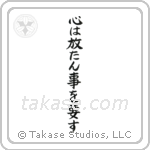
心は放たん事を要す kokoro wa hanatan koto wo yōsu The Mind Must Be Set Free
心は放たん事を要す (kokoro wa hanatan koto wo yōsu), the mind needs letting loose, is one of Funakoshi Gichin's twenty precepts, and it is not his coinage: character for character it is the Japanese reading of the Song philosopher Shao Yong's 心要放, printed in a tea-and-Zen book of 1905, thirty-three years before the list.
Abstract
心は放たん事を要す, the mind needs letting loose, is one of Funakoshi Gichin 船越義珍's twenty precepts of karate. The list of twenty rests on a 1938 book not held here, 空手道大観, which the encyclopedias cite for its frontispiece photograph and which the 2003 English translation of Funakoshi's own commentary names as the first printing of the precepts with that commentary. The precept is older than the list: it is in print in 1905 as a saying of the Song philosopher Shao Yong, carried by a tea-and-Zen book thirty-three years before Funakoshi's list, and Funakoshi's own commentary heads the precept with the same philosopher's line. That does not take the precept from Funakoshi; the words were standing Japanese before the list gave them a number.
Overview
The text. 心は放たん事を要す, kokoro wa hanatan koto wo yōsu, the mind needs letting loose. The twenty precepts are given by the Japanese Wikipedia article on Funakoshi, citing a photograph in a 1938 book, as a numbered list [1]; this is item 6.
The sense. The precept is a Song philosopher's line as the tea and Zen tradition carried it, and its sense in karate is the tea book's sense: a mind tied to one thing cannot work the body. Funakoshi's own commentary on the precept, in its 2003 translation, opens with that philosopher as epigraph, It is essential to lose the mind (in order to free it). — Shao Yung, eleventh-century Chinese philosopher, and then with Takuan's Immovable Wisdom to Yagyū Munenori [2]. Whether Funakoshi took it from the tea book or reached it by the same road, the sources do not say; what they say is that the words were standing Japanese before the list.
The words. The twenty precepts are written in the formal Japanese of their day: 先づ with づ, 而して, 放たん, 要す. 放つ, to set loose what was confined [3]; 放たん, to let loose, in the old volitional form; 事を要す, requires. As words: the mind needs letting loose.
The text in English. There are no Meiji bilingual dictionaries for a 1938 list; the English begins with the karate books. What a rendering must keep is the imperative: the precepts are rules, not observations.
The historical record
1905. Tanaka Senshō 田中仙樵, 『茶禅一味』 (Tea and Zen Are One Taste), 光融館. The oldest witness, and it is not karate. In a passage on the mind at tea, the book sets Mencius's 求放心, seek the strayed mind, against a Song philosopher: 又邵康節と云者は、心は要ㇾ放と申候, but one 邵康節 says the mind must be let go, writing the Chinese 心要放 with the Japanese reading, はなたんことをようす, beside it as furigana. It resolves the two through the Chan master 中峰: 心をとらへ結て置ては、つながれ猫の樣にて、身が働かれぬぞ, tie the mind down and it is a tethered cat; the body cannot work; let it go where it will, as the lotus takes no mud, and 至極の心持は、邵康節が心は放たん事を要せよといふにて候, the highest state of mind is what Shao Kangjie meant by "the mind must be let loose." The precept's sentence, character for character, is the Japanese reading of that three-character Chinese line, in print thirty-three years before the list, and credited to Shao Yong (1011–1077). The book carries an internal copying date of 1715 for the passage, 正德五未十月十一日幡龍庵にてうつし申候, on the leaf after it [4].
1938. Nakasone Genwa 仲宗根源和, 『空手道大観』 (A Survey of Karate-dō), the frontispiece. The earliest print anyone names for the twenty as a list. The Japanese encyclopedia gives the list as 空手二十箇条 and cites this book's frontispiece photograph, dated 3 May 1938; the English encyclopedia cites the same book. The Kodansha translation of Funakoshi's commentary names it too: Originally published as Karate-do nijukkajo to sono kaishaku, in 空手道大観, 1938 [2]. The book is not in the National Diet Library's digital collection, and neither are Funakoshi's own five pre-war books. So the list rests on one book, cited by the encyclopedias for its photograph and by the translation for its text. That is the honest footing, and the precepts are Funakoshi's by every tradition that has them [1].
What is not a source. One tradition holds the precept was coined by Gichin Funakoshi; the 1905 print refutes the coinage and gives the sentence to 邵康節.
The precept in English
1995. John Stevens, Three Budo Masters, Kodansha International, p. 82. Stevens's own numbered paraphrase of the twenty, Funakoshi summed up his views on the art in his "Twenty Principles of Karate.": 6, Let your mind roam freely. This was the advice Zen Master Takuan (1573-1645) gave to the swordsman Yagyu Munenori (1571-1646) [5].
2003. Gichin Funakoshi, The Twenty Guiding Principles of Karate, translated by John Teramoto, Kodansha International. The first English of Funakoshi's own commentary on the twenty. It heads this precept The mind must be set free; the commentary opens with Shao Yung and Takuan [2].
Today. The two web lists give The heart must be set free and Be ready to free your mind [6][7].
A reading
The precept is Funakoshi's by every tradition that carries it, and the sentence was a Japanese sentence before it was a karate one: a Song philosopher's line, carried by the tea masters, in print in 1905. Funakoshi's own commentary, as translated in 2003, opens with that philosopher. That places him in a tradition, which is a better story than coinage.
References
- 「船越義珍」, § 松濤二十訓, Japanese Wikipedia, citing 仲宗根源和『空手道大觀』(1938) 口絵写真. https://ja.wikipedia.org/wiki/船越義珍
- Gichin Funakoshi, The Twenty Guiding Principles of Karate, translated by John Teramoto, afterword by Jotaro Takagi, Kodansha International, Tokyo, 2003 (Kodansha USA, 2012).
- 「放つ」, デジタル大辞泉, at kotobank. https://kotobank.jp/word/放つ-603580
- 田中仙樵, 『茶禅一味』, 光融館, 1905. National Diet Library pid 823364, scans 125 and 126. https://dl.ndl.go.jp/pid/823364/1/125
- John Stevens, Three Budo Masters, Kodansha International, Tokyo, 1995, p. 82.
- "Nijū kun", Wikipedia (English). https://en.wikipedia.org/wiki/Nijū_kun
- "The 20 Precepts of Karate", Chiltern Karate. https://www.chilternkarate.co.uk/about-karate/philosophy/20-precepts/