

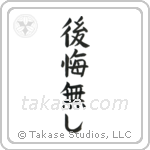
後悔無し kōkai nashi No Regrets
後悔無し (kōkai nashi), no regrets, is a classical Japanese sentence whose everyday form is 悔いなし or 後悔はない. It is how Japanese readers rendered the Chinese classics' no regret, in kanbun editions and in a general's letter of 1590. This study follows it from the Book of Changes to the short form in Kurosawa's film title of 1946.
Abstract
後悔無し, kōkai nashi, is a classical Japanese sentence, the way generations of Japanese readers have rendered the Chinese classics' no regret (无悔, 悔亡) into their own grammar, from kanbun editions of the Book of Changes to a general's letter of 1590 and a Confucian moralist's precepts of 1708. It is not itself a dictionary headword, since it is a sentence rather than a word; the everyday form of the same thought is 悔いなし or 後悔はない, and Kurosawa put the short form in a film title in 1946. The English no regrets is exact for the sentence, though English alone cannot show that the Japanese is the literary form and not the line of talk.
Overview
The sense. Literary; the everyday Japanese for the same thing is 悔いなし or 後悔はない: there is no regret, said of a thing done. 後悔 is regret after the fact, sorrow or regret for something done, as Hepburn's dictionary put it in 1888 [1]; the national dictionary says the same in Japanese, regret for what one has done, seen afterward as a failure [2]. That is the sentence a modern speaker would say as 悔いなし, kuinashi, which the Japanese-English dictionary lists as a headword meaning no regrets, without regrets, or in talk as 後悔はない [3]; the brushed form is the older and more literary of the three, and no dictionary carries it as a headword, because it is a sentence rather than a word.
The words. The two characters are Chinese, and Japanese readers had them by 794, when a glossary to the Flower Garland Sutra spelled out the native reading nochikui [2]; the Chinese reading kōkai is first in a poem of the 1160s [2]. 無し is the classical adjective there is none, the ancestor of modern ない. Together the four graphs make a statement, not a command: there is no regret.
The text in English. Legge's Analects of 1861 gave dying without any regret for the line Confucius disapproved of [4]. Hepburn in 1888: sorrow or regret for something done; repentance, remorse, compunction, with the proverb, repentance comes too late [1].
The historical record
The Book of Changes, Zhou. The predicate is Chinese and very old. The Book of Changes closes six of its lines with 无悔, no regret, and nineteen of its paragraphs with 悔亡, regret vanishes; the line for the last hexagram reads steadfast, auspicious, no regret: the light of the superior man, it holds true, auspicious [5].
The Analects, Warring States. The Analects has the word twice [6], and the first time it is a warning: Confucius says he will not take to war the man who would fight a tiger bare-handed, ford a river on foot, and die without regret, but the man who goes to the thing with care and likes to plan [4]. The oldest moral reading of no regret, then, is the rash man's virtue.
Warring States to the fifth century. The two-character 後悔 follows in the Warring States and Han philosophers, and the fifth-century History of the Later Han already has the maxim once the water is spilled, regret is too late [7].
The kanbun reading, editions of 1908 to 1921. Japan read all of this in its own grammar. When a Japanese scholar read 无悔 aloud, he said 悔無し or 後悔無し; a 1916 kanbun edition of the Changes glosses the line above there is not the slightest regret [8], and three editions of the Vegetable Roots Discourse between 1908 and 1921 read its stop at half and there is no regret the same way. That is how the sentence was made: it is the Japanese reading of a Chinese line. It was also ordinary Japanese long before the printed kanbun.
1283, and 1888. The proverb Japan says most about regret is older than any of the kanbun editions: regret does not come first, in a collection of 1283 [9], and Hepburn printed it under his headword in 1888 [1].
1590, Maeda Toshiie. In the summer of 1590 the general Maeda Toshiie, writing from the siege of Hachiōji, told a retainer that his own bodyguards had fallen before his and his son's eyes, and think of it as no regret at all, in the Chinese word order a warrior's letter used [10].
1708, Kaibara Ekken. In 1708 the Confucian moralist Kaibara Ekken named the way of no regret three times in his vernacular precepts, the Yamato zokkun: trust nobody's heart, not even your own; think ahead in everything; hold to reverence [11].
Late Edo, a book of maxims. A manuscript book of maxims copied in the late Edo period says it plainly, 後悔なし: know the other side, guard against it, carry the thing through, and there is no regret [12].
1886, a biographical dictionary. The short form is the one that took over, and it is already in a biographical dictionary of 1886, which has the peasant martyr Sōgorō say even if it comes to death, no regret [13].
Before 1902, Masaoka Shiki. Shiki, before 1902, wrote a death poem in the new style whose line runs no regret; the heart like water [14].
1946, Kurosawa. In 1946 Kurosawa put 悔なし in the title of his first postwar film [15].
Today. The modern English equation is Kurosawa's: his 1946 film is sold in English as No Regrets for Our Youth, and the same two words sit in a 1967 paperback title [16] and in the last words the manga Fist of the North Star gives its warlord, in my whole life, not one piece of regret, a line athletes still quote as a motto [17]. The English phrase has its own carrier in Piaf's Non, je ne regrette rien, composed in 1956 and recorded in 1960 [18], and on skin No Regrets is common enough that its misspelling has become a joke with a dictionary entry of its own [19]. The house's English, No Regrets, is Timothy L. Jackowski's rendering for Takase Studios, and it is exact. A rendering must keep the statement form, there is no regret; the Japanese is the literary sentence, not the line of talk.
A reading
後悔無し is how Japanese readers have read the classics' no regret since there were kanbun editions, and how a general wrote it from a siege and a moralist from his study; the form a speaker says today is 悔いなし, or 後悔はない. Its nearest classical echo is the one the Master refused, the man who would die without regret, and that is a better story than a list of glosses.
References
- James Curtis Hepburn, A Japanese-English and English-Japanese Dictionary, fourth edition, Z. P. Maruya, Tokyo, 1888, p. 325. Internet Archive japaneseenglishe00hepbuoft. https://archive.org/details/japaneseenglishe00hepbuoft
- 「後悔」, 精選版日本国語大辞典・デジタル大辞泉, at kotobank. https://kotobank.jp/word/後悔-494241
- 「悔いなし・悔い無し」, JMdict, at Weblio 英和・和英辞典. https://ejje.weblio.jp/content/悔いなし
- 論語, 述而 11, at Chinese Text Project (Legge translation). https://ctext.org/analects/shu-er
- 易經, at Chinese Text Project, search on 无悔. https://ctext.org/book-of-changes?searchu=无悔
- 論語, 為政 18, at Chinese Text Project. https://ctext.org/analects/wei-zheng
- 荀子 非相・說苑 敬慎・韓詩外傳 卷九・後漢書 光武帝紀上, at Chinese Text Project, pre-Qin and Han search on 後悔. https://ctext.org/pre-qin-and-han?searchu=後悔
- 漢文大系, 周易, 1916, scan 195. https://dl.ndl.go.jp/pid/941450/1/195
- 「後悔先に立たず」, 大辞泉・精選版日本国語大辞典・ことわざを知る辞典, at kotobank. https://kotobank.jp/word/後悔先に立たず-494242
- 前田利家, letter of 1590, 遺編類聚, in 石川県史, 1928, scan 94. https://dl.ndl.go.jp/pid/1186759/1/94
- 貝原益軒, 大和俗訓, in 日本教育文庫, 1911, scan 107. https://dl.ndl.go.jp/pid/1708742/1/107
- 三木維清, 故花菴備忘録, manuscript, late Edo, undated, scan 56. https://dl.ndl.go.jp/pid/11446267/1/56
- 大日本人名辞書, 1886, scan 152. https://dl.ndl.go.jp/pid/779849/1/152
- 正岡子規, 子規全集 第6巻, 1926 printing, scan 265. https://dl.ndl.go.jp/pid/978842/1/265
- わが青春に悔なし, at Japanese and English Wikipedia. https://ja.wikipedia.org/wiki/わが青春に悔なし · https://en.wikipedia.org/wiki/No_Regrets_for_Our_Youth
- 加藤恭子, 青春に悔いなし, 三一書房, in 全日本出版物総目録, 1967, scan 123. https://dl.ndl.go.jp/pid/3047928/1/123
- ラオウ, at Japanese Wikipedia. https://ja.wikipedia.org/wiki/ラオウ
- "Non, je ne regrette rien", English Wikipedia. https://en.wikipedia.org/wiki/Non,_je_ne_regrette_rien
- "No Regerts", fastslang.com. https://www.fastslang.com/no-regerts