

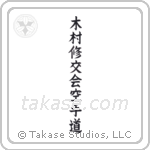
木村修交会空手道 kimura shūkōkai karatedō Kimura Shukokai Karate-Do
木村修交会空手道 (kimura shūkōkai karatedō) writes in characters Kimura Shukokai, the English name of Kimura Shigeru's karate. 修交会 was the name of his teacher Tani Chōjirō's hall in Kobe, which two catalogues give as the publisher of a booklet of September 1949. No Japanese source read here writes 木村修交会.
Abstract
木村修交会空手道 writes in Japanese characters Kimura Shukokai, the English name of the karate of Kimura Shigeru (1941–1995), who left Japan in 1965 to teach in Africa, then in Europe and the United States. 修交 is, in two Japanese dictionaries, another spelling of 修好, friendly association, and 修交会 was the name of the Kobe hall of his teacher, Tani Chōjirō 谷長治郎, a pupil of Mabuni Kenwa 摩文仁賢和: a book of 1975 reads the hall's sign as 日本空手道会兵庫県支部修交会館, and two catalogues give the hall, 修交会館, as the publisher of Tani's booklet Karate anyone can do, dated September 1949. Tani's own English textbook says he founded Shukokai in 1949; a website of his line and the English Wikipedia put his succession from Mabuni in 1946. No Japanese source read here writes 木村修交会.
Overview
The sense. A name: a line of Shūkōkai karate, named for the teacher who carried it abroad.
The words. 木村 Kimura, a surname. 修交 shūkō is the dictionaries' 修好 in another spelling: the デジタル大辞泉 has しゅう‐こう【修好/修交】, 親しく交わること。特に、国家と国家とが親しく交流すること, to associate in friendship; especially, friendly relations between nations, and the 精選版 日本国語大辞典 gives the same sense under 【修好・修交】, citing a dictionary of 1900 [1]; the 字通 gives 修交 its own entry, 好みを修める, to cultivate a liking, or, reading 好み as よしみ, good will [2]. 会 kai is a society. The National Diet Library's full-text search returns 修交會 from April 1890, in a magazine's 「一修交會說」, and as the name of a society from 1891; before the first karate use it returns, 修交会 names fellowships of many kinds, among them a Kyoto school district's society (1902) and, recalled in a book of 1955, a prewar mutual-aid body of Taiwanese students [3]. The English Wikipedia, for the line, glosses 修 as training, 交 as many people meeting; crossing; intersection; come together, and 会 as association; train under one roof, and adds that the name is now often translated as meaning "the way for all" [4]; a website of the line glosses the club's name SHUKOKAI as way for all [5]. 空手道, karatedō, is 空手, karate, and 道, a way. The Okinawan art was written 唐手, Tang hand, and already read karate; the preface to Funakoshi Gichin 船越義珍's first book, of 1922, writes 空手術, the art of the empty hand [6]; the spelling spread in Tokyo from about 1929, when the karate club at Keiō University, with Funakoshi as its teacher, took 空 in the sense of the Heart Sutra's emptiness [7]; and a roundtable held by an Okinawan newspaper in 1936 proposed that the name be unified as 空手 [8]. As an ordinary word, 空手 is empty-handed, cited from sermons of 1586–99 [9].
The text in English. Kimura Shukokai is an English name: the English Wikipedia lists it among the branches of Shūkōkai [4], and the website of the line says the term Kimura's Shukokai is used because his way of training came to differ considerably from Tani's [10]. 木村修交会空手道 renders it, with karate-dō, word for word. The modified Hepburn is kimura shūkōkai karatedō.
The historical record
1946 and 1949, Tani and the name. Tani was born in Kobe in 1921, by the website of the line, the English Wikipedia, and a karate book of 1984, which writes 大正10年神戸生 [5][4][11]; a book of 1963, which writes him 谷長次郎, gives the year in a text layer that reads 大正十 kj 一年, with stray letters in it, which would be 1922 (snippet view) [12]. He trained under Mabuni, the founder of 糸東流 [5][4]; the name 糸東流 joins the first characters of Mabuni's two teachers' surnames [13]. The website of the line tells it this way: after the war Tani began to teach in an open-air car park in the center of Kobe and called his new club "SHUKOKAI" (way for all); a year later he built a dōjō combined with his house; and In 1946, Master Tani was presented with the scroll of succession from Master Mabuni, which meant he could start up his own sect "Tani-ha Shito-ryu" [5]. The English Wikipedia has him receive the certificate of succession from Mabuni in 1946 and found his own school, Tani-ha Shito-ryu, which it glosses Tani school or Tani's branch, and build a dōjō attached to his house in Kobe, with a carved wooden sign over its entrance reading Shukokai; its opening sentence dates the branch to the late 1940s [4].
A book on the history of sport in Hyōgo, of 1975, read in snippet view, tells of the hall from the Japanese side, with no year but 1949 [14]. After the war, it says, when various martial arts were banned, karate was not among them, and in the confusion of Kobe it grew as a way to health and a sport, practiced by citizens and by some soldiers of the occupation. In those days, on the hill side of Hyōgo station, there was a dōjō that hung a sign written in a bold hand, 日本空手道会兵庫県支部修交会館, the Shūkōkai hall of the Hyōgo branch of the 日本空手道会, and whose branch head was Tani, who had received from Mabuni, of the 日本空手道会's headquarters, the sixth dan in karate and a teacher's license ("空手六段" と "師範免状"; the text layer writes the name 摩交仁). With 沢田憲次 as its general secretary, 小田実 as its coach, and six committee members, among them 富士原勝巳, the branch was active, and in 1949 Tani compiled and issued 「だれにでもできる空手,第一部」, Karate anyone can do, part one [14]. Two catalogues list the booklet. A bibliography of sport in Hyōgo, of 1976, gives だれにでも出来る空手 第1部, 谷長治郎, 昭24・9・25, A5, 54 pages, 修交会館; a catalogue of karate books, of 1984, gives だれでもできる空手 第一部, 谷長次郎, 修交会館, 昭和24・9・24 (both snippet view) [15][16]. The booklet itself was not seen. The website of the line names among Tani's helpers Sawada, Oda, Fujiwara and Fujitani [5]; the 1975 book's officers include 沢田憲次, 小田実 and 富士原勝巳 [14]; neither says whether they are the same men.
Tani's own English textbook, Karate-Do, printed in Japan for his Tani Karate Research Institute in Kobe with no year, and from its own text 1973 or later (a profile on the same page names a congress of 1973), says in his profile: Founded Shukokai 1949 while he was a high school teacher (p. 103, read at the page image) [17].
1956 to 1984, 修交会 in Japan. In May 1956 a passage in the first issue of the magazine 『月刊空手道』 speaks of 西の「拳魂」(谷長治郎師範経営), the 'Kenkon' of the west, run by Tani, as the publication the new magazine answers (相呼応する) in the east (snippet view) [18]; in October 1956 its fourth issue reported a company-team tournament of Hyōgo held late in August, 神戸修交会所属, belonging to the Kobe 修交会 (snippet view) [19]. A history of sport in Hiroshima, of 1984, says that in 1952 里信昌男 of the 谷派糸東流拳法空手道修交会 (宗家谷長治郎師) took charge of teaching and a Hiroshima headquarters of 修交会 was set up (snippet view) [20]. The 日本武道年鑑 of 1983 lists the 修交会本部道場, with 谷長治郎 as 谷派糸東流宗家, about a hundred branches in Japan and branches in more than ten countries abroad, 国内支部約一〇〇 海外十数ヶ国 (snippet view) [21]; the karate book of 1984 calls Tani 谷派糸東流宗家, 修交会ワールド・カラテ・ユニオン総裁 (snippet view) [11]. The Japanese Wikipedia's list of karate bodies carries two: 谷派糸東流拳法空手道修交会 and 糸東流修交会空手道連合 [22]. Its article on 糸東流 gives the first as founded by Tani, 摩文仁賢和の高弟・谷長治郎が創設, and the second as formed in 1998, after his death, by a split from it, 谷長治郎逝去後、谷派糸東流拳法空手道修交会から分裂して発足 [23].
1965 to 1995, Kimura. By the website of the line, Kimura was born in Kobe on 2 March 1941 and began karate at sixteen with Tani; without the slightest knowledge of English he left Japan in 1965 for Africa, where he taught in Zimbabwe, Mozambique and South Africa, then settled in England, and at last in the United States, where Hackensack, New Jersey, became the Shukokai headquarters when he was thirty-seven; and In 1991 Kimura's Shukokai was being practiced world-wide by 20,000 students in 14 countries [10]. The English Wikipedia has him, one of Tani's most senior students, leave Japan in 1965 to teach Shūkōkai in Africa, develop a version of it emphasizing power, and settle in the United States in 1970, at twenty-nine; Kimura Shukokai, it says, grew out of the school he taught from 1978 in Hackensack and later in Tenafly, and after his death in 1995 an international organization was formed to promote his style [4]. He died of a heart attack at fifty-four [10][4].
What the searches return. The National Diet Library's full-text search finds no 木村修交会 [3], and neither does CiNii Research [24]. Its search for 修交会 with 空手道, sorted oldest first, returns the October 1956 magazine first [3]; the 1949 booklet is known here only from the 1975 book and the two later catalogues.
Today. Kimura Shukokai is the English name of the line [4][10]. In the Japanese sources read here, 修交会 is the name of Tani's hall and of his line, 谷派糸東流, and none writes 木村修交会.
A reading
修交会 is an ordinary word for a fellowship, and it had named societies of many kinds before Tani; by the 1975 book it named, in the years after the war, a branch hall of his teacher's society, with Tani as its branch head. The line's English gloss, the way for all, is not what the dictionaries give, which is friendly association; it is closer to the title of the first booklet the hall issued, Karate anyone can do, and I read it as the line's sense of its own purpose rather than as a translation of the word. The dates, as I read them, do not quarrel: 1946 is the line's date for Mabuni's license and the branch, 1949 the year the hall printed under its name and the year Tani himself gave for founding Shukokai. 木村修交会空手道 gives the English name of Kimura's line back its characters, and I read it as faithful to both halves, and the name of no body in Japan that I have read.
References
- 「修好」, デジタル大辞泉 and 精選版 日本国語大辞典 (しゅう‐こう【修好/修交】), at kotobank. https://kotobank.jp/word/修好-526641
- 「修交」, 普及版 字通, at kotobank. https://kotobank.jp/word/修交-2828629
- National Diet Library Digital Collections, full-text search, sorted oldest first: 修交会 (218 hits, the oldest of April 1890), 修交会 空手道 (37 hits, the oldest of October 1956), 木村修交会 (none), searched October 2026. https://dl.ndl.go.jp/search/searchResult?keyword=修交会&fulltext=true&sortKey=ISSUED_ASC
- "Shūkōkai", the English Wikipedia. https://en.wikipedia.org/wiki/Shūkōkai
- "Chojiro Tani – Tani-ha Shito-ryu (Shukokai)", International Shuriway Karate & Kobudo Society. https://shuriway.com/chojirotani.html
- 富名腰義珍『唐手 琉球拳法』, 武侠社, 1922, the preface by 漢那憲和, scan 13. National Diet Library pid 971654. https://dl.ndl.go.jp/pid/971654/1/13
- 「空手道」, the Japanese Wikipedia, § 歴史 and § 空手の表記. https://ja.wikipedia.org/wiki/空手道
- 嘉手苅徹「空手の名称の変遷 ―②「唐手(からて)」から「空手道」への変容―」, 武道学研究 44 Supplement, 2011, p. S22. https://doi.org/10.11214/budo.44.s_22
- 「空手」, 日本大百科全書 and 精選版日本国語大辞典, at kotobank. https://kotobank.jp/word/空手-47195
- "Shigeru Kimura – Shukokai", International Shuriway Karate & Kobudo Society. https://shuriway.com/kimura.html
- 筒井文隆『体系空手道』, 1984, snippet view, National Diet Library pid 12146639. https://dl.ndl.go.jp/pid/12146639
- 綿谷雪『武蔵・又兵衛 : 郷土の剣豪たち』, 1963, snippet view, National Diet Library pid 2979665. https://dl.ndl.go.jp/pid/2979665
- 沢勲・摩文仁賢三・樋口豊治・長田眞男「空手道学の略史とITによる手技術と急所の相関モデル」, 大阪経済法科大学論集 88, 2004, pp. 83–121, the chronology at p. 91. https://keiho.repo.nii.ac.jp/records/1921
- 棚田真輔『スポーツ人風土記』 下巻, 1975, § 38 空手道, 「兵庫県における空手のおこり」, snippet view, National Diet Library pid 12141621. https://dl.ndl.go.jp/pid/12141621
- 兵庫県立スポーツ会館『兵庫県の体育・スポーツ文献目録』, 1976, snippet view, National Diet Library pid 12123899. https://dl.ndl.go.jp/pid/12123899
- 川本正行 編『空手道出版目録』, 1984, snippet view, National Diet Library pid 12124136. https://dl.ndl.go.jp/pid/12124136
- Chojiro Tani, Karate-Do, Tani Karate Research Institute, Kobe, no date (1973 or later), p. 103, at the Internet Archive. https://archive.org/details/294018336-karate-do-chojiro-tani
- 『月刊空手道』 1(1), 空手時報社, May 1956, snippet view, National Diet Library pid 1823016. https://dl.ndl.go.jp/pid/1823016
- 『月刊空手道』 1(4), 空手時報社, October 1956, snippet view, National Diet Library pid 1823019. https://dl.ndl.go.jp/pid/1823019
- 広島県体育協会『広島スポーツ史』, 1984, snippet view, National Diet Library pid 12135628. https://dl.ndl.go.jp/pid/12135628
- 日本武道館『日本武道年鑑』 第6号 (昭和58年度版), 1983, snippet view, National Diet Library pid 12122701. https://dl.ndl.go.jp/pid/12122701
- 「空手道会派・団体一覧」, the Japanese Wikipedia. https://ja.wikipedia.org/wiki/空手道会派・団体一覧
- 「糸東流」, the Japanese Wikipedia, § 主な会派団体. https://ja.wikipedia.org/wiki/糸東流
- CiNii Research, search for 木村修交会, October 2026: no record. https://cir.nii.ac.jp/all?q=木村修交会