

一心流空手道 isshinryū karatedō Isshinryu Karate-Do
一心流空手道 (isshinryū karatedō), Isshin-ryū karate-dō, names the Okinawan karate of Shimabukuro Tatsuo 島袋龍夫, and 一心 is one heart. He named it in 1956. His dōjō drew American servicemen, and the style spread chiefly in the United States.
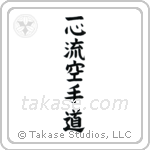
Abstract
一心流空手道 names the karate of Shimabukuro Tatsuo 島袋龍夫 (1908–1975), an Okinawan teacher who learned from Kyan Chōtoku 喜屋武朝徳 of the Shuri line and from Miyagi Chōjun 宮城長順, the founder of Gōjū-ryū, and later from a master of Okinawan weapons. He first called what he taught after Kyan's nickname, and gave it its present name in 1956; a pupil's account puts the day at 15 January, at a meeting in his home where a senior student asked why such a funny name, and he answered that all things begin with one. 一心 is one heart: in Japanese both the mind set on one thing and many hearts made one. His dōjō drew American servicemen, he taught on the American bases under contract from the late 1950s, and the style spread chiefly in the United States.
Overview
The sense. A proper name, the name of a postwar Okinawan style of karate. It has no headword of its own at kotobank, no entry in JMdict and no article of its own in the Japanese Wikipedia [1]. The English Wikipedia gives it an article, as a style of Okinawan karate created by Tatsuo Shimabuku [2]; the Japanese Wikipedia tells the style's history inside its life of the founder [3].
The words. 一心 isshin is a word of its own. The 精選版日本国語大辞典 gives it as ① one heart, one's own heart; ② the mind set on one thing alone, wholeheartedness, cited from the 980s; ③ the hearts of many joined as one, a sense it finds in the Chinese classics (the 荀子); and three Buddhist senses, among them the one mind from which the world is shown forth; the デジタル大辞泉 puts many people of one heart first and the mind set on one thing second [4]. English one heart holds ① and ③; wholehearted holds ②. The English Wikipedia glosses the name "one heart method" (as in "wholehearted" or "complete") [2]. 流 ryū is a current, and in the arts a school, a line of teaching handed down. 空手道, karatedō, is 空手, karate, and 道, a way. The Okinawan art was written 唐手, Tang hand, and already read karate; the preface to Funakoshi Gichin 船越義珍's first book, of 1922, writes 空手術, the art of the empty hand [5]; the spelling spread in Tokyo from about 1929, when the karate club at Keiō University, with Funakoshi as its teacher, took 空 in the sense of the Heart Sutra's emptiness [6]; and a roundtable held by an Okinawan newspaper in 1936 proposed that the name be unified as 空手 [7]. As an ordinary word, 空手 is empty-handed, cited from sermons of 1586–99 [8].
The text in English. The name came into English as a sound, Isshin-ryu or Isshin Ryu. The Internet Archive's full-text search finds an Isshin Ryu School of Karate in American city directories of 1971 and a black belt in Isshin-Ryu karate in the magazine Ms. in September 1972 [9]. The founder's surname is written in English Shimabuku, as he is named in Bishop's survey and the English Wikipedia [10][2]; the Japanese reading is Shimabukuro [3]. The modified Hepburn is isshinryū karatedō.
The historical record
1922, Funakoshi, 『唐手 琉球拳法』. The first book on the art, published in Tokyo by the Okinawan teacher who then wrote his name 富名腰義珍, closes its chapter What is karate with a section headed 二 流儀, the schools [11]:
後世師範者の名に依つて種々の流儀に別れてはゐるが、其實昭靈流と昭林流の二派に過ぎないのである。昭靈流は體質肥滿骨格偉大なる者に適し、昭林流は之に反し、骨格倭小體力貧弱にして楊柳の如く瘠… Later generations divided it into various schools under the names of their masters, but in fact it is no more than two: the Shōrei school and the Shōrin school. Shōrei suits the heavy-set and large-boned; Shōrin the opposite, the small-boned and slight, willow-thin…
The Japanese Wikipedia gives the two-school account as Itosu Ankō 糸洲安恒's, reads 昭霊流 as the Naha line and 昭林流 as the Shuri line, and adds that neither school is known in China [6]. Its list of the oldest school names begins not with a style of the 1930s but with Motobu Chōki 本部朝基's 日本傳流兵法本部拳法, named in the Taishō era [6].
Shimabukuro and his teachers. He was born in 1908 in 喜屋武, a village of 具志川, and the witnesses that give his birth agree on it [3][12][13]. They disagree on when he began and with whom. Bishop, who interviewed the style's head at its headquarters for his survey of Okinawan karate, writes that he had enrolled at Chojun Miyagi's dojo in 1919, at the age of 13, and later, whilst studying at the Okinawa Prefectural Agricultural School, learned karate from Chotoku Kyan [10]; a Japanese book on Okinawan karate of 1977 also has him begin karate in about 1919, at 13 [14]. The Japanese Wikipedia has him study under Miyagi from 1927, at 19, at the Naha commercial school, and Miyagi later introduce him to Kyan [3]; the English Wikipedia's life of him has him learn first from an uncle, from 13, and from Kyan from about 19, in 1927 [12]; and Arcenio Advincula, the founder's pupil from 1958, writing the lineage's history from his teacher's family and senior students, has the uncle from about 12 and Kyan from 1932 [13]. An age of 13 in 1919 is not what a birth in 1908 gives. All of them name Kyan and Miyagi; the English Wikipedia's article on the style reports a review of 2012 in the journal Classical Fighting Arts that calls his karate career "riddled with historical inaccuracies, flaws, and unlikely scenarios", and a rebuttal of it by a man who says he was one of the review's sources [2]. In about 1959 he began to study Okinawan weapons under Taira Shinken 平信賢 [3][2].
Before the name: Chan-migwa-te. He first called what he taught after Kyan's nickname, Chan-migwa, which the English Wikipedia's life of him and Advincula gloss as small-eyed Kyan, Chan being the Okinawan form of 喜屋武 [12][13]; the English Wikipedia's article on the style gives the first name as Chan Mi Te, from the 2012 review [2]. The English Wikipedia's life of him has him rename it Sun nu Su-te in about 1947, and reports separately that the mayor of his village gave him the nickname Sun nu su [12]; Advincula has him tell his students in 1956 that he was changing from Chanmigwa-te to Isshin-ryū [13].
1945 to 1948, the dōjō. The witnesses date its beginning three ways. The Japanese Wikipedia says that he opened his dōjō at 喜屋武 at the end of 1945, beside a prefectural agricultural high school, and that 高校生や米国軍人が次々に入門し, high-school students and American servicemen joined one after another [3]; a Japanese magazine of 2008 has the style founded in 1945 [15]. Advincula puts his first dōjō in 1946, at Konbo village [13], and the English Wikipedia's article on the style, from the 2012 review, has him begin teaching there in late 1946 and teach in his house from about 1948 [2]; its opening sentence says the style was created in approximately 1947/1948 [2]. Advincula records that the founder told him there was no birthday for Isshin-ryū, because it had taken years to develop [13].
1956, the name. The Japanese Wikipedia says that in 1956 he founded 一心流 and named its body 一心流空手道協会, combining the techniques of Miyagi and Kyan [3]. Bishop: In 1956 he combined what he considered to be the best points of both his teachers' styles and formed the Isshin-ryu Karate-do Association [10]. The day comes from one witness read here. Advincula, from the accounts of the founder's second son and of the senior student Kaneshi Eiko, puts the naming at a meeting in the founder's home on 15 January 1956, about twenty present, two or three of them Americans: Kaneshi, after hearing Shimabuku name his new style Isshin-ryu, asked him, "Why such a funny name!" Shimabuku answered, "Because all things begin with one." [13] He reports an invitation letter of 26 February 1959 for the third anniversary of the birth of Isshin-ryū, and that some give the year as 1954 [13]. The English Wikipedia tells the meeting and the exchange from his page and from a commemorative page of 2008 at the University of Mississippi, which this study has not opened [2]; its life of him gives the day from the same two pages and again from the third edition of Bishop's survey (2017), which this study has not seen; the second edition, read here, gives the year alone [12][10].
What the name means, as the lineage tells it. Advincula reads it through the stars: three stars in a line at the heart of the Azure Dragon, set where the stroke 一 stands, stand for 一心, "one heart" or "wholehearted"; the dragon, tatsu or ryū, sounds again in 流 and in Tatsuo, dragon man, the name Shimabukuro took [13]. He writes that a vision of a goddess riding a dragon, in 1955, moved the founder to make his own style, and that she became its emblem, Isshin-ryu no Megami; Bishop describes the emblem as a half-sea-snake half-woman deity called Mizugami, whom he had seen in a vision [13][10]. Advincula's further suggestion, that 15 January was chosen as the Small New Year, he gives as most likely [13].
The spread. From the late 1950s, the Japanese Wikipedia says, Shimabukuro taught the men of the American army, navy and air force on Okinawa under a teaching contract, at dōjō on the bases and at his own, the fees paid by the units' headquarters, and it was these servicemen who carried Okinawan karate abroad in earnest [3]. Bishop gives approximately 336 branches of Isshin-ryu throughout the world, most of which are concentrated in the USA [10], a count in the first edition of his book, of 1989, and printed again in the second, of 1999; the English Wikipedia dates the count to 1989 from the first edition and credits it to the style's world association [2], which Bishop names only as the body whose president he met. The Japanese Wikipedia's article, in its revision of 2025, gives the founder's son more than 700 branch dōjō to direct, and the 2008 magazine has the style spread through the world with America at its center, because he taught in the camps of the American forces [3][15].
What is not a source. Schools with 一心流 or Isshinryu in their names are older than the karate. The 大日本国語辞典 has 〔神道一心流〕, 劍術の一派。文化の頃、櫛淵彌兵衞宣根の創めたるもの, a school of swordsmanship, founded about the Bunka era (1804–18) by 櫛淵彌兵衞宣根 [16]; the 日本社会事彙 of 1901, in its article on swordsmanship, lists 神道一心流 among the schools of a register of their founders [17]; and an English book of 1913, in a chapter on the esoteric side of the martial arts, names the man to whom its author owed his inspiration on the esoteric aspects of judo, belonging to the Shinden Isshinryu school of the art [18]. The English Wikipedia's article opens by setting the karate apart from Isshin-ryū kusarigamajutsu, a traditional school of the chain and sickle [2]. No witness read here connects any of these to the karate's name, and the lineage's own account derives it from Shimabukuro's teaching and his stars [13].
Today. The name is written in English Isshin-ryu. A rendering should keep 流 as -ryū, the school's own spelling of its name, and keep the name a name. One-heart school is what it says, and wholehearted is one of the things its first word means.
A reading
The year stands on witnesses of three kinds that do not lean on each other: Bishop's interview at the style's headquarters, the Japanese Wikipedia, whose one cited source is an encyclopedia of Okinawan karate, and the lineage's own account. The day stands on one read here, Advincula's, who heard it from the people who were in the room and who also reports the founder telling him the style had no birthday. I read 1956 as the year a style a decade in the making took a name, and 15 January as the lineage's day for it. The name itself I read through the founder's own answer, which is the oldest explanation any witness gives: all things begin with one. That points at 一 before 心, at one where there had been two teachers and two lines, Shuri and Naha. The dictionaries give 一心 both as the mind set on one thing and as many hearts made one, and a teacher who joined two traditions and gathered Okinawan and American students into one dōjō can be read under either; I read it under both, and I mark that as a reading. The stars and the dragon are the lineage's later reading of the same characters, and I do not count them as evidence of what he meant.
Sources not seen
高宮城繁・新里勝彦・仲本政博編『沖縄空手古武道事典』, 柏書房, 2008, the one source the Japanese Wikipedia's life of the founder cites. It would show what the 1927 date, the contract with the American forces and the count of 700 rest on.
The review in Classical Fighting Arts 2, no. 46 (2012), pp. 52–59, and the rebuttal the English Wikipedia cites. They would show the case against the received account of his training.
Mark Bishop, Okinawan Karate, third edition (2017), which the English Wikipedia's life of the founder cites for the day, 15 January 1956. It would show whether Bishop's own account came to carry the day after 1999.
The invitation letter of 26 February 1959 that Advincula reports. It would date the naming from the founder's own house within three years.
『精説沖縄空手道 その歴史と技法』 (1977) and 綿谷雪・山田忠史編『武芸流派大事典』 (1969): the National Diet Library serves their pages only inside Japan.
A reader with access to any of these is invited to write to Takase Studios at Tim@Takase.com.
References
- 一心流, searched 11 October 2026 as a headword at kotobank, in JMdict at jisho.org and as an article title in the Japanese Wikipedia, and 島袋龍夫 as a headword at kotobank: no entry, no page and no article. https://jisho.org/search/一心流
- "Isshin-ryū", the English Wikipedia, revision of 20 June 2026. https://en.wikipedia.org/wiki/Isshin-ryū
- 「島袋龍夫」, the Japanese Wikipedia, revision of 24 December 2025. https://ja.wikipedia.org/wiki/島袋龍夫
- 「一心」, 精選版日本国語大辞典 and デジタル大辞泉, at kotobank. https://kotobank.jp/word/一心-31481
- 富名腰義珍『唐手 琉球拳法』, 武侠社, 1922, the preface by 漢那憲和, scan 13. National Diet Library pid 971654. https://dl.ndl.go.jp/pid/971654/1/13
- 「空手道」, the Japanese Wikipedia, § 歴史 and § 空手の表記. https://ja.wikipedia.org/wiki/空手道
- 嘉手苅徹「空手の名称の変遷 ―②「唐手(からて)」から「空手道」への変容―」, 武道学研究 44 Supplement, 2011, p. S22. https://doi.org/10.11214/budo.44.s_22
- 「空手」, 日本大百科全書 and 精選版日本国語大辞典, at kotobank. https://kotobank.jp/word/空手-47195
- The Internet Archive's full-text search on Isshin-ryu and Isshinryu, 11 October 2026, snippet view: FL Hollywood Dania Hallandale 1971 and NY Hamburg 1971 (city directories), and Ms. 1, no. 3, September 1972. https://archive.org/details/flhollywooddaniahalla1971 · https://archive.org/details/nyhamburg1971polkdirector · https://archive.org/details/sim_ms_1972-09_1_3
- Mark Bishop, Okinawan Karate: Teachers, Styles and Secret Techniques, second edition, A & C Black, London, 1999 (first edition 1989), pp. 83–84.
- 富名腰義珍『唐手 琉球拳法』, 武侠社, 1922, 唐手とは何ぞや, § 二 流儀, pp. 4–5, scan 30. National Diet Library pid 971654. https://dl.ndl.go.jp/pid/971654/1/30
- "Tatsuo Shimabuku", the English Wikipedia. https://en.wikipedia.org/wiki/Tatsuo_Shimabuku
- Arcenio J. Advincula, "The Naming of Isshin-ryu, January 15, 1956", Isshinkai, History: Birth of Isshinryu, © 2006–2014, with its bibliography of personal communications; the Internet Archive's copy of 20 November 2015. https://web.archive.org/web/20151120183720/http://isshinkai.net/history03-birthofisshinryu.html
- 『精説沖縄空手道 その歴史と技法』, 1977, snippet view, National Diet Library pid 12141812. https://dl.ndl.go.jp/pid/12141812
- 『青淵』 no. 715, October 2008, snippet view, National Diet Library pid 13782033. https://dl.ndl.go.jp/pid/13782033
- 上田万年・松井簡治『大日本国語辞典』 卷三, 1940, p. 393, scan 201. National Diet Library pid 1870670. https://dl.ndl.go.jp/pid/1870670/1/201
- 『日本社会事彙』 上巻, 1901, the article 劍術, p. 1350, scan 684. National Diet Library pid 1801900. https://dl.ndl.go.jp/pid/1801900/1/684
- E. J. Harrison, The Fighting Spirit of Japan and Other Studies, T. Fisher Unwin, London, 1913, p. 128. https://archive.org/details/india.history.resource.91404