

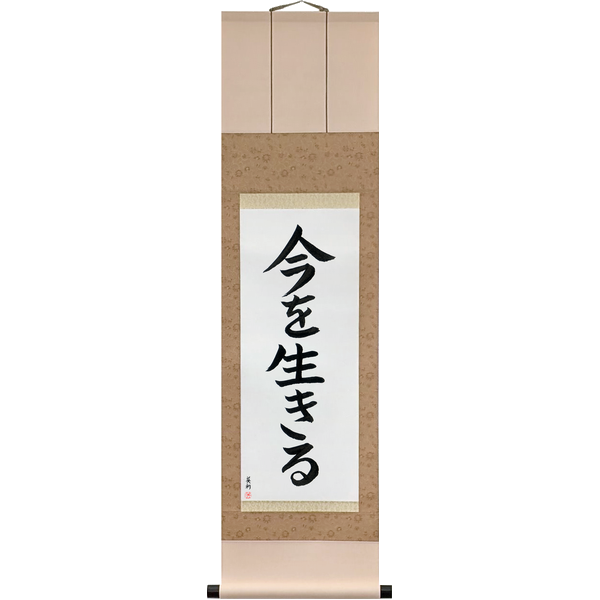
今を生きる ima wo ikiru Live the Moment
今を生きる (ima wo ikiru), live the now, is the Japanese title of the 1989 film Dead Poets Society, いまを生きる, written in kanji; the title renders Horace's carpe diem by way of the English live the moment. The four characters were Japanese before the film: a religious book of 1936 used them for the Buddhist now.
Abstract
今を生きる, live the now, is the Japanese title of the 1989 film Dead Poets Society, いまを生きる, written in kanji; the title renders the English live the moment, which is Horace's carpe diem in the idiom of the 1980s. The four characters were Japanese before the film: a religious book of 1936 uses them for the Buddhist now.
Overview
The sense. Horace's carpe diem by way of the English live the moment and a film title, in four characters a religious writer had used in 1936 for a different reason.
The words. 今 ima, now; 生きる ikiru, to live; を makes the now the thing lived. The words are ordinary.
The text in English. Live the moment is the English the film's title renders.
The historical record
23 BC, 1936, 1989. Carpe diem and いまを生きる. Horace's eleventh ode tells Leuconoe not to ask what end the gods have given, to strain the wine and cut long hope to the short space, and ends dum loquimur, fugerit invida aetas: carpe diem, quam minimum credula postero, while we speak, envious time has fled: pluck the day, trusting the next as little as you may, where carpe is the verb for picking fruit [1]. The English live the moment is the ode's advice in the idiom of the 1980s, and Dead Poets Society (1989) built a plot on it; its Japanese title is いまを生きる, rendered in kana [2]. The four characters were Japanese before the film, and for another reason: a 1936 religious book expounding the teaching of 実相 says 實相の世界は今を生きる世界だ。今といふても今といふうちに過去になつて居るその今を生きる世界だ, the world of true aspect is a world that lives the now, the now that is already past even as one says "now" [3]. Not Horace and not the film; the same words from a Buddhist direction.
Today. What a rendering must keep is the imperative of Horace without the wine.
A reading
Horace's advice by way of an English idiom and a film title, in four characters a 1936 religious writer had already used for the Buddhist now. The 1936 use is not Horace and not the film; it is the same words from a Buddhist direction, and it is the older of the two.
References
- Horace, Odes, 1.11, at the Latin Library. https://www.thelatinlibrary.com/horace/carm1.shtml
- 「いまを生きる」, Japanese Wikipedia. https://ja.wikipedia.org/wiki/いまを生きる
- 辻村楠造, 皇国大日本, 1936, scan 14. https://dl.ndl.go.jp/pid/1092528/1/14