

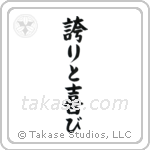
誇りと喜び hokori to yorokobi Pride and Joy
誇りと喜び (hokori to yorokobi), pride and joy, is two everyday Japanese nouns joined by and. The pair, in one order or the other, is in the National Diet Library's full text by 1899, of a teacher's feeling for grown pupils. This study follows it through Tanizaki to the one page where it names a person, a Wordsworth of 1927.
Abstract
誇りと喜び, hokori to yorokobi, pride and joy, is two everyday Japanese nouns joined by と, and; no dictionary at kotobank and no JMdict entry has the pair, which says what its words say. Both nouns are old: the 精選版日本国語大辞典 first cites 喜び, gladness, from a glossed sutra of about 850, and the noun 誇り, which it first cites from a novel of 1910–11, is printed in 1880 as presumption, in an edition of a letter of Nichiren's where modern editions read another word, and in 1893 as honor. The pair's oldest dated witness in the National Diet Library's full text, searched oldest first, is 喜びと誇り in a book of 1899 on the character of teachers, who look on grown pupils as a father looks on his child; 誇りと喜び follows in 1908, and Tanizaki gave the pair twice to a conqueror, in 刺青 (1910) and 金と銀 (1918). In the Japanese witnesses read here the pair names feelings, apart from a translated anthem title that names a homeland, and the one page where it names a person is a translation, a Japanese Wordsworth of 1927, where a Son, his joy and pride becomes 彼の喜びと誇りであつた息子.
Overview
The sense. Pride and joy, two feelings named together: pride, the sense of honor one takes in something, and gladness. No dictionary at kotobank has an entry for 誇りと喜び and JMdict has none, so the pair is read from its words [1][2][3]. デジタル大辞泉 誇り: 誇ること。名誉に感じること。また、その心, being proud; feeling something as an honor; and that feeling, with 一家の誇り, the pride of a family [1]. デジタル大辞泉 喜び, its first sense: よろこぶこと。うれしく思うこと, rejoicing; feeling glad, opposed to 悲しみ, sorrow [2]. と to joins nouns: and.
The words. 誇り hokori is the noun of the verb 誇る, the 精選版日本国語大辞典 says, and it defines it 名誉に思うこと。自慢すること。また、その心, taking something as an honor; boasting; and that feeling. Its first citation is Shimazaki Tōson's novel 家 (1910–11), where the word is written 矜持 and read ホコリ [1]. The verb is old: the same dictionary's first citation for 誇る is the 日本書紀 of 720, a man proud of his archery [4]. The noun is older in print than the dictionary's citation, as the historical record shows. 喜び yorokobi is the noun of 喜ぶ; the 精選版日本国語大辞典's first sense is 快く思うこと。心にうれしさを感じること, feeling pleased; feeling gladness in the heart, first cited from a glossed copy of the 金剛般若経集験記 of about 850 and from the 源氏物語, and its fourth sense is a birth, 出産という慶事, first cited from the Jesuits' Japanese-Portuguese dictionary of 1603–04 [2].
The text in English. Pride and joy and 誇りと喜び are the same two nouns in the same order. English has made pride and joy an idiom: the Cambridge dictionary defines it as a person or thing that gives someone great joy and satisfaction [5]. No JMdict entry is glossed pride and joy [3].
The historical record
1880. Nichiren's letter, as an edition printed it. The edition of Nichiren's writings printed at 久遠寺 in 1880 gives, in his 祈禱鈔: 人間界ヨリ死シテ多ク脩羅道ニ生ス。脩羅多勢ナレバ。誇リヲ成シテ必天ヲ犯ス, people die out of the human world and are born in great numbers among the asuras; and when the asuras are many, they grow proud and are sure to attack heaven [6]. The print glosses 誇 with ホコ, so the word is ほこり, and it is pride as presumption: the asuras swell with it and turn on the gods. The letter is dated 1272, and at this place the modern editions read おごり, arrogance, not ほこり [7]. So the ほこり is the 1880 edition's word, not shown to be Nichiren's; what the page shows is the noun in print in 1880, in the old sense of pride as a fault.
1893. The pride of England. In 竹越与三郎's life of Macaulay the noun names what a nation is proud of: 彼が如何に英國の誇りとせる大政治家ウ井リヤムテムプルを駁論せしかを見れば, if one sees how he refuted William Temple, the great statesman England counted its pride [8]. The noun alone could name a person one is proud of, as the デジタル大辞泉's 一家の誇り, the pride of a family, still does [1].
1899. 喜びと誇り, a teacher. 宗像逸郎's 『教育者之品性』, on the character of teachers, says of the pupils formed under the teachers' hands: されば我等は喜びと誇りとを以て、彼等を見ること猶ほ父が其の子を見るが如きものあり, and so we look on them with joy and pride, as a father looks on his child [9]. It is the oldest dated witness to the pair, in either order, in the National Diet Library's full text searched oldest first for this history.
1908. A dinner and a novel. Two witnesses of 1908 carry the pair: a medical journal's report of a dinner in honor of Robert Koch, giving Andrew Carnegie's speech in Japanese, in which Carnegie shares with his hearers the pride and joy of having such a hero among the Teutonic race [10]; and 斎藤無絃's novel 『天国』, in which a woman at a banquet feels a pride and joy past words, written 誇と喜 [11].
1910 and 1911. Tanizaki, 刺青. In 谷崎潤一郎's story of the tattooer, first printed in the magazine 新思潮 in 1910 [12], the girl is shown a painting called 肥料, Fertilizer: a young woman leaning on a cherry tree gazes at the corpses of scores of men fallen in heaps at her feet. The book of 1911 prints: 女の身邊を舞ひつつ凱歌をうたふ小鳥の群、女の瞳に溢れたる抑へ難き誇と歡びの色, a flock of small birds circling her, singing a song of triumph; in the woman's eyes, brimming, a color of pride and joy that will not be held down [13]. 誇 is glossed ほこり and 歡 よろこ. The collected-works text, as Aozora Bunko gives it, reads 誇りと歓び and has revised the sentence before [14].
1911. A soldier home. A one-year volunteer's memoir opens with his homecoming: 僕は男兒當然の義務を果したに過ぎぬと思ひ、此の過分の歡迎に對して心中聊か忸怩たるものもあつたが、それでも幾分の誇りと喜びとを禁じ得なかつたのである, I thought I had only done what a man must, and felt some embarrassment at the excessive welcome; and yet I could not keep down a certain pride and joy [15].
1913. A mother. 下田次郎's 『胎教』, on care before birth, promises the mother whose child is born sound: 滿足と共に、勝利の誇りと喜びとを感ぜずには居られますまい, with satisfaction, she cannot but feel the pride and joy of victory [16].
1918. Tanizaki again, 金と銀. In 金と銀 the painter 靑野 feels, with 世界を征服した王者のやうな誇りと喜びとで, a pride and joy like a king who has conquered the world, a strange unease and fear taking root deep in his swelling chest [17]. The same sentence is in the magazine 中央公論 in July 1918 [18].
1913 to 1921. The translators. In the library's full text the pair, in its several spellings, is frequent from 1913 in Japanese versions of Western books, beside Japanese writers' own use: in Wilde's サロメ (1913), Goethe's 我が生活より, Dichtung und Wahrheit (1914), Gorky's 懺悔 (1915) and a volume of Tolstoy (1917) [19][20][21][22]. Several pages of the same years pair 誇り instead with 喜悦, delight, which is another word. Wordsworth's joy and pride came into Japanese twice. The first is the Immortality Ode, But it will not be long / Ere this be thrown aside, / And with new joy and pride / The little Actor cons another part (1807) [23], which 畔上賢造's selection of 1915 renders 之は棄てられ、新たなる喜と誇を以て小俳優は他の節を復誦す [24]: the child's own feeling as he takes up a new part.
1927. A person, in a translation. The second is At the Grave of Burns, 1803: There, too, a Son, his joy and pride, / (Not three weeks past the Stripling died,) / Lies gathered to his Father's side, in print by 1842 [25]. 幡谷正雄's Wordsworth of 1927 renders it かしこにも亦、彼の喜びと誇りであつた息子が(彼が死んでから三週間も經てぬ內に)父の傍に横つてゐる, there too the son who was his joy and pride (not three weeks after he died) lies at his father's side [26]. Here the pair is the son, a person, and it keeps the English order, joy before pride. Of the Japanese pages read for this history, it is the one where the pair names a person.
2003. A law. The preamble of the 少子化社会対策基本法, the law of 2003 on measures against the falling birthrate, sets as its aim 子どもを生み、育てる者が真に誇りと喜びを感じることのできる社会を実現し, to bring about a society in which those who bear and raise children can truly feel pride and joy [27]. The statute keeps the pair a feeling, and keeps it in the family.
Titles from another language. The Estonian national anthem, Mu isamaa, mu õnn ja rõõm, is known in Japanese as 我が故国、我が誇りと喜び, my homeland, my pride and joy: the pair names the homeland, in a title rendered from the Estonian [28].
What is not a source. No author of the phrase is named in anything read here. The many pages that join 歓喜 or 歡喜, rejoicing, to 誇り (歡喜と誇り) are a different word, not this pair. The 1937 school-law digest that a first search returned for 誇りと喜び matched the two words on a page, not the phrase.
Today. In English pride and joy is the person or thing that gives the joy [5], and the poets used it both ways: Coleridge's Christabel (1816) has the dying mother pray that the babe for whom she died, / Might prove her dear lord's joy and pride! [29], a child, while Wordsworth's Ode has the feeling. In Japanese the 2003 statute has the feeling [27]. A rendering keeps both nouns, in that order; the と repeated, as in 喜びと誇りとを (1899), 誇りと喜びと (1911), 誇りと喜びとを (1913) and 誇りと喜びとで (1918), is the older written form, and a single と is today's.
A reading
誇りと喜び is plain Japanese, and its two nouns are older than the pair: 喜び from the ninth century, and 誇り in print by 1880 as presumption, where an edition of a letter of Nichiren's set it in place of おごり, and as honor by the 1890s. Joined, in the witnesses read here, they name what someone feels when a thing they formed, bore or won turns out well: a teacher before grown pupils, a soldier at his welcome, a mother at a sound birth, Tanizaki's two conquerors. English can set the pair on the one it is felt for, as Coleridge and Wordsworth did, and Japanese did so, in the pages read here, when it was translating them. I read 誇りと喜び as the feeling, not the beloved: said of a child, it says what the parent feels, and the English idiom's person stays in the English. Signed, 典.
Notes
Earliest is scoped. Oldest dated witness is a statement about the National Diet Library's full text, searched oldest first for this history in fourteen spellings of the pair; two undated items in that search carry 喜と誇. The dictionary's first citations are the 精選版日本国語大辞典's at kotobank; the full 日本国語大辞典 was not opened.
Nichiren's text. The words are quoted as the 1880 edition prints them. The modern edition read here, with its predecessor, prints おごり (をごり) where the 1880 edition prints 誇リ, and 戒を持たず, does not keep the precepts, in the sentence before [7]. The letter's autograph is reported lost, and the manuscript copies were not opened, so which reading the copies carry is not known here.
金と銀. In the library's copy of the 1918 book, 誇 sits under an ink blot and り is clear; the magazine printing of the same year reads 誇りと喜びとで in the library's text [18].
刺青. The 1911 book and the collected text differ in this passage: 誇と歡び against 誇りと歓び, and 算を亂して斃れたる幾十の男の屍骸, the corpses of scores of men fallen in disorder, against the collected text's 足下に累々と斃れて居る多くの男たちの屍骸 [13][14]. The first printing in 新思潮 was not opened.
胎教. The book prints a comma after 共に that the library's text layer drops.
Wordsworth. The poem on Burns is dated 1803 at its foot in the translation of 1927; in print by 1842 is the earliest printing the Internet Archive's full text returned, a newspaper of 6 October 1842. The Ode is quoted from its first edition, Poems, in Two Volumes (1807).
Sources not seen
The first printings of 刺青 (新思潮, 1910) and of Tōson's 家 (1910–11, for the ruby ホコリ).
The 昭和定本 edition and the manuscript copies of Nichiren's 祈禱鈔, for where the 1880 edition took ほこり.
The pages of the 1908 medical journal and of 『天国』, and the 1918 中央公論, which the library opens only in its own reading rooms or not at all to scripts.
The full 日本国語大辞典, for its first citation of the noun 誇り.
The Japanese texts under the English translations of the 源氏物語 and of kabuki that use pride and joy of a person.
The English idiom's own first attestation.
A reader with access to any of these is invited to write to Takase Studios at Tim@Takase.com.
References
- 「誇り」, デジタル大辞泉・精選版日本国語大辞典, at kotobank. https://kotobank.jp/word/誇り
- 「喜び」, デジタル大辞泉・精選版日本国語大辞典, at kotobank. https://kotobank.jp/word/喜び
- JMdict (EDRDG), searched for 誇りと喜び and pride and joy, at jisho. https://jisho.org/search/pride%20and%20joy
- 「誇る」, デジタル大辞泉・精選版日本国語大辞典, at kotobank. https://kotobank.jp/word/誇る
- "pride and joy", Cambridge Dictionary. https://dictionary.cambridge.org/dictionary/english/pride-and-joy
- 日明 編, 小川孝栄 校, 『高祖遺文録』, 久遠寺, 1880, 祈禱鈔, scan 4. https://dl.ndl.go.jp/pid/823618/1/4
- 祈禱抄, 『日蓮大聖人御書全集 新版』, 創価学会, p. 584 (headed 文永9年, 1272), at the publisher's full-text search; the earlier edition, p. 1345, reads をごり. https://goshoshinpan-search.sokanet.jp/name?page=584
- 竹越与三郎, 『マコウレー』, 1893, scan 12. https://dl.ndl.go.jp/pid/782465/1/12
- 宗像逸郎, 『教育者之品性』, 1899, scan 176. https://dl.ndl.go.jp/pid/809721/1/176
- 『醫學中央雜誌』, July 1908, snippet view, National Diet Library. https://dl.ndl.go.jp/pid/1733673
- 斎藤無絃, 『天国』, 日高有倫堂, 1908, snippet view, National Diet Library. https://dl.ndl.go.jp/pid/887373
- 「刺青」, デジタル大辞泉・精選版日本国語大辞典, at kotobank. https://kotobank.jp/word/刺青
- 谷崎潤一郎, 『刺青』, 籾山書店, 1911, scan 10. https://dl.ndl.go.jp/pid/886595/1/10
- 谷崎潤一郎, 「刺青」, Aozora Bunko, card 56641 (底本 潤一郎ラビリンス I; 初出 新思潮 1910). https://www.aozora.gr.jp/cards/001383/files/56641_59496.html
- 水暮, 『奮闘記』, 厚生堂, 1911, printed p. 1, scan 4. https://dl.ndl.go.jp/pid/888121/1/4
- 下田次郎, 『胎教』, 実業之日本社, 1913, scan 92. https://dl.ndl.go.jp/pid/937405/1/92
- 谷崎潤一郎, 『金と銀』, 春陽堂, 1918, scan 27. https://dl.ndl.go.jp/pid/959424/1/27
- 『中央公論』, 15 July 1918, snippet view, National Diet Library. https://dl.ndl.go.jp/pid/10232036
- ワイルド 著, 若月紫蘭 訳, 『サロメ』, 現代社, 1913, snippet view, National Diet Library. https://dl.ndl.go.jp/pid/915436
- ゲエテ 著, 生田長江 訳, 『我が生活より : 所作と真実』, 内田老鶴圃, 1914, snippet view, National Diet Library. https://dl.ndl.go.jp/pid/951389
- ゴリキイ 著, 鈴木三重吉 訳, 『懺悔』, 博文館, 1915, snippet view, National Diet Library. https://dl.ndl.go.jp/pid/950189
- 『トルストイ叢書』, 新潮社, 1917, snippet view, National Diet Library. https://dl.ndl.go.jp/pid/1087986
- William Wordsworth, "Ode" (Intimations of Immortality), Poems, in Two Volumes, vol. 2, 1807, at Wikisource. https://en.wikisource.org/wiki/Poems,in_Two_Volumes(Wordsworth,_1807)/Volume_2/Ode:_Intimations_of_Immortality_from_Recollections_of_Early_Childhood
- 畔上賢造 訳註, 『ウヲルヅヲス詩集』, 聖書研究社, 1915, scan 93. https://dl.ndl.go.jp/pid/954124/1/93
- William Wordsworth, "At the Grave of Burns, 1803", in the National Anti-Slavery Standard, 6 October 1842, at the Internet Archive. https://archive.org/details/per_national-anti-slavery-standard_national-anti-slavery-standard_1842-10-06_3_18
- 幡谷正雄 譯, 『ワアヅワス詩集』, 新潮社, 1927, scan 43. https://dl.ndl.go.jp/pid/1085998/1/43
- 少子化社会対策基本法 (平成十五年法律第百三十三号), preamble, at e-Gov. https://laws.e-gov.go.jp/law/415AC1000000133
- 「我が故国、我が誇りと喜び」, Japanese Wikipedia. https://ja.wikipedia.org/wiki/我が故国、我が誇りと喜び
- Samuel Taylor Coleridge, Christabel, in Christabel; Kubla Khan; The Pains of Sleep, 1816, at Wikisource. https://en.wikisource.org/wiki/Christabel;Kubla_Khan;_The_Pains_of_Sleep(1816)/Christabel