

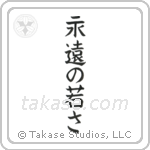
永遠の若さ eien no wakasa Forever Young
永遠の若さ (eien no wakasa), eternal youth, joins the Japanese noun for eternity to youth. It is a translators' phrase, reached for from 1912 to 1921 for Plato, Rodin and Apollo, and a beauty manual had it by 1928. This study sets it beside the English Forever Young, a blessing where the Japanese is a noun.
Abstract
永遠の若さ, eternal youth, joins 永遠, eien, the Japanese noun for eternity, to 若さ, youth. The dictionaries first cite 永遠 from Nakamura Masanao's 1871 translation of Samuel Smiles, though the word is older in Japanese, and the phrase has a real Japanese print life before the war: translators of Eucken and Rodin reached for it, a poet set it at a dawn, a retelling of the Greek myths gave it to Apollo, and by 1928 a beauty manual borrowed it.
Overview
The sense. Standard written Japanese. 永遠 eien is the Japanese noun for eternity and the adverb for forever: the dictionaries' first citation is Nakamura Masanao's 1871 rendering of Samuel Smiles, and its second sense, eternity as what stands outside time, enters with the Tokyo philosophers' vocabulary of 1881. 永遠の若さ, eternal youth, is the noun phrase, 永遠 and 若さ joined by の, and it has a literary life of its own in Japanese, in translations of Eucken and Rodin and in a poem on Apollo and the dying Hyacinthus.
The words. 永遠 eien. デジタル大辞泉: いつまでも果てしなく続くこと。時間を超えて存在すること, continuing without end; existing beyond time, with the examples 永遠に残る名曲, a song that will last forever, and 永遠のスター. 精選版日本国語大辞典 gives the same first sense with its synonyms 永久, とこしえ, 永劫, and dates it: 永遠無疆の福を望むことなり, to hope for a blessedness without end, in 西国立志編 (1870–71), Nakamura Masanao's translation of Self-Help; the second sense, existence outside time, is cited from the 哲学字彙 of 1881 as the entry Eternity 永遠; the dictionary adds that the compound is older in Chinese, in the 書経 [1]. 若い wakai, young, is in the 日本書紀 of 720, and 若さ is its noun [2].
The text in English. 永遠 is the noun eternity and, with に, the adverb forever; here it is the noun, and 永遠の若さ is eternal youth. The bilingual dictionary gives 永遠 as eternity; perpetuity; permanence; immortality and no more [3]. Forever young is a different thing in English, the blessing may you stay forever young; the noun is what the Japanese sources use.
The historical record
1912 to 1921. 永遠の若さ, in translation and in verse. The phrase enters the library in Abe Yoshishige's translation of Rudolf Eucken, where it is what Plato's forms have: 個々物の一切生滅に對して、永遠の若さを以て持續し, against the coming and going of every particular thing they persist with an eternal youth [4]. Two years later it is Rodin's, in Kimura Shōhachi's rendering of the conversations with Gsell, and it has turned toward the body: 永遠の若さと美とに戀着し、すげなくも外を蔽ふ肉體の恥づべき醜さに目を落してゐる無智なる人の不斷の惱みである, the constant torment of the ignorant, who are in love with eternal youth and beauty and cast down their eyes at the shameful ugliness of the flesh that covers them [5]. The poet Kawaji Ryūkō sets it at a dawn: 曉が目覺めた、曉が目覺めた。…そこには永遠の若さ, the dawn has woken, the dawn has woken … and there, eternal youth [6]. And Nakajima Kotō's Greek myths give it to Apollo over the dying Hyacinthus: 又お前の體は、花になつて、いつまでも若々しい春を、永遠の若さを、…久遠の生命を、見る人の心に語るだらう, and your body will become a flower and speak forever, to the heart of whoever looks, of youthful spring, of eternal youth, of life without end. By 1921 the phrase can carry a whole mythology [7]. And by 1928 it is a running head in a beauty manual, 『洋髪の結ひ方と美容の秘訣』, 永遠の若さ秘事, the secrets of eternal youth, as the National Diet Library's full-text search returns it [8].
What is not a source. 永遠の若さ is a translator's phrase for a European idea, eternal youth, and the Japanese pages that carry it are translations and a myth retold. It has no author.
Today. Forever Young has a named English life: Bob Dylan's song on Planet Waves, released in January 1974, written, he said, in Tucson thinking of one of his sons and not wanting to be too sentimental; and Alphaville's synth-pop single of 1984, lyrics by Marian Gold, which is the one most listeners born after 1970 will hear [9][10]. 永遠の若さ is the noun phrase, eternal youth, not the blessing.
A reading
永遠の若さ is the richest of the phrases built on 永遠: the one Japanese translators reached for when Plato's forms, Rodin's models and Apollo's grief each needed a word for a youth that does not end. 永遠 was made for eternity and it has not lost that size, and here it keeps it.
References
- 「永遠」, デジタル大辞泉・精選版日本国語大辞典, at kotobank. https://kotobank.jp/word/永遠
- 「若い」, デジタル大辞泉・精選版日本国語大辞典, at kotobank. https://kotobank.jp/word/若い
- JMdict (EDRDG), 「永遠」, at jisho. https://jisho.org/word/永遠
- オイケン, 『大思想家の人生観』, 安倍能成訳, 東亜堂書房, 1912, scan 35. https://dl.ndl.go.jp/pid/949301/1/35
- 『ロダンの芸術観』, 木村荘八訳, 洛陽堂, 1914, scan 41. https://dl.ndl.go.jp/pid/951911/1/41
- 川路柳虹, 『勝利』, 曙光詩社, 1918, scan 35. https://dl.ndl.go.jp/pid/907732/1/35
- 中島孤島, 『ギリシヤ神話』, 早稲田大学出版部, 1921, scan 78. https://dl.ndl.go.jp/pid/963337/1/78
- National Diet Library Digital Collections, next-generation full-text search on 永遠の若さ, the running head 永遠の若さ秘事 in 東京洋髪研究会, 『洋髪の結ひ方と美容の秘訣』, 1928. https://lab.ndl.go.jp/dl/
- "Forever Young (Bob Dylan song)", English Wikipedia. https://en.wikipedia.org/wiki/Forever_Young_(Bob_Dylan_song)
- "Forever Young (Alphaville song)", English Wikipedia. https://en.wikipedia.org/wiki/Forever_Young_(Alphaville_song)