

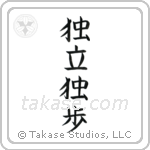
独立独歩 dokuritsu doppo Self-Reliant
独立独歩 (dokuritsu doppo) means acting on what you believe without leaning on others. Its oldest use in the Diet Library's full text, from 1876, is a child learning to stand and walk. This study follows it through Zen lecturers, Fukuzawa's autobiography and the dictionaries that made it self-reliant.
Abstract
独立独歩, dokuritsu doppo, is acting on what one believes without leaning on others, and, in a second sense, having no equal. It joins two words that are old in Chinese, 独立, standing alone, and 独歩, walking alone, which the Chinese corpora searched for this study never join, and its oldest use among the dated books of the National Diet Library's full text is a health manual of 1876, on a child who learns to stand and walk on its own. Translators of Western books used it for independence by 1879, Zen lecturers of 1888 and 1890 for the canon's peerless, an editorial of 1895 for the nation, and Fukuzawa Yukichi for himself in his autobiography of 1899, the national dictionary's first citation. The English came through the dictionaries, as idioms in 1915 and as self-reliance by 1939.
Overview
The sense. Of the dictionaries at kotobank, デジタル大辞泉 gives two senses: 他人にたよらず、自分の信じるところに従って行動すること, acting on what one believes without leaning on others, with the example 独立独歩の精神, the spirit of dokuritsu doppo; and 他に並ぶもののないこと, having nothing to equal it [1]. The 精選版 日本国語大辞典 has the same two, but gives the first only as a pointer to 独立独行, and words the second as having a distinct character of one's own, so that it cannot be treated like the rest [1]. 四字熟語を知る辞典 says thinking and judging for oneself, without leaning on others, and walking the road one believes in [1]. jitenon has its own wording, walking the road one believes in by one's own strength alone, without borrowing anyone else's, and calls it a four-character idiom of about level 5 of the kanji proficiency test (漢検5級相当) [2]. The 大辞泉's synonyms for the first sense include 独り立ち, standing on one's own, 自立, 独力, 孤軍奮闘, fighting alone, and 一匹狼, lone wolf [1].
The words. 独立 (dokuritsu) is standing alone. The 字通 at kotobank quotes Laozi on the Way that stands alone and does not change, 獨立して改めず, and the national dictionary cites the Book of Changes for the sense of acting by one's own strength; its first Japanese use there is a text of about 1716, 学者は独立・特行、何をも頼むことはなし, a scholar stands alone and acts apart, relying on nothing [3]. The national dictionary also notes that the Meiji dictionaries of Chinese words give both ドクリツ and ドクリュウ as its reading until 1887, and only ドクリツ from 1888 [3]. 独歩 (doppo) is walking alone, and the national dictionary gives it three senses: to walk by oneself, as Bashō did in 1687, あめつちに独歩していでぬ, I went out walking alone under heaven and earth [4]; to have no peer, as the Chinese preface to the Kokinshū says of the poet Hitomaro, 獨步古今之閒, he walked alone between past and present [5]; and to act on one's own [4]. The same entry says the old dictionaries split between どくほ and どっぽ for its reading, and that the reading is not clear [4]. The compound's first sense stands on the third of these senses, and its second on the second.
The text in English. JMdict gives self-reliance; self-help [6]. Kenkyūsha's 新和英中辞典, as Weblio carries it, gives self-reliance [7]. The house's title, Self-Reliant, is the first sense. No English word in these entries carries the second.
The historical record
Not Chinese, and two cousins. The four characters in this order are not in the Chinese Text Project's pre-Qin, Han or post-Han corpora, in the CBETA Buddhist canon, or in the Chinese Wikisource [8]. The Chinese books have the parts, and two cousins. The Book of Rites praises the scholar who 特立獨行, stands apart and goes alone [9]. And 獨立獨行, stands alone and goes alone, is in Ming prose: a passage in the collected works of 温純 on the censors says their office 獨立獨行寡合無侣, stands alone and goes alone, joins few and has no companion [10]; and the imperial encyclopedia 古今圖書集成 praises a man of settled purpose who 獨立獨行,一意而不變, stands alone and goes alone, of one mind and unchanging [11].
1530 to 1876, the older sibling in Japan. The national dictionary's first citation for 独立独行 is a commentary on Zhuangzi, in a manuscript by 清原国賢 that it dates to 1530, explaining Zhuangzi's odd man, odd among men and matched with Heaven: 畸は不耦ななりぞ。独立独行したなりぞ。人に耦せぬぞ, odd means unpaired; he stands alone and goes alone; he pairs with no one, as the dictionary quotes it [12]. By 1876 a Meiji dictionary of Chinese words heads it among its four-character entries: 獨立獨行, ドクリツドクカウ, 人アテニセズヒトリダチデコトヲスル, to do things standing on one's own, counting on nobody [13].
1876, a child learning to walk. The oldest use of the walk form among the dated books of the National Diet Library's full text is the plainest. A book on health of 1876, 養生のすゝめ, says that a child, out of swaddling, learns with a prop to stand and take a step, 終は獨立獨歩する, and at last stands and walks on its own, sooner or later as the child is strong or weak, at about a year and eight months to the end of the second year [14]. The four characters carry two rubies, どくりつどつぽ on the right and ヒトリダチアルキ, standing alone, walking, on the left [14].
1879 and 1880, the translators. Within four years the four characters were in translations of Western books. In 1879 a Japanese translation of a book on Western life, 西洋穴探, says of young men and women there that they may go to dances and the theater, and that 其獨立獨步毫モ長者ニ異ナル所ナシ, in their independence they differ not at all from grown-ups [15]. In 1880 the translator of Bluntschli's 国会汎論 writes of private rights that 他ニ關係ヲ有セス獨立獨步ノ性質ヲ佩フル, have no bearing on others and are of an independent nature: the more they are so, the less the state should interfere [16]. He sets a circle beside each of the four characters, marking them out [16].
1888 and 1890, the Zen lecturers. Twelve years after the child, the four characters are in the lecture-commentaries of Zen teachers, as their plain Japanese for the canon's peerless. 白鳥鼎三's commentary of 1888 on Hongzhi's verses glosses the verse's 獨步寰中, walking alone through the world [17], as 一天下ニ獨立獨步シテ一人ノ肩ヲ並ブル人ナキ明了々ノ境界, the bright and clear state of one who stands and walks alone in all the world, with not one person to stand shoulder to shoulder with him [18]. 本高's commentary of 1890 on the Blue Cliff Record comes to Deshan, who looked round the hall, said no, no, and walked out, and to the capping phrase on him, 可殺氣衝天, what spirit, reaching to heaven [19]. It says the way he goes out with his no, no is a tremendous force, like a tiger with its whiskers bristling, that not even the buddhas and patriarchs can come near him, and that he is 獨立獨步ヂヤ, standing and walking alone [20]. Both are the dictionaries' second sense, having no equal.
1892 to 1898, Meiji prose. In 1892 the educator 巌本善治 wrote that under the sage kings Yao and Shun the people did not know there was a sovereign above them, and 万人皆な獨立獨步すると思ひ, everyone thought he stood and walked on his own, so that the realm was transformed without anyone acting; true education, he says, is like that [21]. A budō manual of 1895 says that a man in the world must stand and walk alone, with a line it credits to Saigō Takamori (南洲), 目前毀譽眞耶僞, the praise and blame before my eyes, are they true or false?, and one it credits to Sakuma Shōzan (象山), 謗者任汝謗嗤者任汝嗤, let the slanderers slander, let the mockers mock; without that he is shaken by others' provocations and thrown into confusion by praise and blame [22]. An anthology of 1898 tells a story of Kido Takayoshi's youth, when he was still Katsura Kogorō, a poor student of the Chōshū domain, taking lessons in jōruri chanting. His teacher told him his voice was out of the ordinary and could make him a professional, and when Kido gave the lessons up the teacher protested: 今一と息勉むれば決定して獨立獨步するを得るの見込の有るに, one more effort and you could surely have stood on your own [23].
1895, the nation. On 14 May 1895, after the peace with China, an editorial titled 平和條約の發表, The publication of the peace treaty, took up the advice of Russia, Germany and France under which Japan was to give the Liaodong peninsula back to China, and urged that 吾々日本國民, we the Japanese people, accept the present state of things without the least wavering and give themselves to nourishing the roots of the nation's strength, so that one day, in an emergency in the East, they might 獨立獨步して他の容喙を許さゞる, stand and walk alone and allow no one else a say [24]. It is printed among Fukuzawa's writings of 1895 in the supplement to his collected works, published in 1934 [24]. A political magazine had already written in 1886 of bringing Japan to a position where it stood and walked alone [25].
1899, Fukuzawa's autobiography. Fukuzawa used the word twice of himself in his autobiography, 福翁自伝, published in June 1899 [26]. Once he says he never thought to ask anyone's advice: 貧富苦樂共に獨立獨步, rich or poor, in hardship or ease, I stood and walked alone, and never whined that he was in trouble. The second is the sentence the national dictionary cites: a nation's independence springs from its people's independent spirit, and he resolved to be the example himself, 人間萬事無頓着と覺悟を定めて唯獨立獨步と安心決定したから政府に依りすがる氣もない役人達に賴む氣もない, I made up my mind to be indifferent to everything, settled myself on standing and walking alone, and so had no wish to cling to the government and none to lean on officials [26][1]. The first edition rubies the word two ways: どくりつどくほ on page 464, and どくりつどつぽ on page 512, the last kana a ぽ so far as the scan shows [26]. The 独歩 of Hepburn's dictionary of 1888 is ドクホ, and Brinkley's is どっぽ [27][28].
1917, a dictionary heads it. Among the Diet Library's books to 1892, read oldest first, no dictionary heads the four characters; the two that seem to, of 1874 and 1875, print 獨立 and 獨歩 as separate words, one above the other, and one of 1881 could not be opened. The 大字典 of 1917 heads both forms. It defines 〔獨立獨行〕 as 他に屈從せず又支配せられずに、自己の所信を遂行すること, carrying out what one believes without submitting to others or being ruled by them, and gives 〔獨立獨步〕 as 前條に同じ, the same as the entry before [29].
The 1900s to the 1940s, on one library's count. This study keeps a mirror of 10,540 books from the Diet Library's digitized prewar collection, chosen for its own research, so its counts are a view and not a sample. In that mirror the walk form is in more books each decade from the 1900s to the 1930s, 22, 96, 128 and 166, and the go form is in more books than the walk form in every decade to the 1940s, 187 against 166 in the 1930s [30]. Fukuzawa's own volumes there use 獨立獨行 about twenty-two times in thirteen books, and the walk form five times in four [30].
1947 to today. The four-character dictionary quotes Sakaguchi Ango in 1947 and Ariyoshi Sawako in 1972 [1], and a book of 1948 uses the new spelling of Lincoln's rise, 自学自習、独立独歩の経歴, a career of teaching himself and standing on his own [31]. The dictionaries now disagree on which form heads: the 大辞泉 heads 独立独歩 and sends 独立独行 to it, and the national dictionary, like the 大字典 of 1917, does the reverse [1][12]. Japanese uses the word as praise. A junior high school in Gamagōri has it as its motto, a 2002 episode of テレビ東京's 『テレビ・人間発見』 on the calligrapher 榊莫山 took it as its title, and 103 Japanese Wikipedia articles carry it [32].
The word in English
1888 and 1907, Hepburn and Brinkley. Hepburn's dictionary, in its fourth edition of 1888, has no entry for the four characters. It gives DOPPO, ドクホ, 獨歩, as To walk out alone; to take a walk alone; to be alone in talent or ability; above all others; under INDEPENDENT it gives Dokuryū, hitori-dachi, jiritsu na, dokuritsu na; and under SELF-RELIANT, Mizukara tanomu, mizukara yoru, hito ate ni senu, to rely on oneself, to lean on oneself, to count on nobody (my glosses) [27]. Brinkley's dictionary of 1896, read in its twelfth printing of 1907, gives doppo three senses, going or walking alone, independence and preëminence, with an example glossed one excelled by none in the world [28].
1915 and 1918, the idioms. The English came to the word first as idiom. Saitō Hidesaburō's Idiomological English-Japanese Dictionary of 1915 renders To stand on one's own bottom as 獨立獨歩する, To fight for one's own hand as 一本立ち(獨立獨步), and Let each man look out for himself as 各自(他の世話に成らずに)獨立獨步せよ [33]. Takenobu's Japanese-English dictionary of 1918 turns them round: 獨立獨歩する, to stand on one's own bottom; fight for one's own hand [34].
1939 to 1946, self-reliance and self-sufficient. The Supplement to the Vaccaris' Complete Course of Japanese Conversation-Grammar, a book first published in 1937, gives self-sufficient as dokuritsu doppo in an undated printing from before 1946, with the sentence Musuko wa kitto dokuritsu-doppo no otoko ni naru deshō, the son will surely become a man who stands on his own (my gloss) [35]. Kenkyūsha's New Japanese-English Dictionary, in its printing of 1939, heads dokuritsu-dokkō (獨立獨行) with ~-doppo (獨立獨步) beside it, Independence; self-reliance; self-help, and for the verb be self-reliant; stand on one's own legs; look out for oneself … fight for one's own hand; paddle one's own canoe; sail on one's own bottom [36]. It is the earliest self-reliance set against the word in the books read for this study. Rose-Innes's Beginners' Dictionary of Chinese-Japanese Characters, in its American edition of 1944, gives Dokuritsu-dokko, the go form, as self-reliance [37].
The English word. Self-reliance is older than Emerson's essay. It is in Letitia Landon's novel Francesca Carrara of 1834 [38], and Emerson made it the title of his essay of 1841, the essay of Trust thyself [39].
A reading
The word was made in Japan from two Chinese words, and its oldest use in the Diet Library's full text is the plainest one: a child that lets go of the prop and stands and walks. Within a few years the translators of Western books used it for what they were translating, the independence of young people and of private rights, and Bluntschli's translator marked it as a term. The Zen lecturers came later, in 1888 and 1890, and used the same four characters for what the old verses meant by a man with no equal. That is the dictionaries' second sense, and on these instruments it is the younger of the two, not the older. An editorial of 1895 said it of the nation, and in 1899 Fukuzawa said it of himself, in a book that rubies its second half two ways. The English came through the dictionaries, first as idioms, to stand on one's own bottom, and then as self-reliance, a word that was already old in English. Self-reliant says the first sense exactly. A buyer who means I stand on my own has the word, and its oldest witness is a child learning to walk. A buyer who means I have no equal has the second sense, and the English title does not carry it.
Notes
Dokuritsu doppo, the reading of the 1876 and 1898 rubies and of both dictionaries' headwords, is the reading standard [1][14][23]. Fukuzawa's first edition also rubies it dokuritsu dokuho once [26].
References
- 「独立独歩」, デジタル大辞泉 · 精選版日本国語大辞典 · 四字熟語を知る辞典, at kotobank. https://kotobank.jp/word/独立独歩
- 「独立独歩」, 四字熟語辞典オンライン (jitenon). https://yoji.jitenon.jp/yojic/1325
- 「独立」, 精選版日本国語大辞典 (with its 語誌) · 字通 (citing 老子 25), at kotobank. https://kotobank.jp/word/独立
- 「独歩」, 精選版日本国語大辞典, at kotobank. https://kotobank.jp/word/独歩
- 古今和歌集 真名序, 905–914, at Japanese Wikisource. https://ja.wikisource.org/wiki/古今和歌集真名序
- JMdict (EDRDG), 「独立独歩」, at jisho.org. https://jisho.org/api/v1/search/words?keyword=%E7%8B%AC%E7%AB%8B%E7%8B%AC%E6%AD%A9
- 研究社 新和英中辞典, 「独立独歩」, at Weblio. https://ejje.weblio.jp/content/独立独歩
- Searches for 獨立獨步: the Chinese Text Project, pre-Qin and Han and post-Han corpora (0 in both); CBETA (0); the Chinese Wikisource full text (0). https://ctext.org/pre-qin-and-han?searchu=獨立獨步 · https://ctext.org/post-han?searchu=獨立獨步 · https://cbdata.dila.edu.tw/stable/search?q=%E7%8D%A8%E7%AB%8B%E7%8D%A8%E6%AD%A5 · https://zh.wikisource.org/w/index.php?search=%22%E7%8D%A8%E7%AB%8B%E7%8D%A8%E6%AD%A5%22&ns0=1&fulltext=1
- 禮記, 儒行, at the Chinese Text Project. https://ctext.org/liji/ru-xing
- 温純, 温恭毅集 (四庫全書本), 卷5, at Chinese Wikisource. https://zh.wikisource.org/wiki/温恭毅集_(四庫全書本)/卷05
- 欽定古今圖書集成, 經濟彙編, 選舉典, 卷24, at Chinese Wikisource. https://zh.wikisource.org/wiki/欽定古今圖書集成/經濟彙編/選舉典/第024卷
- 「独立独行」, 精選版日本国語大辞典 (citing 清原国賢書写本 荘子抄, 1530) · デジタル大辞泉, at kotobank. https://kotobank.jp/word/独立独行
- 長橋間右衛門 著, 大谷淳蔵 補, 増補漢語字解大全, 松田幸助, 明治9 (1876), scan 41. https://dl.ndl.go.jp/pid/863223/1/41
- 浦谷義春, 養生のすゝめ, 下, 騰采閣ほか, 明治9 (1876), scan 18. https://dl.ndl.go.jp/pid/837277/1/18
- キルワン 著, 加藤政之助 訳, 西洋穴探, 2編, 慶応義塾出版社, 明治12 (1879), scan 25, p. 39. https://dl.ndl.go.jp/pid/767915/1/25
- ブルンチュリー 著, 石津可輔 訳, 国会汎論, 下巻, 文会舎, 1880, scan 53. https://dl.ndl.go.jp/pid/1079344/1/53
- 從容録, the verse with 獨步寰中, Taishō 48, no. 2004, 251a17–18, at CBETA. https://cbdata.dila.edu.tw/stable/lines?linehead=T48n2004_p0251a17
- 白鳥鼎三, 宏智禅師頌古接觜録, 乾, 文光堂, 明治21 (1888), scan 58, p. 52. https://dl.ndl.go.jp/pid/823560/1/58
- 碧巌録, case 4, 德山挾複子, with the capping phrase 可殺氣衝天, Taishō 48, no. 2003, 143b06, at CBETA. https://cbdata.dila.edu.tw/stable/lines?linehead=T48n2003_p0143b06
- 本高, 碧巌録耳林鈔, 鴻盟社, 明治23 (1890), scan 15. https://dl.ndl.go.jp/pid/823482/1/15
- 巌本善治, 吾党之女子教育, 明治女学校, 明治25 (1892), scan 5, p. 3. https://dl.ndl.go.jp/pid/808102/1/5
- 隈元実道, 武道教範, 武揚館, 明治28 (1895), scan 25, pp. 10–11. https://dl.ndl.go.jp/pid/1086788/1/25
- 洒々道人 編, 洒落文庫, 鴻盟社, 明治31 (1898), scan 86, pp. 156–157. https://dl.ndl.go.jp/pid/882521/1/86
- 福沢全集, 続 第4巻, 慶応義塾 編, 岩波書店, 1934, 平和條約の發表 (明治二十八年五月十四日), scans 205–206, pp. 368–370. https://dl.ndl.go.jp/pid/1078065/1/205 · https://dl.ndl.go.jp/pid/1078065/1/206
- 東京輿論新誌, no. 245, 嚶鳴社, June 1886, snippet view, National Diet Library. https://dl.ndl.go.jp/pid/1572782
- 福沢諭吉 述, 矢野由次郎 記, 福翁自伝, 時事新報社, 明治32 (1899), scan 239, p. 464 · scan 263, p. 512 · colophon, scan 282. https://dl.ndl.go.jp/pid/2387720/1/239 · https://dl.ndl.go.jp/pid/2387720/1/263 · https://dl.ndl.go.jp/pid/2387720/1/282
- J. C. Hepburn, A Japanese-English and English-Japanese Dictionary, fourth edition, Tokyo, Maruya, 1888, at the Internet Archive. https://archive.org/details/japaneseenglishe00hepbuoft
- F. Brinkley, An Unabridged Japanese-English Dictionary, Tokyo, Sanseidō, 1896, the twelfth printing of 1907, at the Internet Archive. https://archive.org/details/cu31924082117288
- 上田万年 等編, 大字典, 啓成社, 大正6 (1917), scan 762. https://dl.ndl.go.jp/pid/950498/1/762
- This study's mirror of 10,540 books from the National Diet Library's digitized prewar collection, searched for 獨立獨歩, 獨立獨步, 独立独歩, 独立独步, どくりつどっぽ, 獨立獨行 and 独立独行; the counts by book and decade are held in the research record.
- 新島繁, 時代の青春, 伊藤書店, 昭和23 (1948), scan 124. https://dl.ndl.go.jp/pid/1062378/1/124
- Japanese Wikipedia, full-text search for 独立独歩 (103 articles), with the articles 蒲郡市立三谷中学校 and 人間発見. https://ja.wikipedia.org/w/index.php?search=%22%E7%8B%AC%E7%AB%8B%E7%8B%AC%E6%AD%A9%22&ns0=1&fulltext=1 · https://ja.wikipedia.org/wiki/人間発見
- 齋藤秀三郎, Saito's Idiomological English-Japanese Dictionary, Tokyo, S.E.G., 1915, pp. 114, 402, 738, 1274, at HathiTrust. https://catalog.hathitrust.org/Record/102679753
- 武信由太郎 編, 武信和英大辞典, 研究社, 大正7 (1918), scan 126, p. 234. https://dl.ndl.go.jp/pid/925665/1/126
- Oreste Vaccari and Enko Elisa Vaccari, Supplement to the Complete Course of Japanese Conversation-Grammar, New York, Frederick Ungar, undated, under licence of the Alien Property Custodian, at the Internet Archive. https://archive.org/details/TheCompleteCourseOfJapaneseConversationGrammarSupplement280PagesBy
- 武信由太郎, Kenkyusha's New Japanese-English Dictionary, American edition, Harvard University Press, 1942, photolithographed from the printing of 1939, at the Internet Archive. https://archive.org/details/kenkyushasnewjap0000take
- Arthur Rose-Innes, Beginners' Dictionary of Chinese-Japanese Characters, American edition, Cambridge, Mass., Harvard University Press, 1944.
- "self-reliance", Wiktionary, quoting L. E. Landon, Francesca Carrara, London, Richard Bentley, 1834, vol. I, p. 207. https://en.wiktionary.org/wiki/self-reliance
- "Self-Reliance", English Wikipedia (Emerson, 1841). https://en.wikipedia.org/wiki/Self-Reliance