
初心忘る可からず · 初心 shoshin wasurubekarazu · shoshin Never Lose Your Beginner's Spirit · Beginner's Mind
A philological study of Zeami's maxim 初心忘る可からず (shoshin wasurubekarazu), the beginner's mind must not be forgotten: the treatise it closes, the three parts he gave it, and how a master's rule for every stage of life became advice to beginners.
Abstract
初心忘る可からず, the beginner's mind must not be forgotten, is the maxim with which Zeami 世阿弥 (1363–1443) closed his treatise on the Noh, 花鏡, The Mirror of the Flower, in 1424, calling it the one line his school held good in every art and dividing it in three: the beginner's mind of right and wrong, of each stage, and of old age. This study follows the line from the treatise, which lay unpublished for five centuries, through the manuscripts that disagree on its first clause, into the haikai criticism, the schoolbooks and the maxim collections of 1909 to 1948 that carried it out of the Noh, and into English from 1963 on. It finds that the general sense, advice to beginners to keep the humility they started with, is the dictionaries' second sense and the tradition's later one. In the source it is a master's rule, that there is a beginning at every stage of a life, and the last of them is old age.
Overview
The sense. Two senses, and the dictionaries say which came first. デジタル大辞泉 gives the general one: 習い始めのころの謙虚で真剣な気持ちを忘れてはならない, one must not forget the humble and earnest state of mind of the time one began to learn. The 精選版 日本国語大辞典 gives the Noh sense first: 能楽で、若年のころに学んだ芸や、その当時の未熟だったこと、また、時期時期での初めての経験を忘れてはいけないという教え, in Noh, the teaching that one must not forget the art learned young, one's immaturity then, and the first experience of each stage; and then 転じて一般に, by extension in general, the humility of the beginner and the resolve one first formed. 故事成語を知る辞典 reads the source rightly: 初心者はもちろん、大ベテランに至るまで、芸を身に付けていくそれぞれの段階に「初心」があり、それを忘れてはいけない, not only the beginner but the great veteran has a beginning at each stage of mastering an art, and must not forget it [1]. In the source the beginner's mind is not one state but a state renewed at every stage, and the last of them is old age [2]. Between the treatise and the dictionaries the record below shows the line doing three kinds of work: a rule of the Noh house, quoted whole with its three parts by the scholars who edited the treatises; a rule of learning, set in school readers and adopted by a school as its iron rule; and a proverb, said of a first book, of love, of a life.
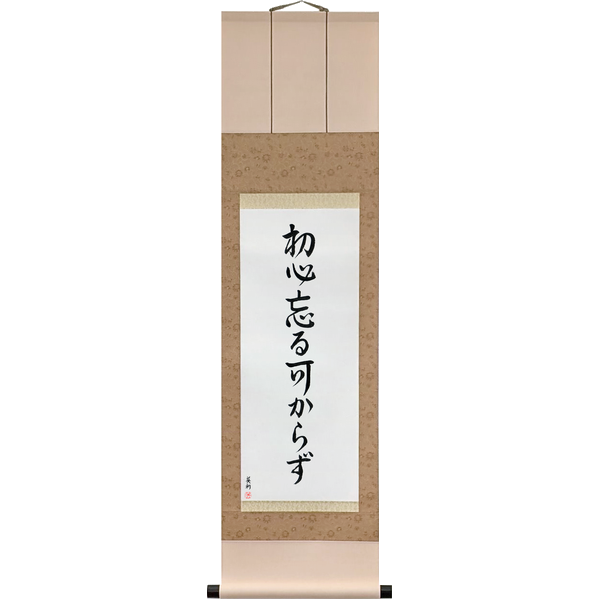
The words. 初心, shoshin, is the word the line turns on, and it is older than the line. The 精選版 日本国語大辞典 gives four senses in order of age: the resolve one first formed, attested in the 本朝文粋 of about 1060; the Buddhist 初発心, the first arising of the mind that seeks awakening, attested in the 正法眼蔵随聞記 of Dōgen 道元 (1200–1253), of the 1230s; the learner's state, 学問・芸能の道にはいったばかりであること, attested in the 無名抄 of about 1211 and in Zeami's own 風姿花伝; and unpracticed, green, attested in a tea diary of 1569 [3]. Zeami's line takes the third sense and, in the treatise, gives it three parts of its own [2]. 忘る is the classical verb forget, modern 忘れる. べからず is must not, the Japanese reading of the source's Chinese 不可. The scroll writes the last word 可からず, with the character 可 for the syllable べ: the same word, and a legitimate way to write it, since 可 is read べし in the Japanese reading of Chinese; a translation of the treatises for general readers in 1926 prints it that way, 忘る可らず, three times [4]. The dictionaries write べからず in kana [1], and the source writes the whole line in Chinese order with return marks, 初心不レ可レ忘 [2]. Three spellings, one sentence. The line's first clause has a variant that changes its shape. The 1909 first printing reads 是非トモ初心ハ不可忘, by all means, the beginner's mind must not be forgotten, with トモ and ハ printed as small reading marks beside the characters [5]; two of the manuscripts read 是非初心不可忘, the beginner's mind of right and wrong must not be forgotten, the first of three parallel nouns, and the critical edition of 1940 sets the two side by side in its apparatus [6]. An adverb in one reading, a noun in the other; the record below gives the witnesses.
The text in English. The treatises reached English late. The maxim's earliest English rendering known to this study is a hyphenated coinage in the English abstract of a Japanese article of 1963, Never-forget-original-intention; the passage itself was translated whole in 1984, in the Princeton edition of the treatises, as an actor must never forget the experiences he has undergone as a beginning artist, with the three as fresh experiences. Beginner's mind, the idiom every later rendering leans on, entered English in 1970 as the title of a Zen book that gives the word 初心 without Zeami, and a book on the way of tea set Never forget the beginner's mind. —Zeami as its epigraph in 1995. A proverb guide of 2004 renders it Always remain as humble as you were when you were a novice, the general sense. What a rendering has to keep is that 初心 is a state, not a wish, and that the sentence forbids forgetting it; what none of the short renderings keeps is Zeami's three.
The historical record
1424. Zeami 世阿弥, 花鏡, The Mirror of the Flower, the closing section 奥段. The treatise ends by naming the school's single maxim and dividing it in three [2]:
當流に、萬能一德の一句あり。初心不レ可レ忘。此句、三ヶ條の口傳在。是非初心不レ可レ忘。時々初心不レ可レ忘。老後初心不レ可レ忘。此三、能々口傳可レ爲。 Our school has one line that is a virtue in every art: the beginner's mind must not be forgotten. It has three oral teachings: the beginner's mind of right and wrong must not be forgotten; the beginner's mind of each stage must not be forgotten; the beginner's mind of old age must not be forgotten. These three are to be handed down by word of mouth.
Zeami then glosses the first: 是非の初心を忘るべからずとは、若年の初心を不レ忘して、身に持ちて在れば、老後にさまざまの德あり, "the beginner's mind of right and wrong must not be forgotten" means: keep the beginner's state of your youth unforgotten and carry it in you, and old age brings many virtues, with two old sayings about learning from earlier error, 「前々の非を知るを、後々の是とす」 and 「先車のくつがへす所、後車の戒め」 [2]. The 精選版 日本国語大辞典 gives this passage as the saying's first citation [1]. The teaching is older than the passage in Zeami's own writing: his 風姿花伝, finished by about 1418, tells an actor twice in other words never to forget what he learned as a beginner, and the 1984 translation gives one of them as an actor must never forget the aspects of his art that he has learned from his beginnings as an actor, so that, in response to varying circumstances, he may make use of them [7]. The treatise of 1424 is where the sentence takes its fixed form and its three parts.
1909. Yoshida Tōgo 吉田東伍 (1864–1918), 世阿弥十六部集, The Sixteen Treatises of Zeami, 能楽会. The first printing of the treatises. They had stayed in private hands until 1908, when a set was found in a Tokyo secondhand bookshop, bought by a collector and edited by Yoshida for publication the next year [7]. The passage on pages 110 and 111, printed with reading marks beside the characters: 當流に萬能一德の一句あり、此句三个條ノ口傳在リ、是非トモ初心ハ不レ可レ忘、初心不可忘、時々初心不可忘、老後初心不可忘、此三句、能々可レ爲二口傳一、一、是非初心をわするへからずは、若年の初心をわすれずして、身にもちて [5]. The first clause reads 是非とも初心は忘るべからず, by all means, the beginner's mind must not be forgotten, and the gloss that follows, 是非初心をわするへからずは, keeps the noun the marks had turned into an adverb. Every Japanese book below that quotes the passage before 1961 quotes it in this form.
1909. Higuchi Dōgyū 樋口銅牛 (1866–1932), 俳諧新研究, New Studies in Haikai, 隆文館, pages 288 and 289. The same year the treatises appeared, a haikai scholar read them as a rule for his own art. In a section on the key to haikai he quotes the passage, 是非とも初心は不レ可レ忘。此の句に三ヶ條の口傳あり。初心不レ可レ忘。時々初心不レ可レ忘。老後初心不レ可レ忘。此三句能々可レ爲二口傳一, with Zeami's sentence on old age, 命には終りあり。能には果あるべからず, life has an end; the art must have none, and closes 豈啻に俳壇にのみ此れを言はむや, how could this be said only of the haikai world? [8]. The line's first step out of the Noh, taken in the year it was first printed.
1926. Ikenouchi Nobuyoshi 池内信嘉 (1858–1934), 能と謡の根原:世阿弥十六部集意訳, The Roots of Noh and Chant: The Sixteen Treatises in Free Translation, 能楽会, pages 82 and 83. A rendering of the treatises into plain modern Japanese for readers outside the profession. The three parts, with the last word written 可らず: 一時々の初心を忘る可らずとは、是は初心より壯年、壯年より老後に至るまで … されば時々の初心は忘る可らずといふのである。一老後の初心を忘る可らずとは、人の命には終りがあるが、能の藝には果てはない, "the beginner's mind of each stage must not be forgotten" means: from the beginning to one's prime, from one's prime to old age … so the beginner's mind of each stage must not be forgotten. "The beginner's mind of old age must not be forgotten" means: a person's life has an end, but the art of Noh has none [4]. This is the printed precedent for the character 可 standing for べ in the last word.
1927. Kaitō Matsuzō 垣内松三 (1878–1952), 国語教授の批判と内省, Criticism and Reflection on the Teaching of Japanese, page 364. The closing page of a book on the teaching of Japanese, where the author, writing of his own life, borrows Zeami's third part as an idiom: 今、老後の初心とでもいふやうな微光が前程を照らして白み初めて來たことを感ずる, now I feel a faint light, something like the beginner's mind of old age, beginning to whiten the road ahead [9]. The phrase has left the treatise and become a way of speaking about oneself.
1932. 垣内先生の御指導を仰ぐ記, A Record of Seeking Professor Kaitō's Guidance, pages 92 and 93. A book by teachers about their teacher, in which the three parts are set on the educator Ashida Enosuke 芦田恵之助 (1873–1951), still teaching at sixty: 世阿彌の言葉に、若い時の初心、壯年の初心、老後の初心、とかうならべて、これを貫くものは初心である、初心を尊重すべしといふことをいつてをりますが, in Zeami's words, the beginner's mind of youth, of the prime, of old age are set in a row, and what runs through them is the beginner's mind; he says it is to be honored [10].
1935. Komiya Toyotaka 小宮豊隆 (1884–1966), 能と歌舞伎, Noh and Kabuki, 岩波書店, pages 14 and 15. A critic's essay on Zeami's art quotes the passage in the 1909 reading, 世阿彌は『覺習條々』の最後で、「されば當流に、萬能一德の一句あり。此句三ヶ條の口傳あり。是非とも初心は忘るべからず。」と言ひ、更に「初心不レ可レ忘、時々初心不レ可レ忘、老後初心不レ可レ忘。此三句、能々可レ爲二口傳一。」と重ね, and sets the three beginner's minds against the seven ages of the 風姿花伝 [11]. The treatise's own title for the section, 覺習條々, Articles on Learning, is the name the early readers used.
1937. 国語 学習指導の研究, Studies in the Teaching of Japanese, volume 10, 岩波書店, pages 598 and 599. The glossary to a school reader whose text is titled 生涯稽古, Practice for Life, prints the passage for pupils with the 1909 reading marks, 【初心不可忘云々】「奧段」に次の如くある。しかれば、當流に萬能一德の句あり。此句三ヶ條の口傳在リ。是非トモ初心ハ不可忘。初心不可忘、時々初心不可忘、老後初心不可忘。此三句、能く能く可爲口傳, and glosses the word: 〔初心〕ショシン(一)初に思つた心。初一念。素志。(二)物事の學び始めであること。初學。(三)物事になれぬこと。世なれぬこと。うぶ。こゝは(二)で、新たな學習に向かふ緊張した心、の意, here sense two: the taut mind that faces a new study [12]. Zeami's passage was a school text, with its three senses of the word laid out for children, twelve years before the dictionaries' modern entries.
1939. Nose Asaji 能勢朝次 (1894–1955), 古代能劇, The Noh Drama of the Early Period, in 日本文学大系, volume 21, 河出書房, pages 158 and 159. The Noh scholar who would edit the treatises numbers the maxim among Zeami's principles: (七) 初心不可忘。世阿彌は「當流に萬能一德の句あり、初心不レ可レ忘、此句三ヶ條の口傳あり。是非共初心不レ可レ忘、時々の初心不レ可レ忘、老後の初心不レ可レ忘。是三句、よくよく口傳たるべし」と述べて、三種の初心不可忘を示してゐる, and glosses the first: 「是非とも初心を忘るべからず」とは、自己の初心時代の事を常に自己の念頭に持つて、自己の藝位反省の資料とせよといふ意である, keep the time of your own beginning always in mind, as the material for reflecting on your own rank in the art [13].
1940. Nose Asaji, 世阿弥十六部集評釈, The Sixteen Treatises of Zeami, with Commentary, volume 1, 岩波書店, pages 414 to 417. The first critical edition. Its preface says the text follows Yoshida's 1909 print, which it calls the 吉田本, and that for 花鏡 it was collated against two manuscripts, the 安田家 copy as Kawase Kazuma 川瀬一馬 (1906–1999) reprinted it in 1938 and the copy owned by 田中允, with the differences set in an apparatus. The text prints しかれば、當流に萬能一德の一句あり。此句三ヶ條ノ口傳在リ。是非トモ初心ハ不レ可レ忘、時々初心不レ可レ忘、老後初心不レ可レ忘、此三句、能々可レ爲二口傳一; the apparatus, 考異 (十一) 是非トモ初心ハ不レ可レ忘 —— 安田本、田中本、是非初心不レ可レ忘, records that both manuscripts read the first clause as a noun, the beginner's mind of right and wrong; and the modern paraphrase keeps the print's adverb, それは、「初心忘るべからず」といふ金言である。これには三ヶ條の口傳がある。それは、「是非とも初心は忘るべからず」。「時々の初心を忘るべからず」。「老後の初心を忘るべからず」である [6]. This is the witness for the variant: the adverb is the 1909 editor's reading of the characters 是非, and the manuscripts he and Nose worked from read them as the first of three nouns.
1941. Hidaka Kenzō 桧高憲三, 皇民錬成西條教育, Education at Saijō for Training Imperial Subjects, 第一出版協会, page 49. A headmaster's account of his school: 私の學校では常にこの點より反省を重視して「初心忘るべからず」の言を鐵則として常に實績の向上をはかる事を忘れぬやうにしてゐる, in my school we always stress reflection from this point, hold the saying "the beginner's mind must not be forgotten" as an iron rule, and never forget to aim at improving our results [14]. The bare line, without Zeami and without its three parts, as a school's rule.
1942. Katayama Toshihiko 片山敏彦 (1898–1961), 心の遍歴, A Pilgrimage of the Mind, 中央公論社, page 61. An essay on the young Hermann Hesse opens a section titled 初心 with the proverb in the modern verb: 初心を忘れるな、と古人が言つたが、良い作家の初めの作品は、その作家の運命全體を暗示する初心の具體化であることが多い, "do not forget the beginner's mind," the ancients said; and a good writer's first work is often the embodiment of a beginner's mind that foreshadows the writer's whole fate [15]. The line as a proverb of the ancients, applied to a European novelist's first book.
1943. Shimizu Mitsuo 清水三男 (1909–1947), ぼくらの歴史教室, Our History Classroom, 大雅堂, pages 134 and 135. A history reader for children with a chapter on Zeami's testament: 最後には「老後の初心忘るべからず。」といつてゐる。之を說明して世阿彌は人の命には終があるが、能の稽古にはもう之でよいといふ終がない … この初心をどうか子々孫々に傳へて貰ひたい, at the last he says "the beginner's mind of old age must not be forgotten." Explaining it, Zeami says a person's life has an end, but the practice of Noh has no end at which one may say this is enough … he asks that this beginner's mind be handed down to children and grandchildren; the chapter tells its readers the passage is in the Iwanami paperback 覺習條條 [16].
1944. 日本文学報国会, 定本国民座右銘, The Standard Book of National Maxims, 朝日新聞社, page 3, the entry for the second of January. A maxim for every day of the year, and the second day, the day of 稽古始, the first practice of the new year, is given to this line: 初心忘るべからず ― 花傳書・世阿彌元清. The entry, signed by Nose Asaji, says 「初心忘るべからず」といふ語は、花傳書に見え、委しい解說は花鏡に於て述べてある。彼はこの語に於て、三つの意義を考へてゐる, the saying appears in the 花伝書, and the full explanation is given in the 花鏡; he thinks three meanings in it, and lays out the three, ending on the third: 習ひ得たものは悉く自己の血肉の中に消化し盡し、何時如何なる時でも、卽座に完全に演出し得るまでに究め盡くせよとの敎訓である, the teaching that everything one has learned be digested wholly into one's own flesh and blood, and mastered until at any moment it can be performed at once and in full [17]. A wartime book set the maxim in the nation's calendar.
1948. Nogami Toyoichirō 野上豊一郎 (1883–1950), 花伝書研究, Studies in the Kadensho, 小山書店, pages 282 and 283. The Noh scholar reads the line as a house rule and gives its plain sense: 初心不可忘とは世阿彌の家の大事な庭訓で、『花鏡』の「奧段」にも「初心不可忘、時々初心不可忘、老後初心不可忘」と、此の三句はよくよく口傳たるべしとあり … 初心を忘れてはならないといふことは、素撲に解釋すれば、初心時代の體驗を忘れるなといふこと, 初心不可忘 is the important household precept of Zeami's family … read simply, not forgetting the beginner's mind means not forgetting the experience of one's beginner's days [18].
1961. 歌論集 能楽論集, in 日本古典文学大系, volume 65, 岩波書店, Nishio Minoru 西尾実 (1889–1979) editing the Noh treatises. The standard critical text, on the 金春本 manuscript with its gaps filled from the 安田本. It prints the first clause 是非初心不レ可レ忘 and gives the reading ぜひの beside it: の is the editor's reading gloss, not a printed character, and the noun reading of the manuscripts is the one the standard edition adopts [2]. This is the text the 1984 English translation was made from [7].
1976. Kamei Katsuichirō 亀井勝一郎 (1907–1966), 愛と死, Love and Death. Both proverb dictionaries at kotobank quote the critic turning the line to love: 能楽の大成者の世阿弥の言葉だが、私はこれを愛についても言いたい, these are the words of Zeami, who perfected the Noh, but I would say them of love as well [1].
2014. 上野太祐, 世阿弥にとって「初心不可忘」の教えとは何であったか, What the Teaching "Never Forget the Beginner's Mind" Meant to Zeami, 一橋社会科学, volume 6. The one modern study devoted to the line. It counts the teaching three times in Zeami's treatises, そもそも「初心不可忘」の教えは、世阿弥伝書中三箇所に出現し, twice in the 風姿花伝 and once in the 花鏡; it reads the 花鏡 form as the one in which 初心 is abstracted until old age itself becomes a beginner's mind; it weighs, and holds at arm's length, the Zen reading of the line through the Zen monk Giyō Hōshū 岐陽方秀 (1361–1424)'s phrase 初心全與後心同, the first mind is wholly the same as the last; and it finds that the teaching does not recur in the treatises Zeami wrote after 花鏡 [19].
The dictionaries today. デジタル大辞泉: 《世阿弥の「花鏡」にある言葉》習い始めのころの謙虚で真剣な気持ちを忘れてはならない [1]. The 精選版 日本国語大辞典 keeps the Noh sense first and the general sense second; 故事成語を知る辞典 gives the source, the stages and the modern reach, 現在では、広くさまざまな分野で用いられています; ことわざを知る辞典 gives the general sense alone, 学び始めたころの心を忘れないことである, and the reach in its own words, 今日では、芸事に限らず、さまざまな分野で用いられます [1]. For the word alone, デジタル大辞泉 gives four senses, the resolve one first formed, the learner's state, the unpracticed, and the Buddhist first arising of the seeking mind [3].
What is not a source. The English list of samurai precepts, Samurai no Kokoroe, that gives the line as its item 21 is not a source for the saying: its one address cites an English sword manual of 2008 and no Japanese text [20]. 徒然草 92's 初心の人、二つの矢を持つことなかれ, a beginner must not hold two arrows, the archery master's rule against counting on the second shot, is a different saying about beginners, set beside this one on the web and not a source for it [21]; Donald Keene's 1967 translation renders it A beginner should not hold two arrows. It will make him rely on the second arrow and be careless with the first [22]. An ikebana teaching attributed to Sōami 相阿弥 (?–1525), 初心を忘れず新敷心をもたず, not forgetting the beginner's mind and not taking up a new one, printed in a 1923 book on flower arrangement, is the same words in another art and not a source [23]. The 1944 maxim book's attribution to the 花傳書 rests on the 風姿花伝's earlier sentences in other words; the maxim in its fixed form is the 花鏡's [7][17].
The maxim in English
1963. Nakayama Kazuyoshi 中山一義, 命には終りあり,能には果てあるべからず:世阿彌の生涯稽古思想, Zeami's Theory of Lifelong Training of the Noh Drama, in 哲學, volume 43, 三田哲學會, pages 227 to 254. An article on the passage this maxim closes, titled with its other sentence, life has an end, the art must have none, which the English abstract opens by rendering Man is mortal and art is eternal. The earliest English rendering of the maxim known to this study is in the same abstract, as one of Zeami's theories: The theory of Never-forget-original-intention (初心不可忘), studying the problem of succession of art from generation to generation [24]. Original intention is the dictionaries' first sense of the word, the resolve one first formed, not the learner's state the line is about; the abstract's gloss, succession from generation to generation, is Zeami's own emphasis in the passage.
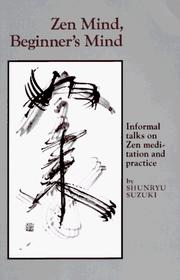
1970. Suzuki Shunryū 鈴木俊隆 (1905–1971), Zen Mind, Beginner's Mind, Weatherhill. The book that made beginner's mind an English phrase. Its prologue: In Japan we have the phrase shoshin, which means "beginner's mind." The goal of practice is always to keep our beginner's mind; and its most quoted line, In the beginner's mind there are many possibilities, but in the expert's there are few. Richard Baker's introduction gives the word its Zen lineage, Beginner's mind was a favorite expression of Dogen-zenji's, and says the frontispiece calligraphy, in Suzuki's hand, reads shoshin, or beginner's mind [25]. Zeami is not named anywhere in the book; the word reached English through the Buddhist sense the 精選版 日本国語大辞典 attests in Dōgen, not through the Noh.
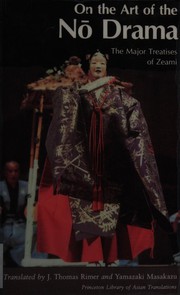
1984. J. Thomas Rimer and Yamazaki Masakazu 山崎正和 (1934–2020), On the Art of the Nō Drama: The Major Treatises of Zeami, Princeton University Press, pages 107 to 109. The passage translated whole, from the 1961 text: In our Kanze school, there is one phrase that is of infinite value concerning the fundamentals of any artistic accomplishment: an actor must never forget the experiences he has undergone as a beginning artist. In the transmitted teaching, there are three explanations provided for this. Accordingly: —he must never forget the fresh experiences he first went through as a young performer. —at each level of accomplishment, there are new levels of fresh experience that the actor must encounter for the first time, as though he were a beginner, and then never forget. —after the actor becomes older, there are still new stages of fresh experience that must never be forgotten. On the third, although there are limits on a human life, the nō never comes to an end [7]. Fresh experience is the translators' word for 初心, a rendering by sense rather than by the word, and it keeps what the short renderings lose: that the beginner's mind is renewed at every stage. The first clause follows the 1961 noun reading.
1995. Dennis Hirota, Wind in the Pines: Classic Writings of the Way of Tea as a Buddhist Path, Asian Humanities Press, the preface. The epigraph of a book on the way of tea: Never forget the beginner's mind. —Zeami [26]. Five words, with the author named and the line carried into a third art.
2004. Edward Trimnell, Tigers, Devils, and Fools: A Guide to Japanese Proverbs, Beechmont Crest, page 131. The proverb under the heading SHOSHIN WASURU BEKARAZU, with the Japanese 初心忘るべからず and the kana, rendered Always remain as humble as you were when you were a novice, and explained: When you undertake a new hobby or profession, you begin with an attitude of humility, and respect for your fellow practitioners. However, many people turn arrogant and jaded after they become good at something [27]. The general sense only; Zeami is not named, and the romaji breaks the verb in two.
2008, at second hand. Masayuki Shimabukuro and Leonard J. Pellman, Flashing Steel, second edition, as quoted in 2011. A numbered English list of samurai precepts, Samurai no Kokoroe, cited from this sword manual, gives item 21 as Never loose your "Beginner's Spirit". (Shoshin o wasurubekarazaru koto.), in the list's own spelling, with the romaji in the attributive form with こと, a different sentence shape from the maxim's [20]. Beginner's spirit is this list's rendering of 初心.
Today. The EDRDG dictionary enters the proverb under 初心忘るべからず, with 初心忘る可からず as a variant spelling, glossed we were all beginners once; never lose your humility [28]. The house title, Never Lose Your Beginner's Spirit, renders the general sense with the samurai list's word for 初心, where the text says word for word that the beginner's mind must not be forgotten: lose is a softer verb than the source's prohibition, and spirit and mind are both fair for a word that means a state of mind. What a rendering must keep: that 初心 is a state one is in, not a wish one holds; that the sentence forbids forgetting it; and, if it can, that Zeami meant three of them.
A reading
What the English cannot carry, and the source does, is Zeami's third 初心. The line is not advice to beginners; it is a master's rule that there is a beginning at every stage of a life, and that the last of them is old age. The general sense is not wrong, since the dictionaries record it and a school of 1941 already lived by it; it is the smaller half. The record shows the line leaving the Noh in the year it was first printed, on the page of a haikai scholar, and reaching the schoolroom and the nation's calendar within a generation, and it shows the scholars who edited the treatises quoting all three parts while the schools and the essayists kept the bare line. The variant in the first clause is a small thing with a real consequence: read as an adverb, by all means, the first teaching is only an emphasis on the maxim; read as a noun, the beginner's mind of right and wrong, it is the first of three states, the one Zeami glosses as the youth's mind carried into old age, and the manuscripts and the standard edition read it so. The spelling 可からず, with 可 for べ, is a choice and not an error: a reader who knows the source's 不レ可レ忘 will recognize it, and a translator of 1926 wrote it that way for readers who did not.
Notes
The 1909 print's トモ and ハ are printed as small reading marks beside 是非 and 初心, not as characters of the text; the edition's own gloss two lines later, 是非初心をわするへからずは, reads the same characters as a noun. The 1940 apparatus attributes the noun reading to the 安田本 and the 田中本; the 1909 print was set from the 安田家 manuscript, so the adverb is the editor's reading of the characters, not a manuscript's [5][6].
The 1944 maxim book attributes the line to the 花傳書 and its explanation to the 花鏡. The 風姿花伝 carries the teaching in other words and the fixed sentence with its three parts is the 花鏡's; the attribution is loose, not wrong [17].
Baker's 1970 introduction gives beginner's mind to Dōgen. The 精選版 日本国語大辞典 attests the word in Dōgen's 正法眼蔵随聞記 in the Buddhist sense, the first arising of the mind that seeks awakening; that is a different sense of the same word from Zeami's, and the two English uses of beginner's mind, the Zen one and the Noh one, descend from different senses [3][25].
Trimnell's romaji, shoshin wasuru bekarazu, breaks the verb 忘るべからず in two; the samurai list's wasurubekarazaru koto is the attributive form, a different sentence. The reading of the line as a sentence is shoshin wasurubekarazu [20][27].
Sources not seen
歌論集 能楽論集, 日本古典文学大系 65, 岩波書店, 1961, 久松潜一 and 西尾實 editing, the printed volume. Its 花鏡 text is cited here through a web transcription that names the volume as its source and quotes its preface; the printed page would confirm the reading gloss ぜひの and the apparatus at the first clause.
花鏡, the 安田本 manuscript as reprinted by 川瀬一馬, 1938, and the 岩波文庫 覺習條々 edited by 野々村戒三, 1931. Both are held at the National Diet Library and are not served to readers outside Japan. Either would confirm at the leaf the noun reading the 1940 apparatus reports for the 安田本, and the 1931 paperback is the edition the 1943 children's reader names.
中村泰子, 世阿弥の「初心不可忘」, in 青須我波良, volume 43, 1992. A catalogue record at CiNii; the article is not online. It would add a second modern study of the line to the one of 2014.
A manuscript image of the 花鏡. The 国書データベース lists the 宝山寺 copy, formerly the 金春 family's, dated 1437, the 観世 family's copy of 1723, the former 安田 copy and the 田中 copy, none with images served. Any one would put the first clause's characters before the reader without an editor between.
A reader with access to any of these is invited to write to Takase Studios at Tim@Takase.com.
References
- 「初心忘るべからず」, デジタル大辞泉 · 精選版 日本国語大辞典 · 故事成語を知る辞典 · ことわざを知る辞典, at kotobank. https://kotobank.jp/word/初心忘るべからず-534696
- 世阿弥『花鏡』奥段, in 久松潜一 · 西尾實 校注『歌論集 能樂論集』(日本古典文学大系 65), 岩波書店, 1961, 底本 金春本; web transcription. https://sybrma.sakura.ne.jp/383syoshin.html
- 「初心」, デジタル大辞泉 · 精選版 日本国語大辞典, at kotobank. https://kotobank.jp/word/初心-534695
- 池内信嘉『能と謡の根原:世阿弥十六部集意訳』, 能楽会, 1926, pp. 82–83. National Diet Library pid 1019033, scan 48. https://dl.ndl.go.jp/pid/1019033/1/48
- 吉田東伍 校注『世阿弥十六部集:能楽古典』, 能楽会, 1909, pp. 110–111. National Diet Library pid 859394, scan 95. https://dl.ndl.go.jp/pid/859394/1/95
- 能勢朝次『世阿弥十六部集評釈』上巻, 岩波書店, 1940 (1944 printing), pp. 414–417. National Diet Library pid 1125601, scans 217–218 (the text and apparatus at 217, the 口譯 at 218). https://dl.ndl.go.jp/pid/1125601/1/217 · https://dl.ndl.go.jp/pid/1125601/1/218
- J. Thomas Rimer and Masakazu Yamazaki, translators, On the Art of the Nō Drama: The Major Treatises of Zeami, Princeton University Press, 1984, pp. xxi, 58, 107–109.
- 樋口銅牛『俳諧新研究』, 隆文館, 1909, pp. 288–289. National Diet Library pid 875384, scan 156. https://dl.ndl.go.jp/pid/875384/1/156
- 垣内松三『国語教授の批判と内省』, 1927, p. 364. National Diet Library pid 1464638, scan 190. https://dl.ndl.go.jp/pid/1464638/1/190
- 『垣内先生の御指導を仰ぐ記』, 1932, pp. 92–93. National Diet Library pid 1033102, scan 50. https://dl.ndl.go.jp/pid/1033102/1/50
- 小宮豊隆『能と歌舞伎』, 岩波書店, 1935, pp. 14–15. National Diet Library pid 1235611, scan 13. https://dl.ndl.go.jp/pid/1235611/1/13
- 『国語 学習指導の研究』巻10, 岩波書店, 1937, pp. 598–599. National Diet Library pid 1456539, scan 315. https://dl.ndl.go.jp/pid/1456539/1/315
- 能勢朝次『古代能劇』, 日本文学大系 第21巻, 河出書房, 1939, pp. 158–159. National Diet Library pid 1116154, scan 82. https://dl.ndl.go.jp/pid/1116154/1/82
- 桧高憲三『皇民錬成西條教育』, 第一出版協会, 1941, p. 49. National Diet Library pid 1139781, scan 33. https://dl.ndl.go.jp/pid/1139781/1/33
- 片山敏彦『心の遍歴』, 中央公論社, 1942, p. 61. National Diet Library pid 1150779, scan 35. https://dl.ndl.go.jp/pid/1150779/1/35
- 清水三男『ぼくらの歴史教室』, 大雅堂, 1943, pp. 134–135. National Diet Library pid 1169256, scan 74. https://dl.ndl.go.jp/pid/1169256/1/74
- 日本文学報国会 編『定本国民座右銘』, 朝日新聞社, 1944, pp. 3–4. National Diet Library pid 1039842, scans 10–11 (p. 3 at 10, p. 4 with the signature at 11). https://dl.ndl.go.jp/pid/1039842/1/10 · https://dl.ndl.go.jp/pid/1039842/1/11
- 野上豊一郎『花伝書研究』, 小山書店, 1948, pp. 282–283. National Diet Library pid 1125589, scan 144. https://dl.ndl.go.jp/pid/1125589/1/144
- 上野太祐「世阿弥にとって「初心不可忘」の教えとは何であったか」, 『一橋社会科学』6, 2014, pp. 1–14. https://doi.org/10.15057/26547
- "Samurai no Kokoroe: Precepts of the Samurai", The Fight of the Philosopher, 2011, item 21, citing Masayuki Shimabukuro and Leonard J. Pellman, Flashing Steel, 2nd ed., Blue Snake Books, 2008. https://thefightofthephilosopher.wordpress.com/2011/09/18/samurai-no-kokoroe-precepts-of-the-samurai/
- 兼好『徒然草』第九十二段, 校註日本文學大系 text at Wikisource. https://ja.wikisource.org/wiki/徒然草_(校註日本文學大系)
- Donald Keene, translator, Essays in Idleness: The Tsurezuregusa of Kenkō, Columbia University Press, 1967, § 92, p. 77.
- 『生花の話』, 1923, pp. 78–79. National Diet Library pid 977061, scan 56. https://dl.ndl.go.jp/pid/977061/1/56
- 中山一義「命には終りあり,能には果てあるべからず:世阿彌の生涯稽古思想」, 『哲學』43, 三田哲學會, 1963, pp. 227–254, English abstract. https://koara.lib.keio.ac.jp/xoonips/modules/xoonips/detail.php?koara_id=AN00150430-00000043-0227
- Shunryu Suzuki, Zen Mind, Beginner's Mind, edited by Trudy Dixon, with an introduction by Richard Baker, Weatherhill, 1970, the introduction and the prologue.
- Dennis Hirota, Wind in the Pines: Classic Writings of the Way of Tea as a Buddhist Path, Asian Humanities Press, 1995, preface epigraph.
- Edward Trimnell, Tigers, Devils, and Fools: A Guide to Japanese Proverbs, Beechmont Crest, 2004, p. 131.
- EDRDG (JMdict), 「初心忘るべからず」, at jisho.org. https://jisho.org/search/初心忘るべからず
Books Cited
Books this article cites that can be ordered today.