

初心忘る可からず · shoshin wasurubekarazu · The beginner's mind must not be forgotten
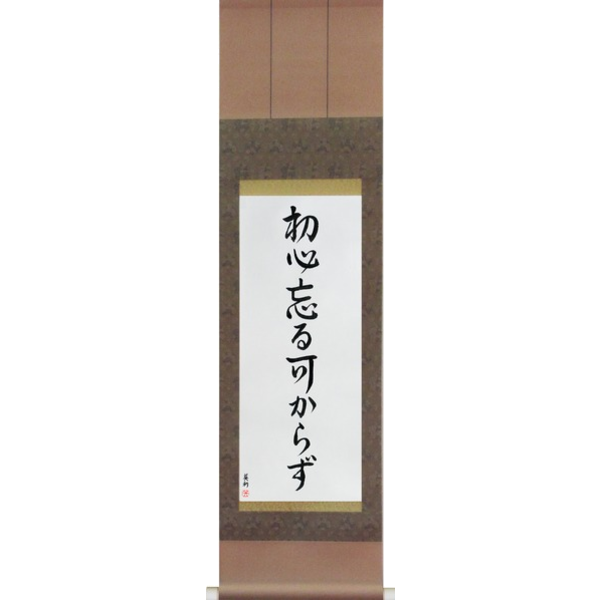
Sold as Never Lose Your Beginner's Spirit · Read shoshin wasurubekarazu · Oldest witness Zeami's treatise 花鏡, the closing section, 1424, where the line is the Noh school's one all-purpose maxim and comes in three · Sense the state you were in when you began must not be forgotten; in the source, there is a beginning at every stage of a life, and the last one is old age.
The words
初心, shoshin, is the word the line turns on, and the source gives it three senses of its own. In the dictionaries it is 習い始めのころの謙虚で真剣な気持ち, the humble and earnest state of mind of one who has just begun, and the 精選版日本国語大辞典 keeps the Noh sense first: the art one learned young, one's own immaturity then, and the first experience at each new stage. 忘る is the classical verb forget, modern 忘れる. べからず is must not, the reading of the source's Chinese 不可. The design writes the last word 可からず with the character 可 for the syllable べ: the same word, a legitimate way to write it, and one no printed book in the corpus searched uses; the dictionaries and every book found write べからず in kana, and the source writes the whole line in Chinese order, 初心不可忘. Three spellings, one sentence.
A history, from the earliest witness
1424. 世阿弥, The Mirror of the Flower (花鏡), the closing section. The treatise ends by naming the school's single maxim and splitting it in three: 當流に萬能一德の一句あり。初心不可忘。此句、三ヶ條の口傳在。是非の初心不可忘。時々の初心不可忘。老後の初心不可忘, our school has one line that is a virtue in every art: the beginner's mind must not be forgotten. It has three oral teachings: the beginner's mind of right and wrong must not be forgotten; the beginner's mind of each stage must not be forgotten; the beginner's mind of old age must not be forgotten. Zeami then glosses the first: 若年の初心を忘れずして、身に持ちて在れば、老後にさまざまの徳あり, keep the beginner's state of your youth unforgotten and carry it in you, and old age brings many virtues, with two old sayings about learning from earlier error. The manuscripts were not opened; the text is read at two typesets, below, which differ in the first of the three. [the 1961 岩波 critical text on the 金春本, as transcribed at sybrma.sakura.ne.jp/383syoshin.html; text; the volume not opened]
1909. 吉田東伍, editor, The Sixteen Treatises of Zeami (世阿弥十六部集), 能楽会. The first modern edition of the treatises and the first printed witness found. The leaf was read by eye. It prints the passage with reading marks beside the characters, and its first of the three reads 是非トモ初心ハ不可忘, by all means, the beginner's mind must not be forgotten, where the 1961 text reads 是非の初心, the beginner's mind of right and wrong: an adverb in one edition, a noun in the other, from different base manuscripts. The commentary of 1944 follows the 1909 reading. [2]
1937 to 1944. The proverb in kana. The National Diet Library has the kana form 初心忘るべからず in eight books, all from 1937 on, and five of them quote Zeami's three: a treatise on Japanese literature, a study of Noh, a history reader for children (最後には「老後の初心忘るべからず。」といつてゐる … 能の稽古にはもう之でよいといふ終がない, at the last he says the beginner's mind of old age must not be forgotten: practice in Noh has no point at which it is enough), and the 1944 commentary on the sixteen treatises. One is a school's rule for itself, one a maxim list. The classical form 初心不可忘 is in seventeen books from 1909. [NDL search, keyword 初心忘るべからず, 8 hits; text]
Today. デジタル大辞泉: 《世阿弥の「花鏡」にある言葉》習い始めのころの謙虚で真剣な気持ちを忘れてはならない. 故事成語を知る辞典 reads the source rightly: 初心者はもちろん、大ベテランに至るまで、芸を身に付けていくそれぞれの段階に「初心」があり、それを忘れてはいけない, not only the beginner but the great veteran has a beginning at each stage of mastering an art, and must not forget it. Both proverb dictionaries quote 亀井勝一郎 (1976) turning the line to love: 能楽の大成者の世阿弥の言葉だが、私はこれを愛についても言いたい. [6]
The sense across time
The dictionaries hold two senses and say which is older. In the source the line is a master's maxim: the beginner's mind is not one state but a state renewed at every stage, and the one that matters is the last. In general use, which the dictionaries date no more precisely than now, it is a maxim for beginners: do not lose the humility and seriousness you started with. The English beginner's spirit carries the second; the history's job is the first. Nothing between 1424 and 1909 was opened, so when the line left the Noh stage for common speech is not known here.
What is not a source
The house's page says the saying appears in a slightly different form as part of a Samurai Code which appears in English but does not appear at all in the Japanese sources that we could find. Two things are true at once. The saying has one of the best-documented sources in the catalogue, named and dated by every dictionary opened and quoted above at its passage. The Samurai Code the page means is a numbered English list, Samurai no Kokoroe, whose one opened address cites a 2008 English sword manual and no Japanese text; that the list has no Japanese source is a fact about the list, not about the saying. 徒然草's 初心の人、二つの矢を持つことなかれ is a different saying about beginners, set beside this one on the web, and not a source.
The text in English
The Meiji bilingual dictionaries were not checked for this line, and no printed English book carrying it was opened. The English list Samurai no Kokoroe gives it as Never loose your "Beginner's Spirit" with the romaji shoshin o wasurubekarazaru koto, the attributive form with こと, a different sentence shape from the scroll's. The house title, Never Lose Your Beginner's Spirit, and its second rendering, Never Forget Your Original Intention, divide the dictionary's two general senses between them. Beginner's mind is the other English idiom for 初心, made current by Shunryū Suzuki's Zen Mind, Beginner's Mind (Weatherhill, 1970), not opened. What a rendering must keep is that 初心 is a state, not a wish, and that the sentence forbids forgetting it.
A reading
The page says the line has no Japanese source and puts it in the thirteenth century; it is Zeami's, 1424, and the passage is a page anyone can open. That is the correction, and it is the whole of it. The design's 可 for べ is a choice and not an error, and a reader who knows the source's 不可忘 will recognize it, though the page should carry the dictionary's spelling in its text. What the English cannot carry and this page can is Zeami's third 初心: the line is not advice to beginners, it is a master's rule that there is a beginning at every stage of a life, and the last of them is old age. Signed, 典, 2026-09-05.
How this was read
By eye: the 1909 leaf at the page image. By text, at the address: the four dictionary entries at kotobank; the 1961 critical text in a transcription; the 1909 page at the National Diet Library's page API; the eight kana-form search results and the two counts; the English list at one blog; the Suzuki title at Wikipedia; the live word page. Not opened: any manuscript of 花鏡; the 1961 volume in print; anything between 1424 and 1909; the eight kana-form books at their pages; 亀井's essay; the 2008 sword manual; Suzuki's book. Every address in this history is a text address except the 1909 leaf, which also has one, and a reader's AI can open all of them. The full apparatus, with every address, is in the account.
References
- The design (ours) (—) — K2021; cultural_works 381
- 世阿弥『花鏡』奥段, as the 1909 typeset prints it (1424 (text); 1909 (print)) — NDL pid 859394 koma 95, by eye s33; page API OCR agrees ↩
- 世阿弥十六部集評釈 (1944) — NDL pid 1125601, search highlight
- 花鏡 奥段, 岩波 日本古典文学大系65 text (1961, 金春本 base), as transcribed (1424 (text)) — sybrma.sakura.ne.jp/383syoshin.html (TEXT); the volume not opened
- 精選版 日本国語大辞典, 初出 (1424) — kotobank 534696
- デジタル大辞泉 · 故事成語を知る辞典 · ことわざを知る辞典 (current) — kotobank 534696 ↩
- NDL corpus, three spellings (1909–1946) — lab.ndl.go.jp search, counts re-run
- *Samurai no Kokoroe*, item 21, an English list (2008 (its stated source)) — one blog, citing *Flashing Steel* 2nd ed.; the book not opened