

己に忠実なれ · onore ni chūjitsu nare · To thine own self be true
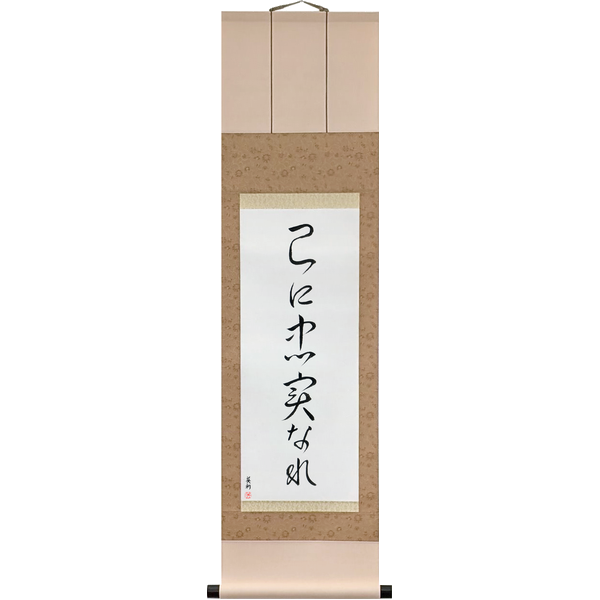
Sold as To Thine Own Self Be True · Read onore ni chūjitsu nare · Oldest witness Hamlet, act one, scene three, Polonius to his son; for the five Japanese characters, 久米正雄's translation of the play, 1922; for the maxim they abbreviate, a manifesto of Japanese naturalism, 1908 · Sense be faithful to yourself; in Japanese the words were a watchword of the self before they were Shakespeare's.
The words
Five characters. 己, oneself, the literary reflexive, read onore. に, to. 忠実, read chūjitsu, is the word the scroll turns on: the dictionaries give まごころをこめてよくつとめること, serving with a whole heart, and the sense faithful to an original, of a copy or a translation; it carries loyal before it carries true, and Polonius's true meant loyal too. なれ is the classical imperative, be, which is what makes the line a maxim rather than a sentence. The scroll writes 忠実 in the modern form; the 1922 book writes 忠實; one word. Two forms of the phrase share the books: the scroll's 己に忠実なれ, and 自己に忠実なれ with the two-character self, and the second is the older and far commoner one in Japanese.
A history, from the earliest witness
About 1600. William Shakespeare, Hamlet, act one, scene three. Polonius is sending Laertes to France with a string of precepts, and this is the last: This above all: to thine own self be true, / And it must follow, as the night the day, / Thou canst not then be false to any man. The line before it is Neither a borrower, nor a lender be. The scroll carries the first half of the couplet and drops the then that makes it an argument. [en.wikisource.org, the 1917 Yale edition, page 21, line 78; text]
1908. 長谷川天渓, Naturalism (自然主義). The oldest Japanese witness opened, and it is not Shakespeare. Arguing that art has no standard but the artist's own sense, the critic writes 種々の習慣、證典、法則、模型等は、之れを顧慮するの必要なし。たゞそれ自己に忠實なれ, habits, scriptures, rules and models need no regard; only be faithful to yourself. The maxim is already a principle with a name, 自己發展主義, the doctrine of self-development. [5]
1909. 坪内逍遥, Hamlet (ハムレット), the first complete Japanese translation. The scene was read on the page image, and the column that carries the clause is under an ink blot on the National Diet Library's copy. What survives is the couplet's tail: すれば夜の晝に繼ぐが如く、他人に對しても忠實ならん, …then, as day follows night, you will be faithful to others too. 逍遥 used 忠實 for true; how he rendered to thine own self is not known from this copy. [4]
1912. 高山樗牛, collected works (樗牛全集). An essay on prose style, collected here after the critic's death and not dated in what was read, ends its demands on the writer with the same words: 詮ずるところ忠實の二字に歸着すべし。文を作るもの、自己に忠實なれ, in the end it comes down to two characters, 忠實: writer, be faithful to yourself. [6]
1917. 中島半次郎, translating John Adams, The Evolution of Educational Theory (教育学説の進化). The first witness opened that names Polonius. The translator gives the line as ボローニヤスの『汝自身の自己に忠實なれ』 and his author calls it 舞臺で屢〓用ゐられて古臭い言葉, a stage line worn old with use; the argument is that a teacher cannot afford it. [7]
1919. 帆足理一郎, The Remaking of National Life (国民生活の改造). A book on individualism quotes the couplet whole, without naming its translator, 『お前自身に忠實なれ、然らば、お前は决して他人に不忠實であることは出來ぬ』, be faithful to yourself, and then you can never be unfaithful to others, and glosses it at once with the maxim: 自己に忠實なれとは單に個人主義の道德のみではない, "be faithful to yourself" is not merely the morality of individualism. Shakespeare's line and the Japanese watchword are the same thought to him. [8]
1922. 久米正雄, Hamlet (ハムレツト), 新潮社. The scroll's source, character for character. Polonius: 最後にこれが最も大切なる事だ。曰く「己に忠實なれ、然らば夜に日のつゞくが如く、自ら他人にも虚僞あらざるべし」だ, and last, this most of all: "be faithful to yourself, and then, as day follows night, you will be false to no one". 久米 gave Polonius the maxim his readers already knew, with the one-character 己 for 自己, and the five characters on the scroll are his. [3]
1930. 田所輝明, A Small Dictionary of Social Science (社會科學小辭典). The maxim filed under its owner. The entry for Ibsenism ends: 『主觀に從へ! 自己に忠實なれ』とはイブセン主義のアフォリズムである, "follow your own judgment; be faithful to yourself" is the aphorism of Ibsenism. [9]
1934. 新渡戸稲造, Western Conditions and Thought (西洋の事情と思想). The second book, and the last opened, that writes the scroll's five characters. Explaining the English word honest as faithfulness to one's self, Nitobe writes 己に忠實なれ······といふこと廣くいはれる言葉であるけれども、實際にはいろ〓〓な障りがある, "be faithful to yourself" is a widely said phrase, but in practice it meets all sorts of obstacles. He treats it as a common saying, not as a quotation. [10]
The sense across time
One sense, two careers. In English the line is a father's precept that became a proverb: be true to yourself and you cannot be false to others. In Japanese the words arrived first as 自己に忠實なれ, the watchword of naturalism and of Ibsen's readers in the 1900s, a maxim about the self against rules, models and society, and the books of 1908 to 1933 use it that way without a thought of Denmark. The two careers meet in the 1910s, when 中島 and 帆足 quote Polonius in the maxim's words, and they fuse in 1922, when 久米 makes the maxim Polonius's own line. A reader of the scroll today hears Shakespeare; a reader of 1920 heard both, and the second is why the five characters sound like a proverb.
What is not a source
The Ibsenist maxim is not derived from Hamlet in any source opened; the 1930 dictionary gives it to Ibsen, and the naturalists of 1908 and 1912 give it to nobody. It is a parallel that became a translation, not an origin. The popular English pairing of the line with Emerson's self-reliance was not looked for here.
The text in English
The English is the original, so this section is short. Shakespeare's line is the standard the Japanese is measured against, and the house title, To Thine Own Self Be True, is that line in its own words. What the scroll keeps is the imperative and the self; what it drops is the second half, the then by which faithfulness to oneself becomes honesty to everyone else. A history can carry the half a scroll cannot.
A reading
The scroll is a Shakespeare line in the words of a Japanese maxim, and it is right to sell it as both, because that is what 久米 made and what a Japanese reader has heard since. The catalogue says a standard translation; it can now say whose, and when, at a scan anyone can open. The one thing the page should not say is that the phrase is Shakespeare in Japanese and nothing more: for the writers who first used these words, faithfulness to the self was the whole of a modern ethic, and Polonius was the old man who happened to have said it first. On the form, 忠実 for 忠實 is one word; the scroll's modern characters are right. Signed, 典, 2026-09-05.
How this was read
By eye: the 1909 leaf, at the page image, where the clause is under ink. By text, at the address: Polonius at the Wikisource transcription of the 1917 Yale edition; 久米 1922 and six other books at the National Diet Library's page API, each located from the book's OCR zip; the thirty search highlights for the phrase, read one by one; the kotobank entries for 忠実; the live word and scroll pages. Not opened: the twenty-two other books that carry 自己に忠實なれ between 1910 and 1933, which would say whether any names Ibsen or Polonius; the date of 樗牛's essay; a clean copy of 逍遥's 1909 leaf, or his 1938 revision, which would give the first Japanese rendering of the clause; 福田恆存 and 小田島雄志, the postwar translations, in copyright; the First Folio. Every address in this history is a text address except the 1909 leaf, and a reader's AI can open the rest. The full apparatus, with every address, is in the account.
References
- The scroll (ours) (—) — S0005SSVB5A; cultural_works 966
- Hamlet I.iii.78, 1917 Yale text (c. 1600) — en.wikisource page 33 (TEXT)
- 久米正雄 訳『ハムレツト』 (1922) — NDL pid 968980 koma 19, OCR ↩
- 坪内逍遥 訳『ハムレット』 (1909) — NDL pid 873484 koma 27, by eye s33 ↩
- 長谷川天渓『自然主義』 (1908) — NDL pid 871651 koma 157, OCR ↩
- 高山樗牛『樗牛全集』 (1912 (collected)) — NDL pid 930959 koma 459, OCR ↩
- 中島半次郎 訳, J. Adams『教育学説の進化』 (1917) — NDL pid 980219 koma 45, OCR ↩
- 帆足理一郎『国民生活の改造』 (1919) — NDL pid 961703 koma 93, OCR ↩
- 田所輝明 編『社會科學小辭典』 (1930) — NDL pid 1086078 koma 67, OCR ↩
- 新渡戸稲造『西洋の事情と思想』 (1934) — NDL pid 1272080 koma 109, OCR ↩
- NDL corpus (1908–1934) — counts, highlights read