

Fine Japanese Calligraphy

The Art of Master Japanese Calligrapher Eri Takase

0

己に忠実なれ onore ni chūjitsu nare To Thine Own Self Be True

Be faithful to yourself.
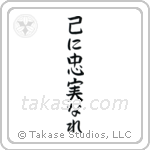
To Thine Own Self Be True (己に忠実なれ) in Block style Japanese calligraphy by Eri Takase
To Thine Own Self Be True 己に忠実なれ onore ni chūjitsu nare Vertical Block VB5C
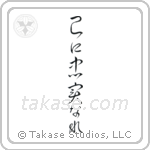
To Thine Own Self Be True (己に忠実なれ) in Cursive style Japanese calligraphy by Eri Takase
To Thine Own Self Be True 己に忠実なれ onore ni chūjitsu nare Vertical Cursive VC5B
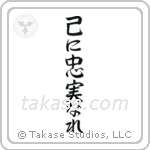
To Thine Own Self Be True (己に忠実なれ) in Semi-Cursive style Japanese calligraphy by Eri Takase
To Thine Own Self Be True 己に忠実なれ onore ni chūjitsu nare Vertical Semi-Cursive VS4C
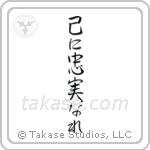
To Thine Own Self Be True (己に忠実なれ) in Semi-Cursive style Japanese calligraphy by Eri Takase
To Thine Own Self Be True 己に忠実なれ onore ni chūjitsu nare Vertical Semi-Cursive VS5C
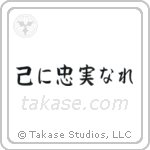
To Thine Own Self Be True (己に忠実なれ) in Block style Japanese calligraphy by Eri Takase
To Thine Own Self Be True 己に忠実なれ onore ni chūjitsu nare Horizontal Block HB5A
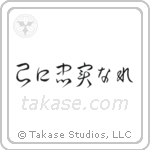
To Thine Own Self Be True (己に忠実なれ) in Cursive style Japanese calligraphy by Eri Takase
To Thine Own Self Be True 己に忠実なれ onore ni chūjitsu nare Horizontal Cursive HC5A
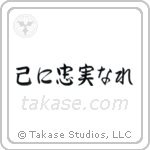
To Thine Own Self Be True (己に忠実なれ) in Semi-Cursive style Japanese calligraphy by Eri Takase
To Thine Own Self Be True 己に忠実なれ onore ni chūjitsu nare Horizontal Semi-Cursive HS5A
More about 己に忠実なれ

Be faithful to yourself: Polonius's precept to his son, and in Japanese a maxim in its own right. 忠実 is faithful, loyal, the word for serving with a whole heart and for a copy true to its original, which is what Shakespeare's true meant too; なれ is the old imperative, be, which makes the line a maxim rather than a sentence. The six characters are a translator's, Kume Masao's Polonius, and his readers already knew them as the watchword of a generation of Japanese writers who set faithfulness to the self above every rule and model, so a Japanese reader hears a proverb where an English reader hears the play. The words carry the precept; the half that follows it, that you cannot then be false to any man, is yours to keep.

The six characters are 久米正雄's 1922 translation of Polonius's line in Hamlet (about 1600); but the same words already existed in Japanese as a naturalist watchword for faithfulness to the self, independent of Shakespeare, from a 1908 essay, and the two origins fused only when 久米 gave Polonius the maxim his readers already knew.

We want you to be as happy with the meaning as you are with Master Takase's art. To learn more, visit Philology of 己に忠実なれ.

About the Designs

Each design is Master Japanese Calligrapher Eri Takase's hand-brushed calligraphy of the word or phrase on this page, delivered as a PDF you can print. Every PDF includes the line art, so a tattoo artist or a craftsperson can work from the outline as well as the brushed image.

Licensing

Your purchase includes a personal-use license: use the design as a tattoo reference, frame it, engrave it, print it for yourself, or make it into a gift. For more information see Licensing, which also covers commercial-use options that may be purchased separately.

Delivery

Your PDF is available for download the moment your order completes, and a copy is attached to your emailed receipt.

If you need your design again later, ask us for it and we will send it.

To Thine Own Self Be True as a hand-brushed scroll

Master Takase personally brushes your scroll when you order, and it bears her red seal and her signature. The scroll has real silk borders and layered Japanese paper, so it hangs straight, and it arrives ready to display.