

温故知新 · onko chishin · Warm the old and know the new
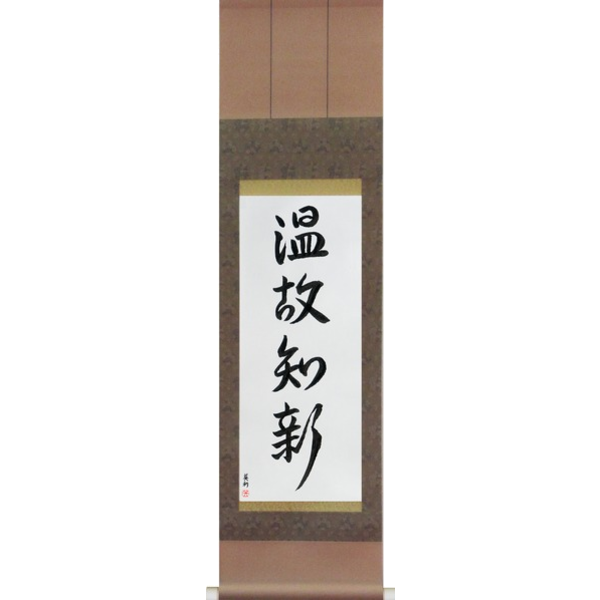
Sold as Respect the Past, Create the New · Read onko chishin; the catalogue writes it as one word, onkochishin, and the sounds are not in dispute · Oldest witness the Analects of Confucius, the eleventh saying of the chapter 為政; the four characters as a phrase in a Chinese edict of 23 BC and a Japanese one of 703 · Sense go back over what you once learned until it is alive again, and you will find in it something you did not know; a person who can do that is fit to teach.
The words
The line the scroll carries is four characters of a seven-character sentence. Confucius said 溫故而知新,可以為師矣, warm the old and know the new, and you may be a teacher; the phrase drops the connective 而 and keeps the two verbs and their objects. 故, ko, is the old, and the commentators are careful about what kind of old: 朱熹 glosses it 舊所聞, what one heard before, so it is one's own past learning, not the past as history. 知新, chishin, is to know the new; 朱熹 again, 新者,今所得, the new is what one gets now. The character every reader argues about is the first. 溫, on, is the ordinary word for warm, and the oldest commentary, 何晏's of the third century, glosses it 溫,尋也, 溫 means to seek out. Four centuries later 邢昺 explained why the two meanings are one, by quoting 鄭玄's note on the same phrase in the 中庸: 溫讀如燖溫之溫, read 溫 as the 溫 of reheating; learning you have let go cold is warmed until it can be eaten again, 猶若溫燖故食也. 朱熹 in the twelfth century kept both: 溫,尋繹也, to seek and draw out, in his note on the Analects, and 溫,猶燖溫之溫, like the warming of cold food, in his note on the 中庸. Japanese readers inherited the split as a choice of reading. 温ねて, tazunete, seeking out, is what the kunten printing of 何晏's commentary writes beside the character, what the 1910 proverb dictionary's headword says, and what the Edo saying said in kana, ふるきをたづねてあたらしきをしる; 温めて, atatamete, warming, is the reading the Iwanami paperback Analects adopts and one modern dictionary records as another view. Both are the commentaries' own, and the 1786 kana edition for town readers sidestepped the choice with 考へ溫て, think it over and warm it. The four-character reading is onko chishin, unambiguous since at least 1915, when 上田's romanized dictionary entered it as Onko-chishin; the modern dictionaries warn that writing 温古 for 温故 is an error. The English on the page, Respect the Past, Create the New, has no word in it for warming or seeking, turns the old into the past and know into create; it is a motto that uses the phrase, and it is looked at below.
A history, from the earliest witness
Fifth to third century BC. The Analects, 論語, chapter 為政, saying 11. 子曰:「溫故而知新,可以為師矣。」 The Master said: warm the old and know the new, and you may be a teacher of others. The saying is about who is fit to teach. Its neighbors are Confucius on his pupil 回, who is not stupid, and the line 君子不器, the gentleman is not a tool. [ctext.org/analects/wei-zheng, saying 11; text; an edition, not a manuscript]
The 中庸, the chapter of the 禮記 later made one of the Four Books, section 28. The phrase again, inside a portrait of the 君子: 溫故而知新,敦厚以崇禮, he warms the old and knows the new, and is thick and generous so as to honor the rites. This is the passage on which 鄭玄, in the second century AD, wrote the note that made 溫 a reheating, and every later commentator quotes him from here. [ctext.org/liji/zhong-yong, section 28; text]
23 BC. An edict of the emperor 成帝, in the 漢書. The four characters without 而, already a phrase. Explaining why the scholars of the imperial academy are called 博士, the edict says they should all be clear about old and new, warm the old and know the new, and understand the body of the state: 宜皆明於古今,溫故知新,通達國體,故謂之博士. The phrase's first life is as the job description of a teacher, which is what Confucius meant it as. [ctext.org/han-shu/cheng-di-ji, section 62; text]
Third century AD, with an eleventh-century commentary on it. 何晏's 集解, as carried in the 論語注疏. The note: 溫,尋也。尋繹故者,又知新者,可以為人師矣, 溫 means to seek out; one who seeks out and draws out the old, and also knows the new, may be a teacher of others. 邢昺's sub-commentary of the Song opens 此章言為師之法, this chapter tells the way to be a teacher, and defends the gloss with 鄭玄 and with the 左傳, where 尋 and 溫 are used of renewing a covenant: 言人舊學已精熟,在後更習之,猶若溫燖故食也, it says that what a man has already learned well he practices again later, like warming up old food. [ctext.org/lunyu-zhushu/wei-zheng; text, read through a fetch summarizer, which is a step removed from the page]
703. The 続日本紀, the court chronicle, under the third month of 大宝 3. The earliest Japanese use the 精選版日本国語大辞典 knows, and the earliest opened here: an order about provincial teachers, the 國博士, who by the new code were to be recruited from within the province and its neighbors. 下制曰。依令國博士於部内及傍國取用。然溫故知新希有其人。若傍國無人採用。則申省。然後省選擬更請處分, the order was given: by the code, provincial teachers are to be taken from within the province and the neighboring provinces; but men who warm the old and know the new are rare. If the neighboring provinces have no one to appoint, report it to the ministry, and the ministry will then select and propose candidates and ask for a decision. The year after the 大宝 code, the phrase arrives in Japan doing what it did in the Han edict: naming what a teacher must be. [6]
1177. 朱熹, the 論語集注. The Song commentary, printed in Japan again and again; the archive's classical return holds a 林羅山-pointed edition and this 1766 one. 溫,尋繹也。故者,舊所聞。新者,今所得。言學能時習舊聞而每有新得,則所學在我,而其應不窮,故可以為人師。若夫記問之學,則無得於心,而所知有限, 溫 is to seek out and draw out. The old is what one heard before; the new is what one gets now. It says that if in learning one can practice in season what one heard before and each time get something new, then the learning is in oneself and its answers are without end, so one may be a teacher of others. As for learning that is only memory and questions, it gets nothing in the heart, and what it knows has a limit. [7]
Sixteenth century. 清原宣賢's lecture notes on the Analects, 論語聴塵, a manuscript. The line with a Japanese gloss in katakana beginning 温故トハ, as for 温故…, in a cursive hand only partly legible on the leaf; it is enough to show the line being lectured on in Japanese, in the court scholar's tradition, before any printed commentary. [5]
Undated Edo printing. 何晏's commentary with Japanese reading marks, 論語集解. The line with the kana that tell a Japanese reader how to say it: 温 read タヅネテ, tazunete, seeking out, and 故 read フルキヲ, the old. This is the reading the older commentary implies and the one Japanese tradition took as first. [4]
Undated Edo printing. 荻生徂徠's 論語徴 with 西山元's head notes, 論語徴冠註. The head note above the line carries the whole Chinese chain into Japanese print: 何晏曰溫尋也。尋繹故者。皇侃引溫燖。又見中庸。鄭玄註溫讀如燖溫之溫。謂故學之熟矣。後時習之, 何晏 says 溫 is to seek; to seek out the old; 皇侃 cites 溫燖; it also appears in the 中庸; 鄭玄's note reads 溫 as the 溫 of reheating, meaning that old learning is well cooked and one practices it again later. [9]
1645, cited at second hand. 毛吹草, the first Japanese proverb collection. The 1910 proverb dictionary gives it as the Japanese source of the proverb in its kun form. The leaf was not opened. [藤井乙男, 諺語大辞典, 1910, at the headword below]
1694 to 1836. The saying in kana in Edo popular books. ふるきをたづねてあたらしきをしる, seek out the old and know the new, in a 1694 collection of honest tales, a 1791 comic book, an 1802 picture book and an 1836 book on go, among others; the Analects line had become a Japanese proverb in Japanese words. [pids 2533049, 9892710, 2553051 and the rest of the lab's return on the kana spellings; OCR only, none opened at the leaf]
1786. 渓百年's 経典余師, the Analects with a plain-Japanese gloss for readers without a teacher. The line with reading marks and, in the left column, the town reader's paraphrase: 故く習學たる事を考へ溫て自の工夫にて新き事を悟知して … 人の上に立て師と為ても可し, think over and warm what you once studied, and by your own effort come to know something new … then you may stand above others and be a teacher. [8]
1910. 藤井乙男, 諺語大辞典, the standard proverb dictionary. The headword in the kun form: 【故キヲ溫ネテ新シキヲ知ル】既往の成敗得失を見て、今の世の新しき事變に應用すべし。〔毛吹草〕。〔論語〕爲政篇、子曰溫故而知新、可以爲師矣, look at the successes and failures, gains and losses of the past and apply them to the new turns of the present world; Kefukigusa; the Analects, chapter 為政. It stands between abandon the old and take up the new, from the 楚辭, and a saying about rusty nails. The four-character form is cross-referenced to it. [10]
1915. 上田萬年's romanized dictionary, ローマ字びき國語辭典. Onko-chishin 溫故知新 もと學んだ所を復習して,新しい道理を發明する, to review what one first learned and discover a new principle. The earliest witness opened to the four-character reading in roman letters. [pid 1900620, scan 357, OCR]
Today. デジタル大辞泉: 過去の事実を研究し、そこから新しい知識や見解をひらくこと, to study the facts of the past and open new knowledge and views from them, with the note that the line is read 故きを温ねて新しきを知る, that some read 温 as あたためて, and that 温古知新 is a misspelling. 精選版日本国語大辞典: 昔のことを研究して、そこから新しい知識や道理を見つけ出すこと, with the 703 edict as first citation and the 漢書 as the Chinese one. 四字熟語を知る辞典 gives examples from 坪内逍遙 in 1891, 石坂洋次郎 in the 1930s and 五味川純平 in 1978, and notes that the Iwanami paperback Analects reads あたためて while the character dictionaries give both. [kotobank.jp/word/温故知新; text]
The sense across time
The sense has not moved in two thousand years, and the argument has never been about it. From 何晏 to the modern dictionaries the line means one thing: what you learned once and let cool, take up again until it is alive, and in doing so you will know something you did not know. What the tradition argues about is the picture inside the first character, seek out or warm up, and the commentators' answer since the Song has been that the two are one act. What shifts is the object. For Confucius and the Han edict the line describes a teacher, and the Japanese court used it that way in 703. For 朱熹 it is a theory of learning against rote: knowledge held only as memory has a limit, knowledge warmed until it lives answers without end. The Edo proverb books turned it outward, from one's own learning to the past in general, and 藤井's 1910 gloss, look at the successes and failures of the past and apply them to the present, is where the modern dictionaries' study the facts of the past comes from. The house motto, tradition and innovation, is the last step of that widening, and a real modern use of the phrase in school and company mottoes; it is not what the sentence says.
What is not a source
The 中庸 is not a second origin; it is the same phrase in a second canonical book, and matters because 鄭玄's note on it is where the reheating reading comes from. The 漢書 edict and the 続日本紀 edict are the phrase's earliest uses, not its source, which is the Analects. 温古知新, with the character for antiquity, is a modern misspelling the dictionaries warn against, not a variant. And Respect the Past, Create the New is not a translation from any translator; no rendering opened, from Legge in 1861 to the modern glossaries, has respect or create in it.
The text in English
The Analects reached English before any Japanese proverb book did, so the lineage here is the sinologists', and every Japanese-English equation descends from them. 1861. James Legge, The Chinese Classics, volume 1. If a man keeps cherishing his old knowledge, so as continually to be acquiring new, he may be a teacher of others. Legge's is the sentence every later translator answers; his cherishing is a third reading of 溫, neither seeking nor warming. [quoted from ctext's parallel text and from Soothill's apparatus; Legge's own page not found in the two archive.org scans pulled] Angelo Zottoli, in Latin; Séraphin Couvreur, in French; Ku Hung-ming, in English. Recole antiqua et hinc deduc nova, et poteris fieri praeceptor; Celui qui repasse dans son esprit ce qu'il sait déjà, et par ce moyen acquiert de nouvelles connaissances; If a man will constantly go over what he has acquired, and keep constantly adding to it. All three are quoted as Soothill printed them, the lineage as a reader in Yokohama saw it in 1910; their own editions and dates were not opened. 1910. William Edward Soothill, The Analects of Confucius, Yokohama, pages 160 to 161. The Master said: 'He who keeps on reviewing his old and acquiring new knowledge may become a teacher of others.' In his note he gives the literal, Warm up your old and learn the new, sets the line beside the scribe of Matthew who bringeth forth out of his treasure things new and old, a reference his note prints as Mt XII. 52, and prints Legge, Zottoli, Ku and Couvreur under it. Soothill translates the character both ways on one page, which is the commentators' position exactly. [archive.org, analectsofconfuc00confrich, full text; a printed book, checkable by a reader who holds it or the scan] 1915. 上田萬年. Onko-chishin, glossed in Japanese only; the four-character word is absent from Hepburn's dictionary of 1872 and from fourteen other Japanese-English dictionaries of 1904 to 1929 swept in the archive, three of which carry onko only as other words.
Today. The EDRDG dictionary the site's own dictionary carries gives developing new ideas based on study of the past; learning from the past, and keeps study, which is the half of the line the page loses. The house title, Respect the Past, Create the New, is on both pages that sell the design; the catalogue's own explanation, review the old to know the new, is right and is printed on neither. What a rendering must keep: two verbs, one for the old and one for the new; the old as what you yourself once learned; and the teacher at the end of the sentence, whom every short form drops.
A reading
The design is sound, the reading is sound, and the text is as old and as clean as anything in the catalogue: four characters unchanged from a Han edict to a Japanese one to a scroll, with a canon address anyone can open. The one defect is the English, and it is worth fixing because the sentence is better than the motto. Respect the Past, Create the New is a fair account of how the phrase is used on a Japanese company wall; it is not what Confucius said, and a customer buying his sentence should be told the sentence. The catalogue already has it right, review the old to know the new, and that line belongs on the page with the motto under it. The story worth telling is the one word. For two thousand years readers have asked whether 温 means to seek out or to warm up, the commentaries say both and mean it, and the Japanese still read it either way. I would give a buyer the older picture, because it is the better one and the one the character actually shows: learning gone cold, heated until it answers. Under it, the addresses: the Analects, chapter 為政, saying 11; and a Japanese court order of 703 complaining that men who can do this are rare. Signed, 典, 2026-09-05.
How this was read
By eye: the 703 edict in the 1900 typeset and the 1766 printing of 朱熹, both re-read on the day of writing; the kunten printing of 何晏's commentary for the reading; 徂徠's head note; the 1786 kana edition; 清原宣賢's manuscript, partly; and 藤井's 1910 dictionary at the headword. By text at the address: the Analects, the 中庸, the 漢書 and the 論語注疏 at ctext, the last through a fetch summarizer; the three kotobank dictionaries; every National Diet Library leaf named above at the page API, re-fetched by a second reader on the day of writing; Soothill in the archive.org text layer; 上田 1915 and the bilingual dictionaries by OCR from the archive; the Edo kana saying by OCR only. Not opened: Legge at his own page; 皇侃's 義疏; 伊藤仁斎; 徂徠's own text beyond the head note; the Iwanami paperback Analects; Waley, Lau and the later English translators, all in copyright; 毛吹草 at its leaf; the 1691 and 1883 printings of the 続日本紀; 逍遥's 梓神子; Zottoli, Couvreur and Ku in their own editions. Every address in this history is a text address except the leaves named by eye, and each of those has a page-API text address beside it, with the warning where the OCR layer misreads the leaf; Soothill and Legge are printed books, checkable by a reader who holds them or a scan. The full apparatus, with every address, is in the account.
References
- 論語 為政 11 (5th–3rd c. BC text; ctext's edition) — ctext analects/wei-zheng 11
- 中庸 28 (the 禮記 chapter; ctext's edition) — ctext liji/zhong-yong 28
- 漢書 成帝紀, 陽朔二年 (23 BC) edict (1st c. AD) — ctext han-shu/cheng-di-ji 62
- 論語集解 (何晏, 3rd c.), a Japanese kunten printing (Edo) — pid 2532143 scan 8, by eye ↩
- 論語聴塵 (清原宣賢, 1475–1550), manuscript (Muromachi) — pid 2544950 scan 54, by eye ↩
- 続日本紀, 大宝三年三月丁丑 (703; the 797 chronicle; 1900 typeset) — pid 1089485 scan 4, by eye ↩
- 四書集註 (朱熹, 1177), 1766 printing (Edo) — pid 2583036 scan 19, by eye ↩
- 経典余師 (渓百年), kana edition (1786) — pid 2599283 scan 22, by eye ↩
- 論語徴冠註 (徂徠's text, 西山元's head notes) (Edo) — pid 2560576 scan 79, by eye ↩
- 諺語大辞典 (1910) — pid 862766 scan 468 = p. 900, by eye ↩
- The catalogue and both live pages (2026) — cultural_works.csv:354