

正勝吾勝 · masakatsu agatsu · True victory is victory over oneself
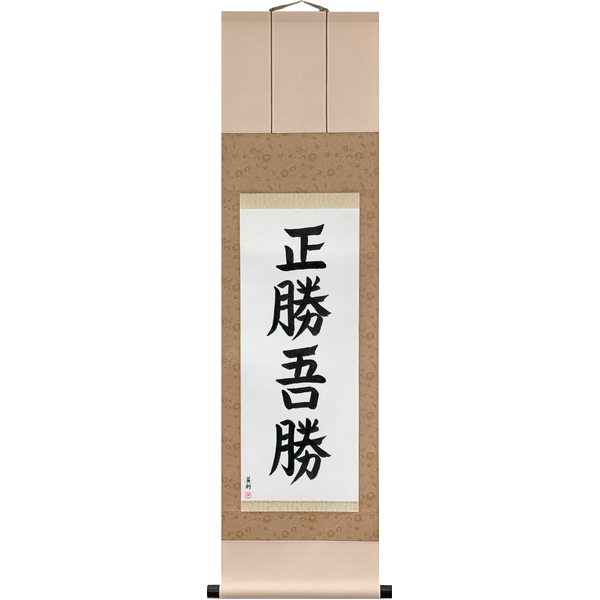
Sold as True Victory is Victory Over Oneself · Read masakatsu agatsu, the aikido reading; the old books read the same characters masakatsu akatsu · Oldest witness the 古事記, 712, where the four characters open the name of a god · Sense at the source, Susanoo's cry truly, I have won, fixed in his son's name; in aikido, since Ueshiba Morihei took it as his motto, the maxim that the only real victory is the one over oneself.
The words
Four characters, two words repeated. 正 masa, right, true. 勝 katsu, to win. 吾 a, I, myself; in the aikido reading the second word is voiced, agatsu. 勝 katsu again. Read as the martial-arts world reads them, the characters say true victory, self victory, and the catalogue's character glosses, correct; true · victory · self · victory, are right one by one. They are also the first four characters of an eight-character name, 正勝吾勝勝速日天忍穂耳, and read in that name they say something else. The 日本書紀 carries a pronunciation note for 正勝 in an earlier passage, where the same two characters name a mountain god: masaka, an adverb, truly, indeed. 吾勝 is a katsu, I have won. 勝速日 katsuhayabi, the two characters that follow the design's four, are glossed by the great Edo commentator 本居宣長, in the words of the Meiji scholar 飯田武郷 who quotes him, as the state the 古事記 calls 勝ちさび, the elation of victory: 速 swift, fierce, violent, and 日 the -buru of ちはやぶる, so victory-raging. The rest of the name, 天忍穂耳, is about rice: the mighty spirit of the rice ear, in the reading of 西宮一民's encyclopedia entry. The eight characters together are a shout and a title, not a maxim. What the aikido reading did with them is the history.
A history, from the earliest witness
712, the 古事記, first book, the oath between Amaterasu and Susanoo, read in the 柏悦堂 typeset of 1870. Susanoo has come up to the plain of heaven and his sister suspects him. To prove his heart they swear an oath and bear children from each other's things: she chews his sword into three goddesses; he asks for the jewels twisted in her left hair-bunch, rinses them in the well of heaven, chews them and blows: 於吹棄氣吹之狹霧所成神御名正勝吾勝勝速日天之忍穗耳命, the god who came into being in the mist of his breath as he blew them away was named Masakatsu-akatsu-kachihayahi-ame-no-oshihomimi-no-mikoto. Four more gods follow from the other jewels. Then Susanoo boasts: 我心清明故我生之子得手弱女。因此言者、自我勝云而、於勝佐備, my heart being pure, the children I bore were gentle girls; by this token I have won, and saying "I have won", in the elation of victory he breaks down the dikes of his sister's rice fields and fouls the hall of the first-fruits feast. The name and the cry are two lines apart, and the cry explains the name. [5]
712, the same book, the commission of the land. When the land below has been pacified, Amaterasu commands: 豐葦原之千秋長五百秋之水穂國者我御子正勝吾勝勝速日天忍穗耳命之所知國, the land of the plentiful reed plain and the fresh rice ears of a thousand autumns, of five hundred autumns, is the land my child Masakatsu-akatsu-kachihayahi-ame-no-oshihomimi is to rule. He stands on the floating bridge, looks down, finds the land in uproar, and comes back up. Later, commanded again as 太子, the heir, he answers that a son has been born to him meanwhile and that the son should go instead. The son is 瓊瓊杵, who descends, and whose great-grandson is the first emperor. So the god whose name the design opens is the one link between the sun goddess and the imperial line that never came down to earth. [5]
720, the 日本書紀, first book, the age of the gods, read in the print of 1599. The court chronicle tells the same oath and writes the name 正哉吾勝勝速日天忍穂耳尊, with 哉, the exclamation, where the 古事記 has 勝. It then does what the 古事記 does not: it gives the etymology in so many words, in the third of the variant accounts it appends to the episode. A boy forms in Susanoo's left palm from the jewels, 則稱之曰正哉吾勝、故因名之曰勝速日天忍穗耳尊, then he exclaimed "Truly, I have won!", and therefore named him Katsuhayahi-ame-no-oshihomimi. The first four characters of the name are a quotation of what the father said. The chronicle's first variant adds that by the birth of sons Susanoo obtained the proof of his victory, and the sun goddess knew his heart was clean. [11]
1798, 本居宣長, 古事記伝, seventh book, read as 飯田武郷 quotes it in 1902. The commentary that fixed how the 古事記 is read glosses the name clause by clause: 言意は正しき哉と云むか如し。吾勝は、記に自我勝云而、とある意なり, the sense of the words is as if to say "truly!"; "I have won" is the sense of the 古事記's own line, "saying I have won"; and 勝速日 is the same in sense as the book's "in the elation of victory". 宣長 also answers the question the name begs. The 古事記 rules that the five sons are Amaterasu's, because the jewels were hers; why then does the eldest carry Susanoo's boast in his name? Because, he says, 吾勝てふ御名は、吹成たまふ主に就て負せ奉しものぞ, the name "I have won" was laid on him after the one who breathed him out. The name records who won the oath, not whose child he is. [13][14]
1597 to 1944, the name in print, by the count. The National Diet Library's full-text index over its public-domain books returns 607 books that carry 正勝吾勝 and 1,441 that carry 正哉吾勝, from a 1597 manuscript of the age-of-the-gods chapters and the 1599 print onward: every edition and commentary of the two chronicles, the genealogies and shrine books, the Meiji national histories, the 1930s books on the Japanese spirit. Their titles were screened for a martial-arts book, a jūjutsu manual, a dōjō, anything with 武 or 剣 or 柔 in it that is not a personal name. There is none. For twelve centuries the four characters are a god's name and nothing else. [The searches and every hit are filed with the account.]
1921, 出口王仁三郎, 記紀真解. Ōmoto, the new religion whose believer Ueshiba Morihei was by the government's own account below, read the chronicles as living scripture, and its co-founder's 1921 commentary quotes the commission of the land in full, with the god's name glossed in small kana: まさかあかつかつはやひあめのおしほみゝのみこと. This is the reading of the 日本書紀 laid over the characters of the 古事記, and it is the book's reading of the name that Ueshiba's motto would shorten. [15]
1937, the Ministry of Justice, report on the Ōmoto case. After the sect's suppression in 1935 a prosecutor of the Kyoto district court wrote up its organization for the ministry's research series. Among the front organizations he lists a 大日本武道宣揚會, the Great Japan Society for the Promotion of Budō, founded in July 1932: 合氣武道と稱する一種の柔道に鍛鍊せる皇道大本信者守高事植芝盛平が皇道大本內の信者に此の武道を習得せしめんと策動し居りたるを、出口王仁三郞が之を利用し, a kind of jūjutsu called aiki-budō, in which the Ōmoto believer Ueshiba Morihei, known as Moritaka, had trained; he was scheming to have the believers inside Ōmoto learn it, and Deguchi Onisaburō turned this to the sect's ends. Its master, 範主, is 植芝守高; its membership, the report says, was claimed at some thirty thousand. This is the one prewar document opened for this history that puts Ueshiba, his art, and the church that read the 古事記 aloud in a single sentence. It does not carry the four characters. [16]
1934 and 1938, Ueshiba's own books. 武道練習, mimeographed in 1934, and 武道, printed privately in 1938, survive at the National Diet Library as bound copies each closed with a note in his brush over the seal 植芝守高. They are not digitized and were not read; whether either carries the four characters is not established here. The aikido literature dates the motto to the founder's mature years and says he brushed it without end. [NDL catalogue records only.]
1976 and 1986, the compilations of his words. The saying the aikido world attaches to the four characters is carried by two posthumous books of Ueshiba's talks, 武産合気 and 合気神髄. The dōjō pages that quote them give it as 真の武は、正勝、吾勝、勝速日であるから、いかなる場合にも絶対不敗である, true budō is masakatsu, agatsu, katsuhayabi, and is therefore undefeated in every case, with the gloss that to be undefeated is to contend with nothing and that to win is to defeat the contending mind in one's own heart; and as 正勝、吾勝、勝速日とは武産合気ということであります, masakatsu agatsu katsuhayabi means takemusu aiki, the art that gives birth to techniques of itself. None of the pages cites a page number and neither book was opened for this history; the sentences are reported, and the English books below translate them. [See the account's witness table for the pages and the editions.]
The sense across time
The tradition holds one sense for twelve centuries and then a second, and the two do not compete because they are not about the same thing. In the chronicles and everything written from them, 正勝吾勝 is the opening of a name, and the name preserves a cry: Susanoo, having won the oath, crying that he has won, and in the next line raging in his victory across his sister's fields. The commentators from 宣長 to 西宮 read it that way and no other. From Ueshiba onward, in aikido, the same four characters are a maxim about what winning is: 正勝, the right kind of victory, is 吾勝, victory over oneself, and 勝速日, the six-character form's tail, is that victory won at once, now, at the speed of the sun. The founder took a god's name from the book his church read aloud and read a teaching into its first six characters. He did not coin the characters; he coined the reading, and the reading is what the design sells.
What is not a source
The maxim is often set beside the Dhammapada's verse that one who conquers himself is greater than one who conquers a thousand men in battle, and Stevens, right after his literal rendering, sets it beside a teaching he calls akin to it, which the search snippet cuts off before naming. That is a pairing, not a source: nothing opened here connects Ueshiba's reading to any Buddhist verse, and the characters come from the 古事記. Nor is the design a proverb or a yojijukugo of the ordinary kind; no Japanese dictionary opened for this history has a headword 正勝吾勝, and the one bilingual entry that does, in JMdict, is an aikido entry that repeats the coined by Ueshiba story.
The text in English
The name entered English before the maxim did, and as a name. 1882, Basil Hall Chamberlain, Ko-ji-ki, or Records of Ancient Matters, Section XIII. His Augustness Truly-Conqueror-I-Conquer-Conquering-Swift-Heavenly-Great-Great-Ears, hyphen for hyphen, a name translated as a name; at Section XXXIII, the commission, he drops one Conquering. [en.wikisource's transcription, as text; the page, 48, from Aston's cross-reference.] 1896, W. G. Aston, Nihongi: Chronicles of Japan from the Earliest Times to A.D. 697, vol. 1, London, published for the Japan Society by Kegan Paul, Trench, Trübner, as Supplement I to its Transactions and Proceedings, pp. 35–40. Aston romanizes, Masa-ya-a-katsu-kachi-hayabi-ama no oshi-ho-mimi no Mikoto, footnotes Chamberlain's page with his own gloss, Truly-I-conquer-conquer-swiftness-heaven-of-great-great-august-person, and in the third variant account renders the cry as English speech: He then said:—"Truly I have won." And the child was therefore called Katsu no haya-hi ama no oshi-ho-mimi no Mikoto. [archive.org, the OCR text of nihongi1asto, as text.] Neither man knew the four characters as a saying, because in their day they were not one.
The maxim comes into English through the founder's son and his American translators, and every witness below was read as a full-text search snippet on the Internet Archive, dated and numbered from the scan's metadata, not at the page. 1985 printing, Ueshiba Kisshōmaru, Aikido, Tokyo, Hozansha, a translation of 合気道 and 合気道技法, p. 14, ISBN 0870406299. AIKI-VICTORY — or masakatsu agatsu — means, "Truth is victorious; therefore I …, the sentence running past the snippet's edge; the earliest English rendering found, and it reads 正 as truth, not true. 1987, John Stevens, Abundant Peace: The Biography of Morihei Ueshiba, Boston, Shambhala, ISBN 0877733503. … victorious because of his reliance on Masakatsu-agatsu, "True victory is self-victory." 1991, Stanley Pranin, The Aiki News Encyclopedia of Aikido. MASAKATSU AGATSU. Correct victory; …, under a reproduction of the founder's calligraphy of the phrase. 1992, Morihei Ueshiba, The Art of Peace, translated by John Stevens, Shambhala; the 2002 edition read, ISBN 1570629641. The heart of the Art of Peace is: True Victory is Self-Victory; Day of Swift Victory! "True Victory" … it contends with nothing. Rely on True Victory is Self-victory, Day of Swift Victory and you will be …, the saying from the compilations in Stevens's English, with 勝速日 as Day of Swift Victory. 1993, The Essence of Aikido: Spiritual Teachings of Morihei Ueshiba, compiled by Stevens, Kodansha International; the 1999 printing read, ISBN 477002357X, pp. 28–31. Morihei took Masakatsu-Agatsu-Katsuhayabi as his motto and explained it like this: The heart of Aikidō is: True Victory is Self-Victory, Day of Swift Victory!, and a note that the name is variously pronounced Masakatsu-Akatsu-…, the only English book found that records the older reading. 1995, John Stevens, The Secrets of Aikido, Shambhala, ISBN 1570620067, chapter "Masakatsu Agatsu Katsuhayabi: True Victory", p. 104. … may be literally translated as "True victory is victory over oneself." (This notion is akin to the teaching …, and two of the founder's teaching-verses on the phrase. This is the sentence the house's title is taken from. 1997, John Stevens, Invincible Warrior: An Illustrated Biography of Morihei Ueshiba, Shambhala; the 1999 printing read, ISBN 0834830167. Masakatsu Agatsu, "True victory is victory over oneself," (top) and Katsuhayabi, "Victory …, captioning the calligraphy, and a photograph of Morihei in the Hombu Dojo brushing "Masakatsu Agatsu". 2001, John Stevens, The Philosophy of Aikido, Kodansha International, ISBN 4770025343. The last major principle of Aikido philosophy is masakatsu agatsu katsu hayabi … A close translation of the entire phrase … would be: "True victory is victory over oneself, right here, right now!" Masakatsu agatsu katsu hayabi was Master Ueshiba's most frequent … 2004, Ueshiba Kisshōmaru, The Art of Aikido, Kodansha. Budo is masakatsu, agatsu, katsuhayabi — "True Victory is Self-Victory, Victory Right Now!" 2007, The Secret Teachings of Aikido, Kodansha, ISBN 9784770030306. We must rely on the battle cry Masakatsu agatsu katsuhayabi … Masakatsu means unflinching. Agatsu …; battle cry is closer to the 古事記 than its author perhaps knew. 2010, The Heart of Aikido: The Philosophy of Takemusu Aiki, Kodansha, the 2013 printing read, ISBN 9781568365145. Masakatsu agatsu katsuhayabi (True Victory is Self Victory Right Here, Right Now).
Today. JMdict enters 正勝吾勝 as まさかつあがつ, an expression and a yojijukugo, glossed true victory is victory over oneself, with the note coined by the founder of Aikido, Morihei Ueshiba. The house's title, True Victory is Victory Over Oneself, is John Stevens's literal rendering of 1995, and his credit stands; the house's 2019 custom-scroll title for the six-character form, True Victory is Victory Over Oneself, Victory Right Here Right Now, is his 2001 one. A rendering of this line must keep the two victories as two and the second as one's own: not self-confidence, not inner strength, but a victory, and over oneself.
A reading
The design is right and the page's story under it is wrong in the one place that matters, and the true story is better. Eri brushes the first half of the name of the god who stands between the sun goddess and the emperors and who never came down to earth. At the source the four characters are a shout, Susanoo's, truly, I have won, and the book that records it has him wrecking his sister's rice fields in the next line, drunk on the winning. That the founder of a martial art with no matches chose this shout for his motto, and read it as the defeat of the fighting mind in one's own heart, is the whole interest of the phrase, and a buyer can be told it in two sentences: the characters are twelve hundred years old and belong to a god; the meaning is Ueshiba's, and it turns a victory cry inside out. I propose no change to the design, the romaji or the title. The page should stop saying the phrase was coined by Ueshiba, and say instead that he took it from the 古事記 and made it mean what it means. The reading of 吾 as ga, which the aikido world uses and the chronicles do not, is a fact about the motto, not a defect in it.
How this was read
By OCR at the National Diet Library's next-generation digital library, with the scan number as part of each address: the 古事記 in the 柏悦堂 typeset of 1870 (pid 772088, scans 24, 25, 47, 56); the 日本書紀 in the 1599 print (pid 1286872, scans 27, 29, 31, 40, 50); 飯田武郷's 日本書紀通釈 (pid 992400, scans 176, 193); the 1930 typeset of the 古事記伝 (pid 1041627, scan 184); 出口王仁三郎's 記紀真解 (pid 926081, scan 8); the Ministry of Justice report (pid 1886676, scans 2, 73, 74). A leaf named as pid P, scan N has its text at lab.ndl.go.jp/dl/api/page/P_N and its image at dl.ndl.go.jp/api/iiif/P/R<N as seven digits>/full/full/0/default.jpg; the text door for scan 24 of the 古事記 was opened and carries the name. As text: Chamberlain's Sections XIII and XXXIII at en.wikisource; Aston's first volume as the OCR text of the Internet Archive's copy; kotobank's three entries on 天忍穂耳尊, whole; JMdict's entry through the gokanji database; the National Diet Library's full-text index on five spellings, every hit listed; the Internet Archive's full-text index on four English spellings, snippets only, with each book's date and ISBN from its scan record. By eye: the scroll template. Not opened: 武産合気 and 合気神髄, where the saying's Japanese lives; Ueshiba's 1934 and 1938 books; Kisshōmaru's 1957 合気道; the English aikido books at the page; Philippi's Kojiki; the 古事記伝 at its own leaf; the 1597 manuscript. A printed book checks only for someone holding it, and the ISBNs above are for that.
References
- The design (ours) (—) — template M1019SSVB6A, by eye; cultural_works 442; whole_designs.csv:654
- 古事記 上巻, the birth of the five gods at the 誓約 (712 (read in the 柏悦堂 typeset, 1870)) — NDL pid 772088 scan 24, OCR; text door `lab.ndl.go.jp/dl/api/page/772088_24`; image `dl.ndl.go.jp/api/iiif/772088/R0000024/full/full/0/default.jpg`
- 古事記 上巻, Susanoo's boast (712 (1870)) — pid 772088 scan 25, OCR; image R0000025 (200)
- 古事記 上巻, the commission (712 (1870)) — pid 772088 scan 47, OCR
- 古事記 上巻, the 太子 and his answer (712 (1870)) — pid 772088 scan 56, OCR ↩
- 日本書紀 巻一 神代上 第六段, main text (720 (read in the 慶長4 = 1599 print)) — NDL pid 1286872 scan 27, OCR; image R0000027 (200, 4.0 MB)
- 日本書紀, 一書第一 (720 (1599)) — pid 1286872 scan 29, OCR
- 日本書紀, 一書第二 (720 (1599)) — pid 1286872 scan 31, OCR
- 日本書紀, 一書第三 — the book's own etymology (720 (1599)) — pid 1286872 scan 31, OCR; image R0000031 (200)
- 日本書紀, a later 一書 (six sons) (720 (1599)) — pid 1286872 scan 40, OCR
- 日本書紀 巻二 神代下, opening (720 (1599)) — pid 1286872 scan 50, OCR ↩
- 本居宣長『古事記伝』卷七 on the name, quoted by 飯田武郷 (1798 (quoted 1902)) — 飯田武郷『日本書紀通釈』第1, 明治書院, NDL pid 992400 scan 176, OCR; image R0000176 (200)
- 飯田武郷, the 一書第三 with its kunten (1902) — pid 992400 scan 193, OCR; image R0000193 (200) ↩
- 本居宣長『古事記伝』, the 1930 typeset, on whose name it is (1798 (吉川弘文館 校訂 1930)) — NDL pid 1041627 scan 184, OCR (double-column, the passage scrambled around these clauses); the entry gloss itself was read only as 飯田 quotes it ↩
- 出口王仁三郎『記紀真解』, the commission with furigana (1921) — 皇道大本大日本修斎会, NDL pid 926081 scan 8, OCR; image R0000008 (200) ↩
- 司法省調査課『報告書』8, 第六項 大日本武道宣揚會 (1937 (submitted 1936-11-30)) — NDL pid 1886676 scans 73–74, OCR; image R0000073 (200) ↩
- 植芝盛平『武道練習』 · 『武道』 (1934 · 1938) — NDL catalogue records only (R100000136-I1970867909769034925 · -I1970867909913662259); NOT digitized, NOT opened
- kotobank, 天忍穂耳尊 (current) — https://kotobank.jp/word/天忍穂耳尊-427113, whole entries
- kotobank, 正勝吾勝 as a headword (current) — controls 温故知新 → 301, 燕雀来賀 → 404
- JMdict 2861876 (current) — gokanji/data/gokanji.db, 2026-09-06
- The NDL Lab full-text index, pre-1945 (1597–1944) — `backlog_reading_2026-09-06/442_masakatsu_agatsu/laball_*.tsv`
- Chamberlain, *Ko-ji-ki*, Sect. XIII (1882) — en.wikisource, Kojiki (Chamberlain, 1882)/Section 13, TEXT; Aston's cross-reference gives Chamberlain p. 48
- Chamberlain, Sect. XXXIII (1882) — en.wikisource, …/Section 33, TEXT (*Conquering* dropped here)
- Aston, *Nihongi*, vol. 1, main text (1896) — archive.org `nihongi1asto` djvu text, pp. 35–36 (running heads), TEXT
- Aston, 一書第一 (1896) — same, p. 37
- Aston, 一書第三 (1896) — same, p. 40
- Ueshiba Kisshōmaru, *Aikido*, Hozansha (1985 printing (a translation of 合気道 and 合気道技法; ISBN 0870406299)) — archive.org `aikido0000uesh`, full-text search snippet; NOT opened
- John Stevens, *Abundant Peace*, Shambhala (1987 (ISBN 0877733503)) — `abundantpeacebio00stev`, snippet
- Stanley Pranin, *The Aiki News Encyclopedia of Aikido* (1991) — `aikinewsencyclop0000stan`, snippet
- Ueshiba Morihei, *The Art of Peace*, tr. Stevens, Shambhala (1992 (scan: 2002 ed., ISBN 1570629641)) — `artofpeace0000uesh` · `_a7l8`, snippets
- Ueshiba Morihei, *The Essence of Aikido*, comp. Stevens, Kodansha (1993 (scan: 1999 printing, ISBN 477002357X)) — `essenceofaikidos0000uesh`, snippets
- Stevens, *The Secrets of Aikido*, Shambhala (1995 (ISBN 1570620067)) — `secretsofaikido0000stev`, snippets
- Stevens, *Invincible Warrior*, Shambhala (1997 (scan: 1999, ISBN 0834830167)) — `invinciblewarrio0000stev`, snippets
- Stevens, *The Philosophy of Aikido*, Kodansha (2001 (ISBN 4770025343)) — `philosophyofaiki0000stev`, snippets
- Ueshiba Kisshōmaru, *The Art of Aikido*, Kodansha (2004) — `KisshomaruUeshibaArtOfAikido` (an uploaded copy, 2015), snippet
- Ueshiba Morihei, *The Secret Teachings of Aikido*, Kodansha (2007 (ISBN 9784770030306)) — `secretteachingso0000uesh`, snippets
- Ueshiba Morihei, *The Heart of Aikido: The Philosophy of Takemusu Aiki*, Kodansha (2010 (scan: 2013, ISBN 9781568365145)) — `heartofaikidophi0000unse`, snippets
- The Japanese wording of the saying, as the dojo pages give it (1976 · 1986 (the books; the pages 2011–2025)) — REPORTED: aiki-net.org (2011), o-katsuhayahi.com (2025), note.com/matsurugi (2021), none with a page; the source books 武産合気 (白光真宏会出版局; 1986 ed. ISBN 4-89214-080-5) and 合気神髄 (柏樹社 1990; 八幡書店 2024 ISBN 9784893509604) NOT opened
- The house (2004 → 2026) — web.archive.org CDX; the live page curled 2026-09-06
Books Cited
The books this article cites. Buying one supports its author.