

Five of Funakoshi's twenty precepts · 空手に先手無し · 先づ自己を知れ而して他を知れ · 技術より心術 · 心は放たん事を要す · 常に思念工夫せよ
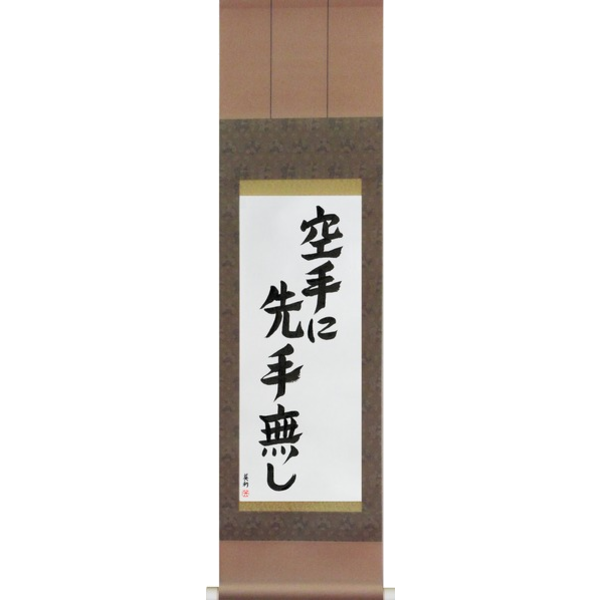
Sold as There is No First Attack in Karate · First Know Yourself Then Know Others · Spirit Over Technique · The Mind Must Be Set Free · Always Be Creative · Read karate ni sente nashi · mazu onore wo shire shikashite ta wo shire · gijutsu yori shinjutsu · kokoro wa hanatan koto wo yōsu · tsune ni shinen kufū seyo · Oldest witness for the list, a photograph printed in a 1938 book on karate, as the encyclopedias cite it; for two of the five sentences, a tea-and-Zen book of 1905 and a kendo manual of 1920 · Sense five rules of conduct from the founder of Shōtōkan karate, in the written Japanese of the late Meiji; two of them were standing Japanese sentences before they were karate's.
The words
The twenty precepts are written in the formal Japanese of their day, and the scrolls keep it: 先づ with づ, 而して, 放たん, 要す. Four scrolls match the list character for character; the first writes 先手無し where the list has 先手なし, the same word with the kanji for the kana. The words that carry the five: 先手, the first move, the term from go and shōgi; 自己 and 他, self and others, with 自己 read onore by the house and jiko by the English lists, both real readings of the same characters; 心術, the mind's bearing, a word whose first citation in the 精選版日本国語大辞典 is Dōgen's 正法眼蔵 and whose second sense is Kant's Gesinnung, a Zen word before it was a karate one; 放つ, to set loose what was confined; 思念, thinking on, in Japanese since the 日本霊異記; and 工夫, which in ordinary Japanese is devising a way and in Zen is giving oneself to practice, both senses live in 思念工夫. The five as words: in karate there is no first move · first know yourself, then know others · the mind's bearing over the technique · the mind needs letting loose · always think and work it out.
A history, from the earliest witness
1905. 田中仙樵, Tea and Zen Are One Taste (茶禅一味), 光融館. The oldest witness for any of the five, and it is not karate. In a passage on the mind at tea, the book sets Mencius's 求放心, seek the strayed mind, against a Song philosopher: 又邵康節と云者は、心は要ㇾ放と申候, but one 邵康節 says the mind must be let go, writing the Chinese 心要放 with the Japanese reading, はなたんことをようす, beside it as furigana. It resolves the two through the Chan master 中峰: 心をとらへ結て置ては、つながれ猫の樣にて、身が働かれぬぞ, tie the mind down and it is a tethered cat; the body cannot work; let it go where it will, as the lotus takes no mud, and 至極の心持は、邵康節が心は放たん事を要せよといふにて候, the highest state of mind is what Shao Kangjie meant by "the mind must be let loose". The sixth precept's sentence, character for character, is the Japanese reading of that three-character Chinese line, in print thirty-three years before the list, and credited to Shao Yong (1011–1077). The book carries an internal copying date of 1715 for the passage. [3]
1920. 高野佐三郎, A Manual of Japanese Kendo (日本剣道教範), 朝野書店. The twentieth precept's words as a chapter heading in the standard kendo manual of the day: 其三 思念工夫の要, third, the necessity of thinking and devising, with the rule 一、思念工夫觀察實驗すべし, think, devise, observe, test, and the text: theory and practice are neither first nor second; note your own habits in every bout, ask seniors your faults, watch others, 常に思を凝らし工夫を積み、思ひ附くことあれば之を實地に試み, always think hard and pile up devices, and whatever you hit on, try it on the floor, ending 常に思念工夫し實地の練習と相俟ちて蘊奥に到らんことを心懸けざるべからず. The compound 思念工夫 is budō-manual vocabulary from at least 1894, when a 武道教範 uses it of sparring. [4]
1902 to 1943. 先づ自己を知れ in fifteen books, none about karate. The fourth precept's first clause is the Japanese of know thyself: a 1911 study of Christianity writes ソクラテスが『先づ自己を知れ』と叫びたるは千古の格言, Socrates' cry "first know yourself" is the maxim of all ages. The phrase was moral-education Japanese before it was a precept. [NDL search, keyword 先づ自己を知れ, 15 hits; text]
1938. 仲宗根源和, A Survey of Karate-dō (空手道大観), the frontispiece. The earliest print anyone names for the twenty as a list. The Japanese encyclopedia gives the list as 空手二十箇条 and cites this book's frontispiece photograph, dated 3 May 1938; the English encyclopedia cites the same book. The book is not in the National Diet Library's digital collection and was not opened, and neither were Funakoshi's own five pre-war books, which are not there either. So the list rests, in this history, on one encyclopedia tradition citing one photograph. That is the honest footing, and the precepts are Funakoshi's by every tradition that has them. [ja.wikipedia.org/wiki/船越義珍, § 松濤二十訓, with its footnote; text; the 1938 book not opened]
Today. The two lists in English that were opened render the five three ways each and credit no translator; the house's own is a fourth. [en.wikipedia.org/wiki/Nijū_kun; chilternkarate.co.uk; text]
The sense across time
Each precept holds one sense and the tradition does not argue it; what the reading adds is where the words came from. The sixth is a Song philosopher's line as the tea and Zen tradition carried it, and its sense in karate is the tea book's sense: a mind tied to one thing cannot work the body. The twentieth is a kendo master's rule for practice, and its sense is his: thinking and devising, then testing on the floor, as one discipline. The fourth's first clause is Socrates in the Japanese of the schoolroom. Whether Funakoshi took these from the tea book, the kendo manual and the moral primer, or reached them by the same road, the sources do not say; what they say is that the words were standing Japanese before the list, and that the founder of a modern art wrote his rules in the language of the older ones.
What is not a source
The house's page for the sixth precept says it was coined by Gichin Funakoshi; the 1905 print refutes the coinage and gives the sentence to 邵康節. The house's page for the fifth attributes a rendering to Rob Redmond at an address that carries the first two precepts and not that sentence; the attribution is unresolved, not refuted. 正法眼蔵 is named here for the words 心術 and 工夫, not as a source of any precept.
The text in English
There are no Meiji bilingual dictionaries for a 1938 list. The English begins with the karate books, none of which was opened; the two web lists give, for the five in order: There is no first strike in karate and There is no first attack in karate; First know yourself, then know others and Know yourself first, before you know others; Mentality over technique and Spirit before technique; The heart must be set free and Be ready to free your mind; Be constantly mindful, diligent, and resourceful, in your pursuit of the Way and Think of ways to apply these precepts every day. The first of those last two is word for word the English the house cites from The Twenty Guiding Principles of Karate (Kodansha; not opened), which points at one book behind both. The house's titles, There is No First Attack in Karate, First Know Yourself Then Know Others, Spirit Over Technique and The Mind Must Be Set Free, are fair. Always Be Creative for 常に思念工夫せよ keeps the devising and drops the thinking; Always think and work it out is nearer to the kendo manual's sense, and Always be mindful and inventive the same in idiom. What a rendering of any of the five must keep is the imperative: these are rules, not observations.
A reading
Five scrolls from one list whose earliest witness is a photograph nobody in this history has seen, and that is enough for a scroll, because the precepts are Funakoshi's by every tradition and the house sells them as his. The reading's gift is that two of the five were Japanese sentences before they were karate ones, one a Song philosopher's line carried by the tea masters, one a kendo chapter heading, and a third is Socrates in Meiji Japanese. That does not take them from Funakoshi. It places him in a tradition, which is a better story than coinage, and it is the story the page for the sixth precept should tell in place of coined by. On the form, the scrolls keep the list's Meiji spelling and should; 先づ is the list's own. Signed, 典, 2026-09-05.
How this was read
By eye: the 1905 and 1920 leaves, at the page images. By text, at the address: the same two pages at the National Diet Library's page API; the Japanese and English encyclopedia articles with their footnotes; the seven search counts and the 1911 snippet; the 1894 manual's OCR, read by an investigator and not re-opened; the kotobank entries for the five key words; the two English lists and the one Redmond page; the five live word pages. Not opened: the 1938 book at its frontispiece, which would give the list's first wording and order; Funakoshi's own books; Shao Yong's text, which would say whether 心要放 is a known line of his or the tea tradition's attribution; a 1715 manuscript of the tea passage; the Kodansha English book; Redmond's series beyond one page. Every address in this history is a text address except the two leaves, which also have one, and a reader's AI can open all of them. The full apparatus, with every address, is in the account.
References
- The five scrolls (ours) (—) — K2002 · K2004 · K2005 · K2006 · K2020
- 空手二十箇条, as ja.wikipedia lists it, citing 『空手道大観』1938 口絵 (1938 (list)) — ja.wikipedia.org/wiki/船越義珍 (TEXT); the 1938 book not opened
- 田中仙樵『茶禅一味』 (1905 (also 1932)) — NDL pid 823364 koma 125, by eye s33; page API OCR ↩
- 高野佐三郎『日本剣道教範』 (1920) — NDL pid 964519 koma 52, page API, OCR ↩
- 隈元実道『武道教範』 (1894) — NDL pid 860494 koma 11, OCR zip; not re-opened
- 井口弥寿男『基督教の研究』 (1911) — NDL search snippet, OCR
- en.wikipedia, Nijū kun (current) — TEXT