

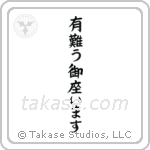
有難う御座います arigatō gozaimasu Thank you
有難う御座います (arigatō gozaimasu), thank you, literally says it is a rare thing. Its oldest print in these kanji in the National Diet Library's full-text search is a storyteller's ghost story of 1884. This study follows how gratitude grew out of rarity, from the 万葉集's hard to come by to the polite formula.
Abstract
有難う御座います, arigatō gozaimasu, thank you, is a spoken formula in the polite register, and literally says it is a rare thing: 有り難い meant hard to come by in the 万葉集, and gratitude grew out of rarity. It has no author. Its oldest print in the National Diet Library's full-text search is the stenographed ghost story of the storyteller Sanyūtei Enchō 三遊亭円朝, of 1884, in these kanji.
Overview
The sense. The polite thanks, 丁寧語: JMdict gives thank you, marked polite and usually written using kana alone, and lists 有難う御座います as one of five written forms with kanji [1].
The words. 有難い arigatai: デジタル大辞泉 《あることがむずかしい、の意から》人の好意などに対して、めったにないことと感謝するさま, from the sense 'hard to be': to be grateful for a kindness as a thing that seldom happens; 精選版日本国語大辞典's first sense is the literal one, 存在がまれである、むずかしい, rare, hard to come by, cited from the 万葉集 in the spelling 安里我多之 [2]. 有難う arigatō is the adjective's adverbial form ありがたく with the sound change to -ō, 連用形「ありがたく」のウ音便, and the 大辞泉 adds, 丁寧に言うときは「ございます」を付ける。関西地方では「おおきに」, to say it politely, add gozaimasu; in the Kansai, ōkini [3]. ございます is the polite there is of ござる, which デジタル大辞泉 illustrates in that sense from the Jesuits' Amakusa Aesop of 1593 [4].
The text in English. Thank you and 有難う御座います do the same work, and the Japanese is longer and more formal.
The historical record
The eighth century, the root. 有り難し, hard to come by, is cited from the 万葉集, 安里我多之, and in the 枕草子 of the late tenth century, ありがたきもの、舅にほめらるる婿, rare things: a son-in-law praised by his father-in-law [2].
1884, Sanyūtei Enchō, 『怪談牡丹燈籠』. The storyteller's ghost story, taken down in shorthand by Wakabayashi Kanzō 若林玵蔵 and printed in 1884, is the oldest book in which the National Diet Library's full-text search finds the phrase in these kanji. A young servant, whose lord offers to stand second to him in a fight to avenge his father, thanks him twice: 有難う御座います有難う御座います, and the lord answers, 已が助太刀をして遣るのを夫程までに嬉しい歟, is it such a joy to you that I should second you? [5].
1885, Enchō again. In the next year's stenographed tale, in a sickroom: 見舞に來て下すつて。誠に有難う御座います, you came to visit me; truly, thank you [6].
The count. The full-text search counts 1,739 books with the phrase in these kanji, and of the 1,727 it lists, dated 1884 to 1962, 1,686 are to 1946 [7].
What is not a source. The formula has no author. The Enchō pages are the oldest printed speech the search finds, not an origin.
Today. JMdict gives the thanks as polite and usually written using kana alone, and the kanji spelling 有難う御座います is one of its listed forms [1]. The kanji spelling is the one the 1884 print sets. What a rendering must keep is the politeness: 有難う御座います is not the bare 有難う, and thanks would be too casual for it.
A reading
有難う御座います moves from rarity to gratitude, a word for what is hard to come by become the word for thanks. In kanji it is the spelling of the stenographers of the 1880s; in the kana a hand writes today it is the same phrase.
References
- JMdict (EDRDG), 「有難うございます」, at jisho. https://jisho.org/search/有難う御座います
- 「有難い」, デジタル大辞泉・精選版日本国語大辞典, at kotobank. https://kotobank.jp/word/有難い-428214
- 「有難う」, デジタル大辞泉, at kotobank. https://kotobank.jp/word/有難う-428222
- 「御座る」, デジタル大辞泉・精選版日本国語大辞典, at kotobank. https://kotobank.jp/word/御座る-500915
- 三遊亭円朝演述・若林玵蔵筆記『怪談牡丹燈籠』第1編, 東京稗史出版社, 1884, p. 16, scan 18. National Diet Library pid 891188. https://dl.ndl.go.jp/pid/891188/1/18
- 三遊亭円朝『業平文治漂流奇談』第7編, 速記法研究会, 1885, p. 72, scan 24. National Diet Library pid 891415. https://dl.ndl.go.jp/pid/891415/1/24
- National Diet Library next-generation full-text search on 有難う御座います, searched again 26 September 2026: 1,739 books counted, 1,727 listed, dated 1884 to 1962, 1,686 of them to 1946. https://lab.ndl.go.jp/dl/api/book/search?searchfield=contentonly&keyword=有難う御座います