
MAKING PRESENTS
It was part of the old Japanese etiquette that a person, especially a lady, making a call, should never go without taking a present. Just as a Japanese letter begins with the compliments of the season or inquiry after the health of its recipient, so a polite person never makes a call “empty-handed.” The teaching is nowadays generally honoured more in the breach than in the observance, but its spirit is none the less remembered, especially among old-fashioned or conservative people.
If this custom of exchanging presents is being less and less observed nowadays, it has lost much of its old-time justification. In feudal days or under social conditions equivalent to old Japan it had a sort of ameliorating influence on the effects of more or less unavoidable social injustice, or misfortune. Relations between poor and rich, between fortunate and unfortunate were rendered occasions for exercise of virtue rather than of envy or strife. Thanks to this benevolent cult of present-making, even the poorest could play the part of “giver,” and were spared the humiliation of being receiver and beggar always.
Symbol of Long Acquaintance
The day you take up your domicile at any place you are a neighbour to a number of people around you, besides being an independent inhabitant of a chō (district), a ku (ward) and a city. In the latter capacity you have to pay
a certain tax. As a neighbour your obligations are of a moral character which you can refuse, though at the risk of being thought eccentric. Women more than men are sticklers in this respect, for they pass most of their time at home and see a good deal of their neighbours. This is much more the case in the Kwansai than in the Kwantō district, for in the Kwansai neighbourly relations were from olden times very much more cordial than in the less urbane northeast.
The day you move into a new house you make a personal call on your neighbours, instead of their calling on you, at least those of the five houses, three opposite and one on each side, accompanied with a present of some soba (buckwheat vermicelli) or coupon exchangeable for such at the local soba vendor’s (which is generally sent by the soba man before or after). This is a very old removal custom, still generally observed, though in some out-of-the-way districts different customs may obtain, the soba being regarded as a symbol of long-enduring acquaintanceship. Thus begins a whole series of present-making. Indeed the soba is symbolic, for present-making continues as long as you live, and it may be a troublesome or pleasing duty according to the light in which you view it.
Rules of the old etiquette, including the canons of good manners and breeding, centre on the problem of present-making—what and how to give and to receive, and how to behave and what to say in speech or letter-writing when giving or receiving. In aristocratic circles in which the first duty was to maintain inherited dignity of rank and station, life was a continuous round of giving and receiving presents, and the least deviation from ac-
cepted rules easily spells ruin. In the famous vendetta of the Forty-Seven Rōnin, the cause of the tragedy may be traced to ill-advised conduct on the part of an inexperienced daimyō or his high retainers in the matter of present-making. Besides, these persons may say: “What is life if there is no giving or receiving of presents?”
Toshidama to Seibo
In New Year season, which practically covers the whole of January, presents are called “toshidama,” or “year-offerings,” and everybody may give and receive with utmost freedom and no scruple. The poor may remember the rich with trifles worth a shilling or two, which the rich may return with presents double, treble or even ten times in value, according to the particular relations in which they stand. Very often presents may be received without returning, as in the case of your grocer and rice man bringing “tokens of a Happy New Year.” At the Bon season in July, presents are known as “chūgen,” or “middle season,” presumably offered at the altar of the dead, the memory of which is fêted by every family at this time.
Presents exchanged at the year end, generally begun in the middle of December and continued to the last minute of the old year, are called “seibo,” or “year-end presents,” and are probably the most important of all. The seibo represents the giver’s sense of gratitude for the honour or favour received in fancy or in fact during the year, and his wish for the continuance of the same in the new year. In case the seibo is omitted, it may be made up by toshidama.
These form the three major present-making seasons of the year which furnish convenient opportunities for mending the omissions made at other times, knowingly or unknowingly. Excuses for present-making are never wanting. They are in fact so numerous that you cannot help omitting or neglecting them sometimes, but the more serious of these omissions, if they prey on your conscience, may be easily rectified at the New Year or Bon season.
All Events Worthy of Presents
After the three seasons above mentioned come the well-known annual festivals of the Girls’ Festival of March, the Boys’ Festival of May, the Children’s Kimono Festival of November, and, you may add, the new festivity of Christmas. One strong cause of the permanent place these festivals have acquired in Japanese life is that they are encouraged through the custom of present-making. One having no intention to celebrate such festivals may find himself obliged to do so by the sheer force of presents pouring into his hands.
Birth, death and marriage are, of course, among the most important events from the viewpoint of making presents. But they are symbolic of numerous other events, both joyous and sad, such as promotions and windfalls or failures and calamities. Birthdays are remembered, of course. Old persons are fêted at 61, 77, 88, 90, etc.
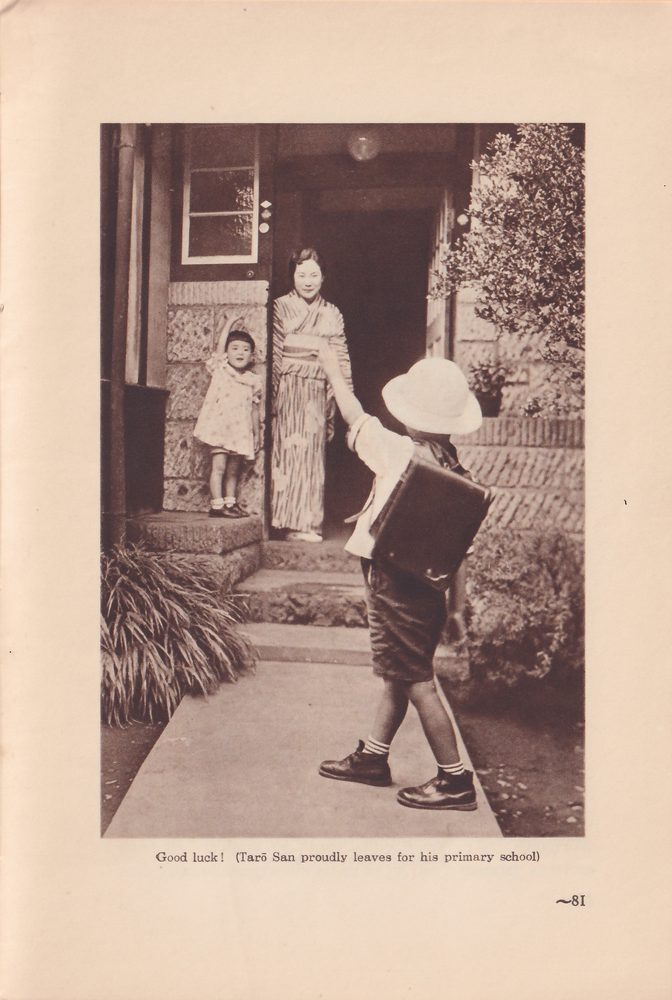
If your child enters a school, it is a congratulatory and present-worthy event at home, and is treated as such by your friends and relatives. If he is graduated, still more so. Should he enter army barracks at twenty, he and you are congratulated in as joyous a manner as when
he returns home after two years’ service with the colours. If he gets a job, or promotion, he will receive presents from his happy relatives.
If you have built a house of your own, or opened a shop, that is, of course, big news in your career, on which both your approving betters and envious inferiors will congratulate you with auspicious presents. Even mere removal is often made an occasion for congratulation, it being interpreted as a change for the better. When you start on a long journey, the present is called “senbetsu,” or “parting cash,” which in former days was of the nature of sympathetic contribution toward the expenses of a journey, travel being treated more as occasion of sorrow than of joy; but nowadays the senbetsu has changed its old significance into one of joyous congratulations, as when one starts upon an honourable commission in a foreign country.
Presents as Charity
Occasions for sympathy and condolence as opportunities of present-making are also numerous. Death elicits presents in money and in kind, and, while these may prove of no small assistance in conducting the funeral where the family are poor, there are cases where the family is thought to be wealthy, and the presents received come very much short of what is to be spent in return presents. In some provincial districts funerals, especially those of old persons, are made occasions for grand feasting continuing for days to “dissipate the sorrow,” and which sometimes make a very serious drain on the coffers of the bereaved. In winter, when farmers have nothing better to do, they find in funerals of well-off families opportunities of enjoying
sumptuous feasts in return for the nominal kōden (“price of incense”) they bring. If the bereaved family should pretend to be “civilized” and stint giving the three-day feasting before and after the funeral, they will probably have earned an eternal notoriety for being “stingy.” There are cases where some alleged rural magnates have gone bankrupt over the funerals of their relatives.
There is an old aphorism concerning the presents to be given to those whose houses have been burned or washed away by flood or tidal waves: “Give fire to victims of fire and water to victims of water.” The first thing those burnt out will want are a shelter and a fireplace where they may cook and warm themselves, so that braziers and charcoals and other warming materials will be welcome, and those in flooded districts will stand in want of clean water to drink, so that pails and other water vessels may prove most helpful, whereas other probably more expensive articles may prove burdensome in such emergencies.
We are reminded of a famous waka, which runs: “Many are the people who will come and praise the cherry trees in bloom, but truly kind are they who visit them after the blossoms are shed.” It is part of human nature, perhaps, to rejoice with the joyful and to bring more to those who already have while leaving pain and sorrow to suffer in solitude. But in the Japanese scheme of present-making the pretexts are so numerous and ever-present that you will never lack an opportunity of sympathizing with sorrow or of relieving suffering, if only you have the intention, without placing your recipient under the humiliation of a debtor or causing any other moral offense.
Attempt to Escape
There are many people, increasing in number with the increasing population, who find too much bother in the restrictions and obligations of family life, and take to the so-called simpler mode of life in the “apart” (a short form for “apartment house”). Such houses are being built everywhere in great numbers. In the “apart” one is free to come and go and to act just as one pleases, which seems the very essence of emancipated life, and there has been a steady exodus of young persons of both sexes from the shackles of family life to take to the life “apart.”
But there is a sort of reaction to this exodus. Or it may be regarded as a counter-current flowing in the opposite direction at the same time. This life in the “apart,” while it has its freedom, has also its darker side in the absence of the protecting wings which the home affords. Cut off from the society of neighbours, often friends and kinsmen, their occupants must, when trouble occurs, solve it by themselves or among themselves without outside counsel. As they grow older, they increasingly feel the “barrenness and loneliness” of such a life, and begin, like the prodigal son, to think of their parental home far away. So there are as many people anxious to get out of home life as those anxious to return to it, because they miss “the old familiar faces.” It is a significant fact that just as apartments are increasing in and out of every large city, so also are increasing at an amazing rate the small homesteads, of three to four or five rooms, near the boundaries of Greater Tokyo, fit for young householders of limited means, or so-called young salaried men and salaried women.
(164 L 17-2037)