

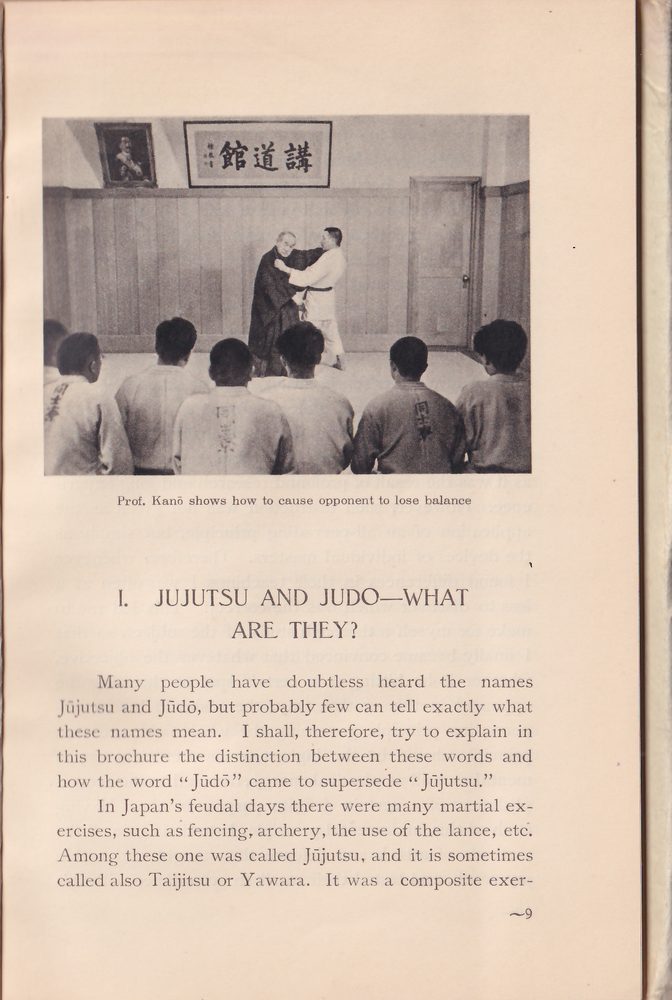
I. JUJUTSU AND JUDO—WHAT ARE THEY?
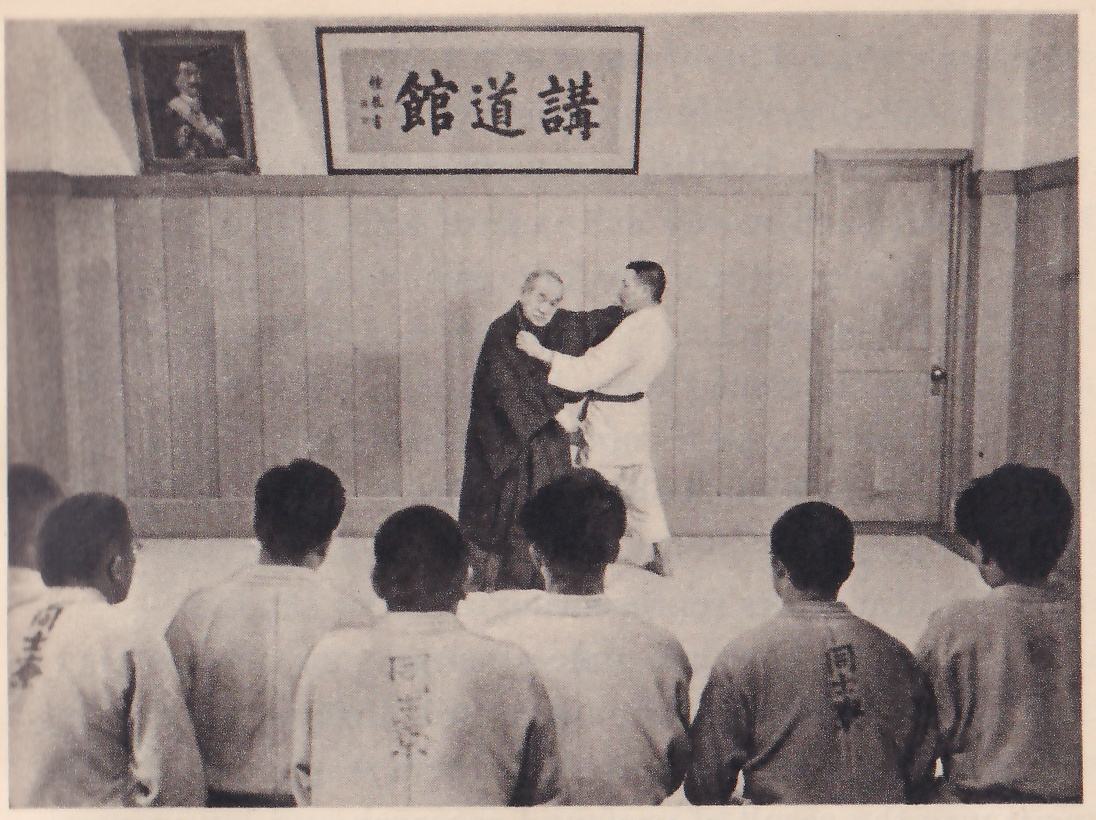
Many people have doubtless heard the names Jūjutsu and Jūdō, but probably few can tell exactly what these names mean. I shall, therefore, try to explain in this brochure the distinction between these words and how the word “Jūdō” came to supersede “Jūjutsu.”
In Japan’s feudal days there were many martial exercises, such as fencing, archery, the use of the lance, etc. Among these one was called Jūjutsu, and it is sometimes called also Taijitsu or Yawara. It was a composite exer-
cise consisting of many ways of attack, such as throwing, hitting, kicking, stabbing, slashing, choking, holding the opponent down, bending or twisting the opponent’s arms or legs in such a way as to cause pain or even fracture, as well as a great variety of ways of defending oneself against these attacks. Such an exercise had existed in Japan from ancient times, but it was only some three hundred and fifty years ago that it came to be taught as a system. During the Tokugawa Period (1615–1867) it developed into an elaborate art, and was taught by quite a number of masters representing different schools.
I learned this art under many eminent masters of the late feudal times who were still living in my young days. The instruction given by them was of great value, as it was the result of profound research and long experience. However, such instruction was not given as the application of an all-pervading principle, but simply as the devices of individual masters. Therefore, whenever I found differences in their teachings I was often at a loss to discover which was the correct. This led me to make for myself a thorough study of the subject, so that I finally became convinced that whatever the objective, whether it be hitting at a certain spot or throwing the opponent in this or that way, there should be one all-pervading principle governing the whole field, and that principle should be the highest or most efficient use of mental as well as physical energy, directed to the accomplishment of a certain definite purpose or aim. Having evolved this fundamental principle, I studied again all the methods of attack and defence then taught and within my reach, and tested their merit in accordance with this
principle. I could thus retain those which accorded with this principle and eliminate those which did not. Then, in place of those which I eliminated, I substituted new methods which I believed to be the right application of the same principle. The methods thus formulated are the ways of attack and defence now taught in the Kōdōkwan under the name of Jūdō, in contradistinction to Jūjutsu taught by the different masters of feudal times.
Let me now explain in this connection the meaning of these words Kōdōkwan, Jūdō and Jūjutsu. Kōdōkwan literally means “a school for studying the way,” “the way” being the concept of life itself. Jūdō and Jūjutsu are composed of two words, jū meaning “gentle” or “to give way,” jutsu “art” or “practice,” and dō “way” or “principle.” Thus, Jūdō means the way of gentleness or of first giving way in order ultimately to gain the victory, while Jūjutsu means the art and practice of Jūdō.
What then does this “gentleness” or “giving way” really mean? To answer this question let us suppose that we estimate the strength of man in units of one. Let us say that the strength of a man standing in front of me is represented by ten units, whereas my strength, less than his, is represented by seven units. Now, if he pushes me with all his force I shall certainly be pushed back or thrown down, even if I use all my strength against his. This would happen because I used all my strength against him, opposing strength with strength. But if instead of opposing him I were to give way to his strength by withdrawing my body just as much as he had pushed, taking care at the same time to keep my
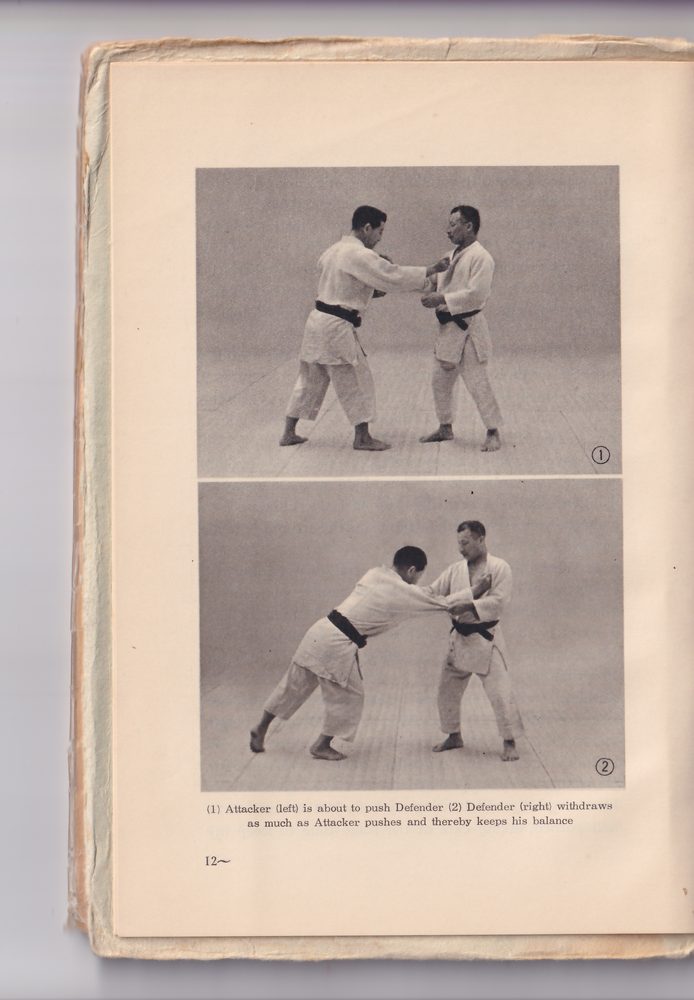
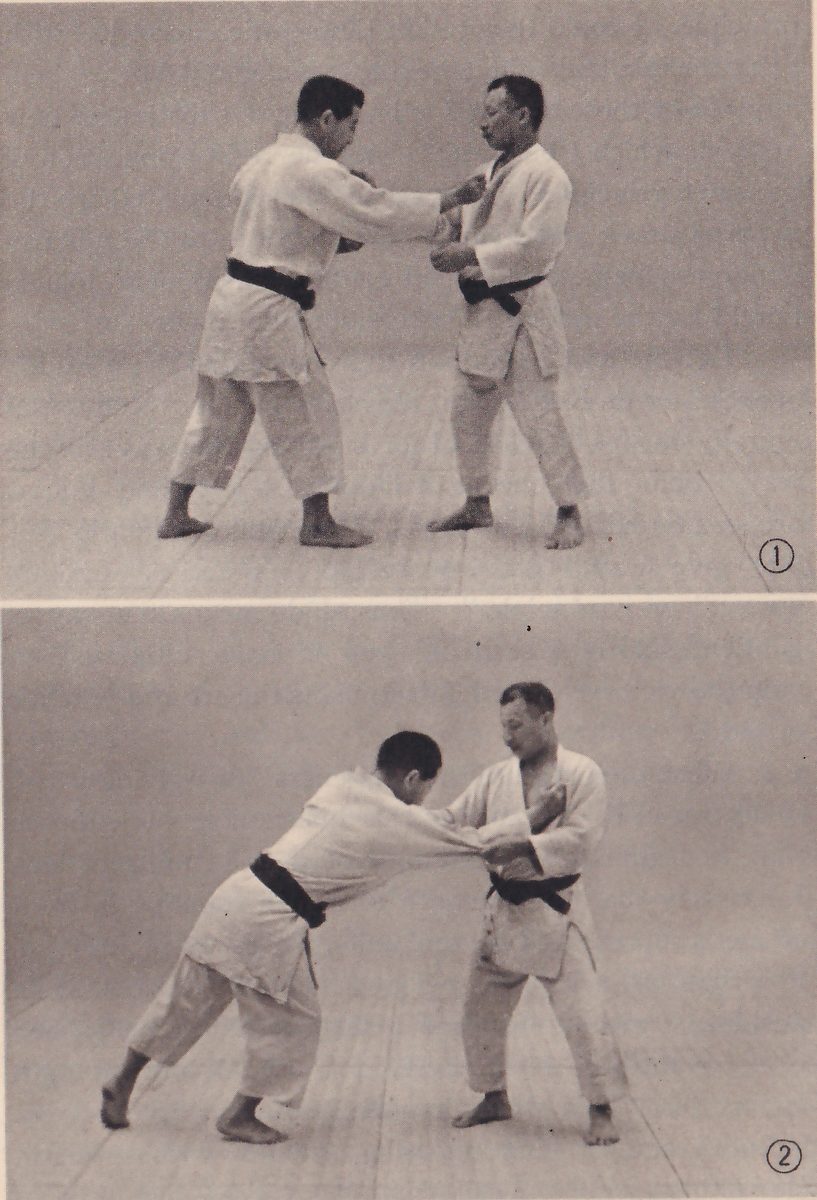
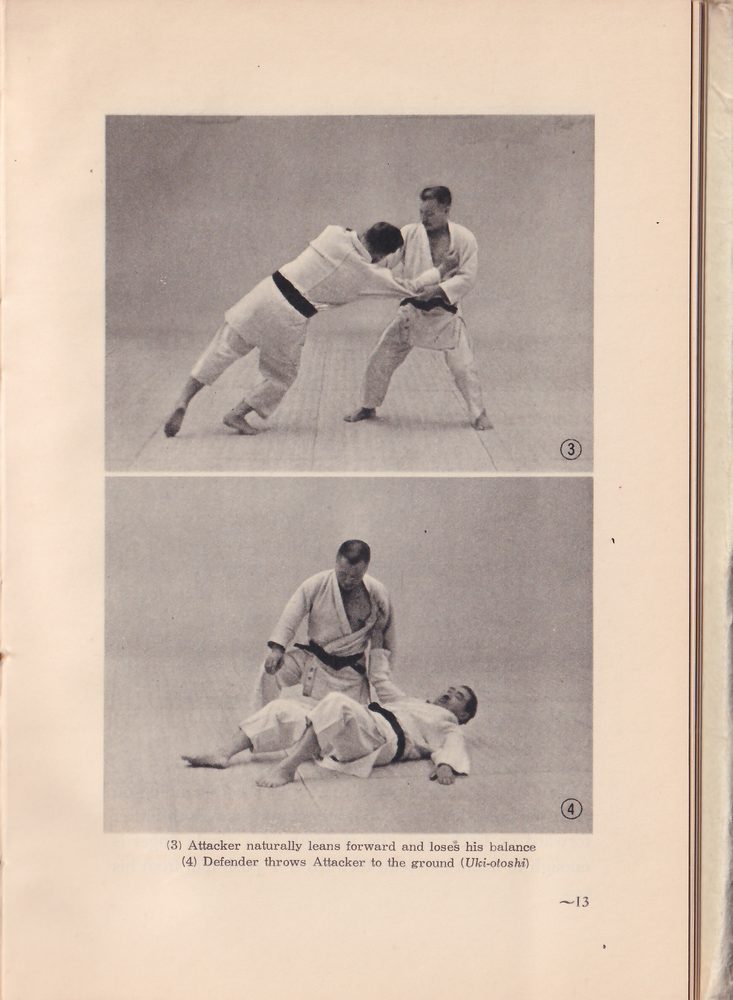
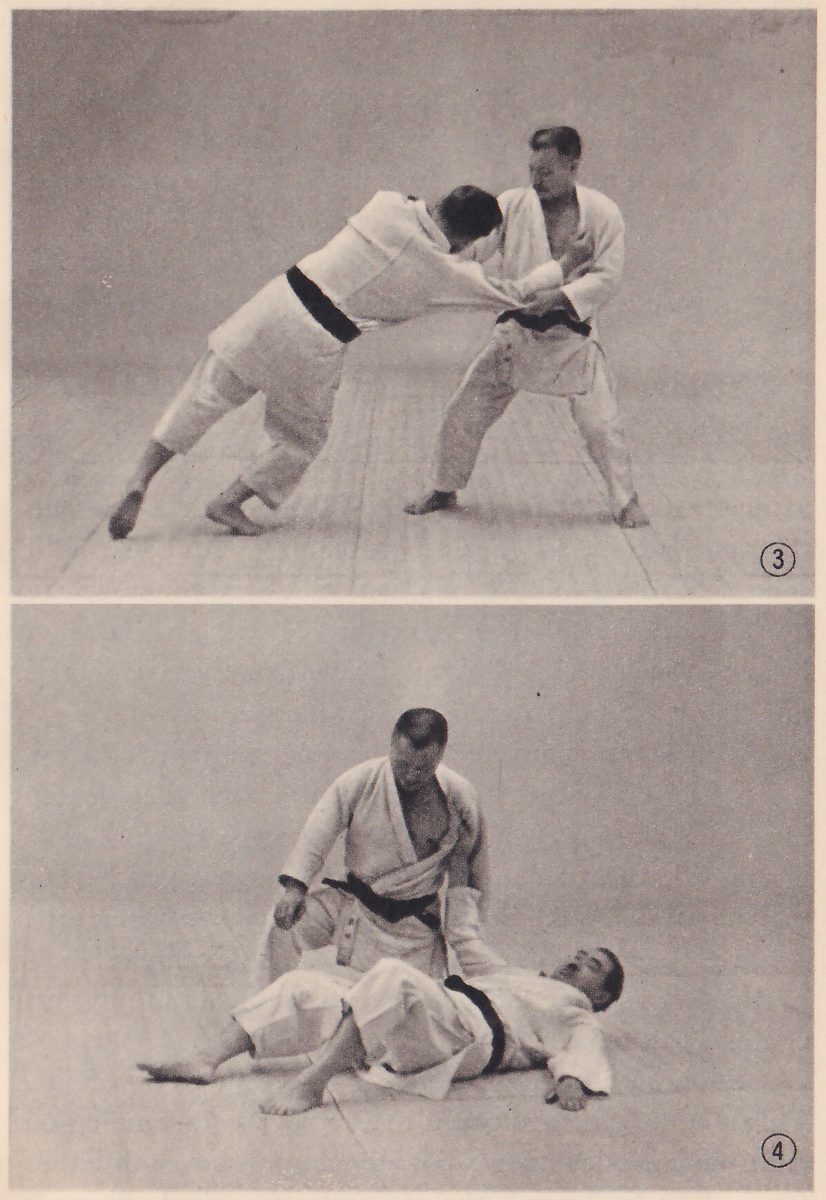
(4) Defender throws Attacker to the ground (Uki-otoshi)
balance, then he would naturally lean forward and thus lose his balance.
In this new position, he may have become so weak (not in actual physical strength but because of his awkward position) as to have his strength represented for the moment by only three units, instead of his normal ten units. But meanwhile, by keeping my balance, I retain my full strength, as originally represented by seven units. Here then I am momentarily in a superior position, and can defeat my opponent by using only half my strength, that is half of my seven units, or three and one-half, against his three. This leaves one-half of my strength available for any purpose. Now, if I had greater strength than my opponent I could of course push him back. But even if I wished to push him back and had the power to do so, it would still be better for me first to give way, because by so doing I should have greatly economised my energy and exhausted my opponent’s.
This is one simple instance of how, by giving way, a contestant may defeat his opponent, and as there are so many instances in Jūjutsu contests where this principle is applied, the name Jūjutsu (that is, the “gentle” or “giving way” art) became the name of the whole art.
Let me now show, by a few more examples, how by this art some of the most wonderful feats in physical contests can be achieved.
Suppose a man is standing erect in front of me. This man may be compared to a log of wood standing on end. In case this man is not exerting his strength either forward or backward, the strength of a single finger is enough to make him lean forward if I push him from his
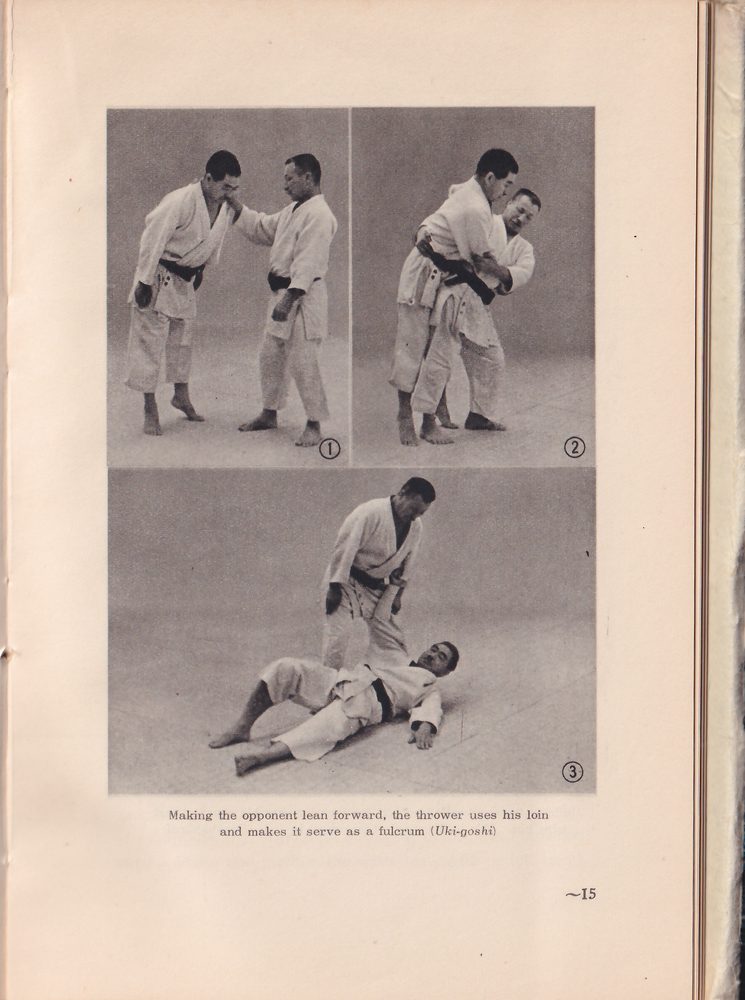
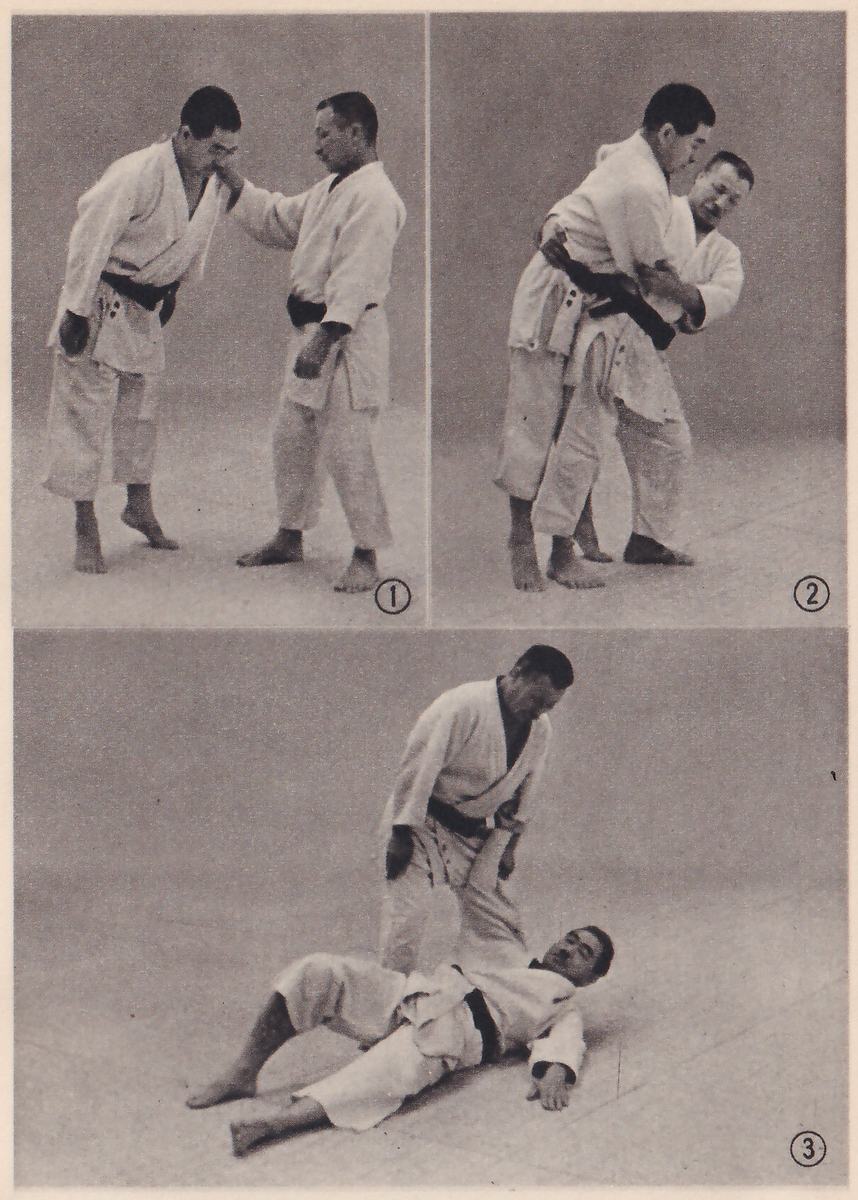
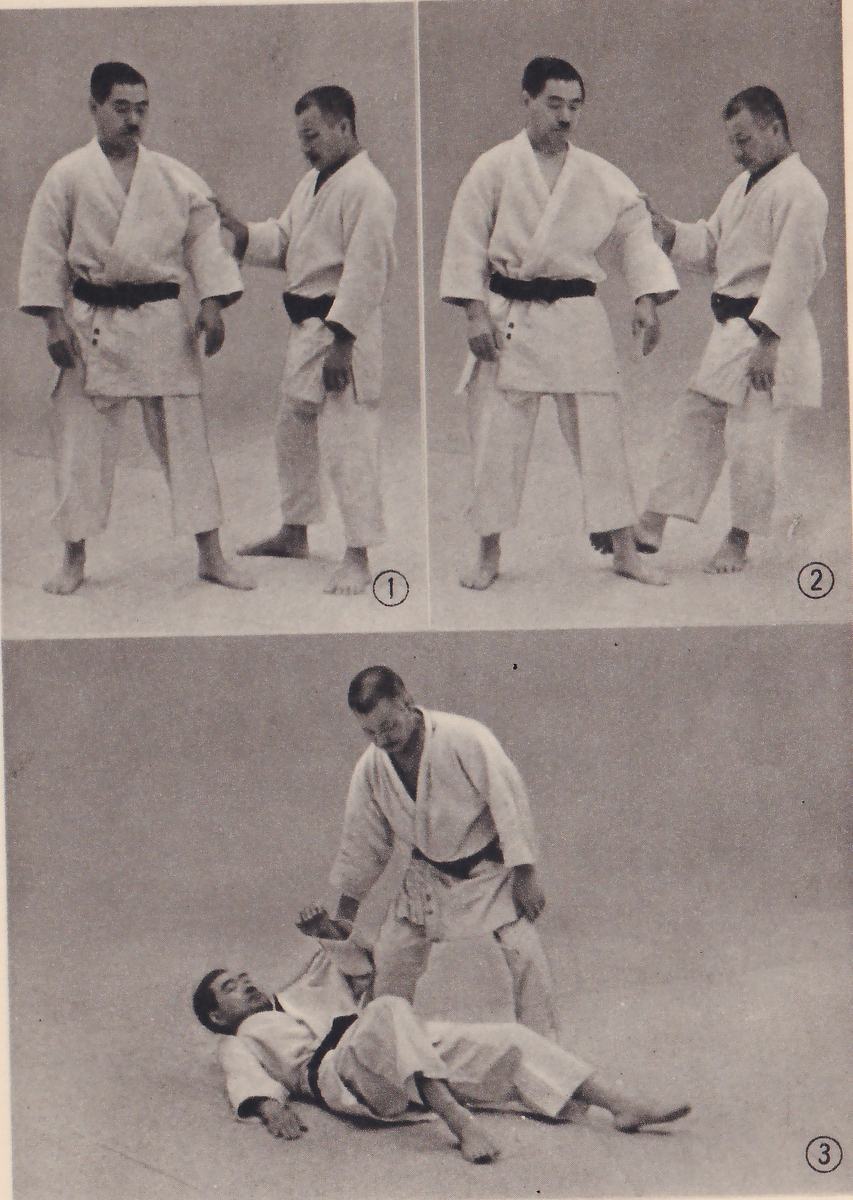
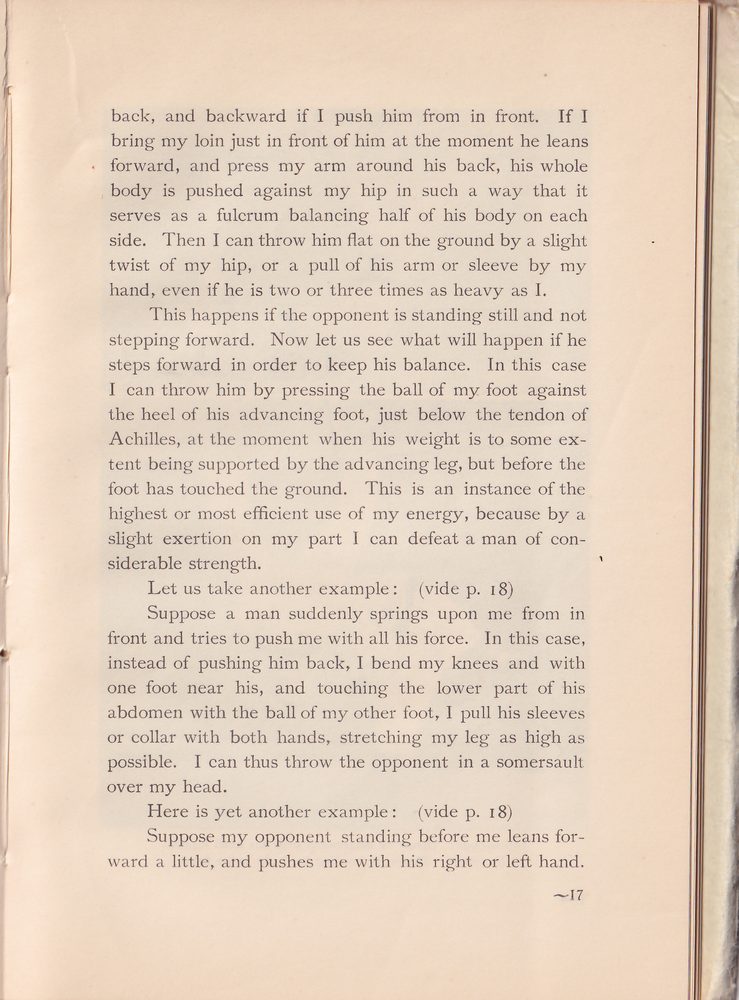
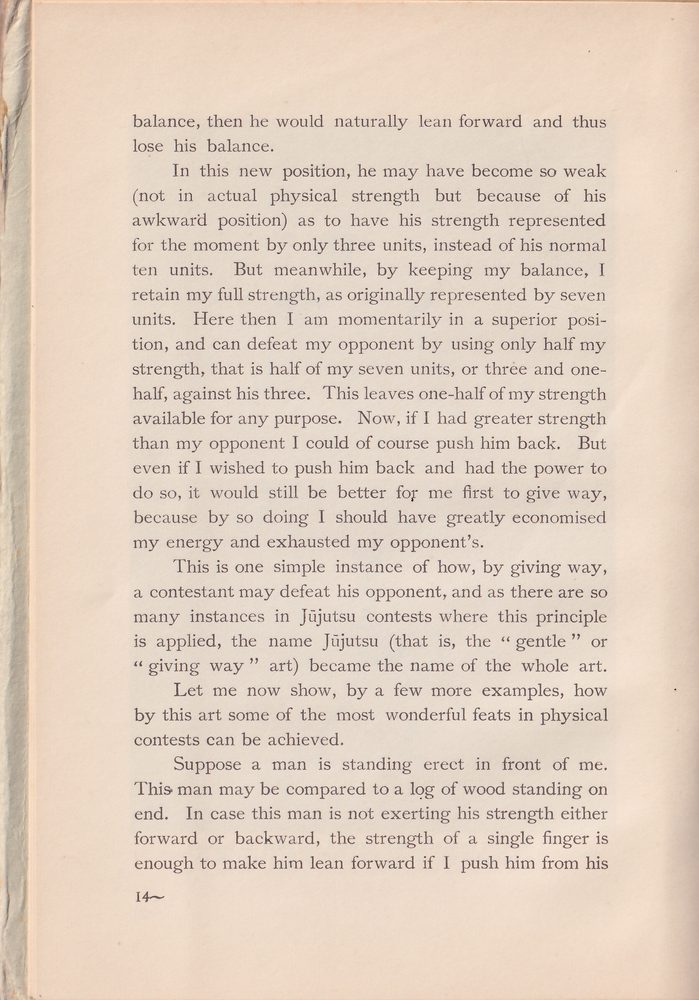
back, and backward if I push him from in front. If I bring my loin just in front of him at the moment he leans forward, and press my arm around his back, his whole body is pushed against my hip in such a way that it serves as a fulcrum balancing half of his body on each side. Then I can throw him flat on the ground by a slight twist of my hip, or a pull of his arm or sleeve by my hand, even if he is two or three times as heavy as I.
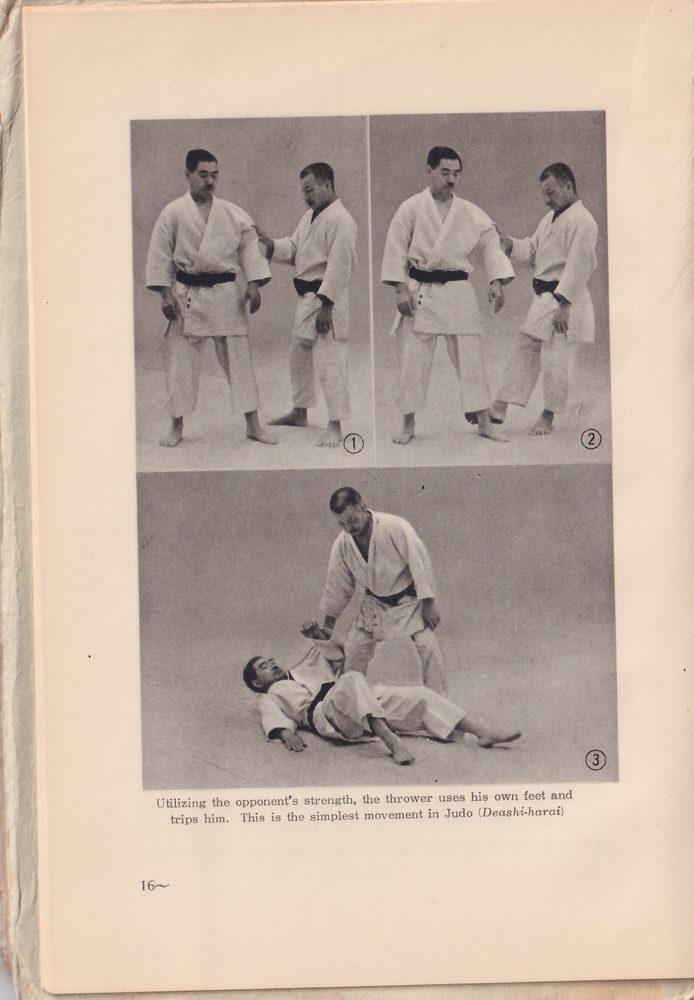
This happens if the opponent is standing still and not stepping forward. Now let us see what will happen if he steps forward in order to keep his balance. In this case I can throw him by pressing the ball of my foot against the heel of his advancing foot, just below the tendon of Achilles, at the moment when his weight is to some extent being supported by the advancing leg, but before the foot has touched the ground. This is an instance of the highest or most efficient use of my energy, because by a slight exertion on my part I can defeat a man of considerable strength.
Let us take another example: (vide p. 18)
Suppose a man suddenly springs upon me from in front and tries to push me with all his force. In this case, instead of pushing him back, I bend my knees and with one foot near his, and touching the lower part of his abdomen with the ball of my other foot, I pull his sleeves or collar with both hands, stretching my leg as high as possible. I can thus throw the opponent in a somersault over my head.
Here is yet another example: (vide p. 18)
Suppose my opponent standing before me leans forward a little, and pushes me with his right or left hand.
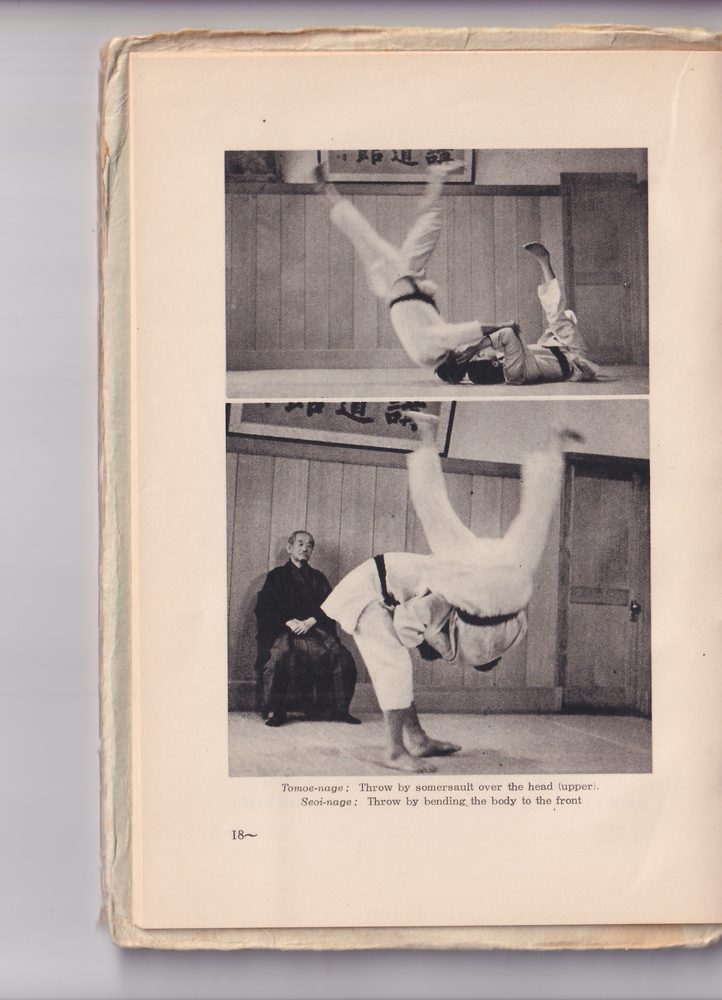
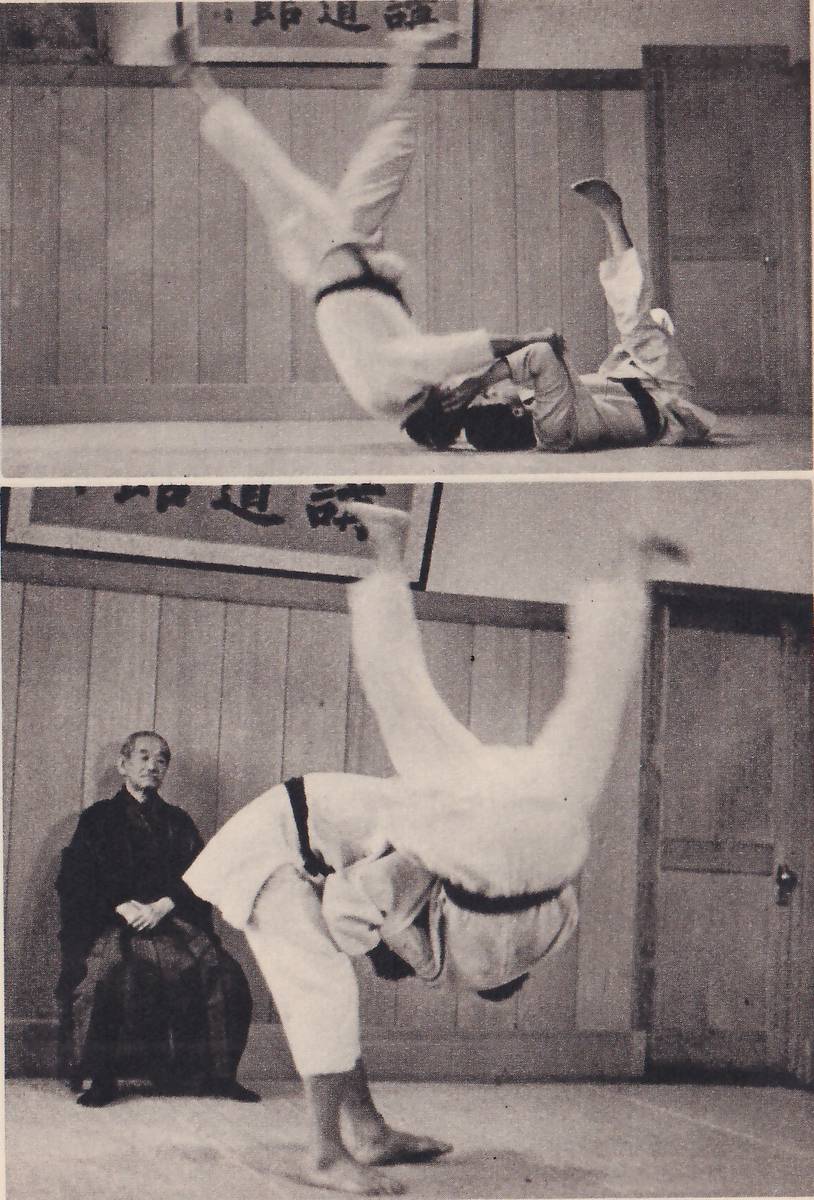
Seoi-nage; Throw by bending the body to the front
Then, by taking advantage of his loss of balance, I pull him, holding the upper part of his sleeve with my right hand if he pushed with his left, and with my left hand if he pushed with his right, at the same time turning my body round so that my back comes close to his chest; and holding his shoulder with my free hand I suddenly bend my body to the front. The opponent’s body will then be thrown over my head flat on the ground.
From these examples, one sees at once that although giving way to the opponent’s strength is often very important, the principle of leverage is sometimes more important for the purpose of throwing. If we consider also that hitting, kicking, choking and other kinds of positive attacks must be used in actual Jūjutsu contests, the name Jūjutsu, the art of “gentleness” or “giving way,” does not convey the real meaning. Actual Jūjutsu is something more. If I explain Jūjutsu as the art or practice of the most efficient use of mental and physical energy, and Jūdō as its way or principle, we can for the first time say that we have arrived at the true definition of those words.
In 1882, I founded the Kōdōkwan and began to teach this newly-formulated art. After some years, the pupils increased by leaps and bounds, and even those who were being trained at schools of the old masters came to the Kōdōkwan from all parts of Japan. The name Jūjitsu was superseded by the new name Jūdō to such an extent that nowadays no one in Japan speaks of Jūjutsu though the name survives abroad.