
I. THE ESSENTIALS OF JAPANESE FOOD
A Conversation with Tourists
In the train returning to Tokyo after I had given a lecture in Osaka, I chanced to meet Mr. and Mrs. H. whom I had known in Chicago.
They said that they were spending two leisurely months in Japan sightseeing and studying as they pleased, and they looked extremely happy and well.
Delighted with this chance meeting after ten years, I renewed acquaintance and sat down opposite them.
They took turns praising the bright clean beauty of Unzen near Nagasaki, Beppu, the hot-spring city, the Inland Sea and Miyajima, and specially admiring the charms of the old Japanese culture of Kyoto and Nara. Then, with unfeigned pleasure, Mr. H. said,
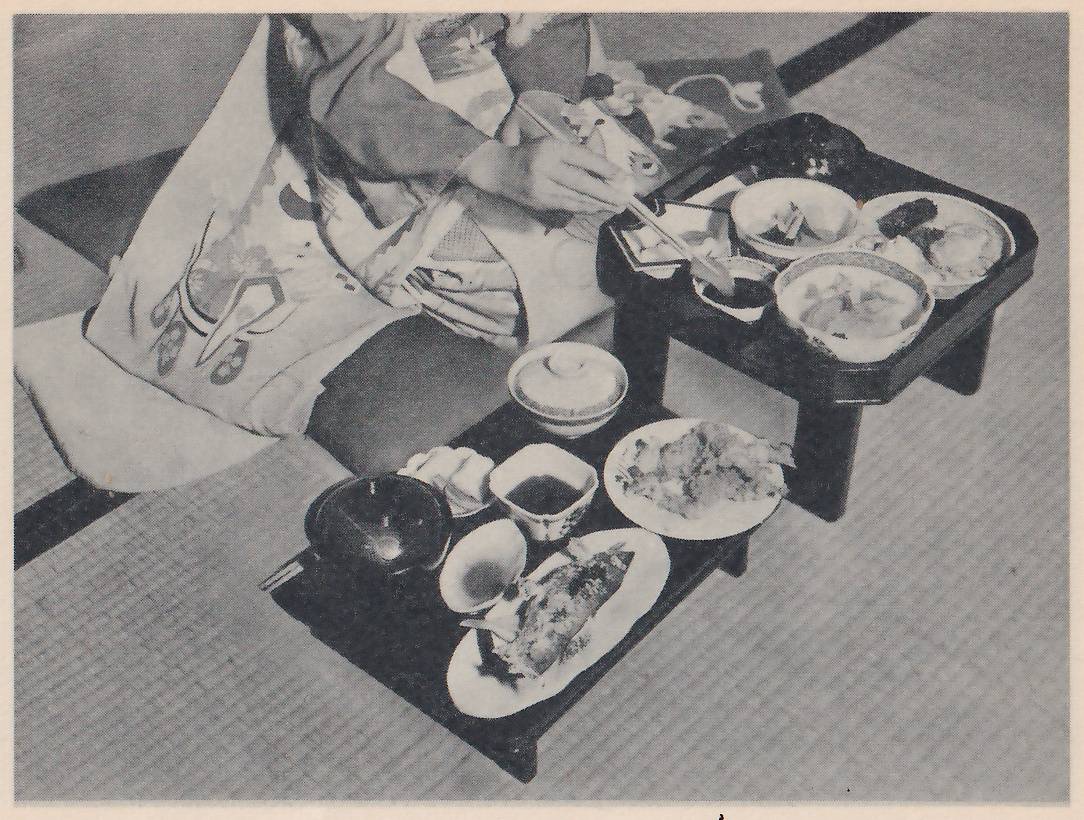
“What we have enjoyed most is the ease of being able, when we wish to live in the style of our own country, to travel practically as if we were at home, stopping at hotels, sleeping in beds, and eating foreign food. But at the same time, when we so desire, to sit on matted floors, eat Japanese food with chopsticks from lacquered and porcelain bowls on trays, sleep on wadded quilts and enjoy to the full the flavour of a foreign country. Because we want to learn all we can of Japan, we have brought ourselves into contact
with Japanese ways of living as much as possible and mean to go on doing so, and we have been delighted to find ourselves gradually beginning to appreciate the charms of Japanese food. We meant of course when we got to Tokyo to call on you and get you to show us over the Women’s College and other institutions with which you are connected, but how fortunate it is that we should fall in with you, a cookery teacher, now while travelling!”
To which I replied, “I’m delighted that you’re travelling in Japan and eating Japanese food. In our country, there are foods that have come down to us through the development of 2500 years since her foundation, and though it may sound only like pride of country, some of them are quite superior. In present-day Japan, to this traditional food has been added much from Western cookery, so that today the most remote mountain inn can serve one or two European-style dishes, and in the cities, besides the restaurants that specialize in these foods, a great deal of Chinese food is eaten.”
“Then, is genuine Japanese food dying out? Won’t you tell us briefly of the essentials of real Japanese food?”
“With pleasure. In every country, the liking for certain foods is a reflection of national character. And when people adjust well and consume the products of their country they make a material gain, improve them, and promote health, don’t they? In the same way, our country was known in ancient times as the Ōyashima or “Eight Great Islands,” and being surround-
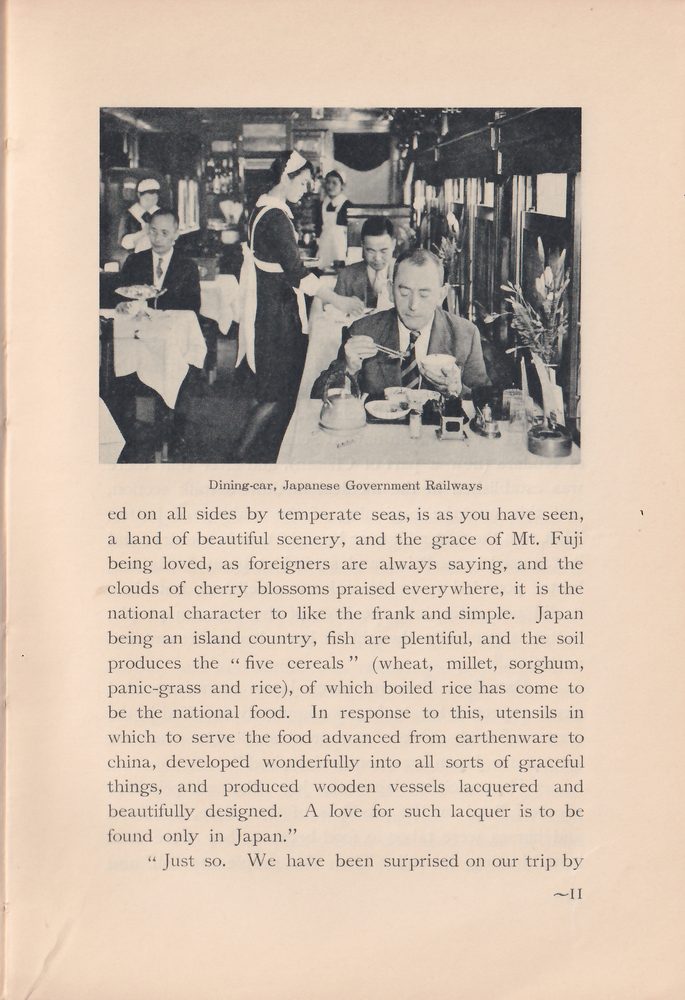
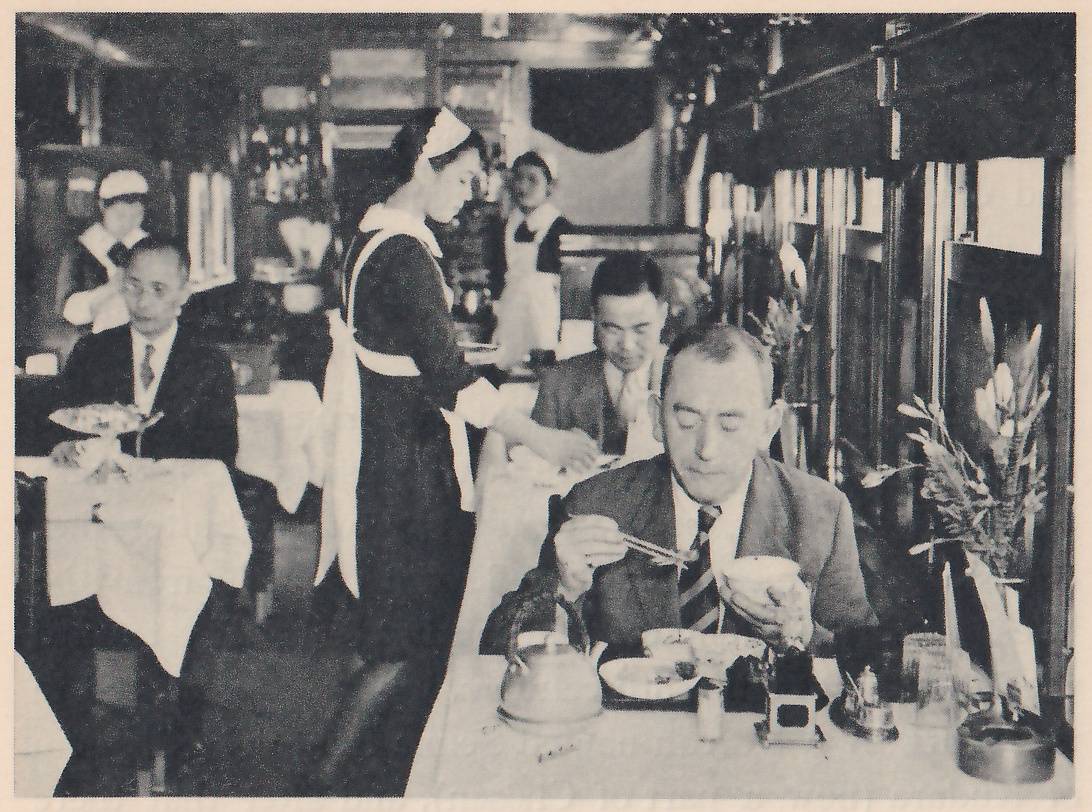
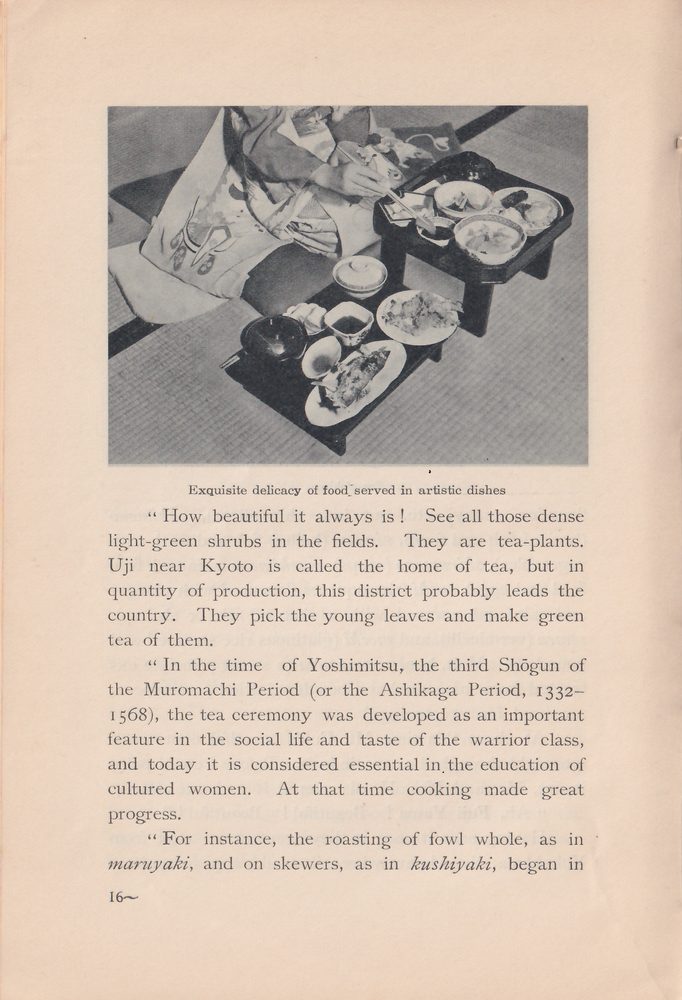
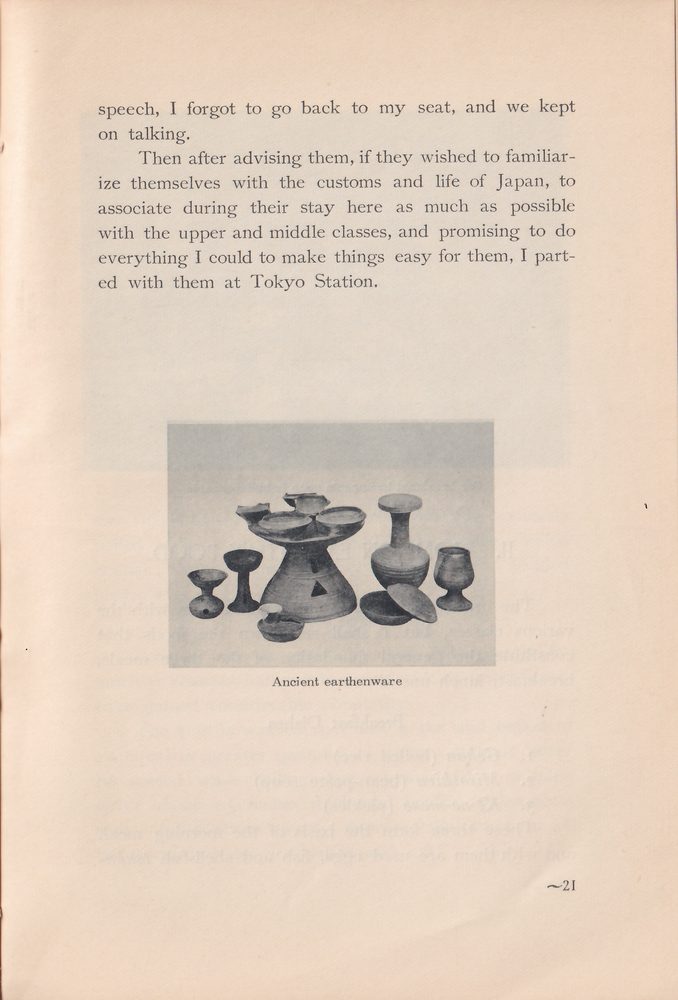
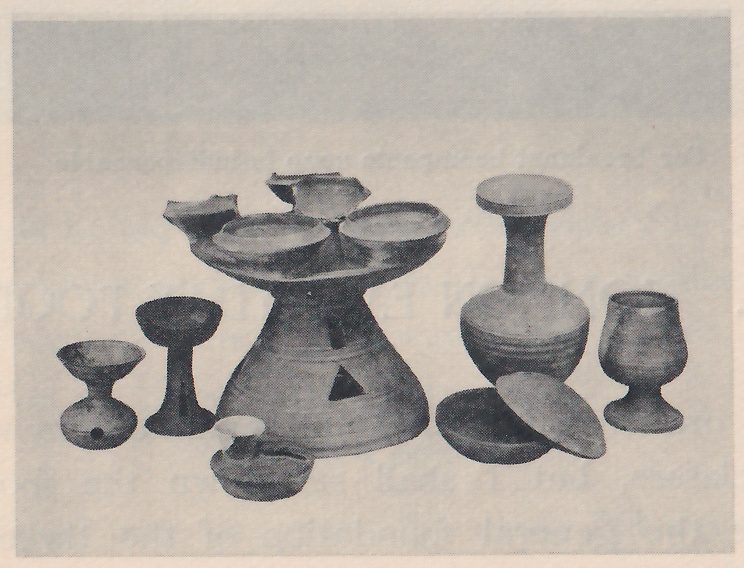
ed on all sides by temperate seas, is as you have seen, a land of beautiful scenery, and the grace of Mt. Fuji being loved, as foreigners are always saying, and the clouds of cherry blossoms praised everywhere, it is the national character to like the frank and simple. Japan being an island country, fish are plentiful, and the soil produces the “five cereals” (wheat, millet, sorghum, panic-grass and rice), of which boiled rice has come to be the national food. In response to this, utensils in which to serve the food advanced from earthenware to china, developed wonderfully into all sorts of graceful things, and produced wooden vessels lacquered and beautifully designed. A love for such lacquer is to be found only in Japan.”
“Just so. We have been surprised on our trip by
the artistic harmony in the china and lacquered vessels and the food served in them. For instance, if we take a china bowl and examine it carefully, we find a deeper and deeper taste in it, and in lacquered ware there is an elaborate beauty attained at great expense of time. In short, a dining tray all set is a beautiful sight in itself.”
“It delights me to hear that you have noticed even that. Then, taking a glance at the history of Japanese cooking, even our people can’t say when butter first entered our homes. Many believe it came in from the West after the Meiji Restoration in 1868. But toward the latter part of the 8th century, milk was presented to the court by a Korean named Senna from the Kingdom of Kudara (now a part of Chōsen), and after that there was established in the medical institute a milk section, and this was the beginning of the making of butter. That was the first milk ever brought to this country, and it was used in medicine and served at great feasts, and butter pounded up in rice-cake was relished, but since it did not enter into the lives of the common people, butter is generally thought to have been a recent importation.”
“Exactly. However much Japan has advanced, I never expected her to be so completely supplied in the matter of food. One of our greatest doubts when we set out for Japan was concerning food.”
“The ancient Japanese, just like all primitive peoples, lived on the products of the chase, but cows and horses were taboo as food because they were used in cultivating the soil. Then the people ate fish, and
for vegetable foods there was an abundance of plants in mountain and field and of the nuts and fruits of trees. Further, they seemed to know how to cook these foods before the foundation of the country.
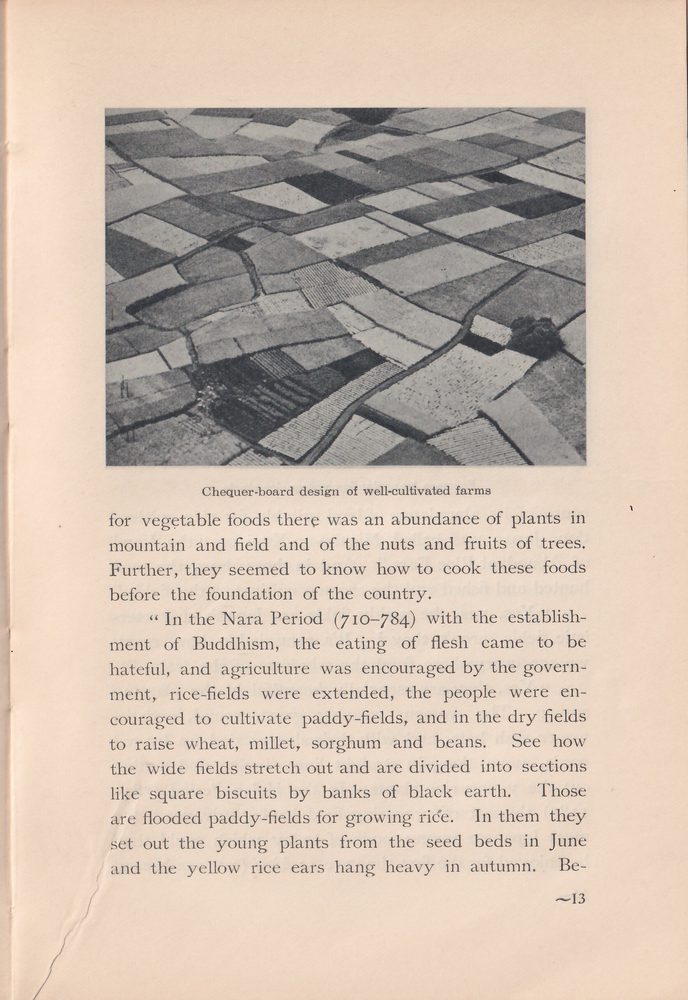
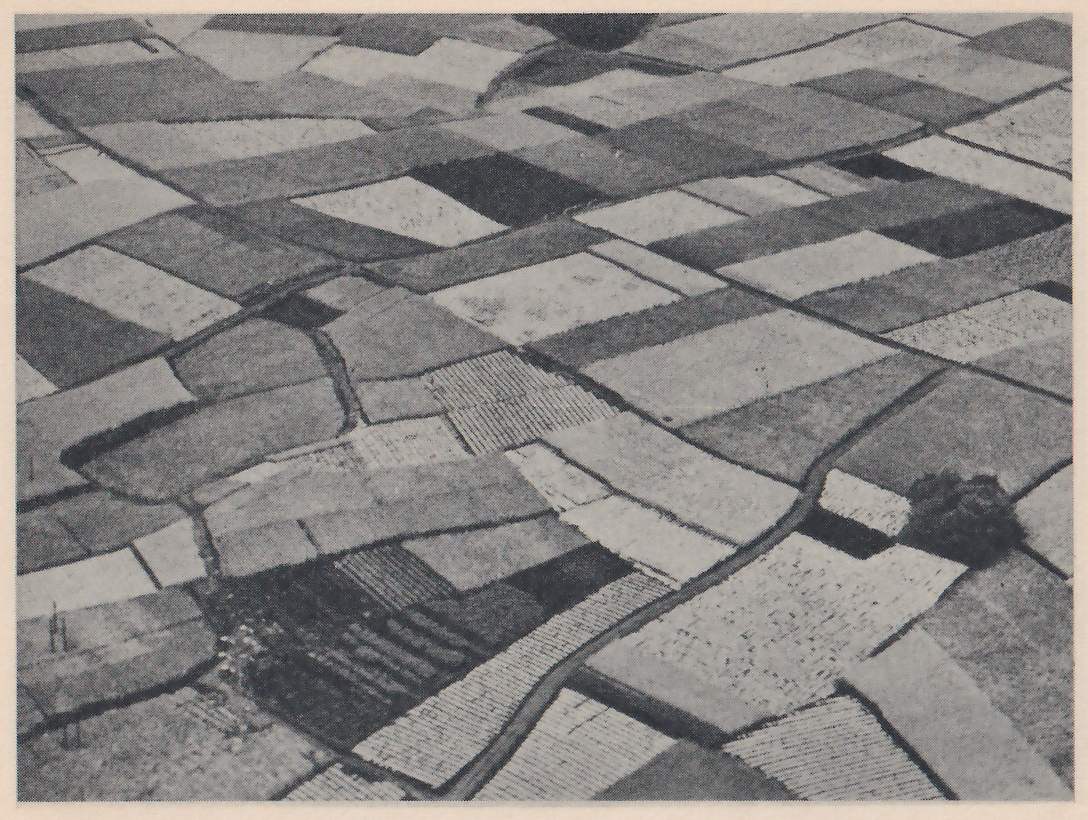
“In the Nara Period (710–784) with the establishment of Buddhism, the eating of flesh came to be hateful, and agriculture was encouraged by the government, rice-fields were extended, the people were encouraged to cultivate paddy-fields, and in the dry fields to raise wheat, millet, sorghum and beans. See how the wide fields stretch out and are divided into sections like square biscuits by banks of black earth. Those are flooded paddy-fields for growing rice. In them they set out the young plants from the seed beds in June and the yellow rice ears hang heavy in autumn. Be-
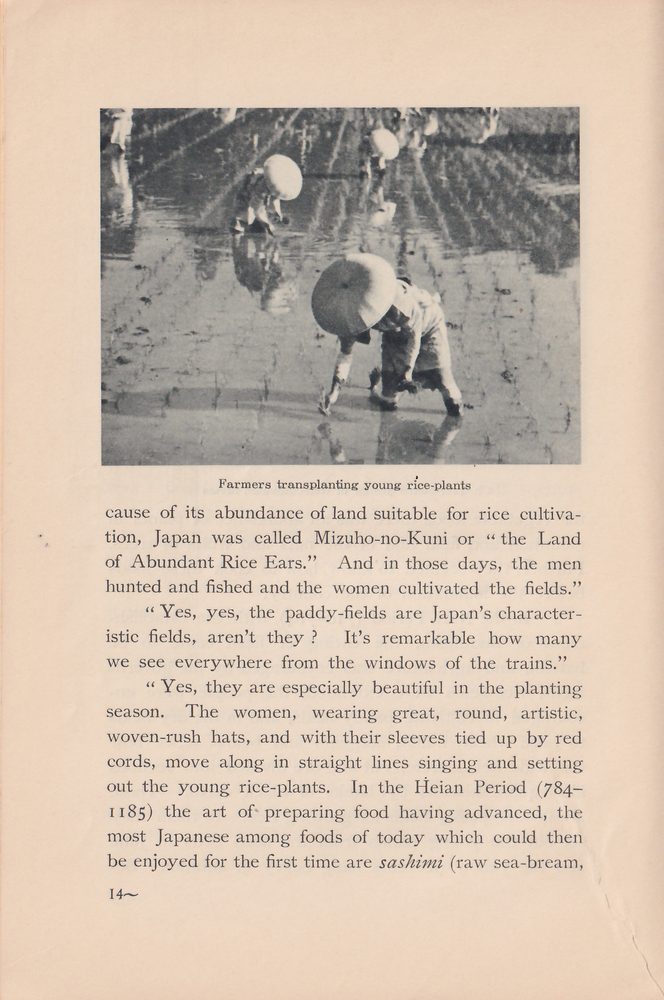
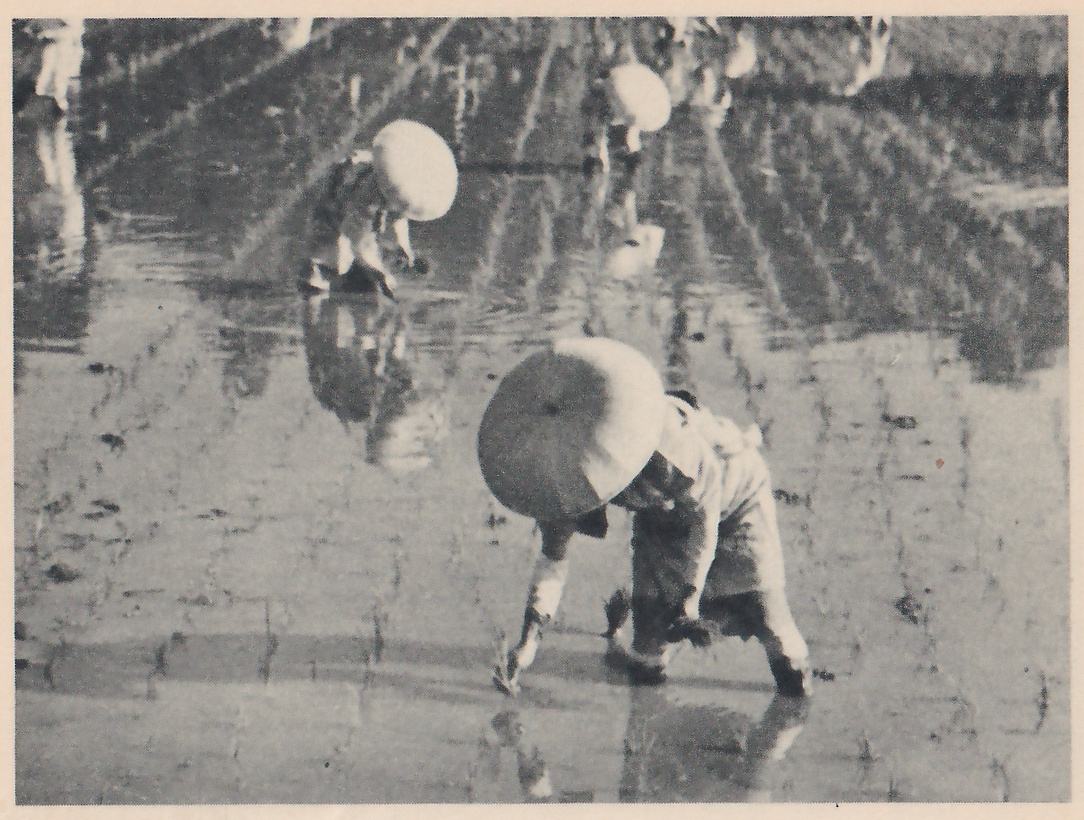
cause of its abundance of land suitable for rice cultivation, Japan was called Mizuho-no-Kuni or “the Land of Abundant Rice Ears.” And in those days, the men hunted and fished and the women cultivated the fields.”
“Yes, yes, the paddy-fields are Japan’s characteristic fields, aren’t they? It’s remarkable how many we see everywhere from the windows of the trains.”
“Yes, they are especially beautiful in the planting season. The women, wearing great, round, artistic, woven-rush hats, and with their sleeves tied up by red cords, move along in straight lines singing and setting out the young rice-plants. In the Heian Period (784–1185) the art of preparing food having advanced, the most Japanese among foods of today which could then be enjoyed for the first time are sashimi (raw sea-bream,
flounder, tunny, etc. cut into thin slices), yakimono (broiled fish and fowl), nimono (boiled fish and fowl with vegetables), shirumono (soups), mushimono (steamed fish, fowl and eggs), sushi (rice squares flavoured with vinegar and salt, and covered with a slice of fish or shrimp), sōmen (vermicelli), and mochi (glutinous rice steamed and pounded). Malt, honey, amazura (a sweet principle extracted from some vine) and powdered dried persimmons, are used for sweetening.”
At about this time Mt. Fuji’s beautiful cone came into sight through the car windows. Before I could point it out, Mr. and Mrs. H. discovered it and exclaimed,
“Ah, Fuji Yama! Beautiful! Beautiful!”
Having seen it once as they went down west from Yokohama, they knew where it would appear again.
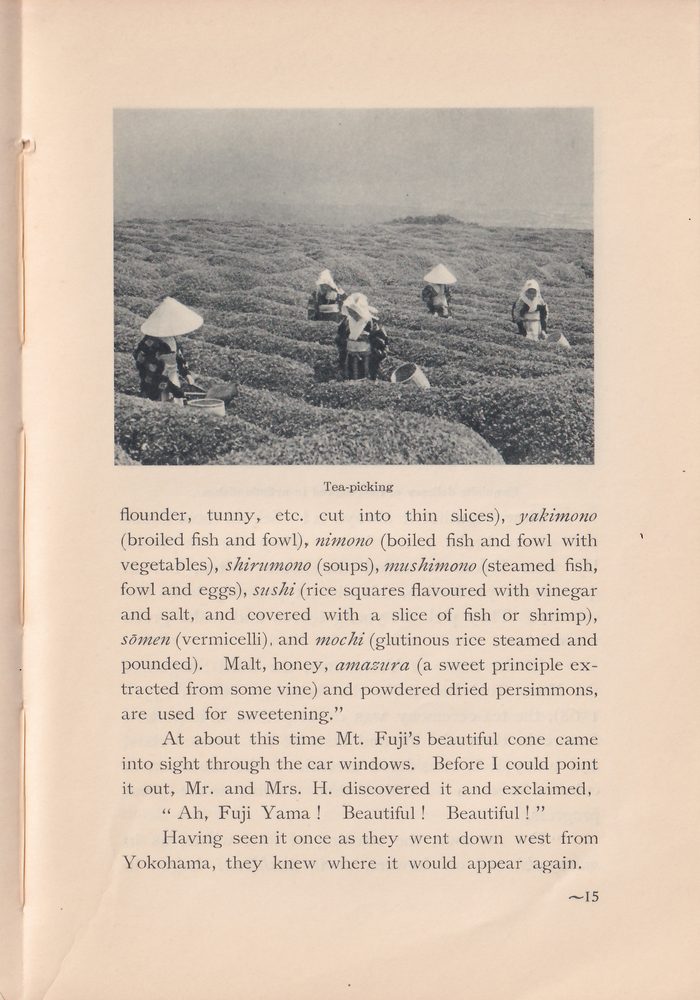
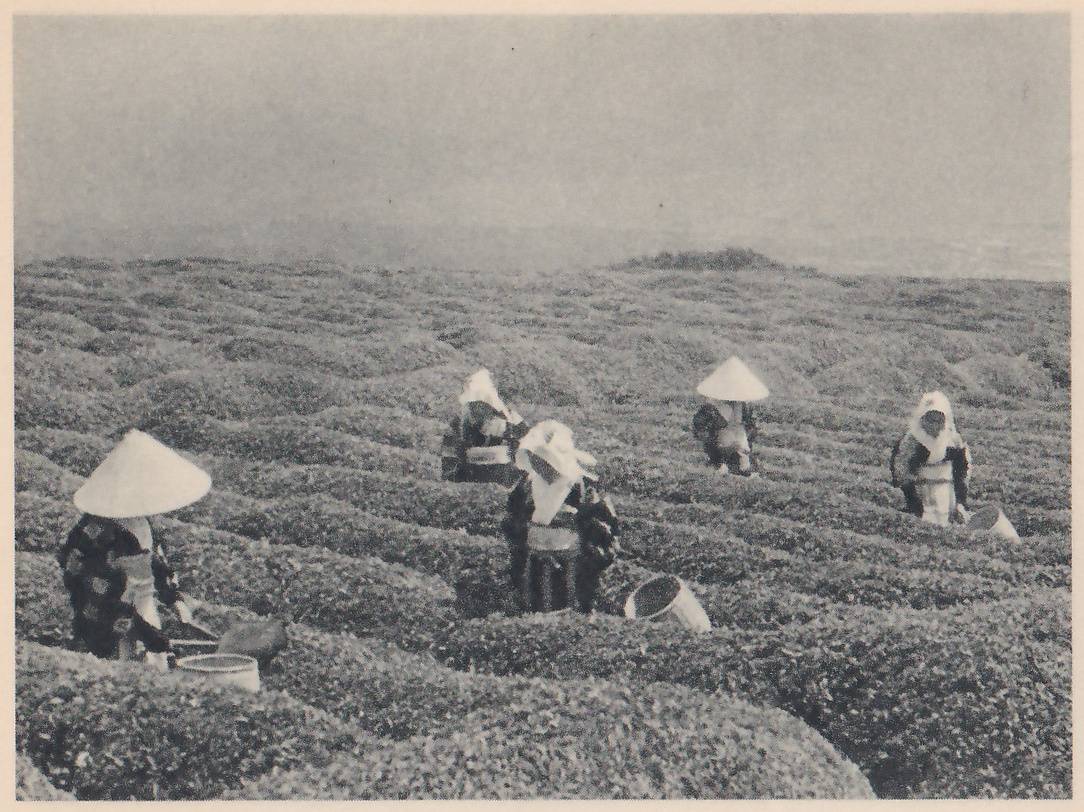
“How beautiful it always is! See all those dense light-green shrubs in the fields. They are tea-plants. Uji near Kyoto is called the home of tea, but in quantity of production, this district probably leads the country. They pick the young leaves and make green tea of them.
“In the time of Yoshimitsu, the third Shōgun of the Muromachi Period (or the Ashikaga Period, 1332–1568), the tea ceremony was developed as an important feature in the social life and taste of the warrior class, and today it is considered essential in the education of cultured women. At that time cooking made great progress.
“For instance, the roasting of fowl whole, as in maruyaki, and on skewers, as in kushiyaki, began in
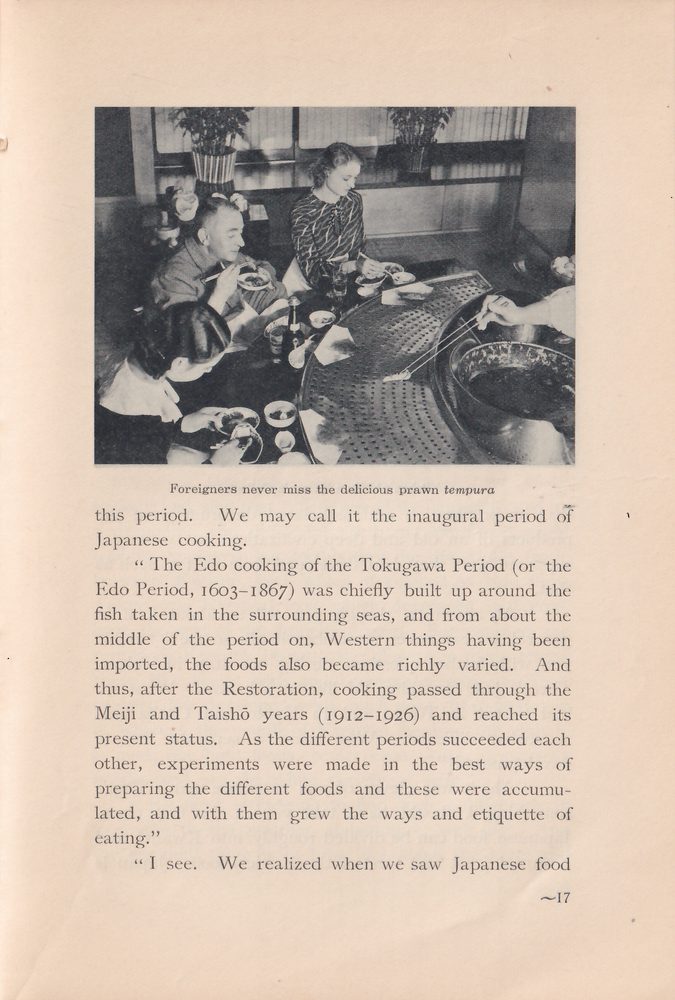
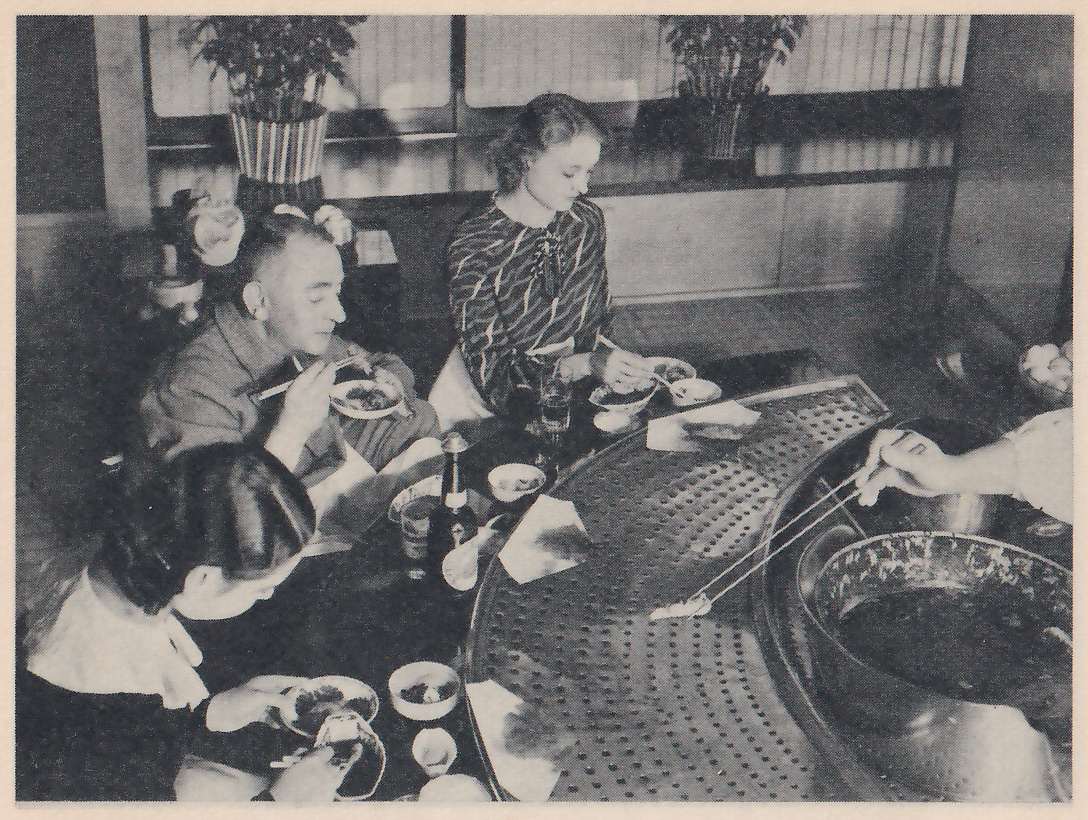
this period. We may call it the inaugural period of Japanese cooking.
“The Edo cooking of the Tokugawa Period (or the Edo Period, 1603–1867) was chiefly built up around the fish taken in the surrounding seas, and from about the middle of the period on, Western things having been imported, the foods also became richly varied. And thus, after the Restoration, cooking passed through the Meiji and Taishō years (1912–1926) and reached its present status. As the different periods succeeded each other, experiments were made in the best ways of preparing the different foods and these were accumulated, and with them grew the ways and etiquette of eating.”
“I see. We realized when we saw Japanese food
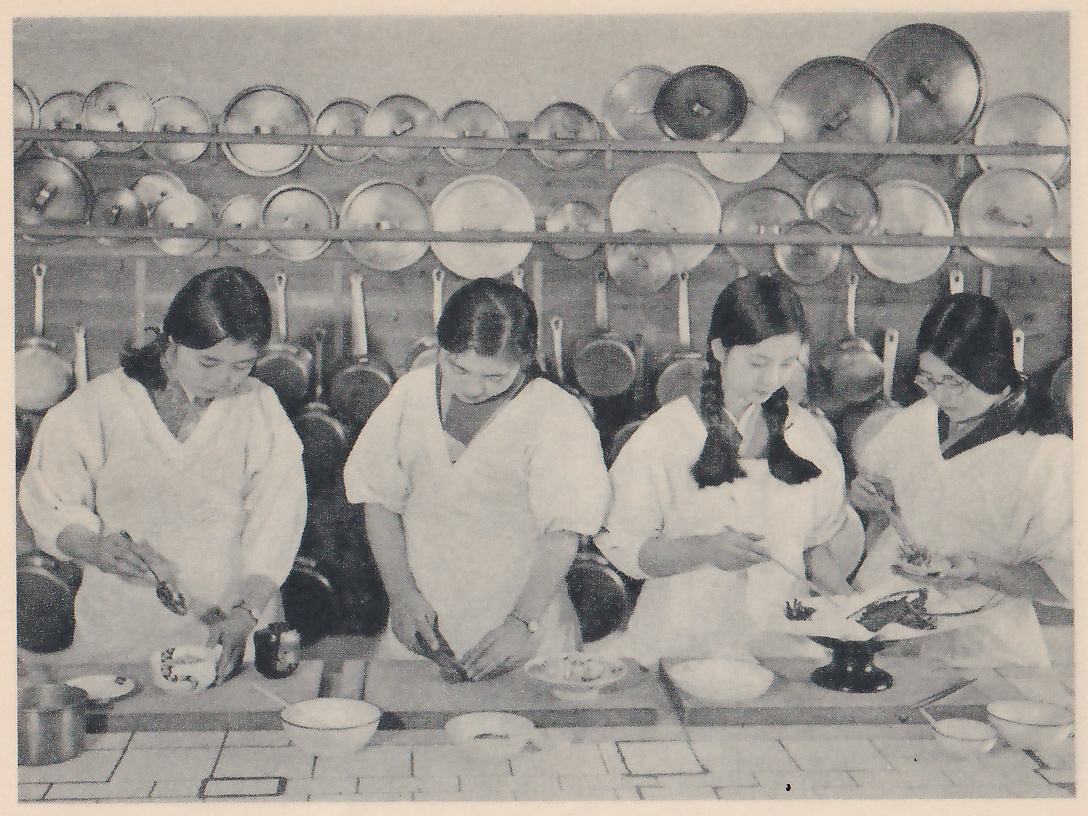
that its preparation and associated decorum were the products of an old and deep civilization, but we never supposed that they had developed from so far back as that.
“At any rate, though you tell us about food in general, we can never remember it all, so we’ll trouble you with further questions during our stay in Tokyo. There’s just one thing I’d like to ask now. What we had to eat in Tokyo and in Kyoto and Osaka was somewhat different. Was there a separate line of development?”
“Ah, it was clever of you to notice that. That’s something I should have told you in the first place. Japanese food can be divided roughly into Kwantō and Kwansai (east and west of the barrier) food. Japan is
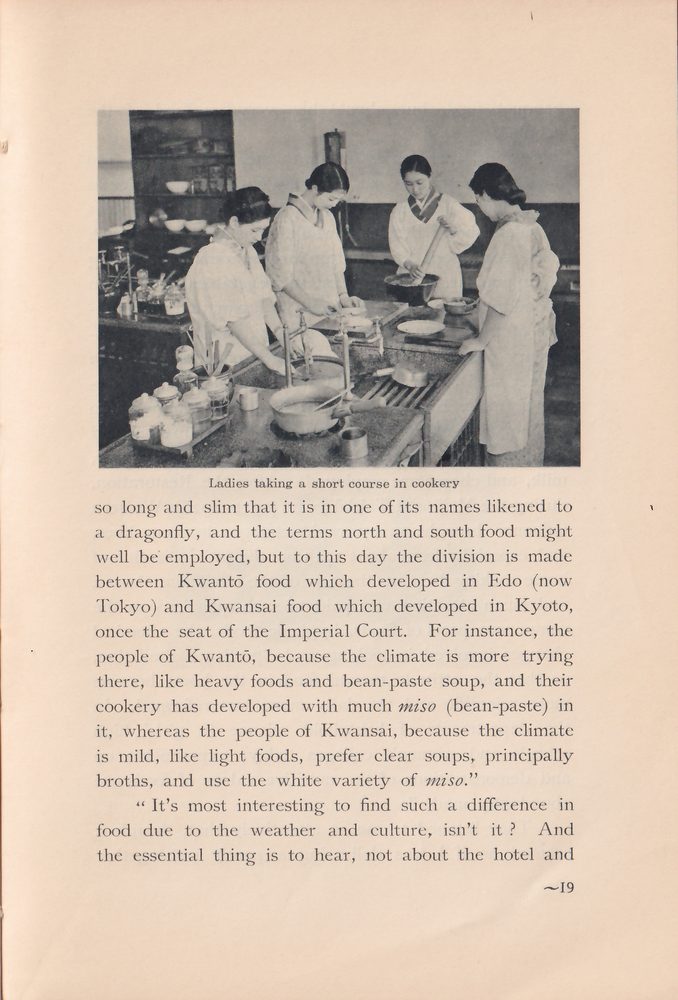
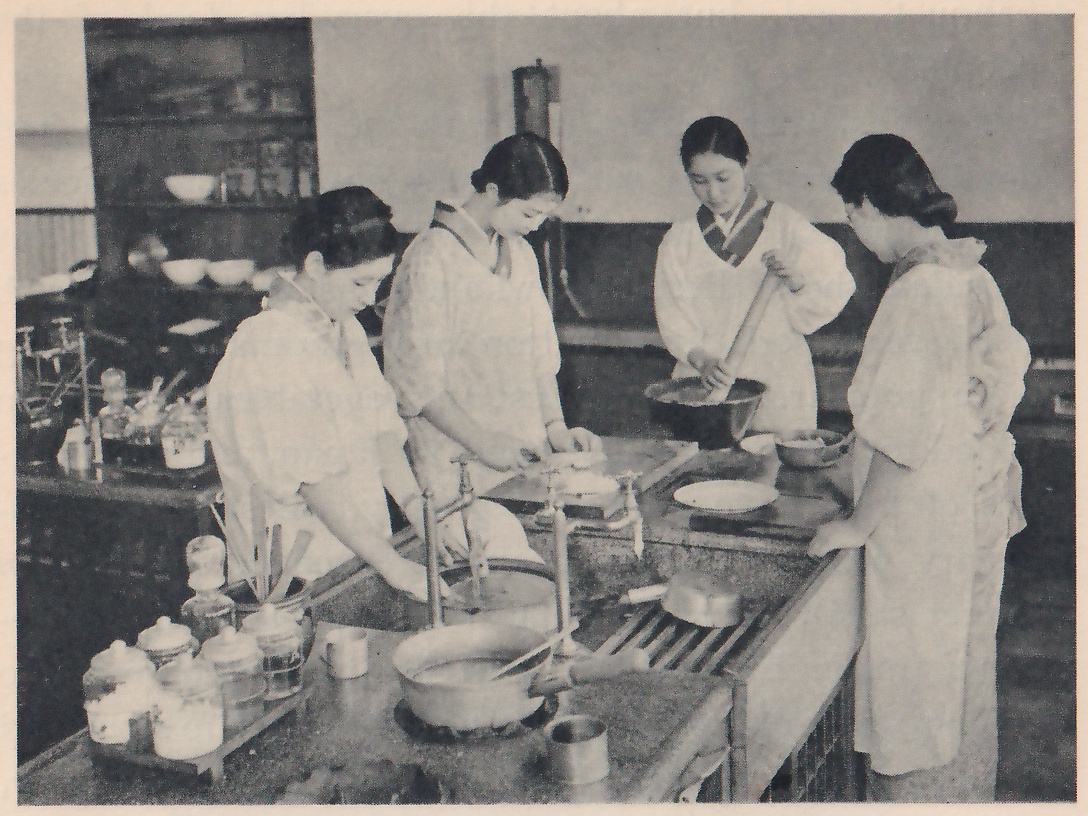
so long and slim that it is in one of its names likened to a dragonfly, and the terms north and south food might well be employed, but to this day the division is made between Kwantō food which developed in Edo (now Tokyo) and Kwansai food which developed in Kyoto, once the seat of the Imperial Court. For instance, the people of Kwantō, because the climate is more trying there, like heavy foods and bean-paste soup, and their cookery has developed with much miso (bean-paste) in it, whereas the people of Kwansai, because the climate is mild, like light foods, prefer clear soups, principally broths, and use the white variety of miso.”
“It’s most interesting to find such a difference in food due to the weather and culture, isn’t it? And the essential thing is to hear, not about the hotel and
banquet food, but about the everyday food of the people.”
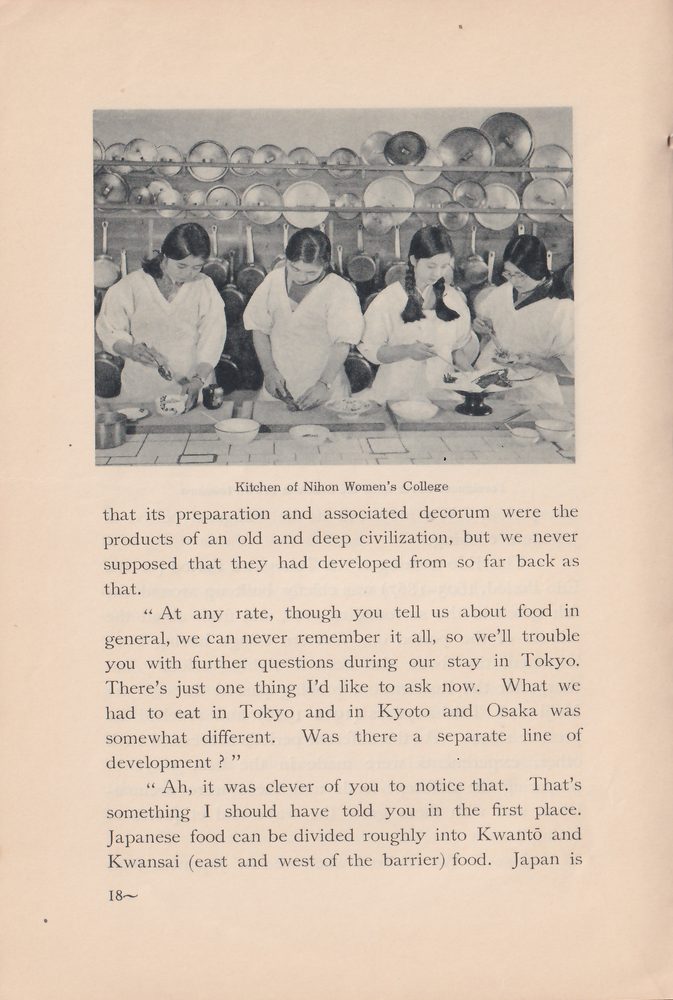
“Yes, that comes first with me, too. I’ll go into details later, but to put it briefly now, polished rice is the principal article of diet, with fish and vegetables as side-dishes. Besides, fowl and eggs are largely used. Beef, veal, pork and mutton are gradually becoming more popular. Many Western vegetables have been added to those originally found in Japan, and the varieties of fruit have increased greatly. Besides the customary condiments, soy, bean-paste, refined saké, mirin (sweet saké), vinegar, sugar and salt, katsuwobushi-no-dashi (made by putting dried bonito grated fine into boiling water and straining) is used as are soup stock and bouillon in the West. Besides, Western stock, butter, milk, and cheese are employed. After the Restoration, during the Meiji and Taishō years (1912–1926), Western influence brought many rapid changes into our lives, and especially from about 1913 on, the rationalization of home cooking became the cry of the intelligent classes, and much attention was paid to such questions as the component parts of foods, hygienic foods, the chemical changes involved in cooking, and digestive assimilation, so that the attitude toward food in the home became more scientific and the daily menu was reformed. In the departments of household science in girls’ high schools and women’s colleges today, experiments on and demonstrations of the nutritive values of foods are abundantly made.”
They listened to me so attentively that, though it seemed as if I was delivering a poorly put-together
speech, I forgot to go back to my seat, and we kept on talking.
Then after advising them, if they wished to familiarize themselves with the customs and life of Japan, to associate during their stay here as much as possible with the upper and middle classes, and promising to do everything I could to make things easy for them, I parted with them at Tokyo Station.