III NOTES ON HIROSHIGE’S MASTERPIECES
Different sizes of colour-prints
Ōban, the standard size of Hiroshige’s prints, is roughly 15 by 10 inches and may be either lateral or vertical.
Kakemonoye is a diptych where the top of a vertical print is joined to the bottom of another vertical sheet, making a picture 30 inches by 10. This print is also called Nimai-tsuzuki.
Ō-tanzaku is a sheet measuring 15 by 6.6 inches. It is about the same size as the Ōban Hosoye which was the term used prior to Hiroshige’s era.
Triptych is three sheet print formed by joining three Ōban usually in vertical form.
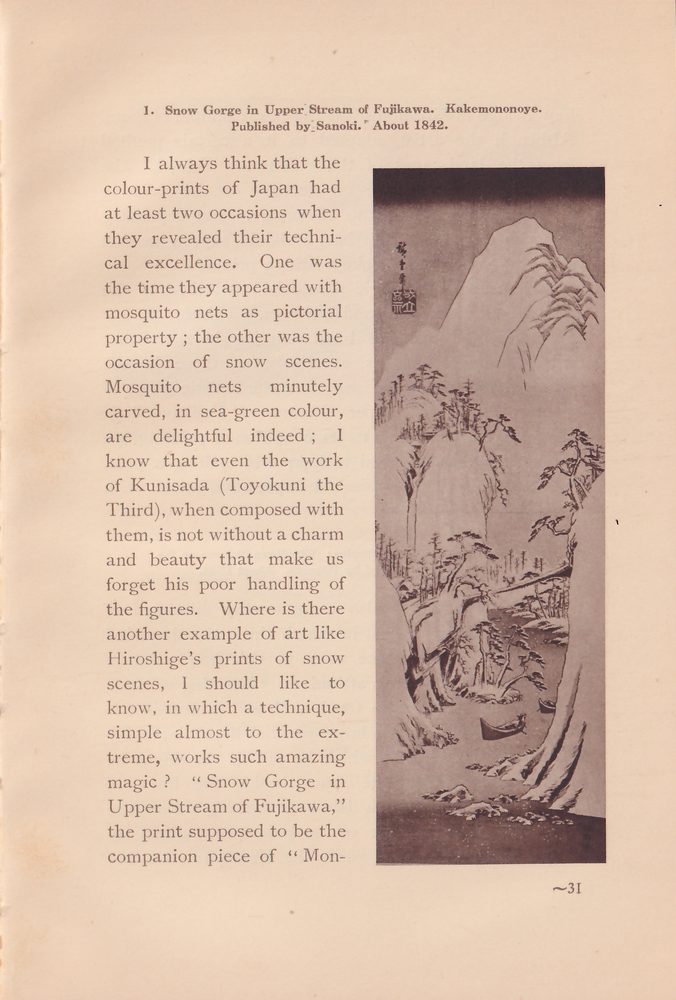
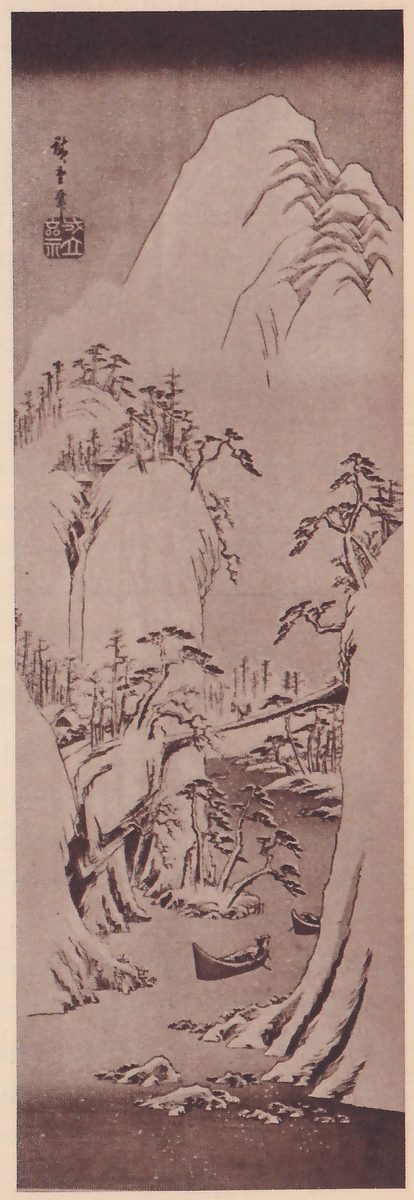
Published by Sanoki. About 1842.
I always think that the colour-prints of Japan had at least two occasions when they revealed their technical excellence. One was the time they appeared with mosquito nets as pictorial property; the other was the occasion of snow scenes. Mosquito nets minutely carved, in sea-green colour, are delightful indeed; I know that even the work of Kunisada (Toyokuni the Third), when composed with them, is not without a charm and beauty that make us forget his poor handling of the figures. Where is there another example of art like Hiroshige’s prints of snow scenes, I should like to know, in which a technique, simple almost to the extreme, works such amazing magic? “Snow Gorge in Upper Stream of Fujikawa,” the print supposed to be the companion piece of “Mon-
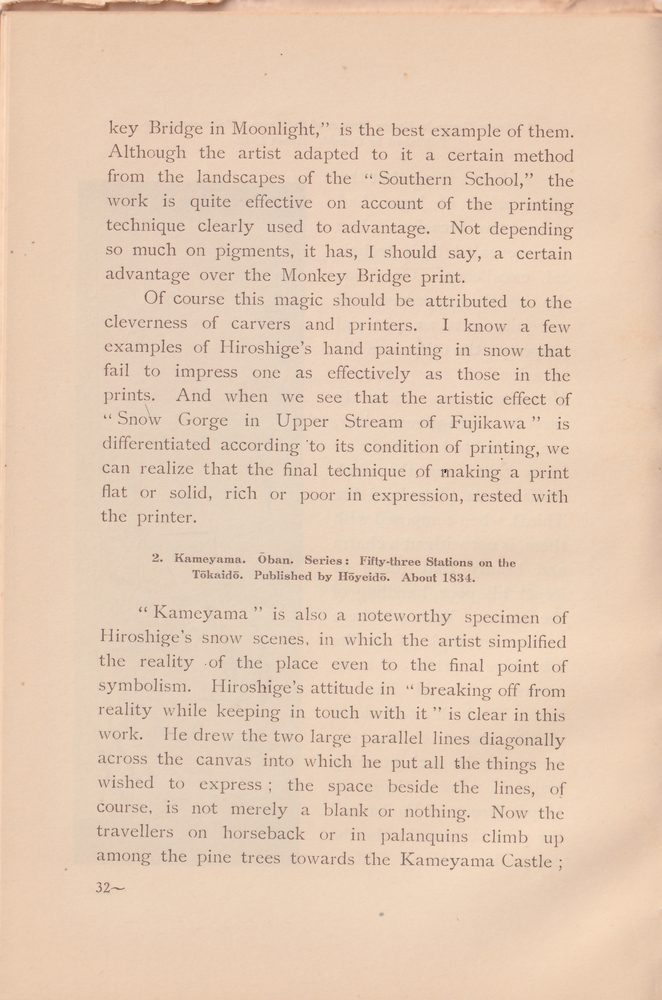
key Bridge in Moonlight,” is the best example of them. Although the artist adapted to it a certain method from the landscapes of the “Southern School,” the work is quite effective on account of the printing technique clearly used to advantage. Not depending so much on pigments, it has, I should say, a certain advantage over the Monkey Bridge print.
Of course this magic should be attributed to the cleverness of carvers and printers. I know a few examples of Hiroshige’s hand painting in snow that fail to impress one as effectively as those in the prints. And when we see that the artistic effect of “Snow Gorge in Upper Stream of Fujikawa” is differentiated according to its condition of printing, we can realize that the final technique of making a print flat or solid, rich or poor in expression, rested with the printer.
“Kameyama” is also a noteworthy specimen of Hiroshige’s snow scenes, in which the artist simplified the reality of the place even to the final point of symbolism. Hiroshige’s attitude in “breaking off from reality while keeping in touch with it” is clear in this work. He drew the two large parallel lines diagonally across the canvas into which he put all the things he wished to express; the space beside the lines, of course, is not merely a blank or nothing. Now the travellers on horseback or in palanquins climb up among the pine trees towards the Kameyama Castle;
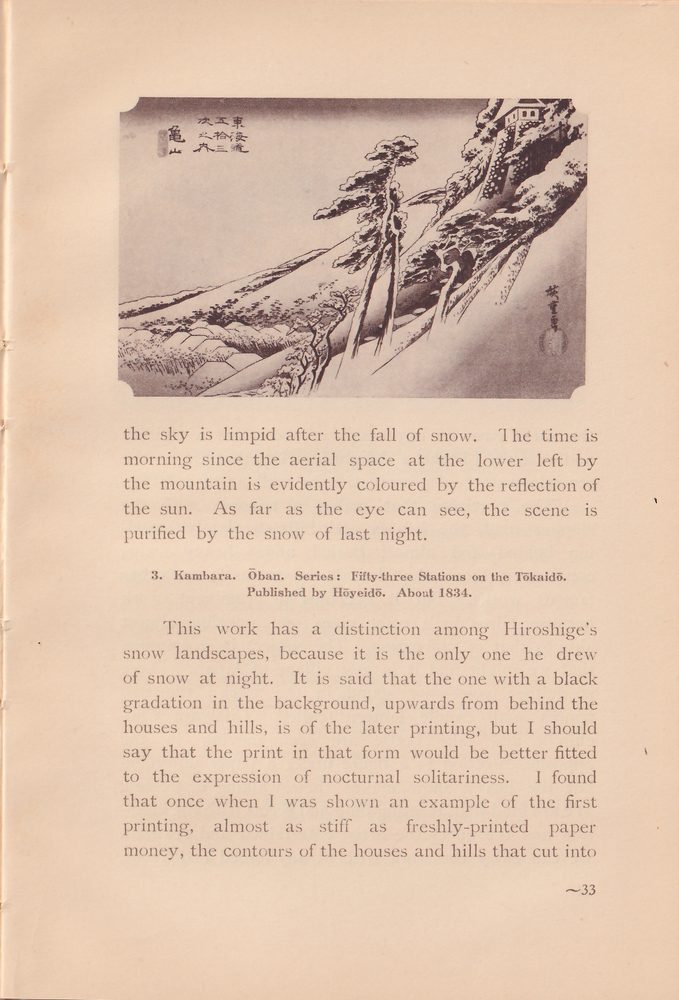
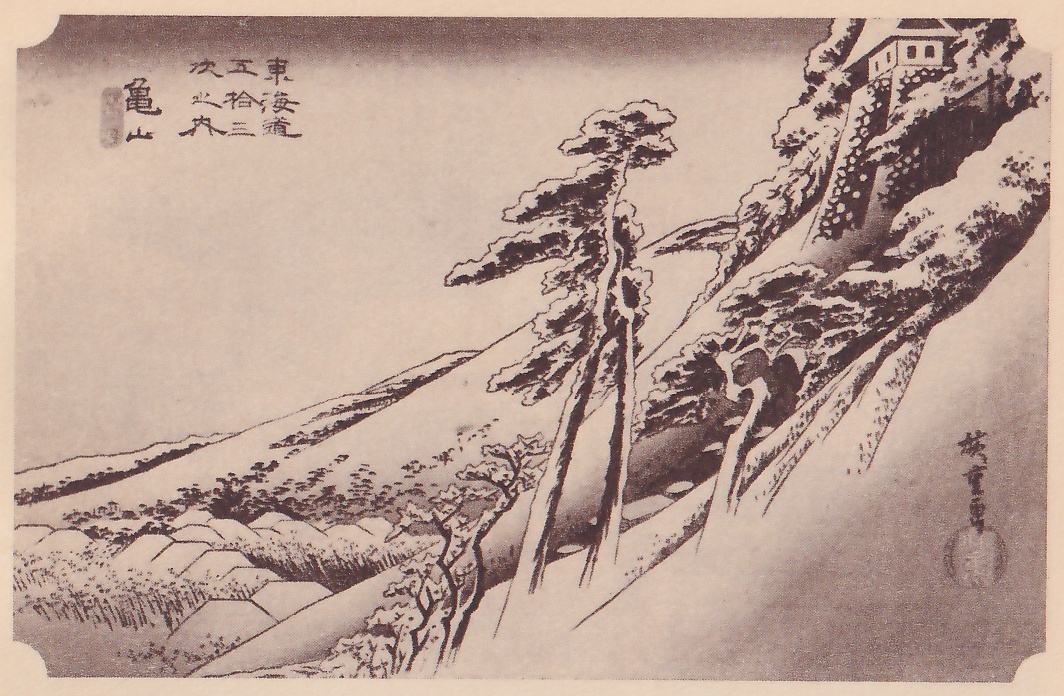
the sky is limpid after the fall of snow. The time is morning since the aerial space at the lower left by the mountain is evidently coloured by the reflection of the sun. As far as the eye can see, the scene is purified by the snow of last night.
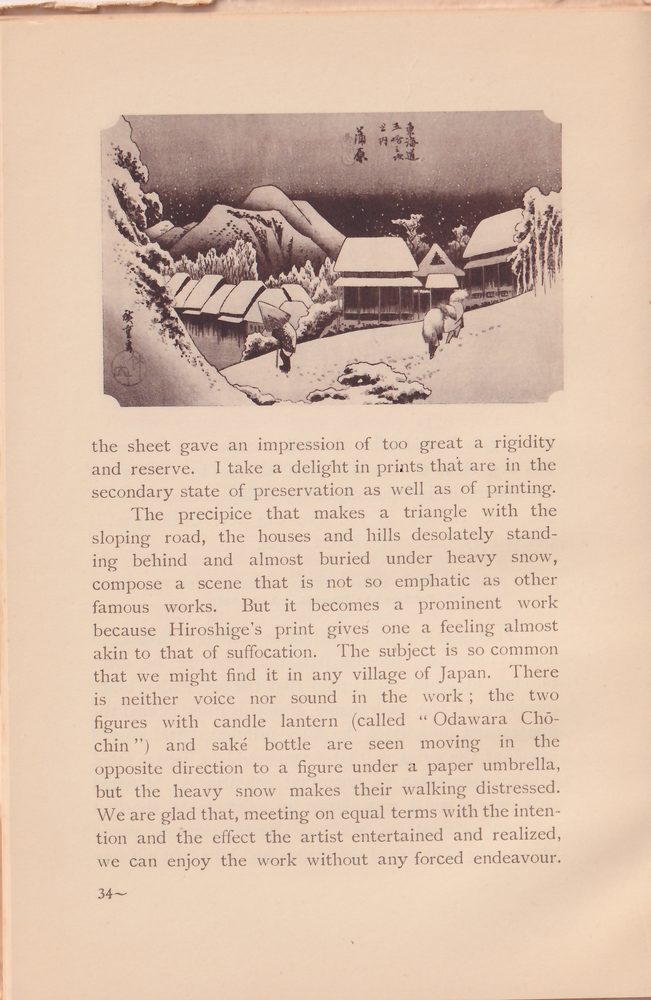
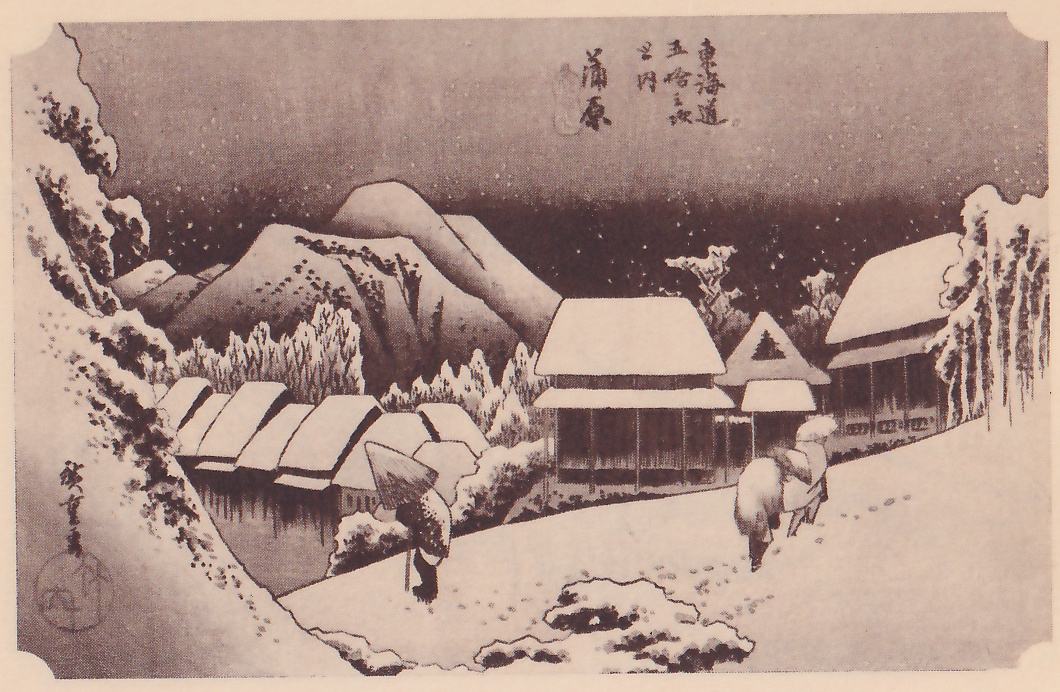
This work has a distinction among Hiroshige’s snow landscapes, because it is the only one he drew of snow at night. It is said that the one with a black gradation in the background, upwards from behind the houses and hills, is of the later printing, but I should say that the print in that form would be better fitted to the expression of nocturnal solitariness. I found that once when I was shown an example of the first printing, almost as stiff as freshly-printed paper money, the contours of the houses and hills that cut into
Published by Hōyeidō. About 1834.
the sheet gave an impression of too great a rigidity and reserve. I take a delight in prints that are in the secondary state of preservation as well as of printing.
The precipice that makes a triangle with the sloping road, the houses and hills desolately standing behind and almost buried under heavy snow, compose a scene that is not so emphatic as other famous works. But it becomes a prominent work because Hiroshige’s print gives one a feeling almost akin to that of suffocation. The subject is so common that we might find it in any village of Japan. There is neither voice nor sound in the work; the two figures with candle lantern (called “Odawara Chōchin”) and saké bottle are seen moving in the opposite direction to a figure under a paper umbrella, but the heavy snow makes their walking distressed. We are glad that, meeting on equal terms with the intention and the effect the artist entertained and realized, we can enjoy the work without any forced endeavour.
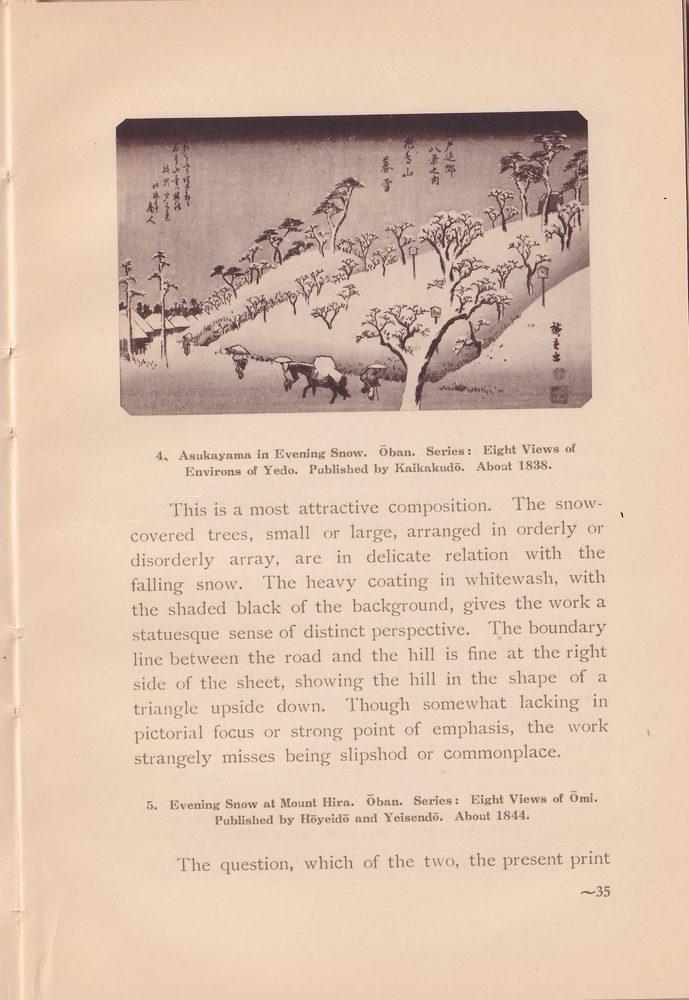
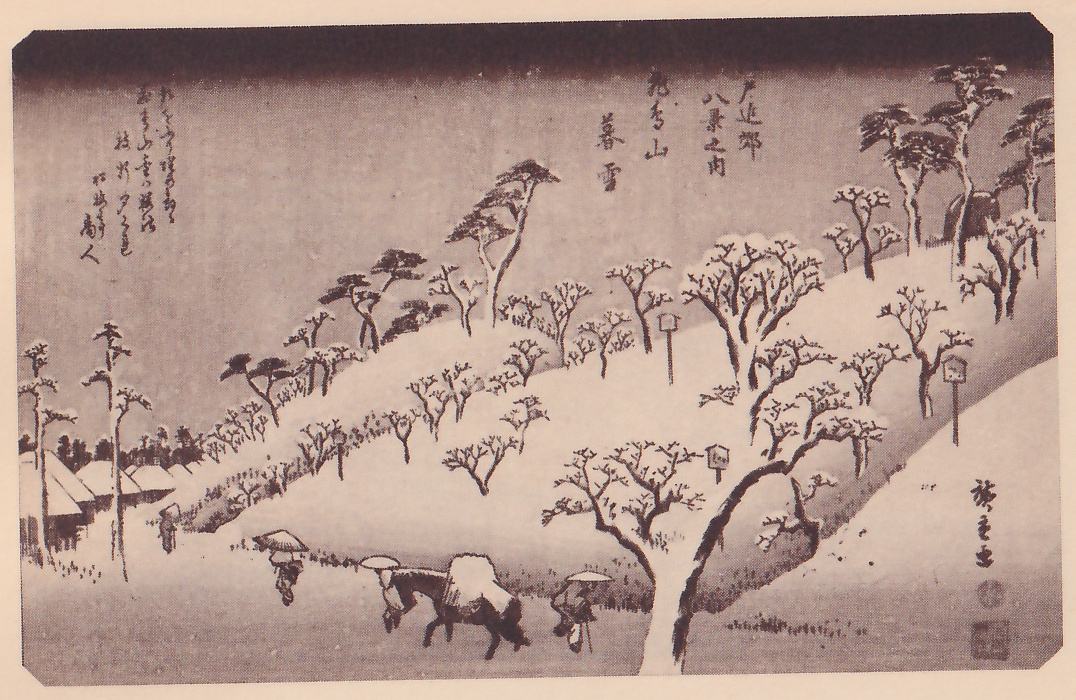
This is a most attractive composition. The snow-covered trees, small or large, arranged in orderly or disorderly array, are in delicate relation with the falling snow. The heavy coating in whitewash, with the shaded black of the background, gives the work a statuesque sense of distinct perspective. The boundary line between the road and the hill is fine at the right side of the sheet, showing the hill in the shape of a triangle upside down. Though somewhat lacking in pictorial focus or strong point of emphasis, the work strangely misses being slipshod or commonplace.
The question, which of the two, the present print
Published by Hōyeidō and Yeisendō. About 1844.
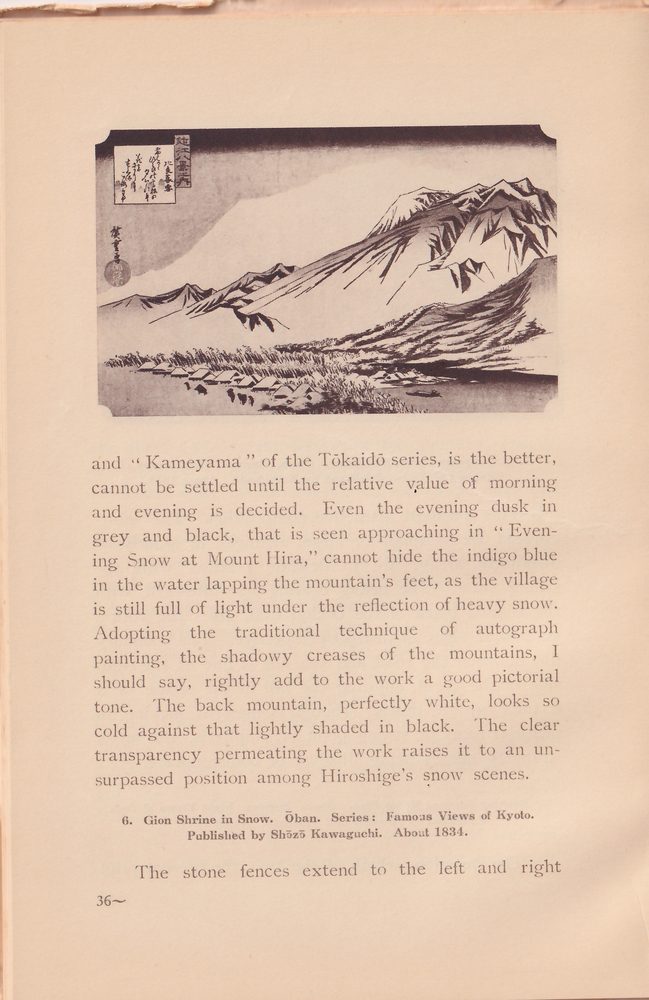
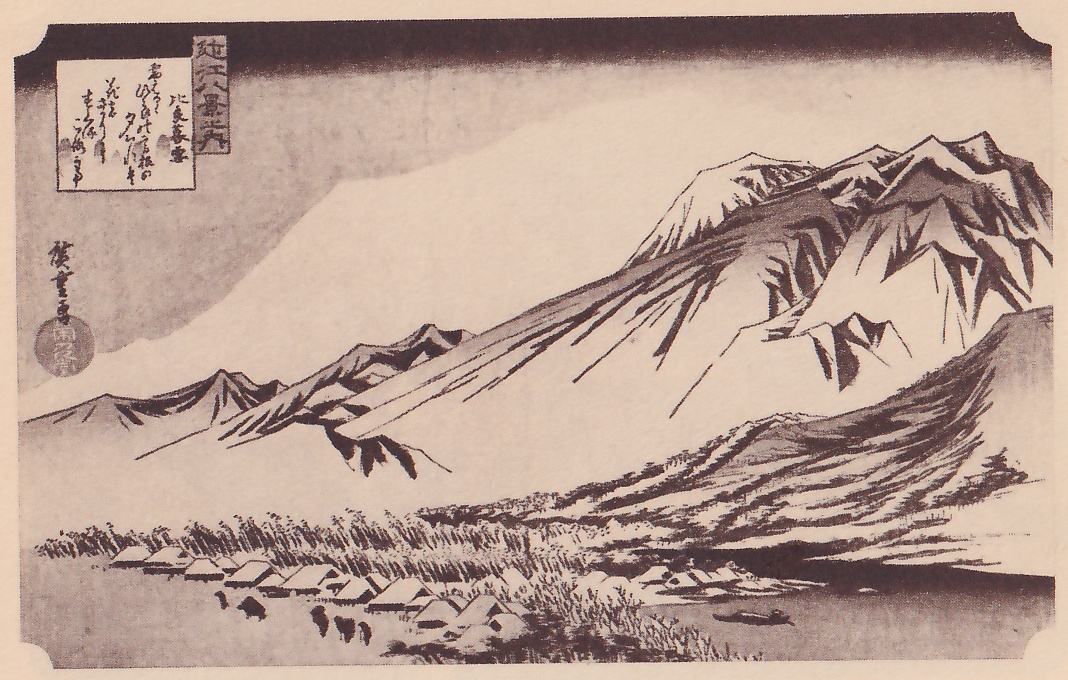
and “Kameyama” of the Tōkaidō series, is the better, cannot be settled until the relative value of morning and evening is decided. Even the evening dusk in grey and black, that is seen approaching in “Evening Snow at Mount Hira,” cannot hide the indigo blue in the water lapping the mountain’s feet, as the village is still full of light under the reflection of heavy snow. Adopting the traditional technique of autograph painting, the shadowy creases of the mountains, I should say, rightly add to the work a good pictorial tone. The back mountain, perfectly white, looks so cold against that lightly shaded in black. The clear transparency permeating the work raises it to an unsurpassed position among Hiroshige’s snow scenes.
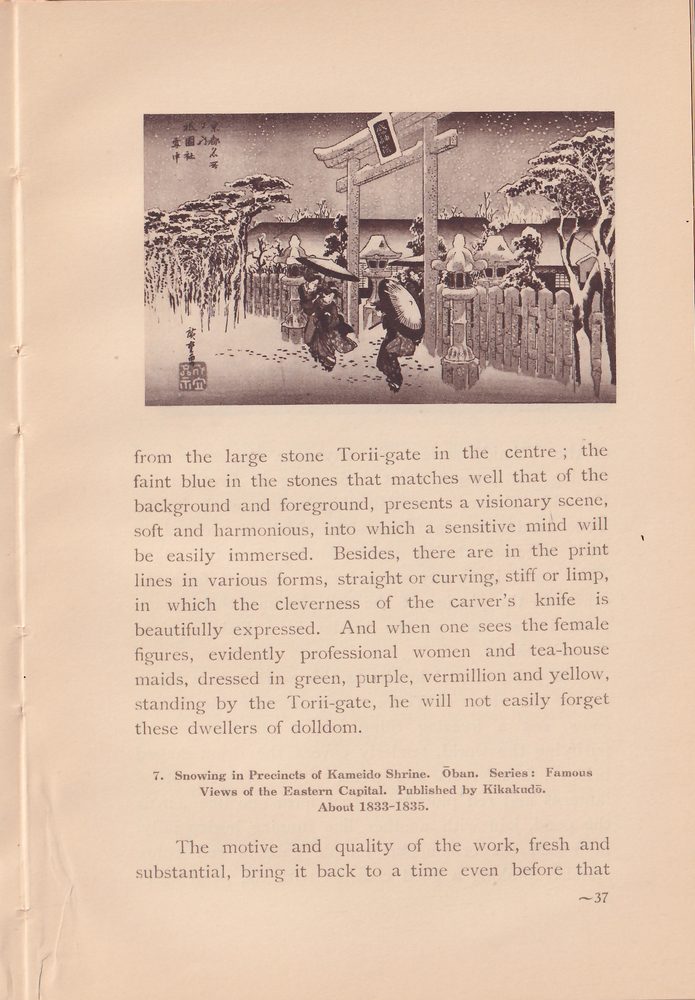
The stone fences extend to the left and right
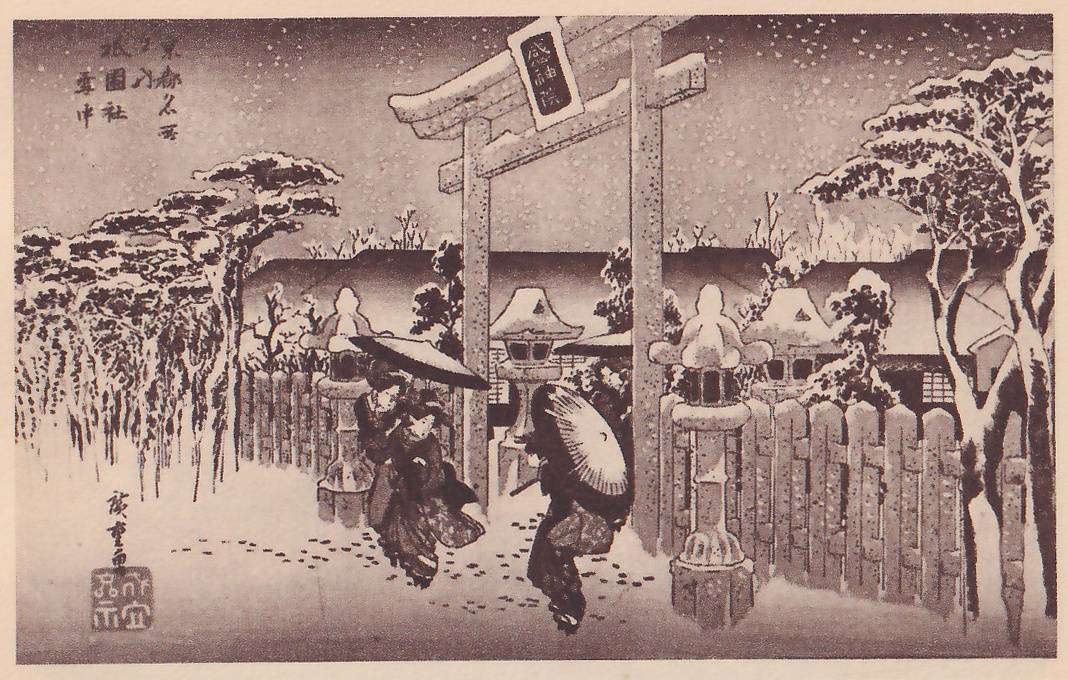
Published by Shōzō Kawaguchi. About 1834.
from the large stone Torii-gate in the centre; the faint blue in the stones that matches well that of the background and foreground, presents a visionary scene, soft and harmonious, into which a sensitive mind will be easily immersed. Besides, there are in the print lines in various forms, straight or curving, stiff or limp, in which the cleverness of the carver’s knife is beautifully expressed. And when one sees the female figures, evidently professional women and tea-house maids, dressed in green, purple, vermillion and yellow, standing by the Torii-gate, he will not easily forget these dwellers of dolldom.
The motive and quality of the work, fresh and substantial, bring it back to a time even before that
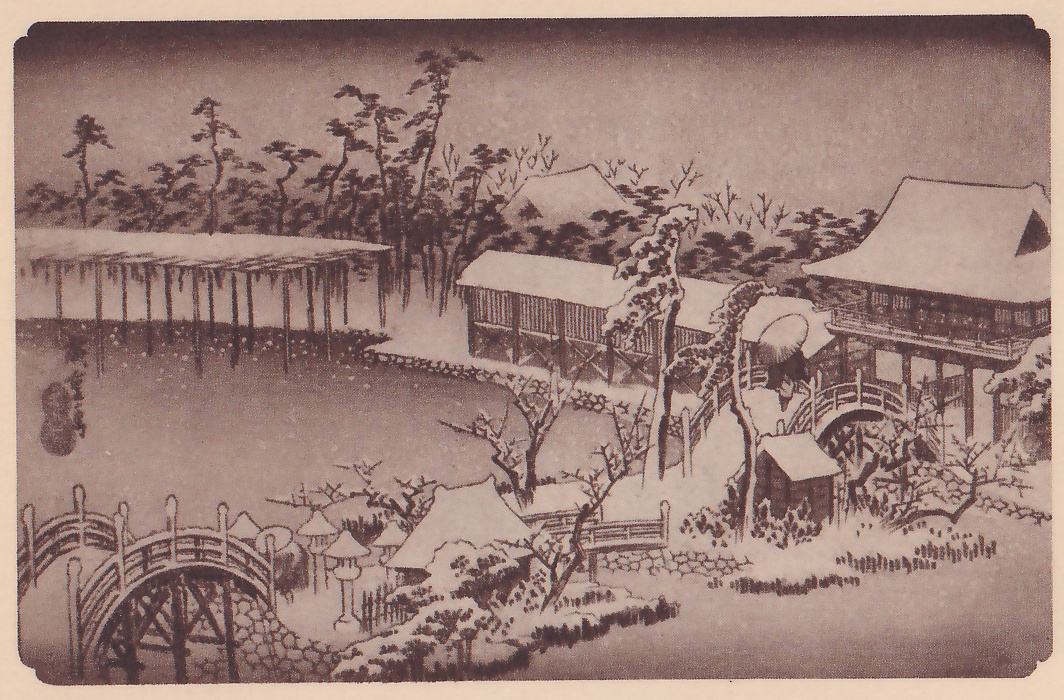
About 1833-1835.
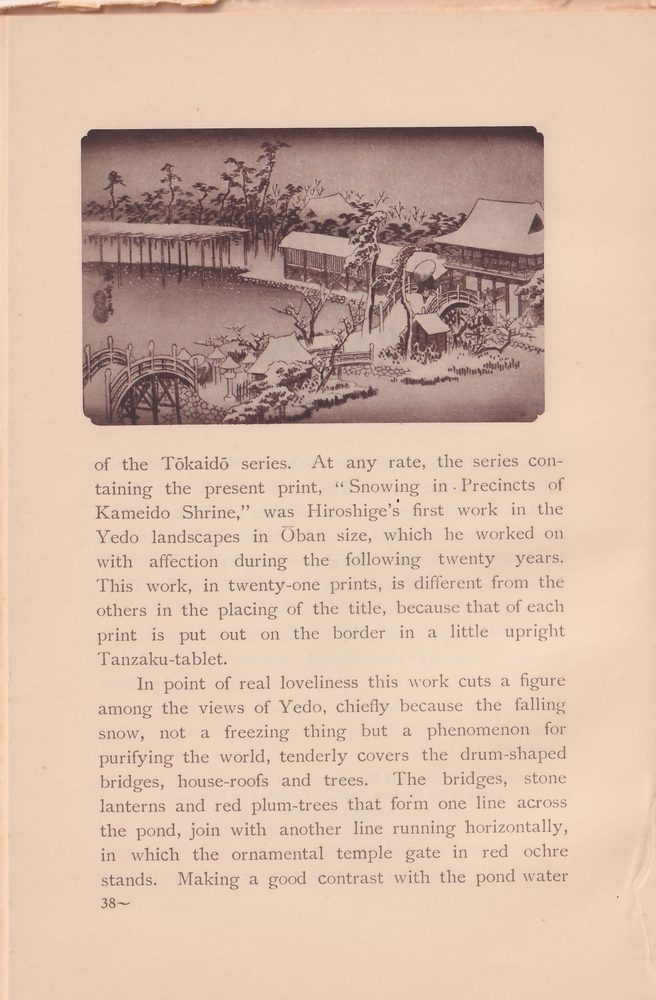
of the Tōkaidō series. At any rate, the series containing the present print, “Snowing in Precincts of Kameido Shrine,” was Hiroshige’s first work in the Yedo landscapes in Ōban size, which he worked on with affection during the following twenty years. This work, in twenty-one prints, is different from the others in the placing of the title, because that of each print is put out on the border in a little upright Tanzaku-tablet.
In point of real loveliness this work cuts a figure among the views of Yedo, chiefly because the falling snow, not a freezing thing but a phenomenon for purifying the world, tenderly covers the drum-shaped bridges, house-roofs and trees. The bridges, stone lanterns and red plum-trees that form one line across the pond, join with another line running horizontally, in which the ornamental temple gate in red ochre stands. Making a good contrast with the pond water
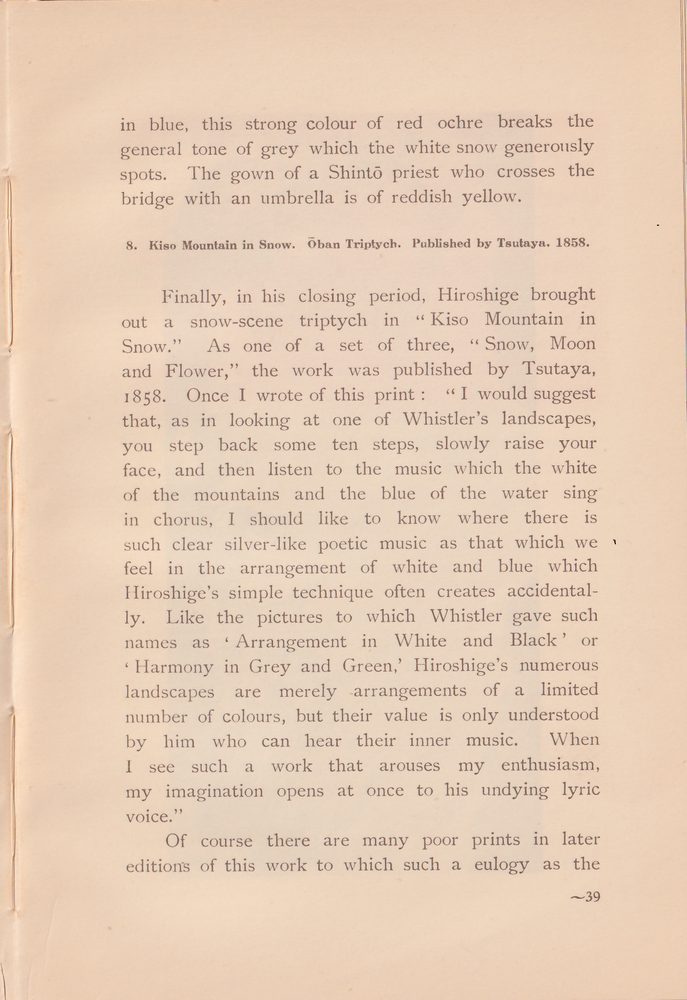
in blue, this strong colour of red ochre breaks the general tone of grey which the white snow generously spots. The gown of a Shintō priest who crosses the bridge with an umbrella is of reddish yellow.
Finally, in his closing period, Hiroshige brought out a snow-scene triptych in “Kiso Mountain in Snow.” As one of a set of three, “Snow, Moon and Flower,” the work was published by Tsutaya, 1858. Once I wrote of this print: “I would suggest that, as in looking at one of Whistler’s landscapes, you step back some ten steps, slowly raise your face, and then listen to the music which the white of the mountains and the blue of the water sing in chorus, I should like to know where there is such clear silver-like poetic music as that which we feel in the arrangement of white and blue which Hiroshige’s simple technique often creates accidentally. Like the pictures to which Whistler gave such names as ‘Arrangement in White and Black’ or ‘Harmony in Grey and Green,’ Hiroshige’s numerous landscapes are merely arrangements of a limited number of colours, but their value is only understood by him who can hear their inner music. When I see such a work that arouses my enthusiasm, my imagination opens at once to his undying lyric voice.”
Of course there are many poor prints in later editions of this work to which such a eulogy as the
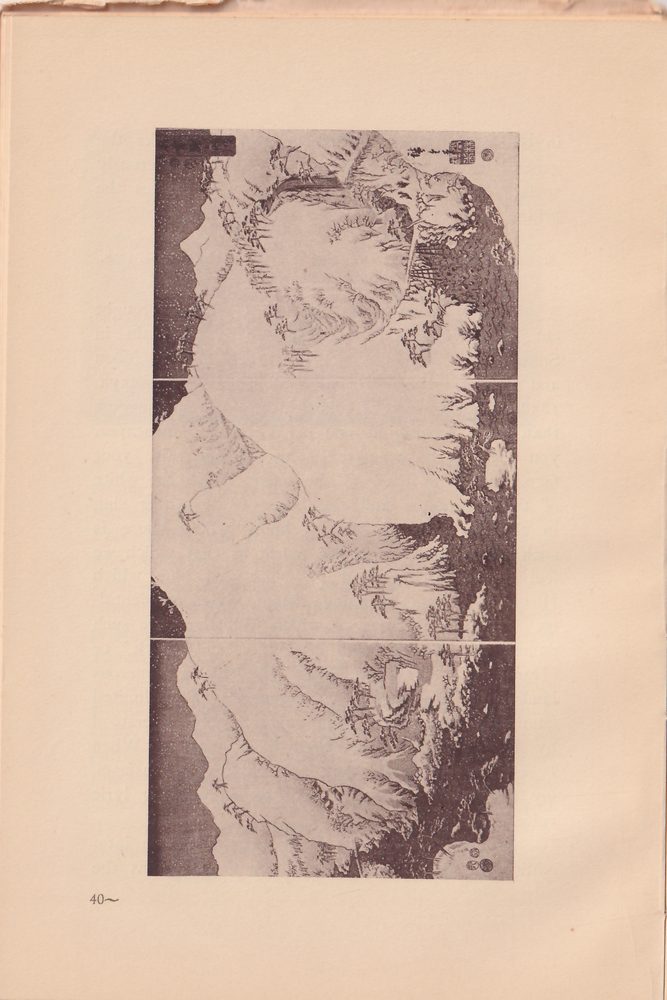
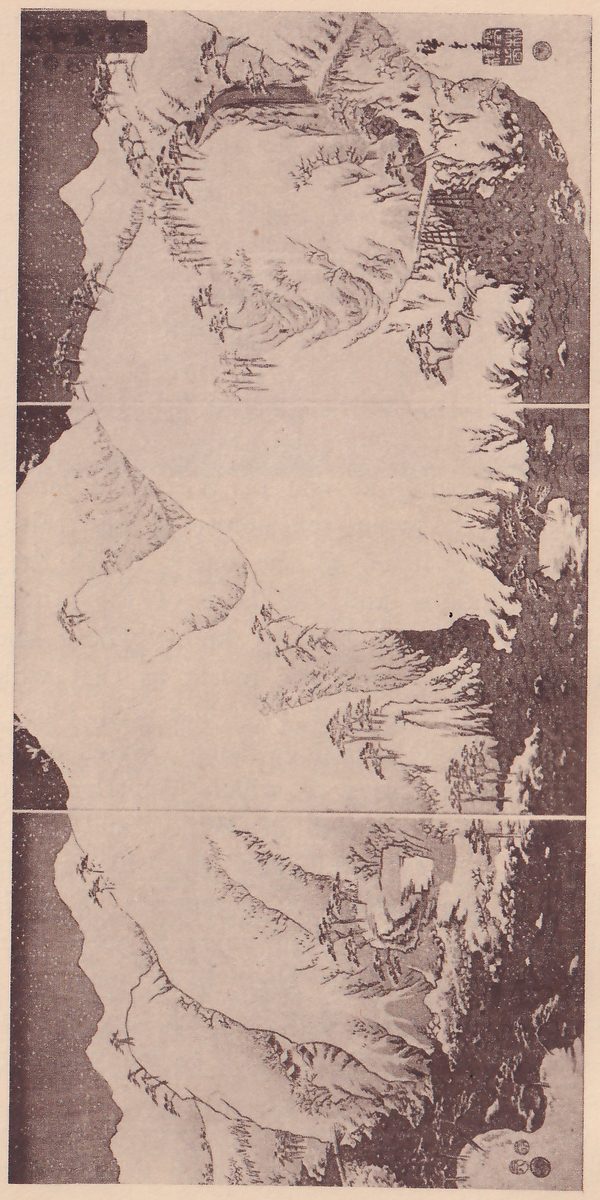
above would be unfitted. We must realise how the pictorial impression of a print may be changed by the manner of a printer, for the responsibility of this silent partner to an artist is certainly great. This is particularly true in a print like “Kiso Mountain in Snow,” which depends upon the colour contrast of indigo-blue and white and black. The mountains under the snow are almost like a huge Chinese yam, a shape which we see so often in the landscapes of the “Southern School” in our autograph painting. The gloominess of a snowy sky is expressed by the blue mixed with black, and the valley stream below, a greyish indigo, is never touched by the din and bustle of the world. But there are also figures and houses in the scene, suggesting that even the coldness of wintry mountains cannot entirely kill humanity.
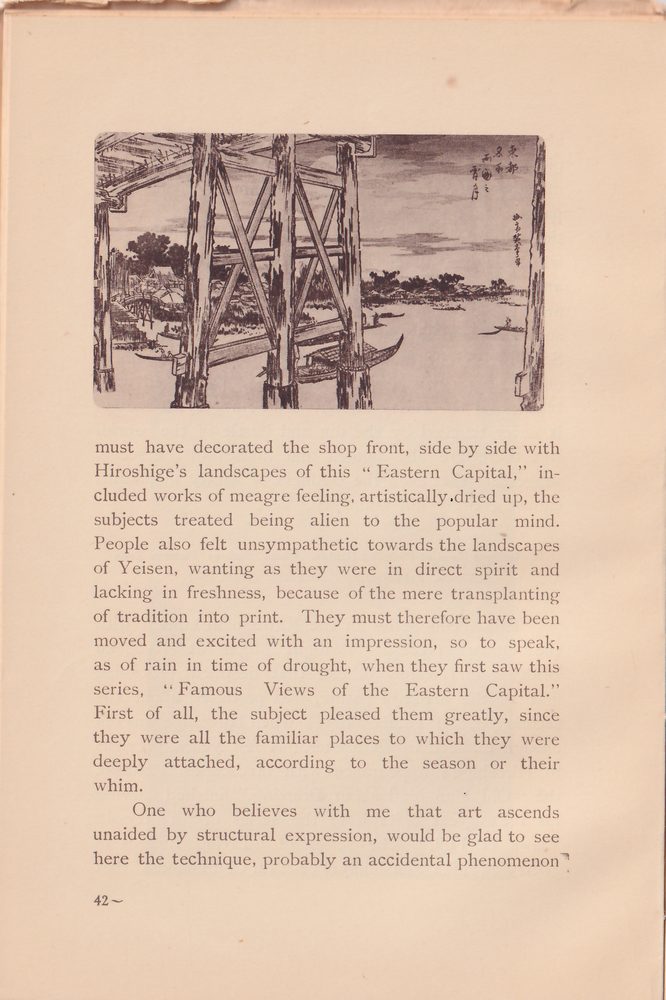
This Yedo series in the Kawaguchi edition with the famous pieces, “Twilight Moon at Ryōgoku Bridge” and a few others, that destined Hiroshige first as the artist of nature, was produced about the second year of Tempō (1831), when Hiroshige was old enough to be his own master. A few years previous to Hiroshige’s appearance with landscapes, Hokusai, the “Old Man Mad about Drawing,” finished carving his life’s great epitaph in the series of “Thirty-six Views of Fuji.” The series of “Living Images of Poetry” (Shika Shashinkyō) or “Lu Chu Islands,” that
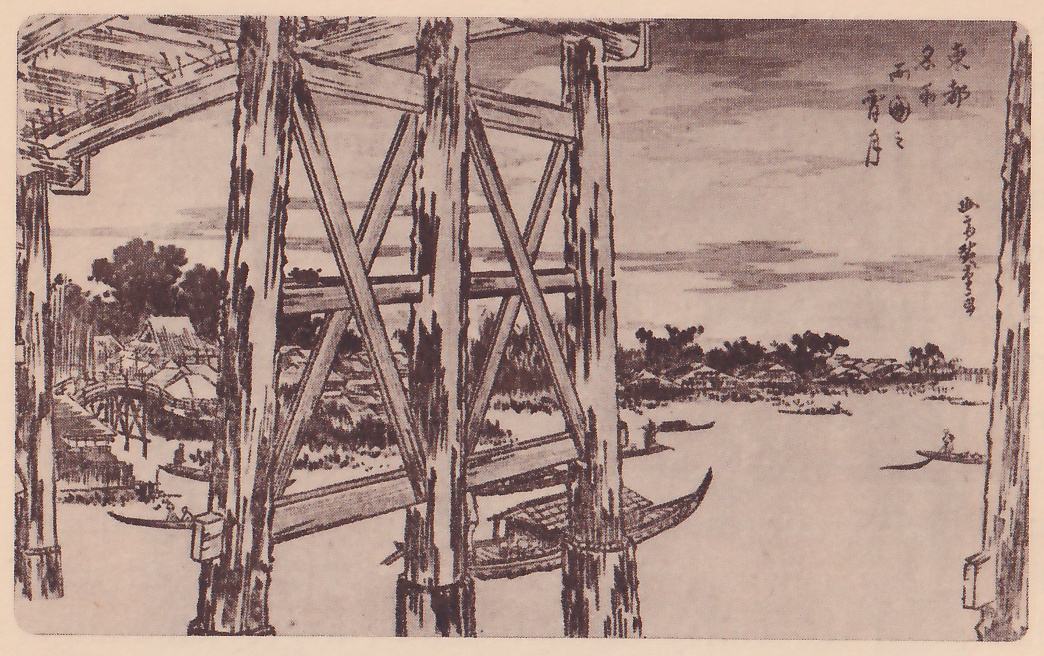
must have decorated the shop front, side by side with Hiroshige’s landscapes of this “Eastern Capital,” included works of meagre feeling, artistically dried up, the subjects treated being alien to the popular mind. People also felt unsympathetic towards the landscapes of Yeisen, wanting as they were in direct spirit and lacking in freshness, because of the mere transplanting of tradition into print. They must therefore have been moved and excited with an impression, so to speak, as of rain in time of drought, when they first saw this series, “Famous Views of the Eastern Capital.” First of all, the subject pleased them greatly, since they were all the familiar places to which they were deeply attached, according to the season or their whim.
One who believes with me that art ascends unaided by structural expression, would be glad to see here the technique, probably an accidental phenomenon
even the artist himself did not foresee, that is just crude enough to invigorate the inner spirit of the work. Hiroshige’s crudity in this series is a thing that broods, working its own wild mystery, and therefore it is not undeveloped childishness at all.
It goes without saying that “Twilight Moon at Ryōgoku Bridge” is one of the best among the ten works of the series, if not the best of all. I have a poem, “The Man Sitting Down,” which runs:—
“The man standing erect, sees nature upward,
from paunch to head....
Doubtless, a few feet nearer the stars. What
in the world profits him that?
The man sitting down, praised be God, sees
the low garden in humble content.”
If one wishes to see Hiroshige, a man sitting down, he should come to “Twilight Moon at Ryōgoku Bridge,” in which, with all love and gratitude, the artist sees nature’s loins or feet. Hiroshige is content to sit nearer the ground, because there is no need to bend his body, thanking God or praising the moon behind the bridge.
The large autumnal moon is slowly rising among the disordered clouds, to brighten up again the Sumida River, over which many bridges in evening already cast their dusky mantle. The soul of the artist that is adjusted in solitude would pay attention to nature’s changing; in the moment when he thought he was part of nature, he would find himself, I believe, stepping aside some ten steps, and, if he were a Whistler, replacing his monocle properly and scrutinising her
objectively. Hiroshige is a poet with a paint brush.
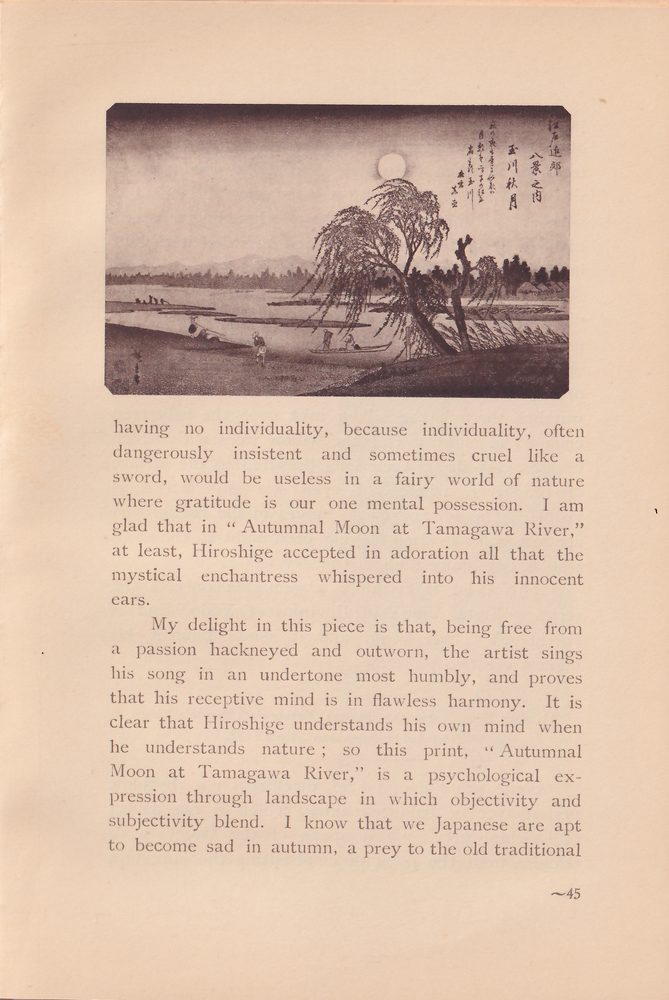
Unless one is gifted in sensibility towards the particular sweet and mellow beauty of autumnal nature in Japan, “Autumn Moon at Tamagawa River” of the series, “Eight Views of Environs of Yedo,” about 1838, one of Hiroshige’s best moonlight views, that glimmers with something, half joy half sorrow, will not be understood by him. It is so delightful in the autumn of Japan that we can leave behind our objective attitude to create a psychological state of contemplation. Because the other seasons are too tumultuous or too stern, and prevent our observing nature minutely and appreciating her beauty accordingly, autumn is the only time when we can build a spiritual extra-territoriality in our minds where nature and life embrace each other in one song. If the print “Autumnal Moon at Tamagawa River” is great, I think it is simply because the artist is highly self-possessed and beautifully composed through the virtue of lying close to the ground and listening to each delicate voice the autumnal moonlight night speaks to him. It is said of a poet that being given no identical nature, he enters into something else and fills himself with it. It is true in this moonlight view that Hiroshige entered nature empty-handed and then filled himself plentifully with the beauty it offered him. Once in my essay I dwelt on the poetical blessing of
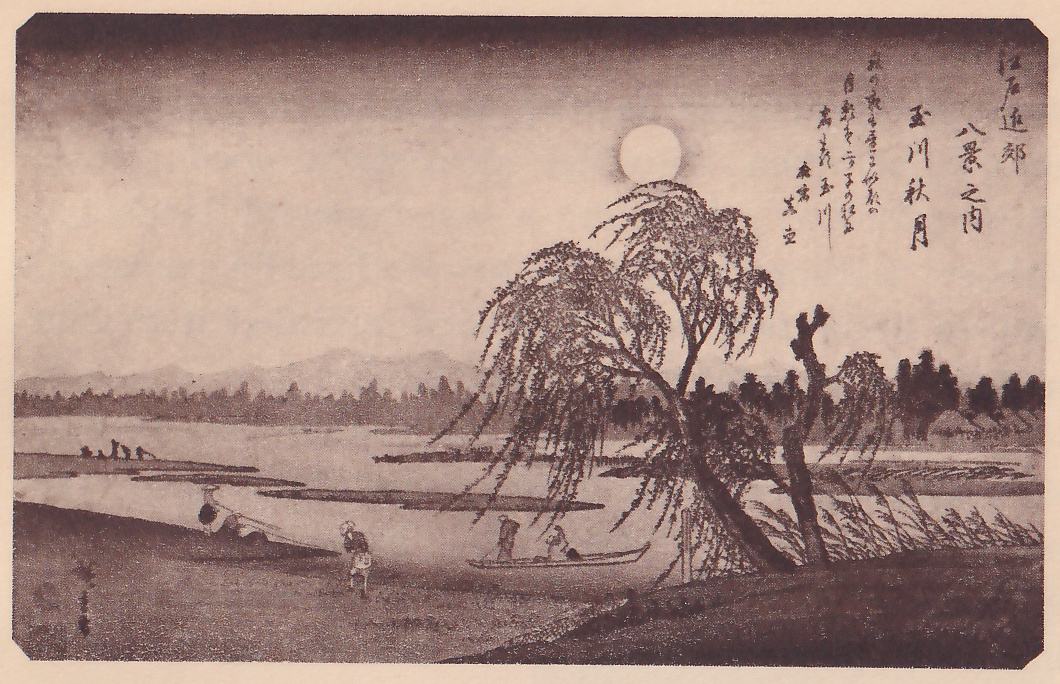
having no individuality, because individuality, often dangerously insistent and sometimes cruel like a sword, would be useless in a fairy world of nature where gratitude is our one mental possession. I am glad that in “Autumnal Moon at Tamagawa River,” at least, Hiroshige accepted in adoration all that the mystical enchantress whispered into his innocent ears.
My delight in this piece is that, being free from a passion hackneyed and outworn, the artist sings his song in an undertone most humbly, and proves that his receptive mind is in flawless harmony. It is clear that Hiroshige understands his own mind when he understands nature; so this print, “Autumnal Moon at Tamagawa River,” is a psychological expression through landscape in which objectivity and subjectivity blend. I know that we Japanese are apt to become sad in autumn, a prey to the old traditional
pessimism because of all that disfigures nature, and we often give ourselves to the sentimental pastime of tears. But when Hiroshige presents a good picture with legitimate sentiment, a “sentimental landscape without sentimentalism,” I know that he accepted nature’s decorative beauty as God revealed it to him in the moonlight of autumn.
I should like to know where there is another piece that can compete with this work, I mean the moonlight view of Tamagawa, in which autumn, wrapped in nocturnal light, steps softly from dream to dream. The moon, like a silent nun at a wake, watches through the silken mist over the fishermen engaged in night work; the willow trees with which breezes play droop their long branches to the surface of the river, where not even one imperfection is visible. The low mountain ranges in the background are just going to sleep, saying good night to the moon who is now quite high in the sky.
This print is certainly a gem, not only of the series, “Eight Views of Environs of Yedo,” but of Hiroshige’s whole work, and it shows him at his highest creative power.
Some years ago, I said, dwelling on a rhythmic performance or balance-making, which is one aspect of Oriental art: “You speak of the Greek word strophe from the point of emphasizing the important
Published by Jakurindo. About 1832.
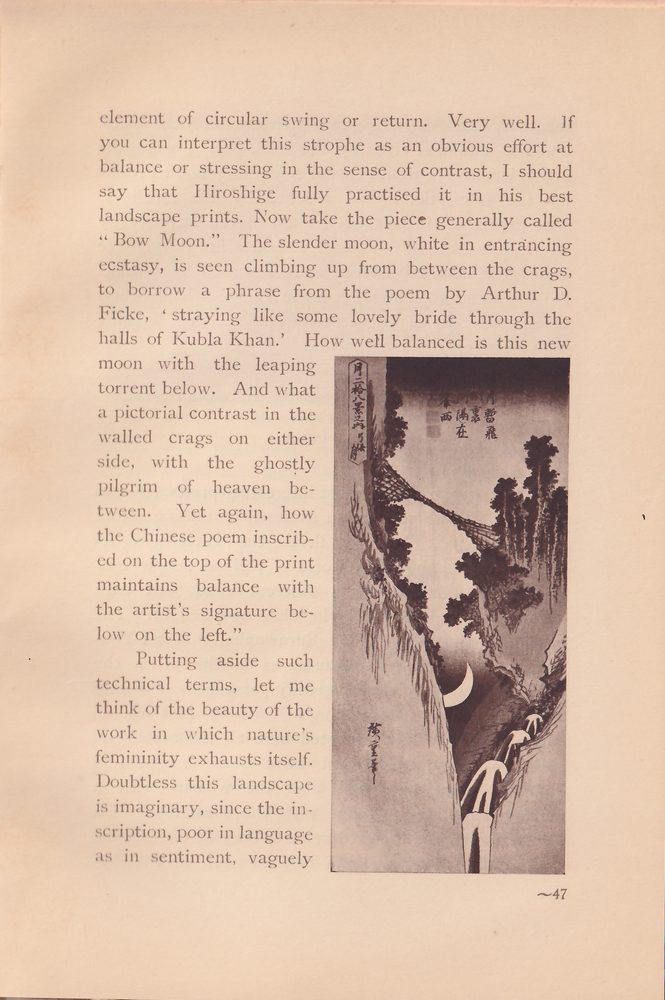
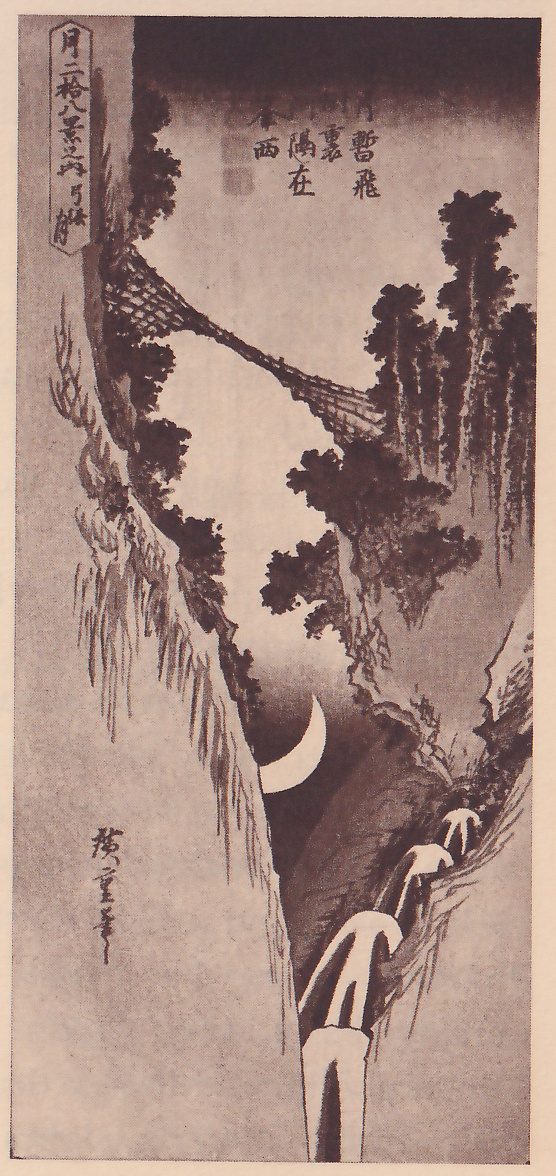
element of circular swing or return. Very well. If you can interpret this strophe as an obvious effort at balance or stressing in the sense of contrast, I should say that Hiroshige fully practised it in his best landscape prints. Now take the piece generally called “Bow Moon.” The slender moon, white in entrancing ecstasy, is seen climbing up from between the crags, to borrow a phrase from the poem by Arthur D. Ficke, ‘straying like some lovely bride through the halls of Kubla Khan.’ How well balanced is this new moon with the leaping torrent below. And what a pictorial contrast in the walled crags on either side, with the ghostly pilgrim of heaven between. Yet again, how the Chinese poem inscribed on the top of the print maintains balance with the artist’s signature below on the left.”
Putting aside such technical terms, let me think of the beauty of the work in which nature’s femininity exhausts itself. Doubtless this landscape is imaginary, since the inscription, poor in language as in sentiment, vaguely
mentions the “morning moon flying among the trees, and the autumnal river by the hills.” If I were the artist, however, I would choose something more precise for the inscription. But touched by the loneliness well expressed in this work I am moved strongly by its reality that, like a pearl, sparkles inwardly. We know that nature is lovely when absorbed in solitude. No one is seen on the net-made bridge which seems to be made out of fragments of spider’s web, hanging high between the crags.
This is one of the most interesting prints, for it is typical of Hiroshige’s art in successfully uniting nature and humanity. The moon floods the water with its beauty where the little world of plebian people congregate in a boat with a different mind, but with life’s equal purpose of enjoying their own delight. The boat was commonly called Rurawanka, “Won’t-You-Eat-Something Boat,” because, as in the print, the river hawkers waylaid the greedy passengers, shouting “Won’t you eat something?” It is pleasing to notice that Hiroshige accepted here all the actualities with no irony. He must have been delighted, I imagine, when he found that the woman with a nursing baby, the pilgrim with the usual mask of a Tengu goblin, and happy drunkards busy in exchanging their cups, common sights he had seen in the by-
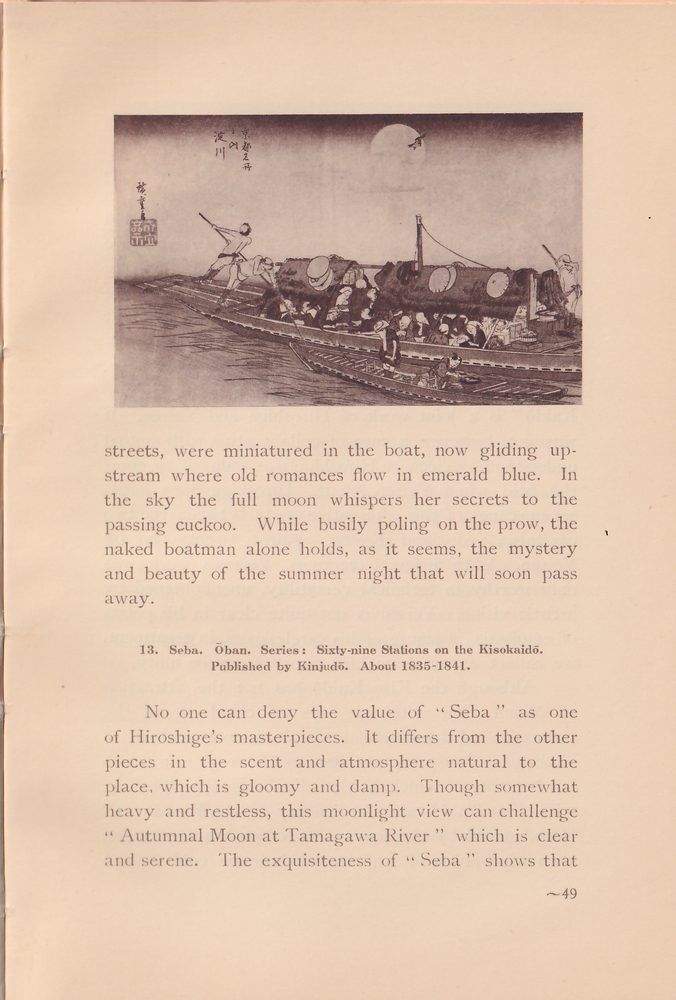
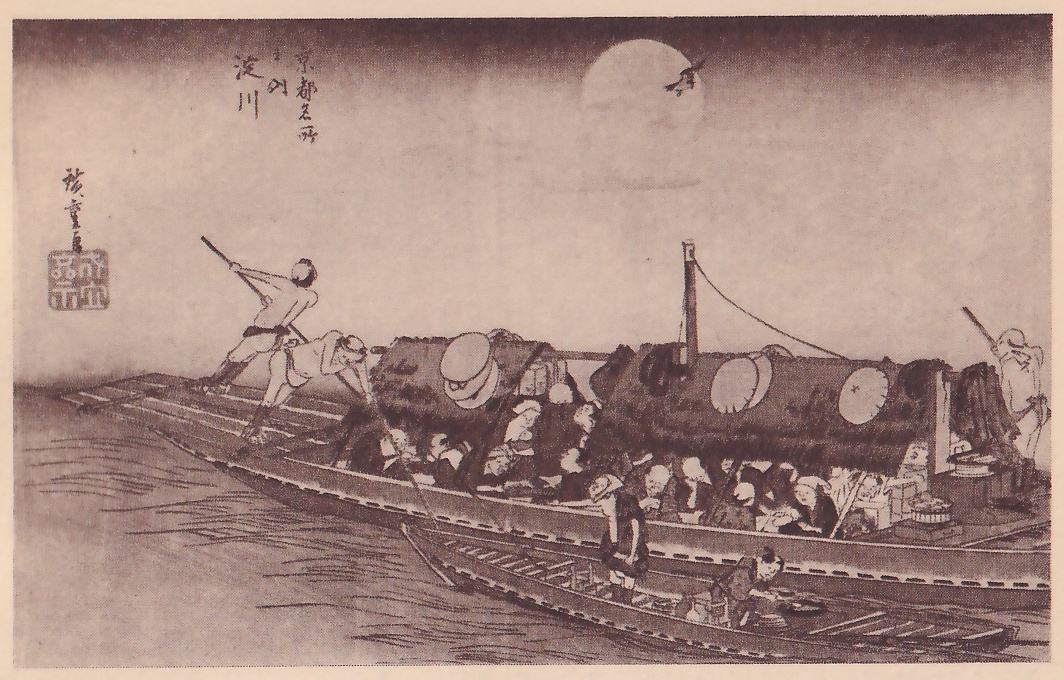
streets, were miniatured in the boat, now gliding upstream where old romances flow in emerald blue. In the sky the full moon whispers her secrets to the passing cuckoo. While busily poling on the prow, the naked boatman alone holds, as it seems, the mystery and beauty of the summer night that will soon pass away.
No one can deny the value of “Seba” as one of Hiroshige’s masterpieces. It differs from the other pieces in the scent and atmosphere natural to the place, which is gloomy and damp. Though somewhat heavy and restless, this moonlight view can challenge “Autumnal Moon at Tamagawa River” which is clear and serene. The exquisiteness of “Seba” shows that
the place is not yet sufficiently humanized; the rustic quality carries freshness and even poignancy.
As an artist who seldom relies on materials, Hiroshige merely used as pictorial properties in “Seba” a raft and a brushwood boat, the moon amid the darkish clouds and a few willow trees that are tossed by the wind along the nondescript country stream, thick in reeds. These simple materials are sufficient for Hiroshige to complete a work of great breadth and solidity, through which his artistic personality, shadow-like but clear, is visible to the spiritual eye.
The series of “Sixty-nine Stations on the Kiso Kaidō” is a joint work of Hiroshige and Yeisen. It was not, however, a case of collaboration with mutual understanding, because Hiroshige was induced to enter the field when Yeisen left it. Hiroshige drew forty-seven scenes of this alternative route between the two capitals, Yedo and Kyoto, against twenty-two by Yeisen. With a few exceptions, Yeisen’s work was only worthy in technical versatility, unenlightened by artistic vision. Yeisen is not quite clear in his points of emphasis; because of his carelessness in treatment, we cannot expect from him transparency or unity.
Although the Kiso Kaidō has not the attraction of Mount Fuji with its coils of cloud, or of the procession of handsome lords, it is not without a distinguished aspect, peculiar to the region, uncouth but humane, of which Yekken Kaibara tells rightly in “Kisoji no Tabi,” or “The Journey by the Kiso Road.” Here, moved by the joyous song of pack-horse drivers, even the pulse of an overwhelmingly cold nature
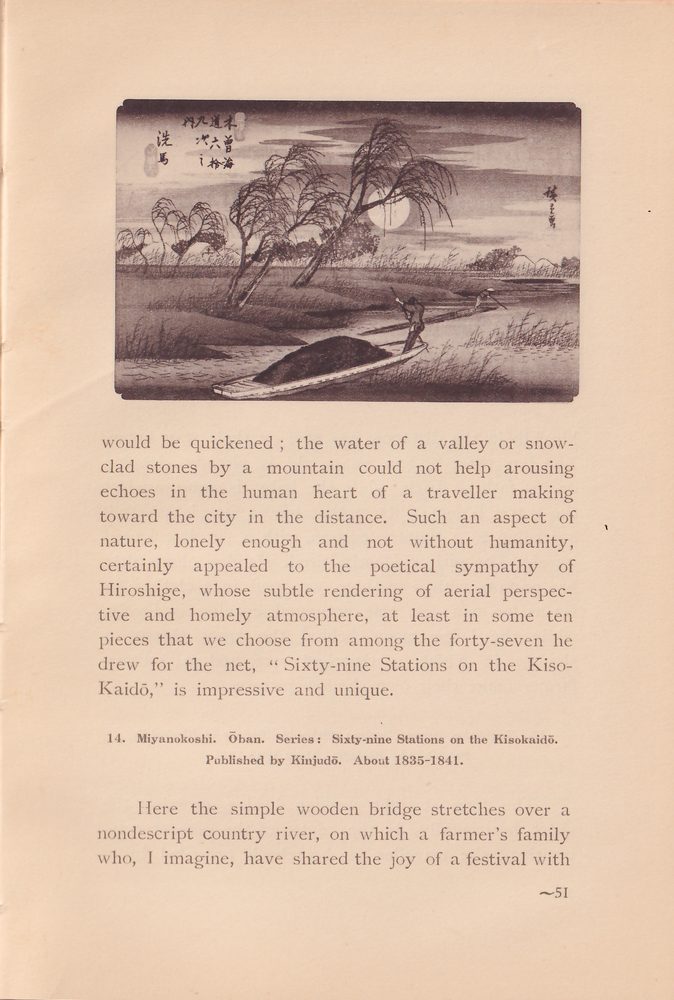
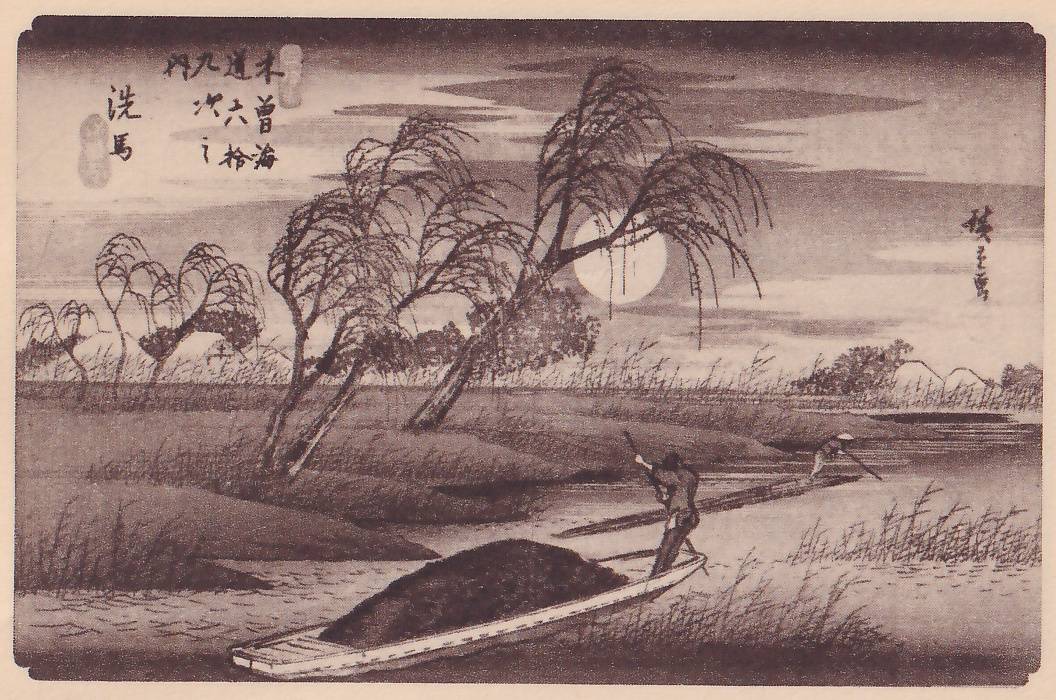
Published by Kinjudō. About 1835-1841.
would be quickened; the water of a valley or snow-clad stones by a mountain could not help arousing echoes in the human heart of a traveller making toward the city in the distance. Such an aspect of nature, lonely enough and not without humanity, certainly appealed to the poetical sympathy of Hiroshige, whose subtle rendering of aerial perspective and homely atmosphere, at least in some ten pieces that we choose from among the forty-seven he drew for the net, “Sixty-nine Stations on the Kiso-Kaidō,” is impressive and unique.
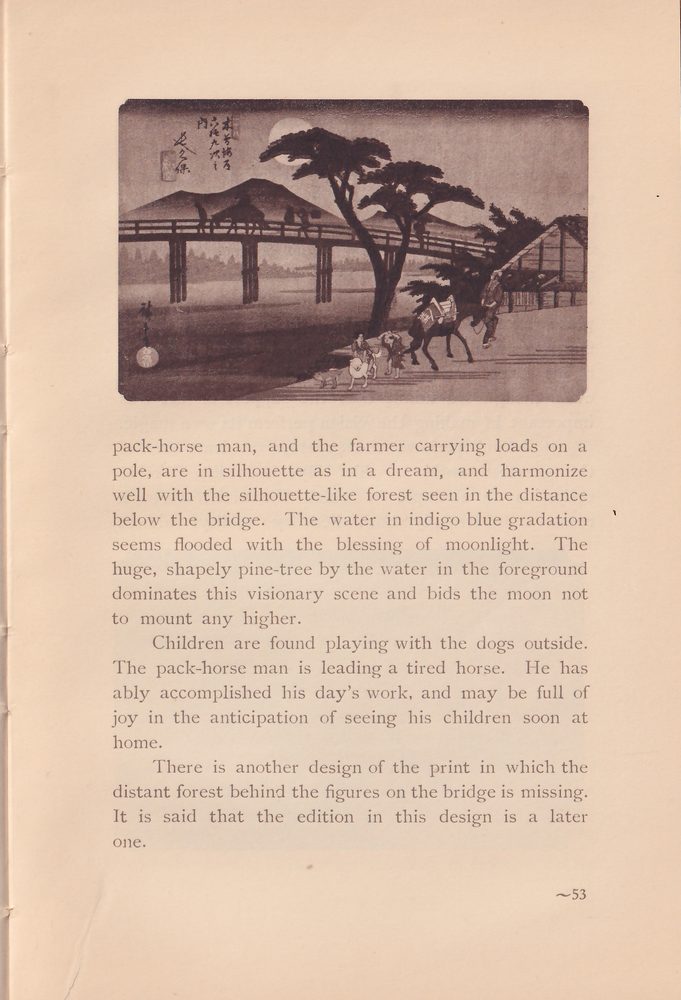
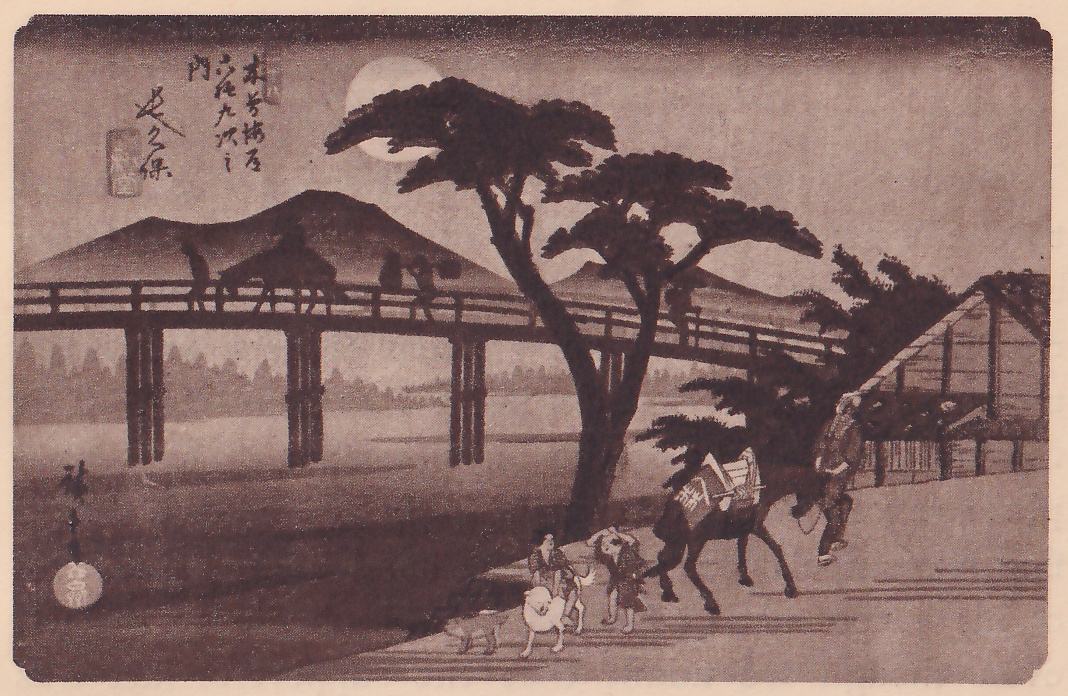
Here the simple wooden bridge stretches over a nondescript country river, on which a farmer’s family who, I imagine, have shared the joy of a festival with
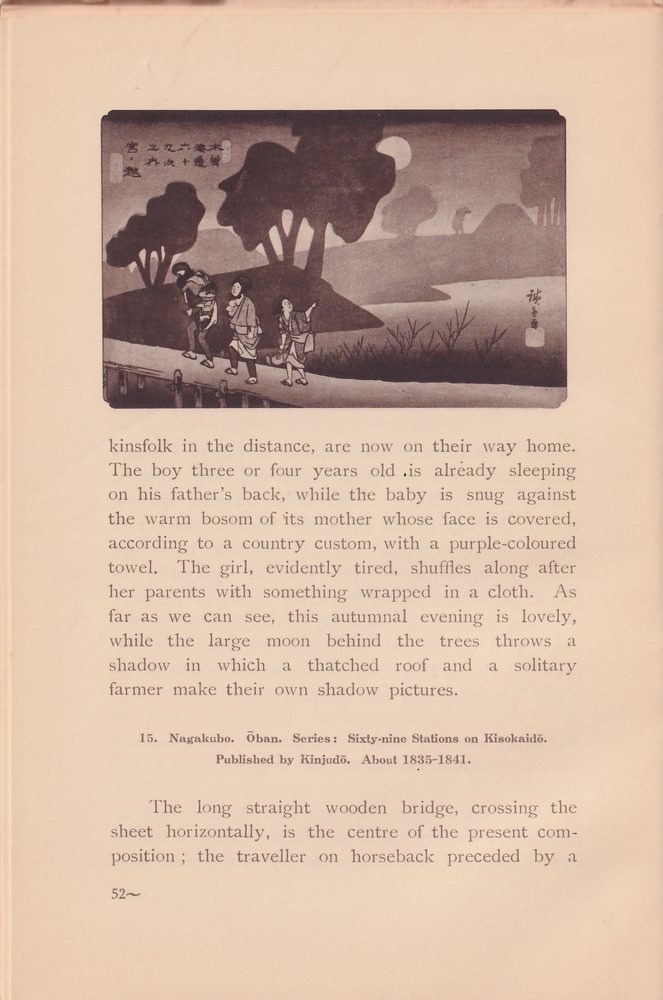
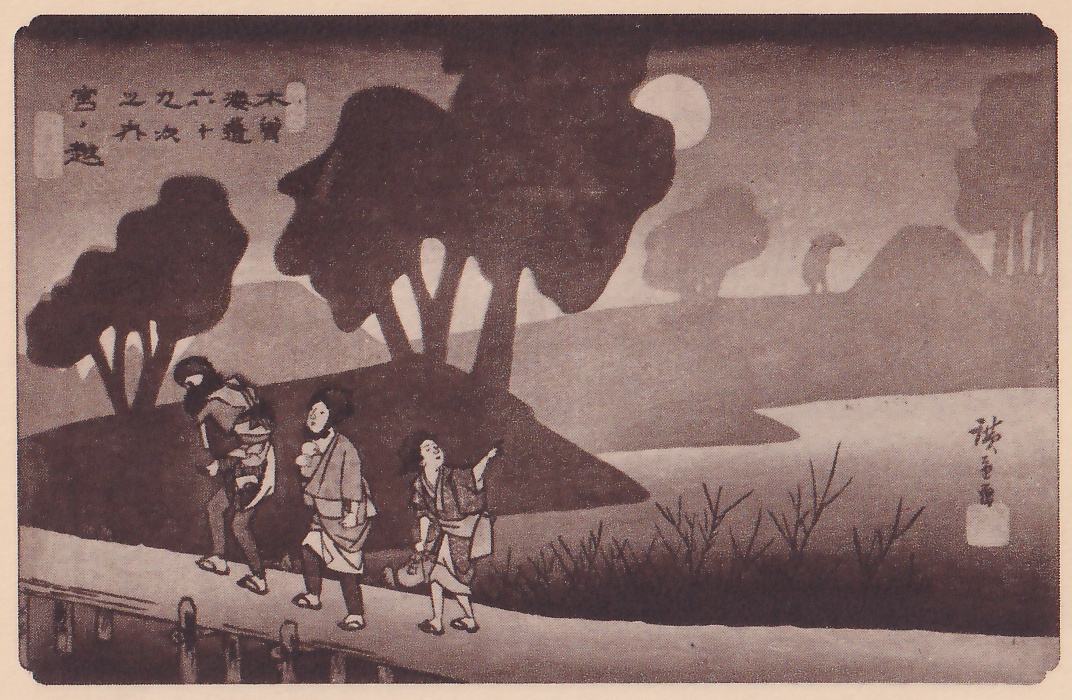
Published by Kinjudō. About 1835-1841.
kinsfolk in the distance, are now on their way home. The boy three or four years old is already sleeping on his father’s back, while the baby is snug against the warm bosom of its mother whose face is covered, according to a country custom, with a purple-coloured towel. The girl, evidently tired, shuffles along after her parents with something wrapped in a cloth. As far as we can see, this autumnal evening is lovely, while the large moon behind the trees throws a shadow in which a thatched roof and a solitary farmer make their own shadow pictures.
The long straight wooden bridge, crossing the sheet horizontally, is the centre of the present composition; the traveller on horseback preceded by a
Published by Kinjudō. About 1835-1841.
pack-horse man, and the farmer carrying loads on a pole, are in silhouette as in a dream, and harmonize well with the silhouette-like forest seen in the distance below the bridge. The water in indigo blue gradation seems flooded with the blessing of moonlight. The huge, shapely pine-tree by the water in the foreground dominates this visionary scene and bids the moon not to mount any higher.
Children are found playing with the dogs outside. The pack-horse man is leading a tired horse. He has ably accomplished his day’s work, and may be full of joy in the anticipation of seeing his children soon at home.
There is another design of the print in which the distant forest behind the figures on the bridge is missing. It is said that the edition in this design is a later one.
Published by Hōyeidō. About 1834.
I often wonder how an actual scene was related to the work in Hiroshige’s prints. I know that there are many instances in which artists are interrupted by reality and their flight shivers and shrinks before the menace of fact. What if I insist that the pieces which related only faintly to the physiognomy of an actual place reveal themselves surprisingly new? We should find Hiroshige’s greatness in the candour and freshness of his vision, not in his manner of obedience to fact, even though we admit that the support of fact was important in making the vision perform its own magic.
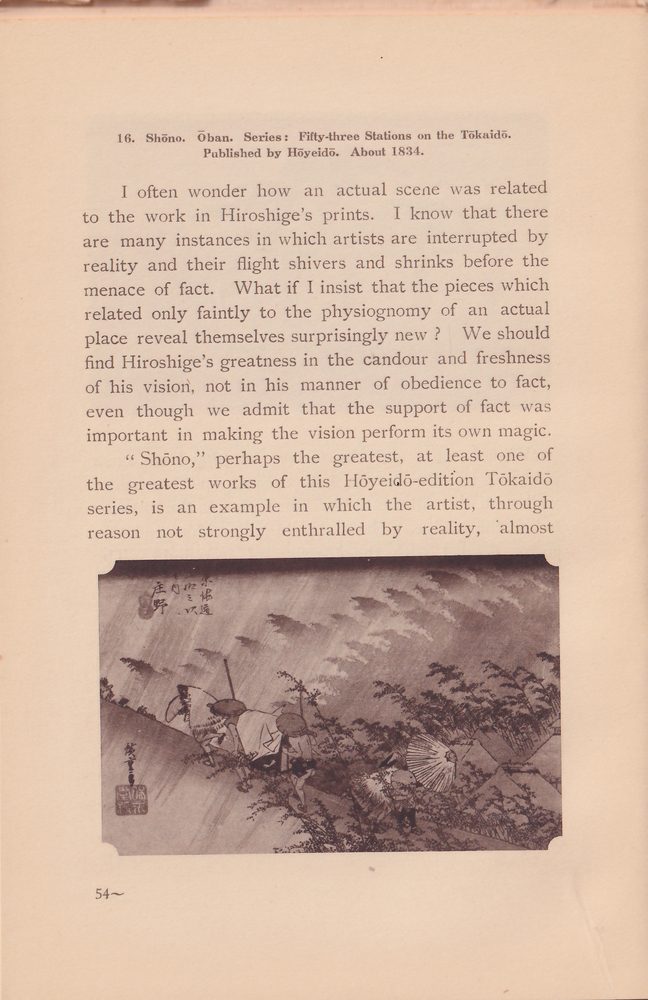
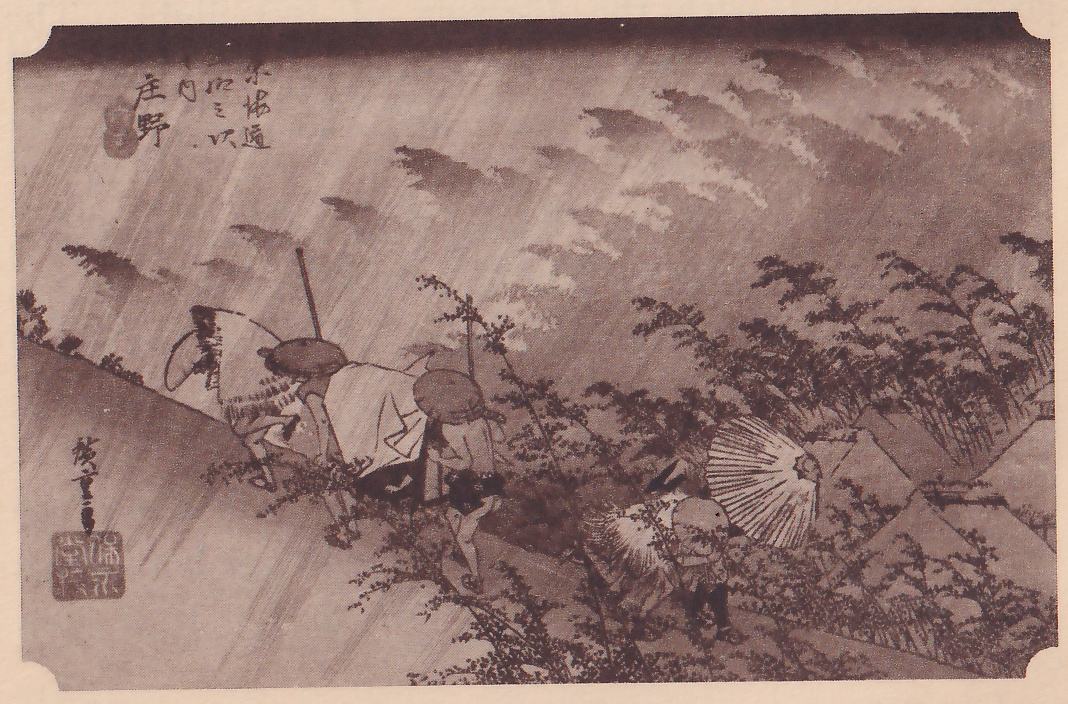
“Shōno,” perhaps the greatest, at least one of the greatest works of this Hōyeidō-edition Tōkaidō series, is an example in which the artist, through reason not strongly enthralled by reality, almost
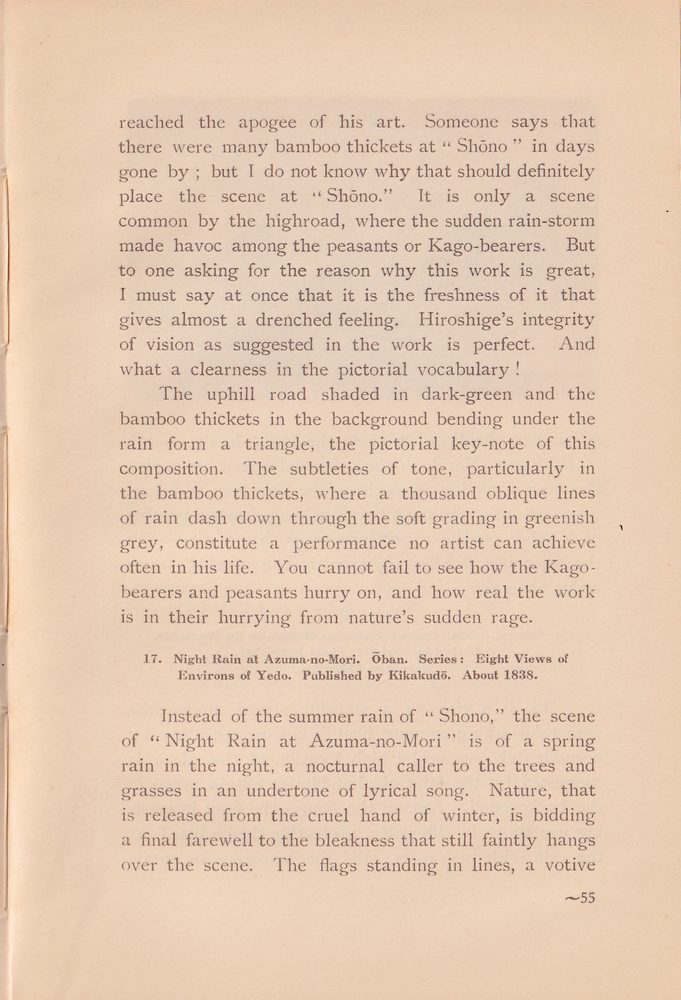
reached the apogee of his art. Someone says that there were many bamboo thickets at “Shōno” in days gone by; but I do not know why that should definitely place the scene at “Shōno.” It is only a scene common by the highroad, where the sudden rain-storm made havoc among the peasants or Kago-bearers. But to one asking for the reason why this work is great, I must say at once that it is the freshness of it that gives almost a drenched feeling. Hiroshige’s integrity of vision as suggested in the work is perfect. And what a clearness in the pictorial vocabulary!
The uphill road shaded in dark-green and the bamboo thickets in the background bending under the rain form a triangle, the pictorial key-note of this composition. The subtleties of tone, particularly in the bamboo thickets, where a thousand oblique lines of rain dash down through the soft grading in greenish grey, constitute a performance no artist can achieve often in his life. You cannot fail to see how the Kago-bearers and peasants hurry on, and how real the work is in their hurrying from nature’s sudden rage.
Instead of the summer rain of “Shono,” the scene of “Night Rain at Azuma-no-Mori” is of a spring rain in the night, a nocturnal caller to the trees and grasses in an undertone of lyrical song. Nature, that is released from the cruel hand of winter, is bidding a final farewell to the bleakness that still faintly hangs over the scene. The flags standing in lines, a votive
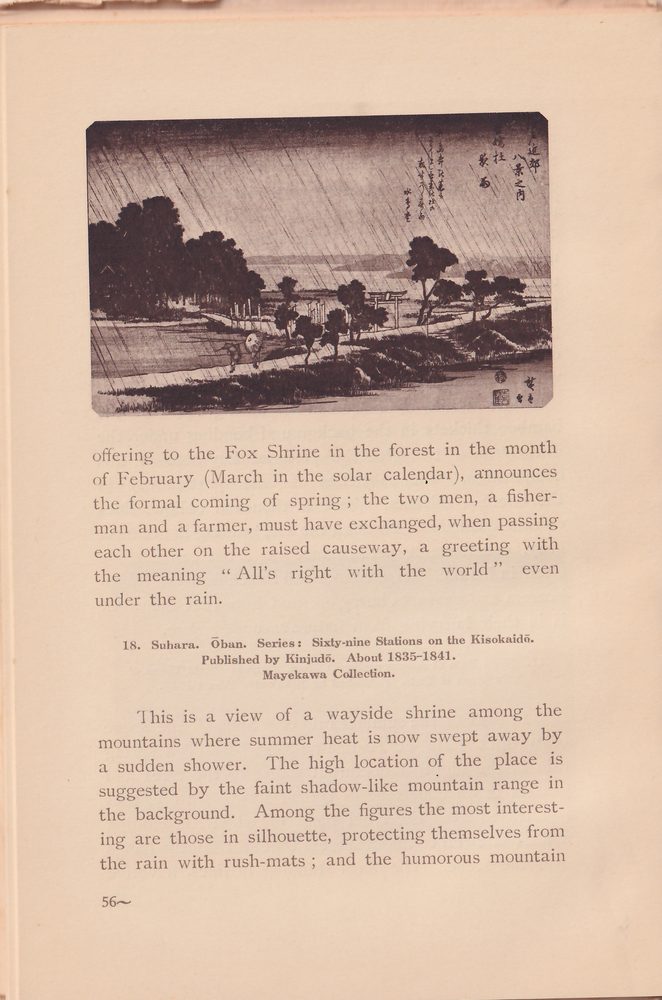
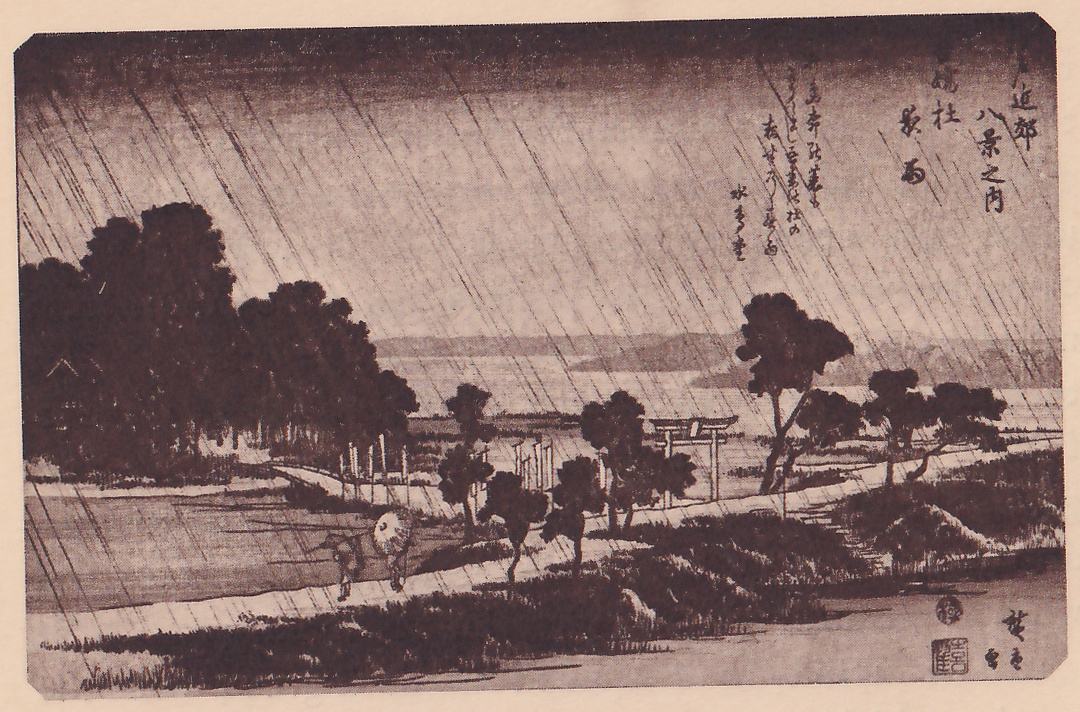
offering to the Fox Shrine in the forest in the month of February (March in the solar calendar), announces the formal coming of spring; the two men, a fisherman and a farmer, must have exchanged, when passing each other on the raised causeway, a greeting with the meaning “All’s right with the world” even under the rain.
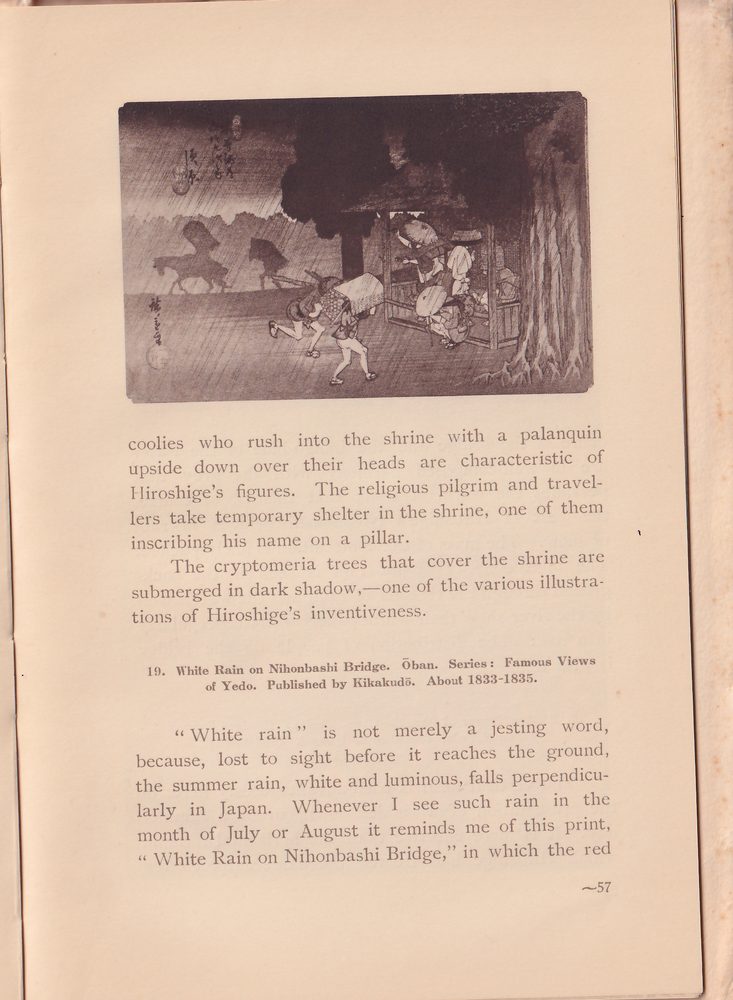
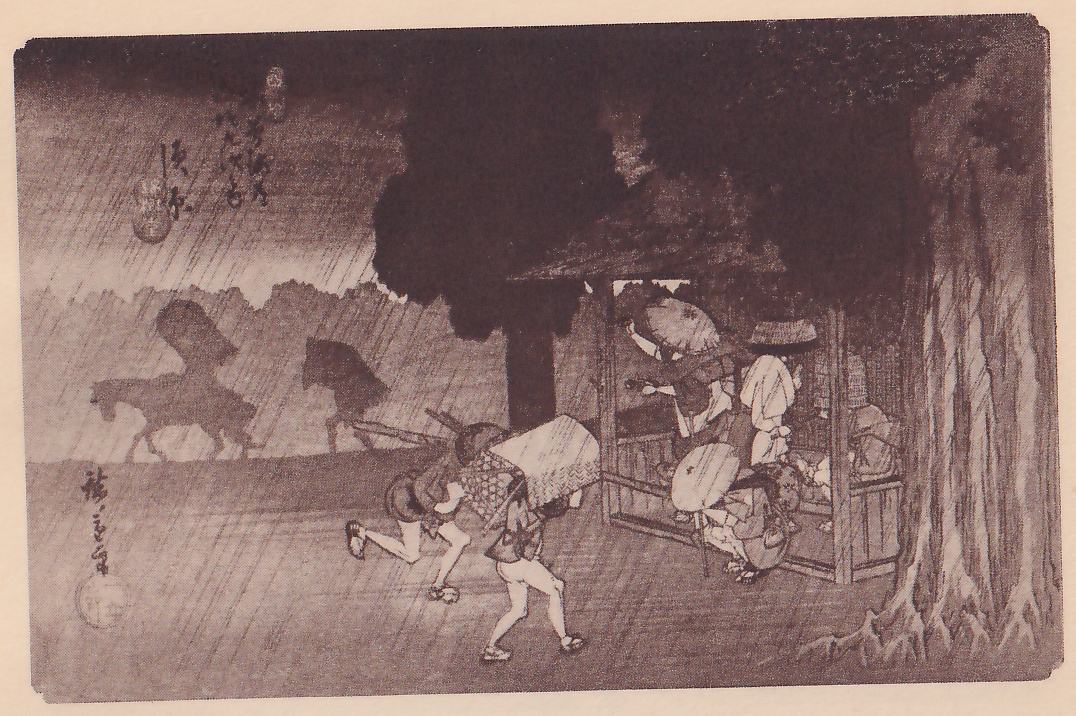
This is a view of a wayside shrine among the mountains where summer heat is now swept away by a sudden shower. The high location of the place is suggested by the faint shadow-like mountain range in the background. Among the figures the most interesting are those in silhouette, protecting themselves from the rain with rush-mats; and the humorous mountain
Published by Kinjudō. About 1835-1841.
Mayekawa Collection.
coolies who rush into the shrine with a palanquin upside down over their heads are characteristic of Hiroshige’s figures. The religious pilgrim and travellers take temporary shelter in the shrine, one of them inscribing his name on a pillar.
The cryptomeria trees that cover the shrine are submerged in dark shadow,—one of the various illustrations of Hiroshige’s inventiveness.
“White rain” is not merely a jesting word, because, lost to sight before it reaches the ground, the summer rain, white and luminous, falls perpendicularly in Japan. Whenever I see such rain in the month of July or August it reminds me of this print, “White Rain on Nihonbashi Bridge,” in which the red
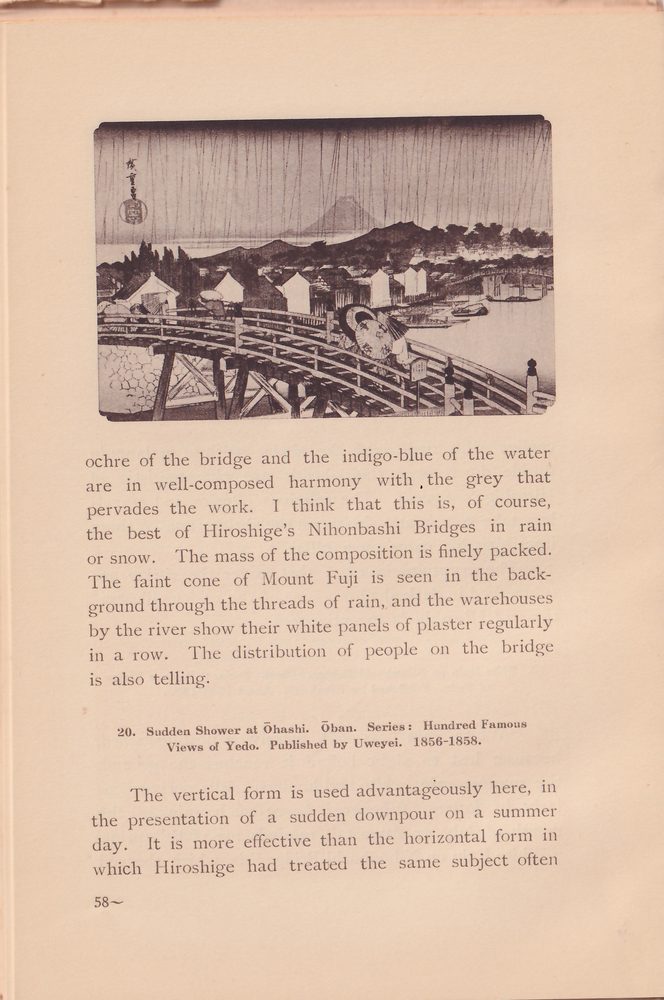
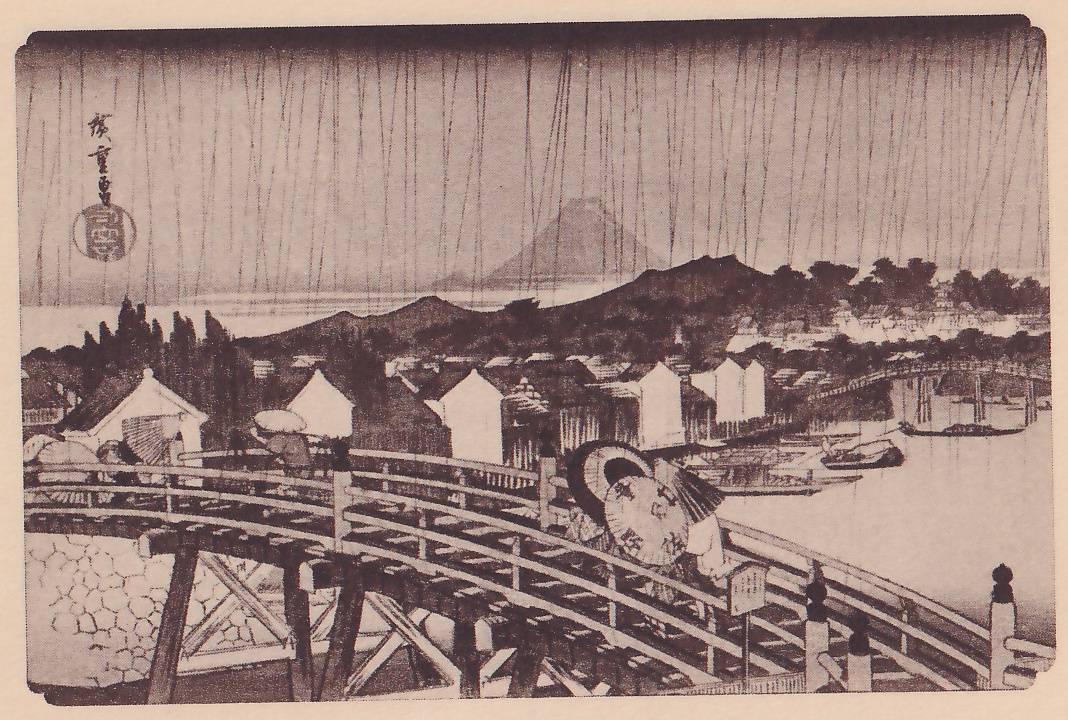
ochre of the bridge and the indigo-blue of the water are in well-composed harmony with the grey that pervades the work. I think that this is, of course, the best of Hiroshige’s Nihonbashi Bridges in rain or snow. The mass of the composition is finely packed. The faint cone of Mount Fuji is seen in the background through the threads of rain, and the warehouses by the river show their white panels of plaster regularly in a row. The distribution of people on the bridge is also telling.
The vertical form is used advantageously here, in the presentation of a sudden downpour on a summer day. It is more effective than the horizontal form in which Hiroshige had treated the same subject often
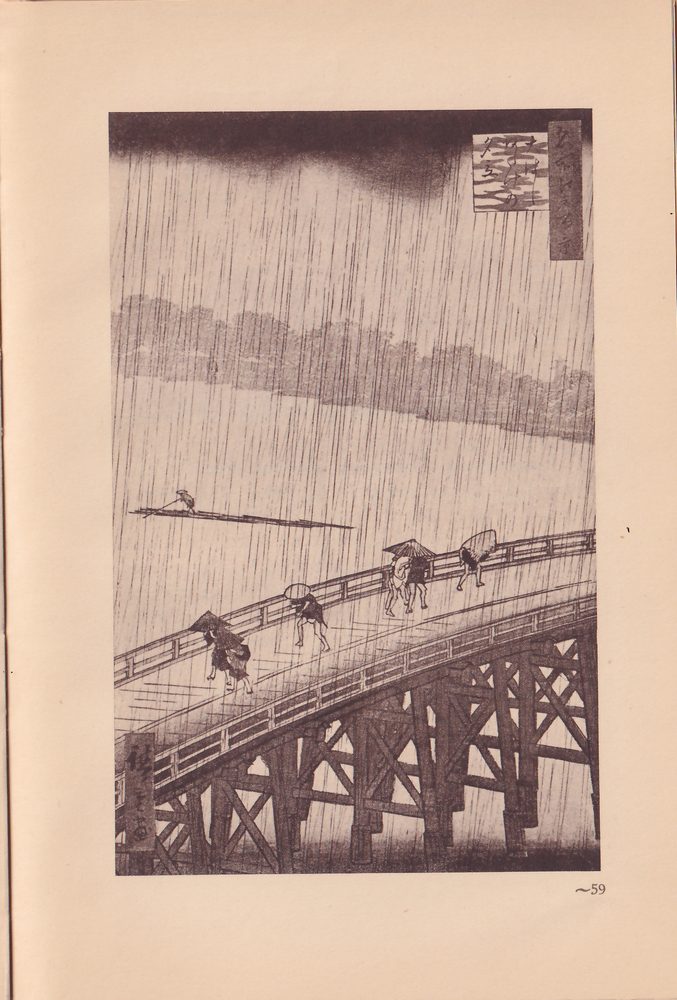
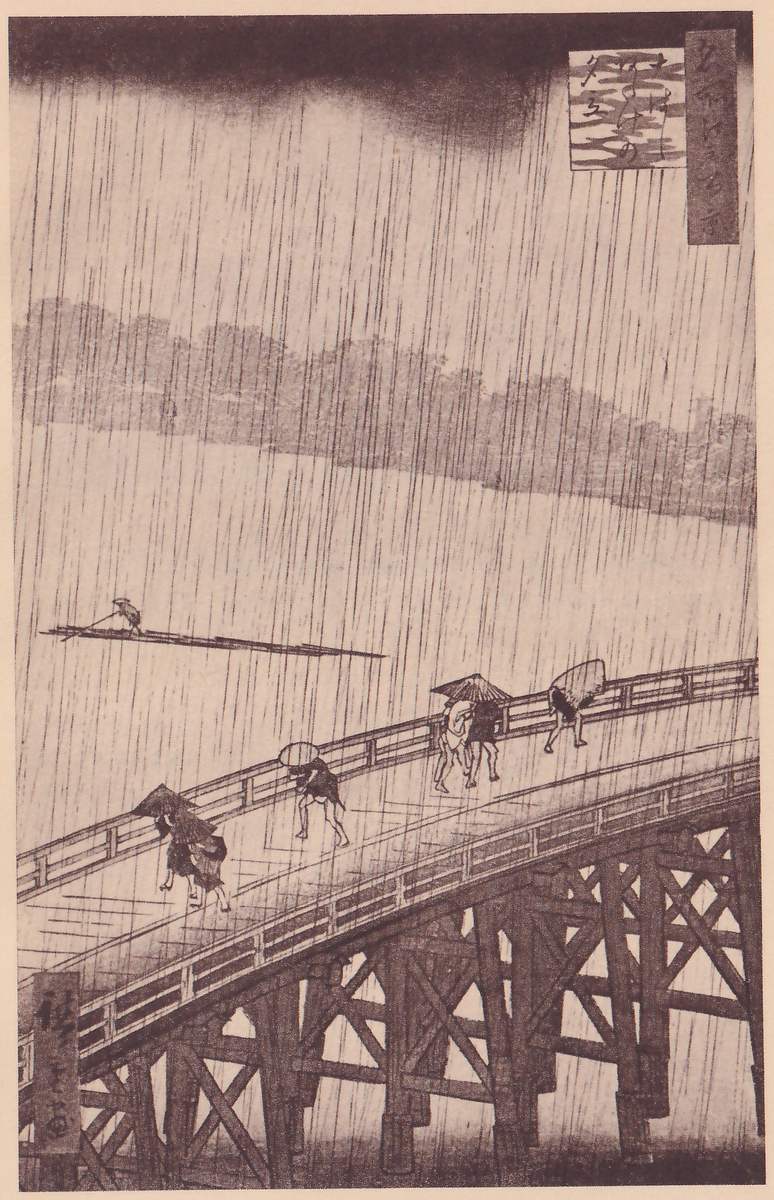
before. It was an accidental triumph, a lucky windfall for him that what he had never anticipated was realized here by chance. The vertical form, when used wisely and freely, makes for breadth of vision and is more impressive.
We must notice in the present piece, “Sudden Shower at Ōhashi,” how the artist deepened the rainy atmosphere and scent by applying a darkish orange-colour to the water. It is one of the rare instances in which a vulgarized pigment used with discretion escapes being gaudy. Without the present print and a few others the series, “Hundred Famous Views of Yedo” (Meisho Yedo Hyakkei), would be, strictly speaking, merely pictorial caprice.
It amuses me to imagine Hiroshige producing this series of a hundred and eighteen prints. Did he ever notice, I wonder, that there was in most of them a degraded art which had no excuse for being and which sought refuge in artistic exaggeration? Did he ever know a time when his tired mind called out more to novelty for rescue? Hiroshige must have been glad, however, when, as in this work, “Sudden Shower at Ōhashi,” his art renewed sometimes its youthful vitality. And when now, more than twenty years since he had brought out the Tōkaidō series in the Hōyeidō edition, he resumed the quietude of self-criticism, Hiroshige must have wondered. at the changes in his art. With a sense of gratitude he must have looked upon his life and art which are equally exuberant.
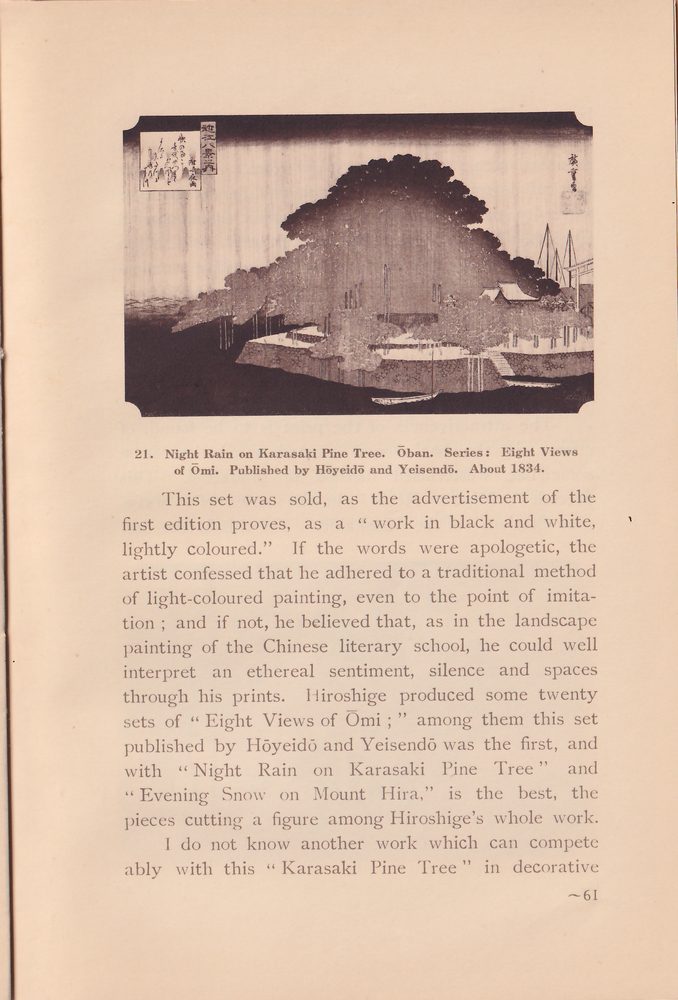
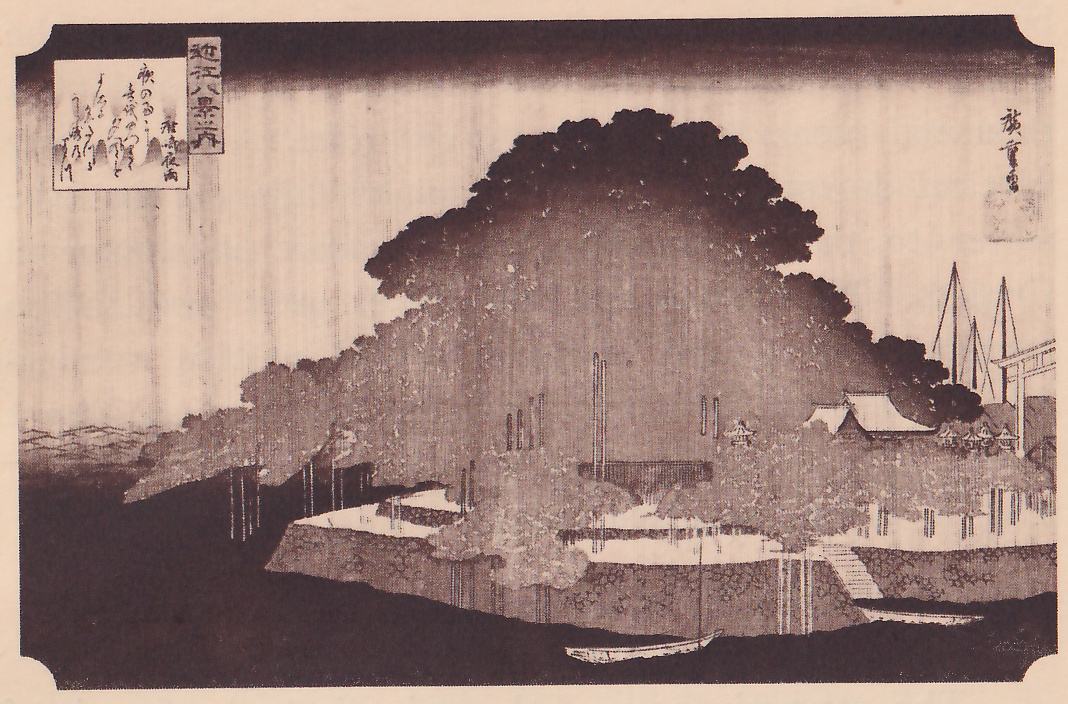
This set was sold, as the advertisement of the first edition proves, as a “work in black and white, lightly coloured.” If the words were apologetic, the artist confessed that he adhered to a traditional method of light-coloured painting, even to the point of imitation; and if not, he believed that, as in the landscape painting of the Chinese literary school, he could well interpret an ethereal sentiment, silence and spaces through his prints. Hiroshige produced some twenty sets of “Eight Views of Ōmi;” among them this set published by Hōyeidō and Yeisendō was the first, and with “Night Rain on Karasaki Pine Tree” and “Evening Snow on Mount Hira,” is the best, the pieces cutting a figure among Hiroshige’s whole work.
I do not know another work which can compete ably with this “Karasaki Pine Tree” in decorative
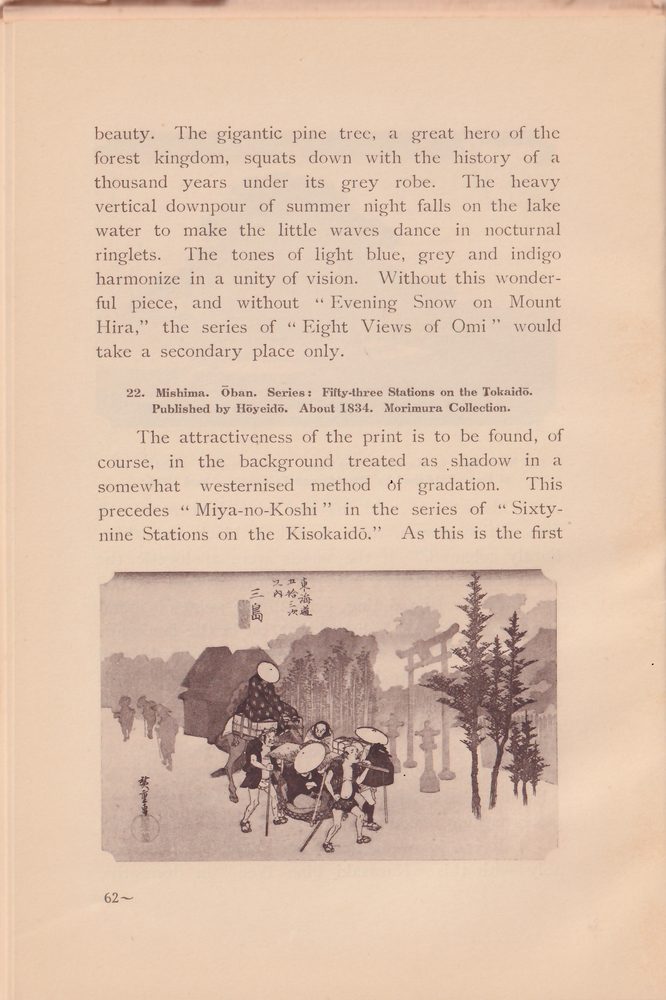
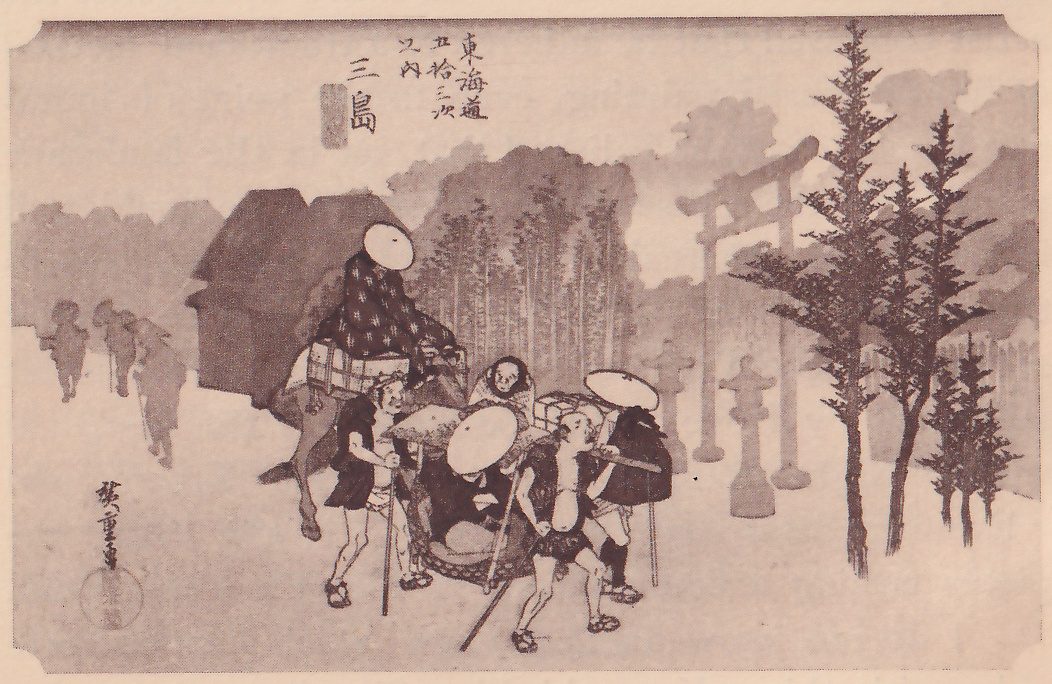
Published by Hōyeidō. About 1834. Morimura Collection.
beauty. The gigantic pine tree, a great hero of the forest kingdom, squats down with the history of a thousand years under its grey robe. The heavy vertical downpour of summer night falls on the lake water to make the little waves dance in nocturnal ringlets. The tones of light blue, grey and indigo harmonize in a unity of vision. Without this wonderful piece, and without “Evening Snow on Mount Hira,” the series of “Eight Views of Omi” would take a secondary place only.
The attractiveness of the print is to be found, of course, in the background treated as shadow in a somewhat westernised method of gradation. This precedes “Miya-no-Koshi” in the series of “Sixty-nine Stations on the Kisokaidō.” As this is the first
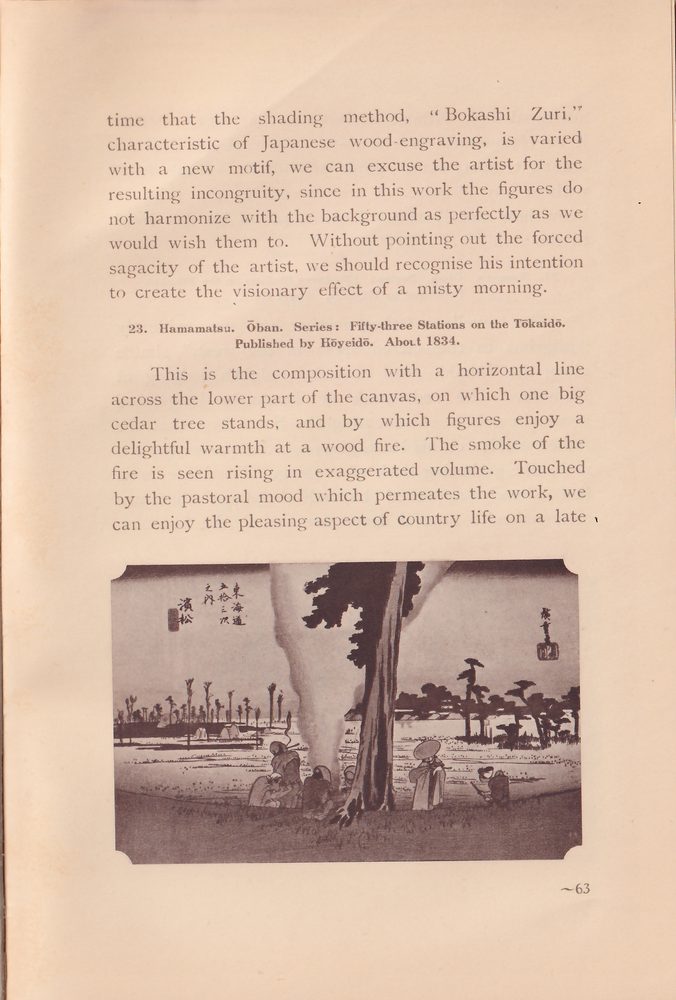
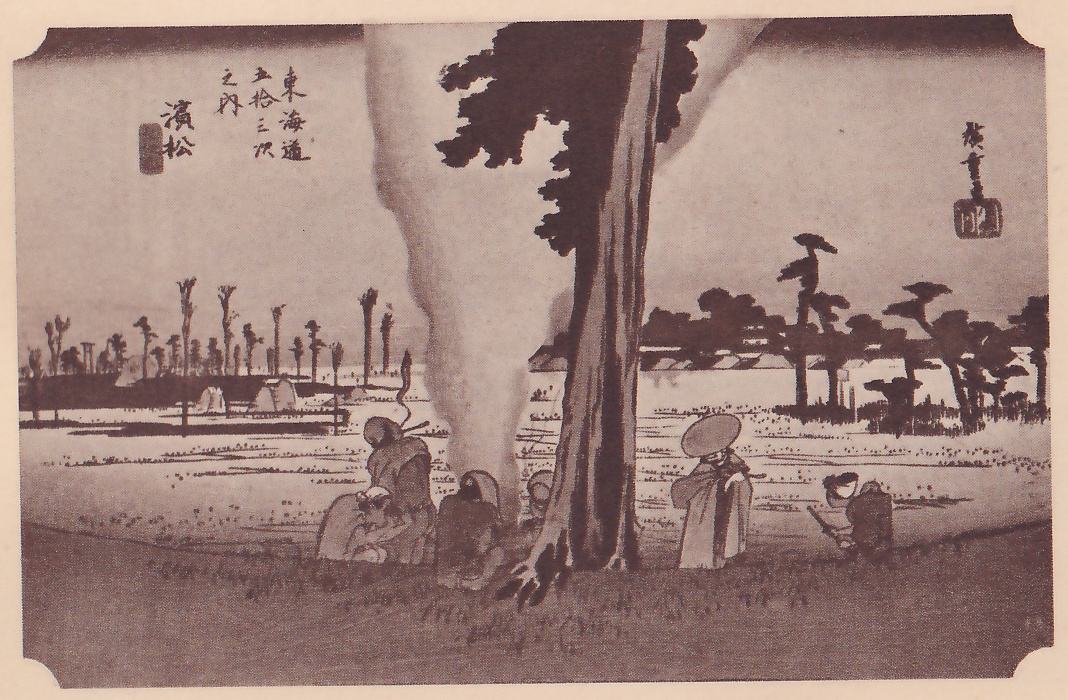
Published by Hōyeidō. About 1834.
time that the shading method, “Bokashi Zuri,” characteristic of Japanese wood-engraving, is varied with a new motif, we can excuse the artist for the resulting incongruity, since in this work the figures do not harmonize with the background as perfectly as we would wish them to. Without pointing out the forced sagacity of the artist, we should recognise his intention to create the visionary effect of a misty morning.
This is the composition with a horizontal line across the lower part of the canvas, on which one big cedar tree stands, and by which figures enjoy a delightful warmth at a wood fire. The smoke of the fire is seen rising in exaggerated volume. Touched by the pastoral mood which permeates the work, we can enjoy the pleasing aspect of country life on a late
Published by Hōyeidō. About 1834.
autumnal day, without reference to the place, whether it be Hamamatsu or elsewhere. In work like this, the artist’s temperament, simple and idyllic, reveals itself without any disguise. I am moved by the print to know how closely the village people of his day lived to the soil.
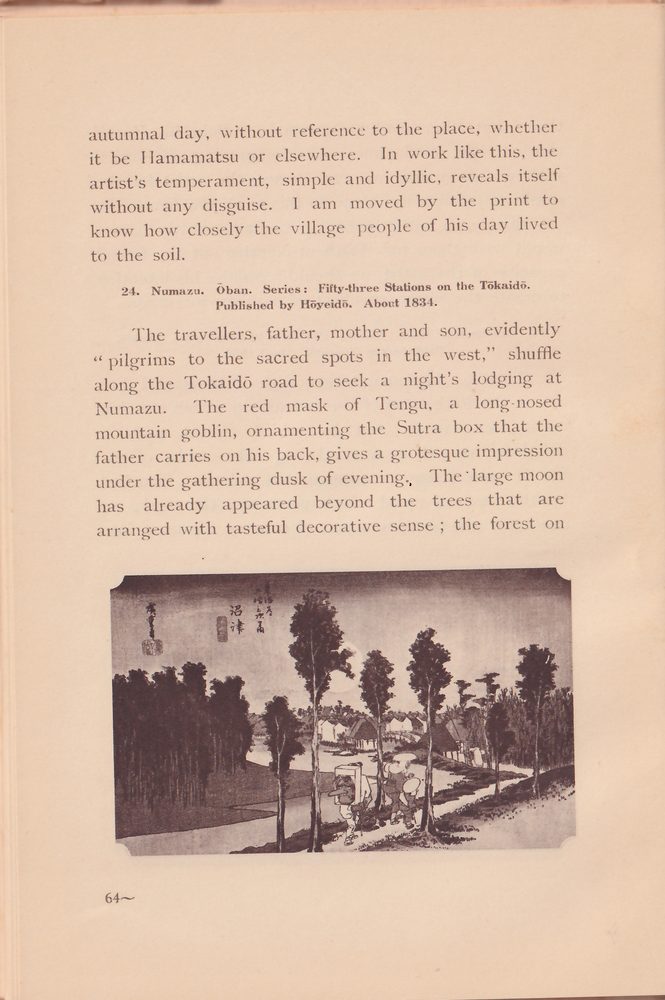
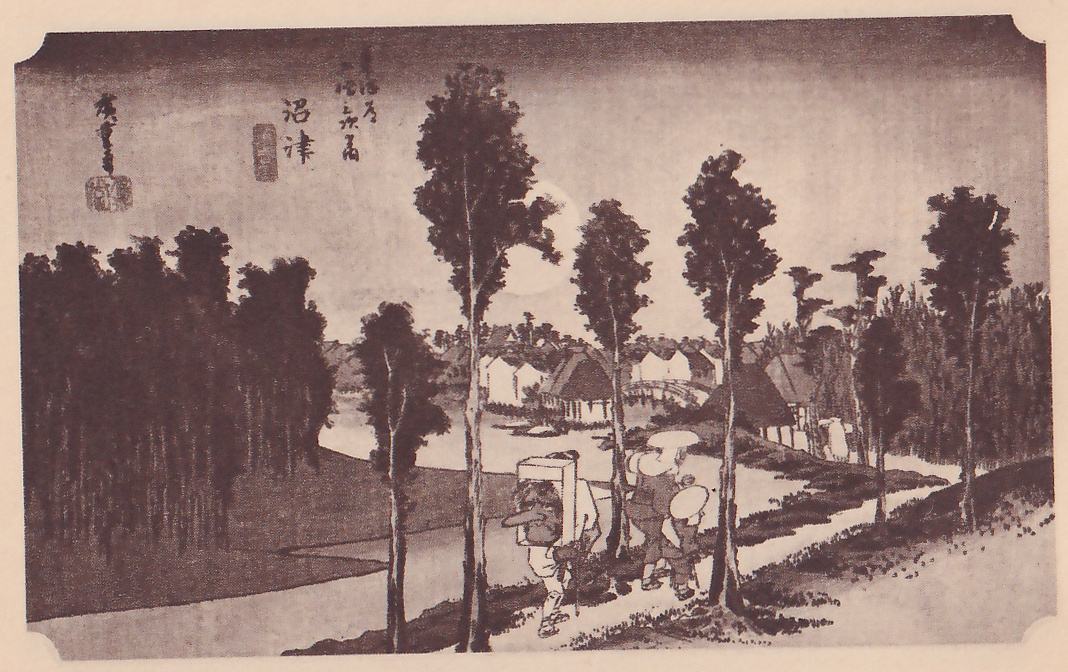
The travellers, father, mother and son, evidently “pilgrims to the sacred spots in the west,” shuffle along the Tokaidō road to seek a night’s lodging at Numazu. The red mask of Tengu, a long-nosed mountain goblin, ornamenting the Sutra box that the father carries on his back, gives a grotesque impression under the gathering dusk of evening. The large moon has already appeared beyond the trees that are arranged with tasteful decorative sense; the forest on
the left tightens the general composition of the work. I cannot help feeling the dreary intimacy which the work suggests in a sad undertone.
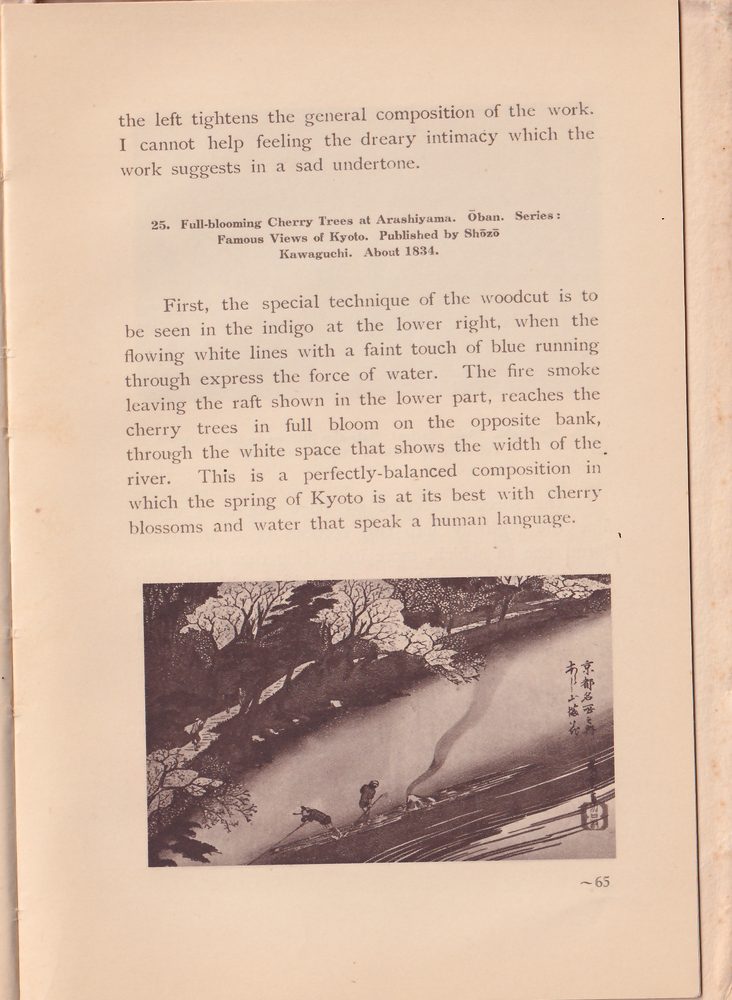
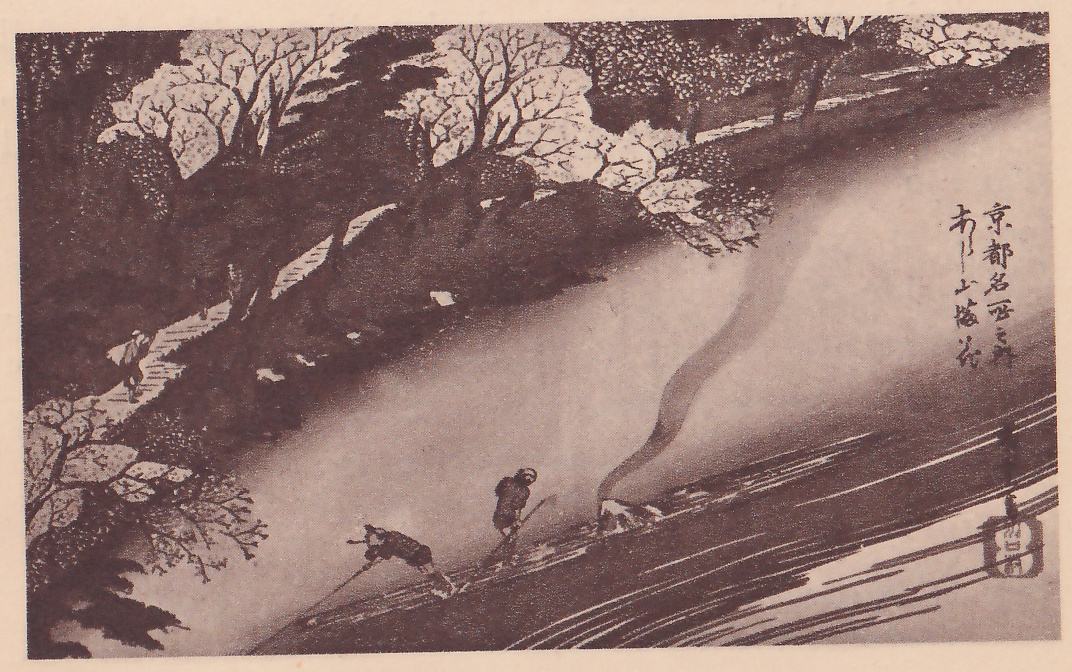
First, the special technique of the woodcut is to be seen in the indigo at the lower right, when the flowing white lines with a faint touch of blue running through express the force of water. The fire smoke leaving the raft shown in the lower part, reaches the cherry trees in full bloom on the opposite bank, through the white space that shows the width of the river. This is a perfectly-balanced composition in which the spring of Kyoto is at its best with cherry blossoms and water that speak a human language.
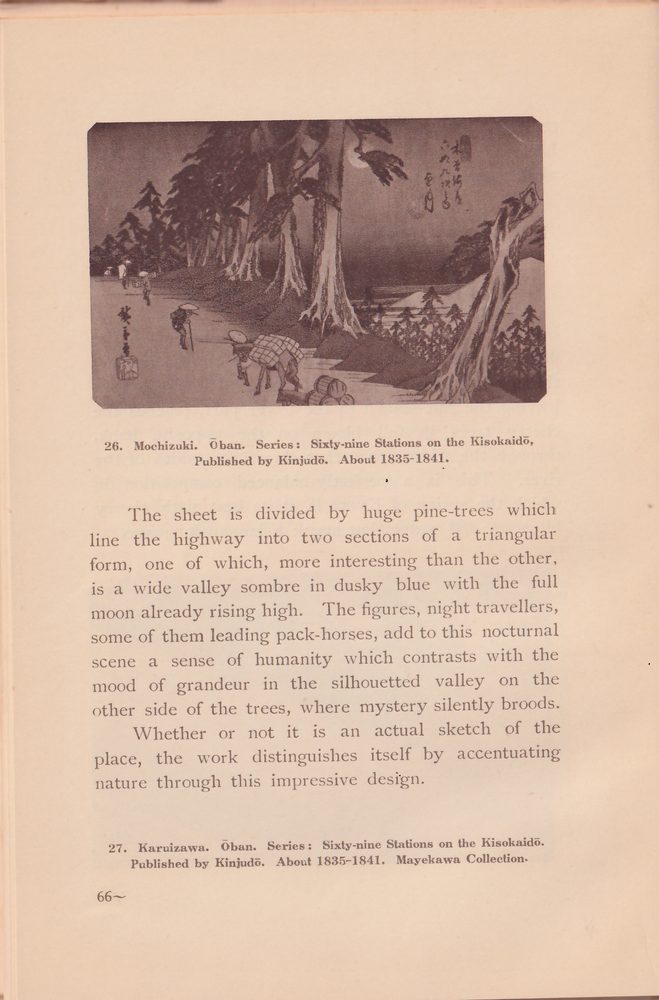
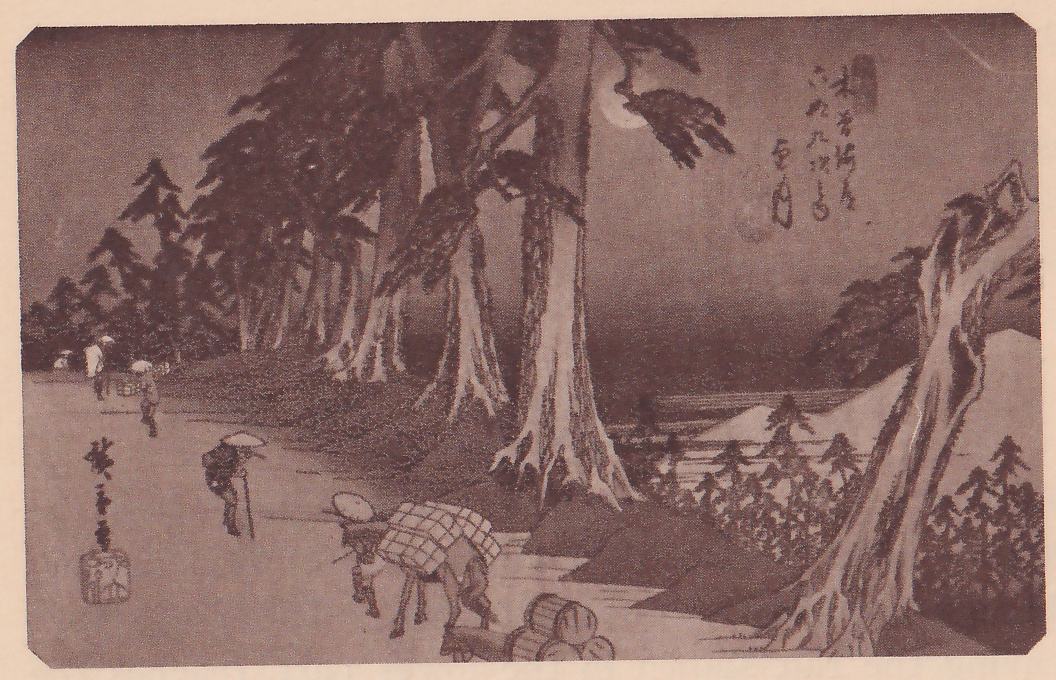
Published by Kinjudō. About 1835-1841.
The sheet is divided by huge pine-trees which line the highway into two sections of a triangular form, one of which, more interesting than the other, is a wide valley sombre in dusky blue with the full moon already rising high. The figures, night travellers, some of them leading pack-horses, add to this nocturnal scene a sense of humanity which contrasts with the mood of grandeur in the silhouetted valley on the other side of the trees, where mystery silently broods.
Whether or not it is an actual sketch of the place, the work distinguishes itself by accentuating nature through this impressive design.
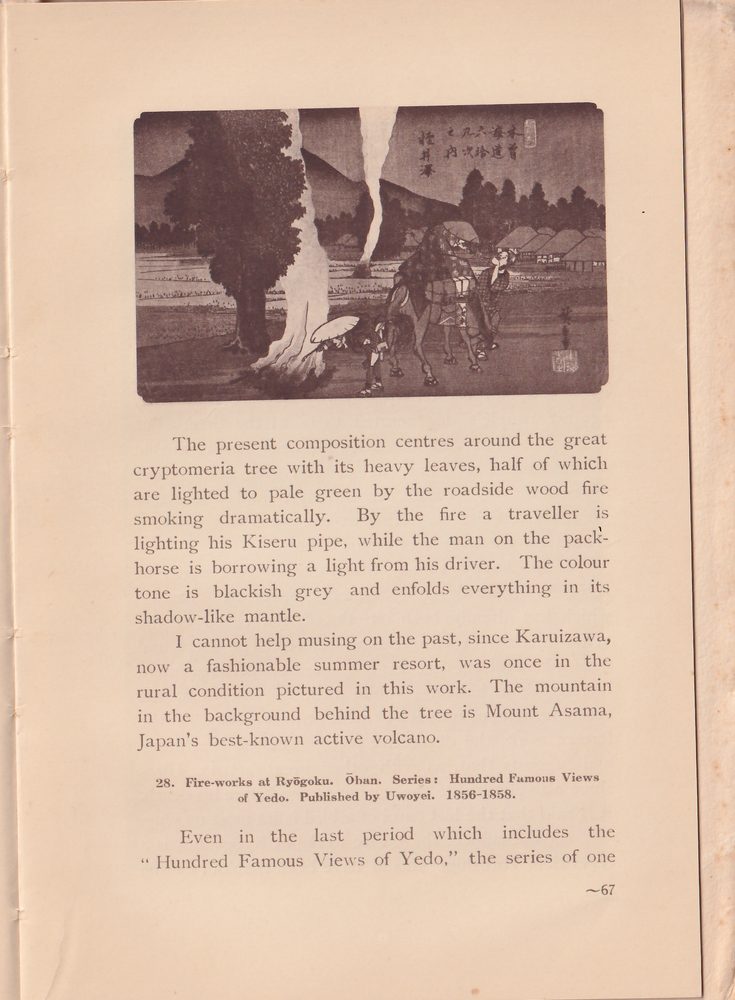
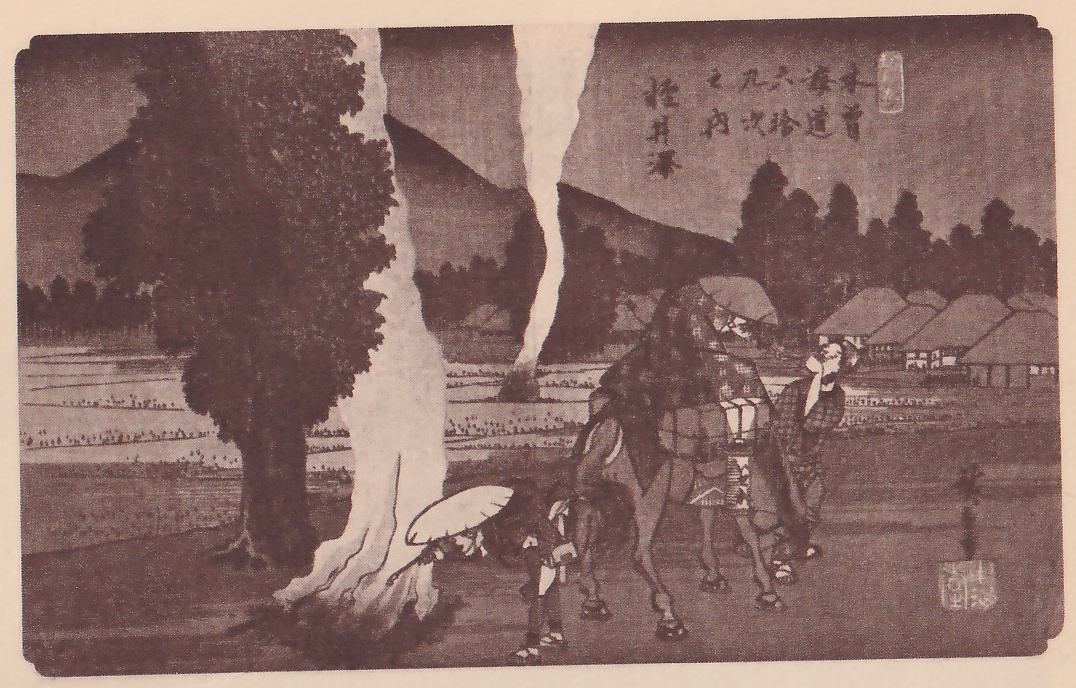
Published by Kinjudō. About 1835-1841. Mayekawa Collection.
The present composition centres around the great cryptomeria tree with its heavy leaves, half of which are lighted to pale green by the roadside wood fire smoking dramatically. By the fire a traveller is lighting his Kiseru pipe, while the man on the pack-horse is borrowing a light from his driver. The colour tone is blackish grey and enfolds everything in its shadow-like mantle.
I cannot help musing on the past, since Karuizawa, now a fashionable summer resort, was once in the rural condition pictured in this work. The mountain in the background behind the tree is Mount Asama, Japan’s best-known active volcano.
Even in the last period which includes the “Hundred Famous Views of Yedo,” the series of one
hundred and eighteen scenes, 1856–1858, Hiroshige had, I am glad to say, not a few moments when he exclaimed:
“Let me stand at imagination’s summit,
Once more think to try my flight of art!”
The present print, “Fire-works at Ryōgoku,” is one of the examples in which the artist became at once audacious and young, like a sunset glow, forgetting his age to indulge in petty caprices or sad fatigue. It is true that most of the works in this series merely report how Hiroshige was helpless against a bad Western pigment, and more than that, against people’s degenerated taste at the time. But although he found himself in such unfavourable circumstances, he was, as of old, the same great appreciator of nature’s eccentricity, and the same great romanticist assaulting at one focus where nature shakes off the details of environment.
I am happy to say that in this “Fire-works at Ryōgoku” and also in “Sudden Shower at Ōhashi” which has already been introduced, the vision of the artist is clear or clearer than before. The scent and atmosphere of the scenes are intense—perhaps more intense than before. While lacking, doubtless, the sensitive scrupulousness or noble transparency of the former work, the decorative picturesqueness is striking, and suggests that, as with other great artists, Hiroshige also climbed to the sun once more before his death. It is said that the last carol of a bird is its most moving.
As the subject the “Fire-works at Ryōgoku” is a repetition, Hiroshige should have been thankful for the
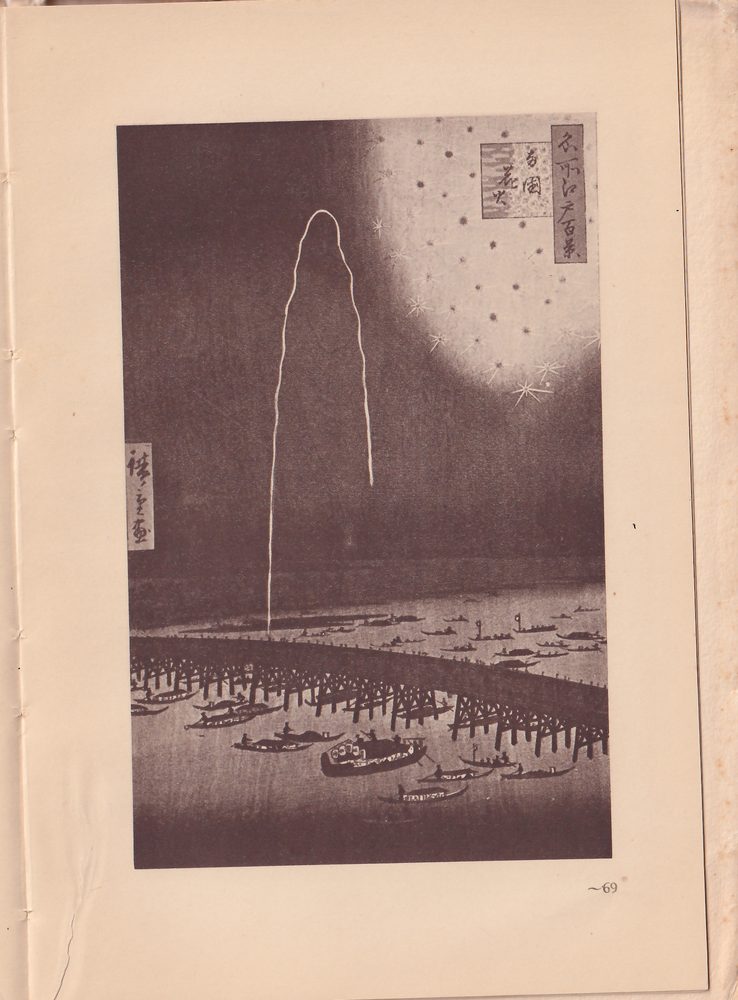
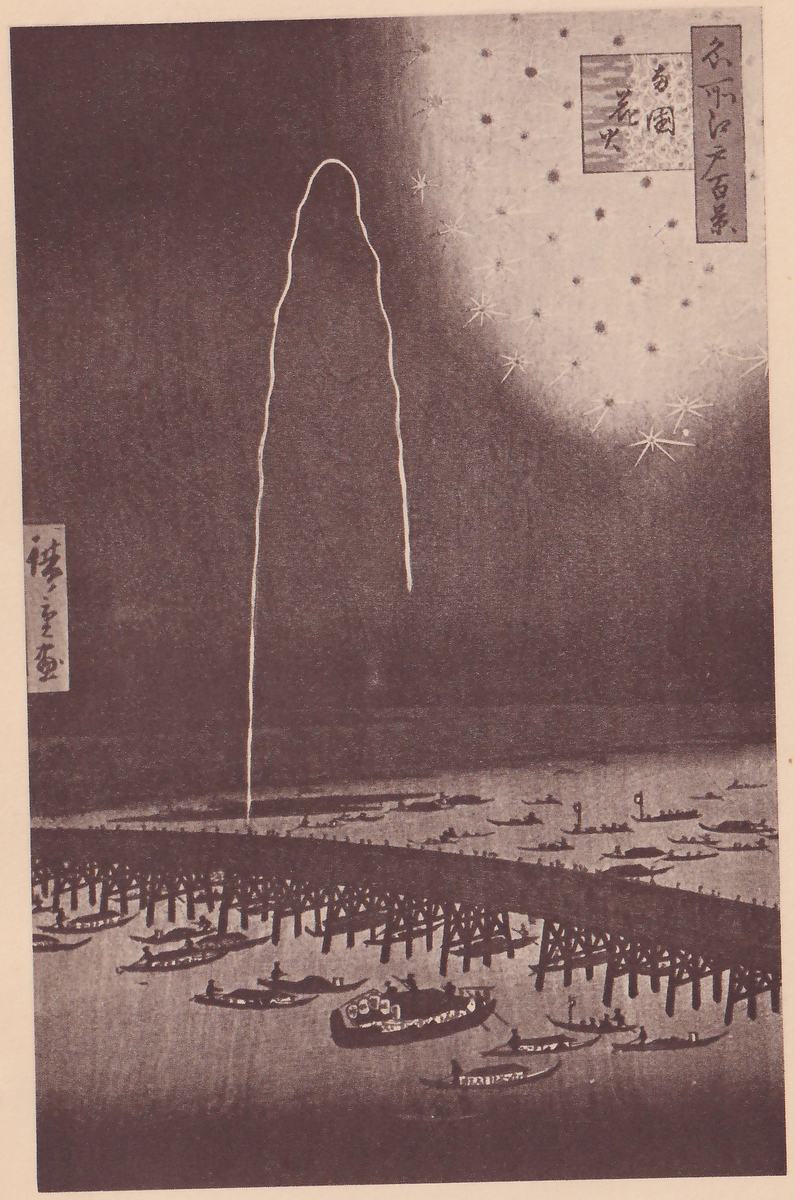
upright form of the aerial spaces with the flowery flash which was better suited than he expected.
Since most of the compositions of this series, “Views in Sixty Odd Provinces,” were borrowed from various books or evolved from the artist’s fancies, the work is therefore weak and flimsy. It is said that Hiroshige could not resist the forcing of his publisher, who thought only of taking advantage of his popularity. Had there been a critic to look after his art, Hiroshige might have been rescued from this mechanical labour with brushes and pigments, and been even worthier. I do not mean that every piece in the series is trash, because some of them the present print, “Maiko-no-Hama,” for instance, and “Hōki with Ōyama Mountain in Rain” and a few others, are lovely enough not to disgrace Hiroshige’s reputation.
In “Maiko-no-Hama” the pine-trees gesticulate, so to speak, with their peculiar arms that are painted in red ochre. I am sure I am not the only one to feel that he hears the tropical call of the southern sea in this print. Red ochre is the colour of the last passion of the sunset glow. I am pleased that, like stage demons with bodies painted red, the pine-trees are dancing in the water. There is nothing clearer than the lyric voice heard in this print.
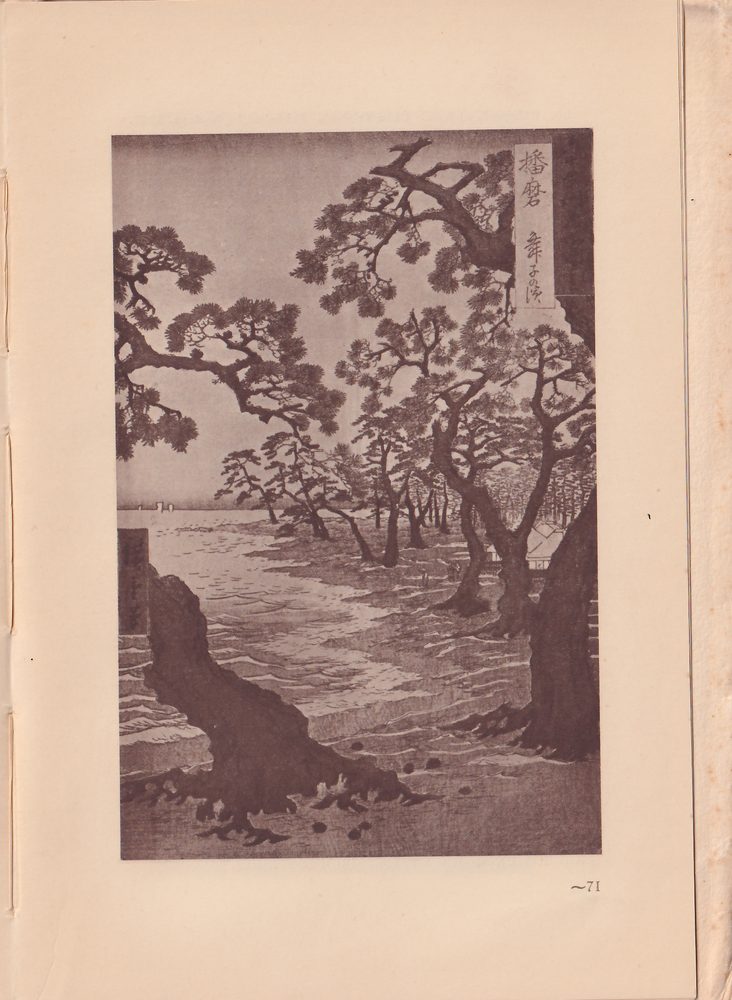
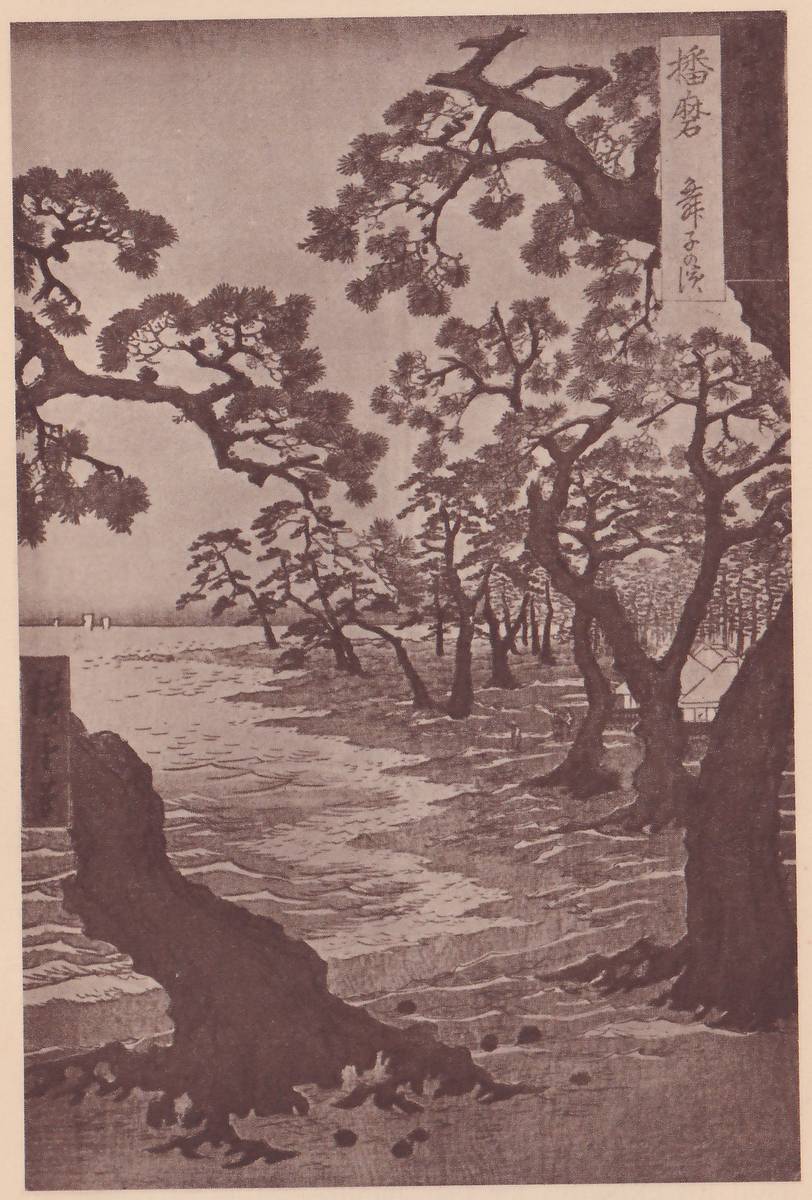
Published by Koshihei. 1853-1856.
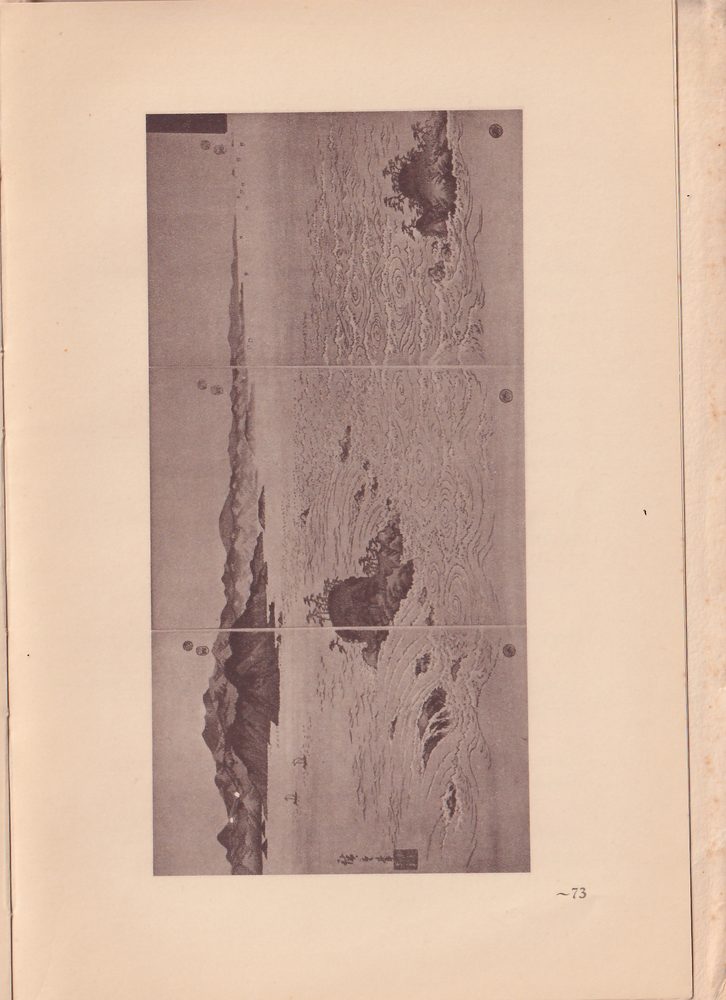
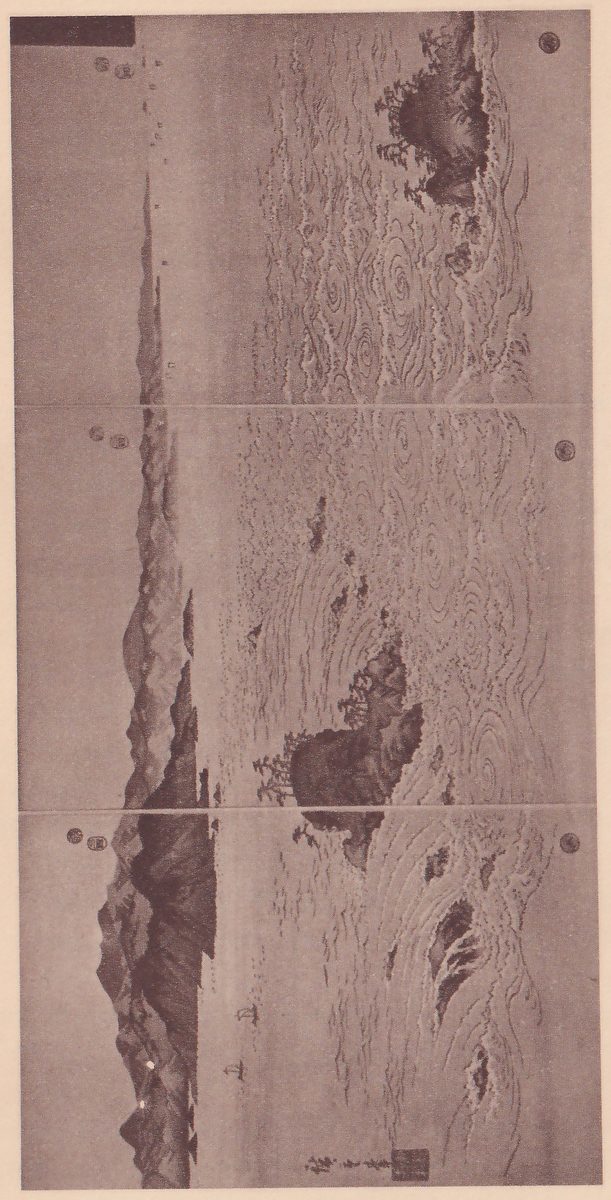
The whirlpools of the strait, Awa no Naruto, large or small, rise and fall in perfect rhythm. Am I wrong in reading here not only the natural phenomena of the Strait, but also the symbolism of life’s rise and fall, success and defeat? What a breadth and freshness of vision is in this work! The artist’s appreciation of space and ethereal atmosphere is extraordinary, and there is nothing to disturb his integrity of eye. But let us not be so hastily enthusiastic! What would you say to one who challenged a thing like this by pointing out the scrupulous quality and general attitude in art which we associate with the work of the middle Tempō period?
Admitting a change in composition as well as in the way of seeing things natural to an exuberantly productive mind of Hiroshige’s calibre, I should say that this print, “Whirlpool at Awa,” distinguishes itself among the flimsy work common through Hiroshige’s last period. As the title of the print tells, it is the scene of the whirlpool (Naruto) of the Awa Strait seen from the Shikoku side, with Awaji Island and the mainland in the background. Its chief value is in the printing technique which, supported by a light colouring in blue, gives us a feeling of clear transparency and airiness. Whether true or not, it is said that Hiroshige set out on a journey towards Naruto without telling his family when he received Tsutaya’s commission. By selling fans as he went along, he paid his expenses for four hundred miles.