
II HIROSHIGE AND LANDSCAPES
Students of Japanese colour-prints whose understanding is profound will be interested to know how prints of nature first lifted their small heads like aliens in the surprising growth of genre art, and how, finally, in the worthy hands of Hokusai and Hiroshige, they began to defy the general assumption that Ukiyoye art consisted of “pictures of the floating world.” When those print-masters of the last period realised the value of nature in the print, the original conception of Ukiyoye was contradicted and rejected. On the other hand, however, this revolutionary conduct may be excused if you interpret Ukiyoye as a synonym for “brocade pictures” (Nishikiye) in general. At any rate, nature’s entrance into the print marked a new epoch in the printing world of Japan.
It is interesting to see that Moronobu, the very forefather of printed pictures, the sensual painter of debauchery and love, touched for a moment the landscape of a sunny coast in “Tōkaidō Bunken Yezu” (The Tōkaidō Stations Illustrated), 1690, and preceded Hiroshige’s Tōkaidō series by a hundred and fifty years. The interest of the Ukiyoye print, a bird’s-eye view after the Western fashion, by Masanobu and Shigenaga of the middle eighteenth century, in connection with the landscapes of a later time, centres in perspective. Most of them dwell not on an outdoor
scene but on the interior of a big house, like those in the licensed quarter of Shin Yoshiwara, or on theatres. Whether it is a crude imitation of the Dutch engravings which drifted into the country after 1720, when the embargo on foreign books was removed, or of Chinese painting with a Western affectation which appeared in the latter half of the seventeenth century, a perspective-print (Ukiye) is interesting psychologically because it suggests how very new a logical perception was at a time when people clung to a fantastic absence of all logic.
When the youthful inspiration of Okyō, the future master of realistic art in autographic painting, was spent during the period of Meiwa (1764–1771) in imitating perspective views, Western or Chinese, for “pictures seen through a peep-box,” Meganeye(1), the artistic appetite of the Yedo people in general towards exoticism must have been great. How popular this peep-box was can be proved by one of Marunobu’s prints in the Mutagawa series, in which two girls are seen enjoying it. It seems certain that Western invasion direct from Holland, or indirectly through China, must have been more active in those days than today we imagine it to have been. Toyoharu, the legitimate successor of Masanobu and Shigenaga in the Ukiye-prints, inherited the ground Okyō had cultivated, and produced many prints of Western landscape in direct imitation, or through free and
(1) Meganeye-bako, a “peep-box,” is an apparatus in which a picture on the bottom, which is reflected on glass at the top, can be seen through a hole in one side of the box.
spontaneous imagination. Among these are a scene of Venice with gondolas afloat, and one of a cathedral—perhaps in Amsterdam. But with numerous views of Yedo and Kyoto, and of theatre scenes, ancient battles or hunting, the naturalisation of this Western technique was assured by Toyoharu.
It seems that Kōkan’s infancy as the bogus maker of Harunobu’s prints is well atoned for by his copperplate engravings, which became inspirations or models for Hokusai’s work at the end of the eighteenth century. In “Ushi-ga-Fuchi of Kudan,” “Fuji seen underneath Takahashi (High Bridge),” “Great Wave at Hommoku off Kanagawa,” “Benten Shrine at Haneda,” and other interesting landscape-prints, Hokusai’s characteristic exoticism is expressed restlessly, as is natural at a time of experiment and transition. According to his “Chats on Western Art” (Seiyō Godan), Kōkan began his steel engravings in September 1783. Although he travelled to Nagasaki, (then the only place where foreign commerce was permitted by the authorities), from Yedo, his own native city, in 1778, Kōkan returned home in the following year with foreign books on art, because he could not find a foreigner there to teach him the Western technique directly. I do not know whether Kōkan was the Leonardo da Vinci of Japan, but there is no mistake in saying that, as an enthusiastic student of Western science, and as a propagator of the materialism of the empiric school, he was the legitimate child of a time when the chaotic curiosity of the people was extraordinary. Before he gave up engraving for oil-
painting, it is said that Kōkan taught his technique in engraving to Denzen. Denzen’s artistic fluency, as is seen from the number of his extant works, qualified him as an excellent expounder of Kōkan’s method in engraving, although he was by no means an artist of undisputed originality.
Hokusai has an imitator in Shinsai, one of his pupils,—particularly in the artistic idiom already mentioned, “Ushi-ga-Fuchi of Kudan” and others. In some of the Yedo views Shinsai also followed his master with such success that a careless judge sometimes mistakes his work for that of Hokusai. There is also Hokuju, another pupil of Hokusai, who, like Shinsai, found his first inspiration in the master’s foreign manner and westernised mental attitude, and continued in it faithfully, even when Hokusai underwent a striking metamorphosis in the glory of “Thirty-six Views of Fuji,” 1833. Now, the master left all the poor walkers, and alone climbed to the peak of creation. It is by Hokusai’s magic hand that Western characteristics of landscape art, for which artists in the past had sought with passion and curiosity, now became fused into a new synthesis. When the organic coherency of landscape art was accomplished by Hokusai, people at once stopped talking about the Ukiye-prints or steel engravings of perspective views, which had alternately pleased and bewildered them during the previous fifty years.
But who is to blame if appetites grow jaded with eating and crave something new? People who had been too highly exhilarated by Hokusai’s fire or
Mihara Collection
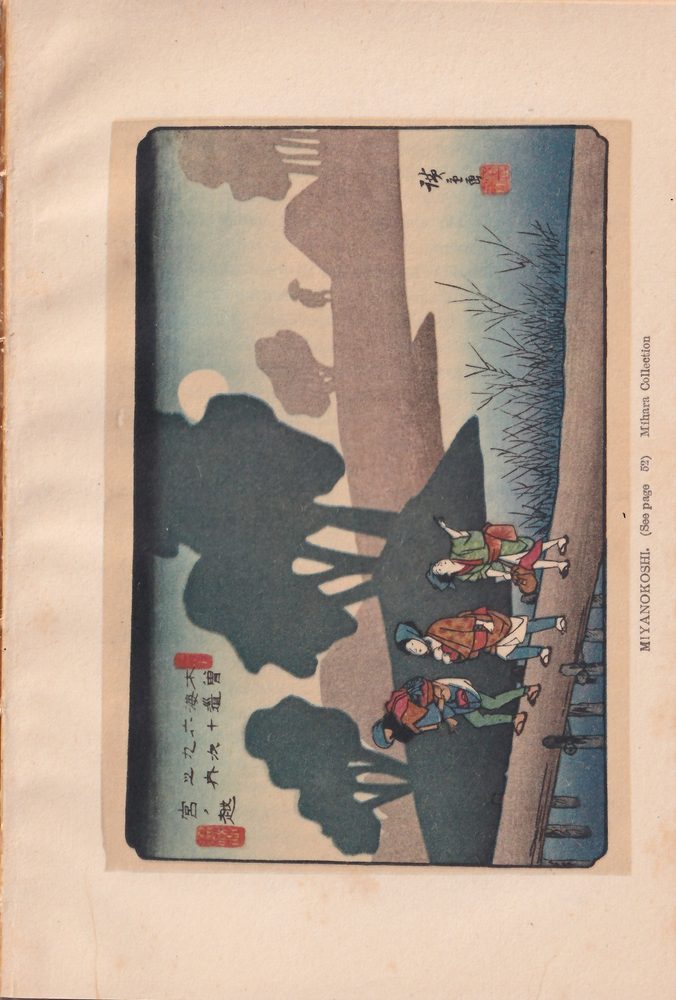
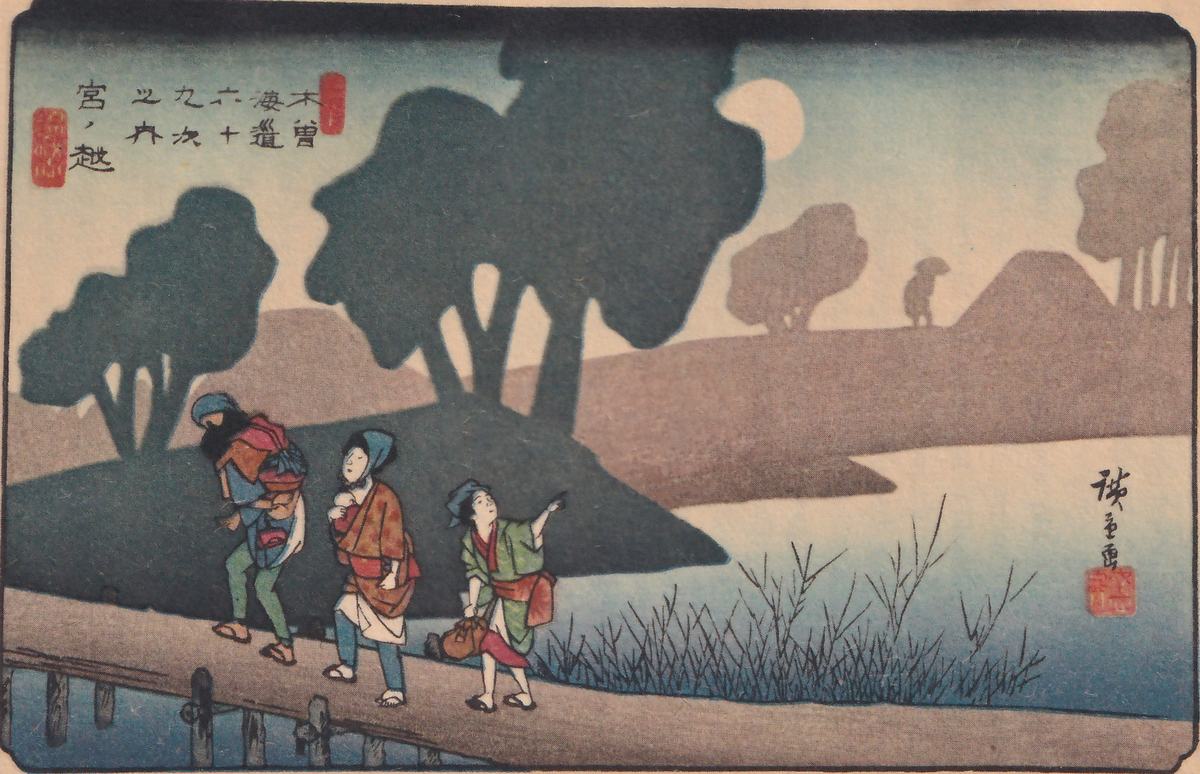
novelty in shapes and colours, with which he interpreted the drama of mountain and water, now wished to settle down to twilight for a moment, indeed to the wonderful moment when nature’s passion suddenly subsides. When Hokusai gave his place to Hiroshige, who was thirty-seven years his junior, the attitude of the people towards his series of Tōkaidō landscapes in 1834 was enthusiastic. Fully acclaimed with cheers and applause, Hiroshige extinguished the temporary light of Yeisen’s landscapes; and Kuniyoshi was wise enough to retire into warrior pictures, where he extended his stout arm in artistic bravery, finding that to contend with Hiroshige in the wrestling-ring of landscape art was at best nothing but a waste of time.
Indeed, Hiroshige’s entrance into the actual field marked the climax and the conclusion of landscape art of old Japan in print. Not only the landscapes of the popular school, but also Nishikiye-prints in general, ended with Hiroshige’s death, leaving in one’s mind the memory of a seven-coloured rainbow which had risen from a wooden block to respond to an artist’s delicate breath. With a new age in Japan lighting the horizon, it is sad that, like Shelley’s guitar without Jane, wood-blocks, once so eloquent and responsive, became suddenly mute. Alas, one more fairyland of art is lost! Where are the artists whose magic touch can turn a block of wood into a violin of most delicate tone? Where is the amorous whisper of life in nature which they taught prints to speak?
Since the Nishikiye-prints of Japan were originally a sensual chronicle of the manners and customs of the
time, the landscape artists, Hokusai, Hiroshige and the others, were certainly rebels or traitors. It is a sad irony that the arch-traitor, Hiroshige, rang the knell for the passing of prints.
But I am happy to think that flowers, moon and snow, real in Japan, are equally real flowers, moon and snow in the West. Therefore the work of Hiroshige, true in Japan, must be equally true, even at the centre of the Western world, in England or France. I am sure that among the mountains and rivers of any Western country our Hiroshige will be found, hidden under the surface. Again, I am sure that as we are in a way all Hiroshiges, even in the West there must be many people who would be pleased to identify themselves with this artist. A time may come when the other Ukiyoye artists will be forgotten in the West; but Hiroshige’s name, surely, will be as lasting as nature.
Whenever I dwell on a Western landscape painting as the product of its environment, but lacking in a certain abstraction, and in the quintessence of art, Hiroshige’s work comes to my mind by way of contrast, for in it the individual aspect of nature is suddenly seen isolated from the entire. His art is a thing that appeals to an artistic person in a moment of rare but sweet union with nature. In another essay I said: “It is my opinion that a true landscape artist should see a natural phenomenon at a striking moment when, being isolated, it flatly refuses to move and act in uniformity with other phenomena. Hiroshige’s famous pictures, without exception, transmit and convey those rare phases which nature reveals in
her blessed isolation. Following a cardinal principle of architecture, viz. concentration, Hiroshige discarded offhand all the extraneous details which are apt to blur or weaken the central theme. His handling of this secret is marvellous, although I know that it belongs not alone to Hiroshige in the world of Oriental art. At any rate, he is extremely suggestive at his best. Western landscape art, whether it is better or worse than the photograph, usually attempts to imitate nature or to make a copy; therefore the artist may become a soft-voiced servant to nature, but not a real lover who truly understands her inner soul, as Hiroshige does. A good landscape artist of the West might become a theoriser of pigments, or something of a metaphysician with his paint brush, or a eulogist of pigment-poems. But since he is often bound by common circumspect knowledge, and seldom escapes from his old habit of expressing some meaning or purpose, it is natural that he should fail to create a poetical landscape where real life is nothing but suggestion. Enter into nature, I should say, and forget! Again, depict nature and forget it!”
Any suggestive art should have its own idiom of expression at once vivid and simple. I should say that every picture I see of Hiroshige at his best, seems to be new and impressive, and that the last one is always so surprising as to leave my mind incapable for the time being of an apprehension of his others. It is certain that one picture of his is quite enough, just as one picture of any other great artist of the world is enough for us. That is proof of Hiroshige’s greatness.
Am I to be blamed as a vague critic, if I say that any artist, whether he be idealist or realist, is good when he is true to himself? It is true, I believe, that even a seemingly realistic work, when it is rightly executed, is always subjective; and a good picture, although superficially it may appear idealistic, is always a work that does not forget the importance of realistic expression. Hiroshige may be called a realist or an objective artist, since the artistic mood is slowly but steadily led to trees, rivers and mountains through his expression of the relation between nature and men. But who can declare that he has followed nature only superficially? It goes without saying that the realistic elements of his art rendered a most important service in bringing out distinctly that indefinable quality which is often called atmosphere or pictorial personality. I think, therefore, that Hiroshige is more truly an idealist or subjective artist.
After all, Hiroshige’s work, in so far as it concerns itself with landscapes and other natural subjects, is an affirmation of our old conception of art, although in most cases he recognized nature in union with humanity and found it richer among the lower classes. Unlike the masters of “mountains and rivers” in the autographic painting of Japan, who praised nature for its own sake, Hiroshige humanized it and made it speak our human tongue. I should like to know where there is any art equal to that of Hiroshige; like a living thing, nature to him, to use Whistler’s classic remark, is “creeping up a bit” with a special movement, and yet conforms to Hiroshige’s idiom. Once, many years
ago, when I awoke to a sudden enthusiasm for Hiroshige, I began a little essay with the following words:
“In the late afternoon of a day in April, some fourteen or fifteen years ago, when greatly troubled by modern life in the West and eager to gain a true sense of perspective towards nature, I glided down the flower-reflecting water near Mukōjima, with two or three others like myself, in a ‘cherry-viewing boat.’ I confess that I was seeing everything through my westernized blue eyes, and even cursing Japan for degenerating into a meaningless and foolish imitation of the West. But then, seeing the calmly-settled deep blue of this Sumida River whereon we were gliding, and thinking that it was the very blue of an old Japanese colour-print, my Western blue eyes suddenly changed, and I began again to look through the black eyes of a Japanese. Unlike Western blue pigment, which is often mixed with other colours to show life in action, that of the Japanese colour-prints is highly homogeneous, and therefore a colour as it was before any other colour was mixed with it. Thus baptised by the blue of the Sumida River in the late afternoon of that spring day, I ceased at once to be a Westerner, and my mind entered slowly into the pictorial domain of Hiroshige.
“How many pictures Hiroshige drew with the Sumida River as his subject! Before my imaginative eyes, many of his pictures depicting the river in snow or under cherry blossoms, appeared as if thrown there by a magic lantern. When I thought of a particular one, ‘Sumidagawa Hanazakari’ or ‘Cherry Blossoms
by Sumida River,’ this very Mukōjima coloured faintly but beautifully by the blooming cherry blossoms began to appear to me just like that picture by Hiroshige. I could not help exclaiming in spite of myself, ‘Why, nature does imitate art’ as Wilde once exclaimed,—‘the Mukōjima of today imitates Hiroshige’s picture of olden time!’
“As we glided through the delightful sights by the river which Hiroshige loved so dearly, and painted in so many pictures, we argued, discussed and expanded on the recent artistic advance of the human mind. There is no doubt that as our minds are glad to imitate the rare and good in art whenever they see it, you will agree, I am sure, that it is not strange that my mind, when so full of Hiroshige’s pictures, could not see the views before my eyes as other than the pictures of Hiroshige. It is not true that the ‘Mukōjima of today imitated Hiroshige’s picture of olden time;’ the fact is that my own poor mind was imitating Hiroshige’s art. In other words Hiroshige, hitherto unknown in my mind, awakened suddenly. Or, to use another expression, my friends and I became one with the artist who was called Hiroshige,—just as it is said that we are all Hamlets, whether men or women. As we were already all Hiroshiges, we were naturally moved by him and could react to his work as to our own creations. A Hiroshige hidden in our own minds found a representative artist in the real Hiroshige who was born in 1797 and died in 1858. He is, in truth, one of the best native and national artists of Japan.”