





Cursive · sōsho 草書 · VC5J
Cursive or sōsho (草書) styles are the most simplified styles and Master Takase's favorite. While very beautiful, these styles are often difficult to read even by specialists.
白雲自去来
hakuun onozukara kyorai su
The White Clouds Come and Go of Themselves
The white clouds come and go of themselves, the closing half of a Zen couplet whose other half says the green mountain never moved.
Master Takase creates this beautiful scroll when your order is placed, personally preparing the ink and brushing your art, which proudly bears her signature and seal. This is an original work of art.
Description
白雲自去来 (hakuun onozukara kyorai su): the white clouds come and go of themselves.
In the line, 白雲 is the white clouds, 自, read onozukara, is of themselves, and 去来 is going and coming. It is the closing half of a couplet that opens with 青山元不動, the green mountain never moved. Its 元不動 is read in print three ways: moto fudō, moto ugokazu and moto dōzezu. 元 is originally, from the start.
A handbook of 1973 for one-line tea scrolls heads 白雲自去来 and calls it the couplet shortened to one line. It reads the line with the mountain behind it: the clouds come and go of themselves, but the mountain never moved.
Lingyun Zhiqin is entered among the heirs of Weishan as the monk who woke to the Way through peach blossoms. The white cloud and the green mountain appear together in the recorded sayings of the Tang master Dongshan Liangjie, which give Dongshan a verse: the green mountain is the white cloud's father, the white cloud the green mountain's child; all day the white cloud leans on it, and the green mountain does not know.
The hermit Tao Hongjing, asked by an emperor what there was in the mountains, answered with a poem: on the ridges, many white clouds. All he could do, he wrote, was delight in them himself, and he could not send them.
The sermon credited to Fusai Zenkyū is one of the funeral torch sermons in his record, spoken for a woman, 性芳. It names Moshan and the nun Tiemo in the line before the couplet. Fusai's record also has a midsummer sermon that says: dark, dark, the green mountain never moved; drifting, drifting, the white clouds change at leisure.
Sōtō biographies printed in 1742 tell of the monk 泰叟妙康. His teacher Gekkō Shōbun asked him when the son returns to the father, what then?; 泰叟 answered with the couplet, and Gekkō let it rest.
A catalogue of Daitokuji's one-line scrolls lists the couplet by Gyokushū Sōban and the line alone by Seigan Sōi. Seigan was Sen Sōtan's teacher in Zen.
In a volume of tea records printed in 1920, Takahashi Sōan describes an alcove holding a scroll by Seigan ending with this line. On its mount 探幽 had painted a green mountain. A tea reported in a tea monthly of June 1939 hung a two-line scroll of the couplet by the priest 柴野松月.
Nitobe Inazō ended an essay on not forgetting peace in the war with Russia with the couplet alone, set apart. The essay is dated April 1904 and was printed in 1907.
Sōseki's diary records that on 22 May 1911 a visitor asked him to write the couplet on Chinese paper. He wrote two sheets, found they came out somewhat free of vulgarity, and the visitor took both home. Sōseki went that evening to Hamlet.
Shaku Sōen's talks, printed in 1928 after his death, explain why the couplet is written as an inscription on Bodhidharma. Bodhidharma, he says, is the exemplar of the original face.
In a book of 1898, Lafcadio Hearn gave the couplet in English, from a wooden grave marker of the Pure Land school: The Blue Mountain of itself remains eternally unmoved: the White Clouds come of themselves and go.
English translators give 青 as blue and as green. R. H. Blyth (1949) has The blue hills are by their nature immovable; / The white clouds of themselves come and go. William Scott Wilson, introducing the 2012 edition of his Hagakure translation, reads the couplet as the state that book is about: Like the blue mountains, nothing can move us. John Stevens (2022) shows a fan by Katsu Kaishū whose inscription he renders Green mountains originally don't move; / White clouds of themselves come and go.
The couplet is Chinese in its form and its first half: Lingyun Zhiqin's answer on getting free of birth and death, in the 景德傳燈錄 (1004, by the dictionaries) with 浮雲飛去來, the floating clouds fly, going and coming, and in the 五燈會元 with 浮雲任去來. The couplet with 白雲自, the white clouds of themselves, is first read, by its author's dates, in a funeral sermon credited to the Sōtō master Fusai Zenkyū (1347–1408), known in a print of 1695; the oldest dated print read that carries it is the phrase book 句雙紙 of 1645, which names no source; the enlarged phrase book of 1688 tags it to the 五燈會元 and notes that the 傳燈錄 writes 浮雲飛.
We want you to be as happy with the meaning as you are with Master Takase's art. To learn more, visit Philology of 白雲自去来.
Delivery
Your scroll is brushed when you order it and completed within 1 to 3 business days. It ships by USPS Priority Mail from Master Takase's studio in Washington State, boxed and ready to hang, with a printed page giving the art's English, romaji and Japanese.
Sending it as a gift? Add your message at checkout and we will include it.
Shipping is calculated at checkout from your address; within the United States it is $13 to $23. We ship worldwide, and any import charges for your country are shown at checkout before you pay.
Every order is covered by our 30-day money-back guarantee. If your scroll arrives damaged, or we made an error, we replace it or refund you in full, including shipping. Refund policy
About Our Scrolls
Master Japanese Calligrapher Eri Takase brushes your scroll by hand when you order it. Each scroll bears her red seal, 英利, and her signature.
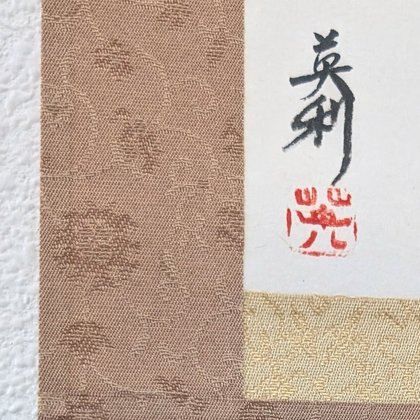


The scrolls are 12 1/4" W × 43" H (31 × 109 cm), with woven damask borders and layered Japanese paper, designed to last generations. The scrolls themselves are made by a scroll maker in Gifu, Japan, and we have worked with them for over two decades.
Eri Takase was born and raised in Osaka, Japan, and holds the rank of Shihan, the highest rank in Japanese calligraphy, from the Bokuteki-kai and the Bunka-shodo. About Master Takase


