





Block · kaisho 楷書 · VB5J
Block or kaisho (楷書) styles are the most common and recognizable styles. Block styles are easily read and are noted for their angular form and their vertical and horizontal lines.
松無古今色
matsu ni kokon no iro nashi
The Pine Has No Color of Past or Present
The pine has no color of past or present, and is the same in all ages; the line is one half of a Zen couplet whose other half says the bamboo has joints above and below.
Master Takase creates this beautiful scroll when your order is placed, personally preparing the ink and brushing your art, which proudly bears her signature and seal. This is an original work of art.
Description
松無古今色 (matsu ni kokon no iro nashi): the pine has no color of past or present, and is the same in all ages.
In the line, 松 is the pine, 無 is has not, 古今 is past and present, and 色 is color. Its 古今 is read kokon. The 日本国語大辞典 notes that kokin serves mostly as the short name of the 古今和歌集, and kokon as the plain word, then and now.
The line is one half of a couplet whose other half is 竹有上下節 (take ni jōge no fushi ari): the bamboo has joints above and below. In the bamboo half, 節 is the joint of a bamboo stem, read fushi, as the English translations of 1981 and 2003 romanize it.
In a Song lamp history, a monk asks the abbot Dagui Zuchun for the house style of Weishan, his monastery. The abbot answers with the couplet. Asked what the people of the house eat and drink, he answers: the minister's rice when they are hungry, tea when they are thirsty. The couplet describes the house: each thing in its place, and always the same.
Taking the abbacy of Engakuji in Kamakura, Musō Soseki imagined being asked why he came now, having firmly declined the appointment the year before. He would answer, he said, with the couplet. Refusal and acceptance are no contradiction: the pine is the same through both.
A monk asked Shūhō Myōchō, known as Daitō, whether a patron's temple was better or worse in merit than the Jetavana built for the Buddha. There is no better or worse, he said, and he closed the sermon with the couplet. Ryūshū Shūtaku, Musō's heir, asked the same of a governor's offering, set beside Su Shi's copy of a sutra, and answered with the couplet alone.
Takuan Sōhō set the couplet among things that are as they are: the heron white without bleaching, the crow black without dye. He asked whether this is nature or cause. A phrase book of 1688 glosses the couplet: none goes against its own nature; manifest just as it is; there is no mystery beyond this.
Separately, the same Japanese words describe the pine of long life and blessing. Zeami's treatise on the kinds of voice in Noh makes the pine without a color of past and present the image of the felicitation voice. His felicitation Noh Takasago sings a pine that does not see the color of past and present.
The haikai poet Onitsura headed a New Year verse of 1688 with the line in its Japanese reading, as a study of 1944 quotes it. He wrote of beginning a felicitation, and singing to the world a verse of the evergreen. An Edo priest's travel diary, prefaced in 1814, opens its list of thirty-six famous pines with the line's words. A literary magazine of 1893 set the line beside the crane's thousand springs, for a woman's seventy-seventh birthday.
A collection of 1774 tells how Ransetsu, Bashō's disciple, was asked by a Zen master for a line with no color of past or present. Back from a pilgrimage, he answered with a Song saying: Spring's color has no high or low; the flowering branches are of themselves short and long. The master accepted it.
In tea, Urasenke's book of 1935 says its room 無色軒, added by the house's seventh head, who died in 1733, was named from the line. A Nagoya sale catalogue, in a series the National Diet Library dates 1913 to 1917, lists a one-line scroll of it as Seigan's. Seigan Sōi was an abbot of Daitokuji and the Zen teacher of the tea master Sen Sōtan. A tea master's record of 1921 tells of a gathering in 1920. In the alcove hung a horizontal scroll of the five characters, given as Seigan's.
In English, Sōiku Shigematsu's A Zen Forest (1981) gives the line as No pine has two colors, old and new. Victor Sōgen Hori's Zen Sand (2003) gives The pine has no old or new color. Of a tea-room scroll, Noriko Morishita's Wisdom of Tea (2020) gives Young or old, the pine is always green.
The couplet is first known as the answer of the Chan abbot Dagui Zuchun in a Chinese lamp history prefaced in 1101, 竹有上下節,松無古今青, the bamboo first and green for color; the Japanese Zen master Musō Soseki wrote 色 in 1329, and the Japanese phrase books, in a manuscript catalogued as early Edo and the print of 1645, set the pine first.
We want you to be as happy with the meaning as you are with Master Takase's art. To learn more, visit Philology of 松無古今色.
Delivery
Your scroll is brushed when you order it and completed within 1 to 3 business days. It ships by USPS Priority Mail from Master Takase's studio in Washington State, boxed and ready to hang, with a printed page giving the art's English, romaji and Japanese.
Sending it as a gift? Add your message at checkout and we will include it.
Shipping is calculated at checkout from your address; within the United States it is $13 to $23. We ship worldwide, and any import charges for your country are shown at checkout before you pay.
Every order is covered by our 30-day money-back guarantee. If your scroll arrives damaged, or we made an error, we replace it or refund you in full, including shipping. Refund policy
About Our Scrolls
Master Japanese Calligrapher Eri Takase brushes your scroll by hand when you order it. Each scroll bears her red seal, 英利, and her signature.
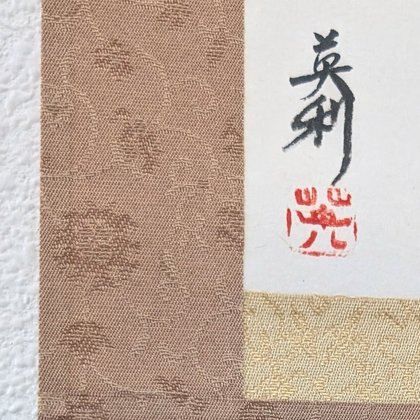


The scrolls are 12 1/4" W × 43" H (31 × 109 cm), with woven damask borders and layered Japanese paper, designed to last generations. The scrolls themselves are made by a scroll maker in Gifu, Japan, and we have worked with them for over two decades.
Eri Takase was born and raised in Osaka, Japan, and holds the rank of Shihan, the highest rank in Japanese calligraphy, from the Bokuteki-kai and the Bunka-shodo. About Master Takase


