




Eri's Choice · VD5J
Eri's Choice is a design that does not keep strictly to one style; it is Master Takase's own artistic choice.
本来面目
honrai no menmoku
The Original Face
The original face: a Zen phrase for the mind as it is from the beginning, with nothing added to it.
Hand-brushed by Master Eri Takase
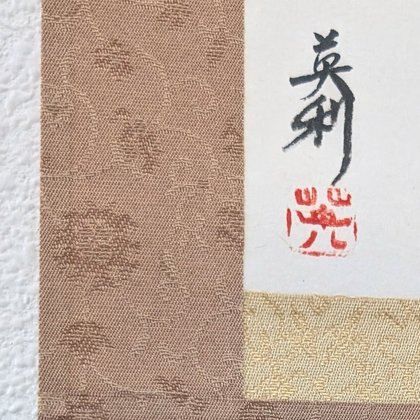
Master Japanese Calligrapher Eri Takase brushes your scroll by hand when you order it. Each scroll bears her red seal, 英利, and her signature.
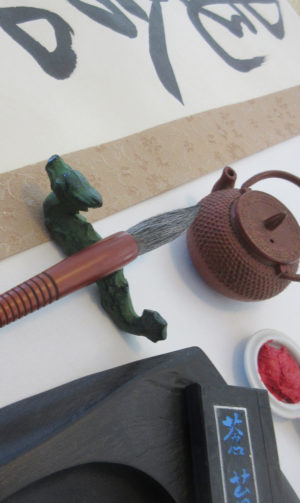
Eri Takase was born and raised in Osaka, Japan, and holds the rank of Shihan, the highest rank in Japanese calligraphy, from the Bokuteki-kai and the Bunka-shodo.
12 1/4" × 43" Japanese Scroll
The scrolls are 12 1/4" W × 43" H (31 × 109 cm), with woven damask borders and layered Japanese paper (washi), designed to last generations. The scrolls themselves are made by a scroll maker in Gifu, Japan, and we have worked with them for over two decades.


Ships in 1-3 days from Washington State
Your scroll is brushed when you order it and completed within 1 to 3 business days.
Your scroll ships from Master Takase's studio in Washington State. Shipping is calculated at checkout. We ship worldwide.
Includes detailed explanation, gift-ready
Your scroll arrives boxed, with a printed insert describing the words in detail.
Sending it as a gift? Add your message at checkout and we will include it with the insert.
30-day money-back guarantee
Every order is covered by our 30-day money-back guarantee. If your scroll arrives damaged, or we made an error, we replace it or refund you in full, including shipping.
Explanation
本来 is from the beginning, and 面目 is the face, what a person is known by. Japanese reads it with の, and reads 面目 here as めんもく, the face; read めんぼく, it means one's honor. Two Japanese dictionaries give the phrase as a Buddhist term of Zen.
In the Chinese texts of 952 and 1004, before your father and mother were born is not part of the Sixth Patriarch's words. It stands apart, as a separate question, in the entry for the master Nanquan. Among the dated texts read for this history, the two stand joined in a twelfth-century sermon of Hongzhi's and instruction of Mi'an's.
The Mumonkan, compiled in 1228, makes the Sixth Patriarch's meeting with the monk Ming its case 23, think neither good nor evil. The Patriarch asks: Just at such a time, which is Senior Monk Ming's original face? Wumen's verse on the case ends: the original face has nowhere to hide; when the world is destroyed, it does not decay.
In the Fukan zazengi, which Dōgen wrote on his return from China, the original face is what appears in sitting: Body and mind of themselves drop away, and the original face appears.
Natsume Sōseki, in a preface dated November 1907, tells of sitting with the priest Sōen at Kamakura. Asked what his original face was before his father and mother were born, he was floored. In his novel Mon, serialized in 1910, an old Zen master sets the hero the same question.
A waka handed down under Dōgen's name, whose authorship is disputed, is titled on the original face. It opens with spring's blossoms, summer's cuckoo and autumn's moon. Kawabata Yasunari opened his Nobel lecture of 1968 with it. He wrote that he sometimes wrote it out, with a poem of the priest Myōe, when asked for calligraphy.
In English the phrase is in print by 1910, untranslated, as the name of a koan, Honrai no Memmoku. Original face, with before you were born, stands in a lecture book of 1924 that quotes D. T. Suzuki, and in Suzuki's Essays of 1927. R. H. Blyth, in his Mumonkan of 1966, wrote that Suzuki's Your original face before you were born, though not literal, gives us a shock.
From the Chan story of the Sixth Patriarch Huineng and the monk Huiming on the Dayu ridge: the oldest Platform Sutra tells the meeting without the question, which stands in four characters in Huineng's mouth by 1004; in Japan, Dōgen uses the phrase in the Fukan zazengi, written in 1227 (the phrase read in the texts the Taishō prints).
Learn More About These Words
We want you to be as happy with the meaning as you are with Master Takase's art. To learn more, visit Philology of 本来面目.


