


Eri's Choice · VD5J
Eri's Choice is a design that does not keep strictly to one style; it is Master Takase's own artistic choice.
無事是貴人
buji kore kinin
The One with Nothing Left to Seek Is the Noble One
The one with nothing left to seek is the noble one.
Hand-brushed by Master Eri Takase
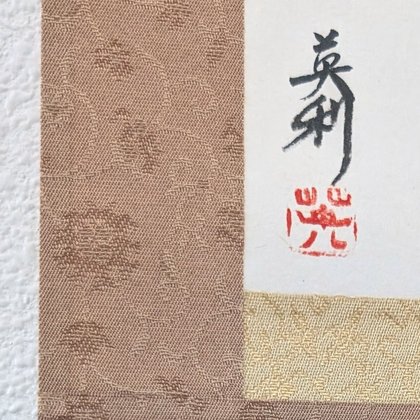
Master Japanese Calligrapher Eri Takase brushes your scroll by hand when you order it. Each scroll bears her red seal, 英利, and her signature.
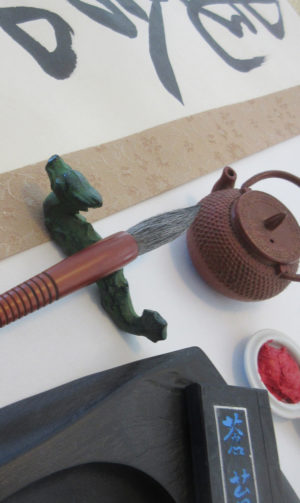
Eri Takase was born and raised in Osaka, Japan, and holds the rank of Shihan, the highest rank in Japanese calligraphy, from the Bokuteki-kai and the Bunka-shodo.
12 1/4" × 43" Japanese Scroll
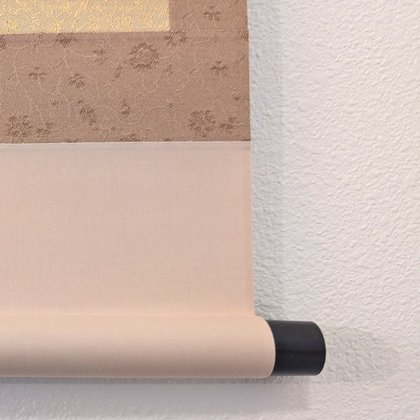
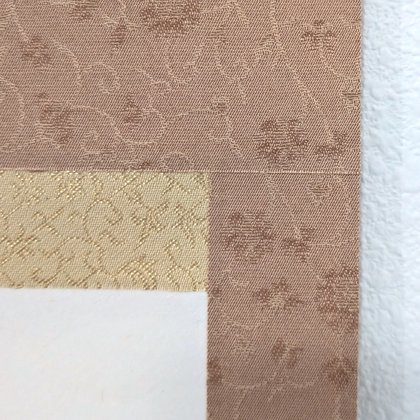
The scrolls are 12 1/4" W × 43" H (31 × 109 cm), with woven damask borders and layered Japanese paper (washi), designed to last generations. The scrolls themselves are made by a scroll maker in Gifu, Japan, and we have worked with them for over two decades.
Ships in 1-3 days from Washington State
Your scroll is brushed when you order it and completed within 1 to 3 business days.
Your scroll ships from Master Takase's studio in Washington State. Shipping is calculated at checkout. We ship worldwide.
Includes detailed explanation, gift-ready
Your scroll arrives boxed, with a printed insert describing the words in detail.
Sending it as a gift? Add your message at checkout and we will include it with the insert.
30-day money-back guarantee
Every order is covered by our 30-day money-back guarantee. If your scroll arrives damaged, or we made an error, we replace it or refund you in full, including shipping.
Explanation
無事是貴人 (buji kore kinin): the one with nothing left to seek is the noble one.
無事是貴人 is a line from the sermons of the Zen master Linji. In those sermons, 無事 is where the seeking mind comes to rest. The noble one is the person of 無事, one who has stopped running after things. A Zen dictionary of 1915 gives the line its own entry. The entry describes one who has seen through to the ground of their own mind and stands free. Such a person, the entry says, is truly one of great nobility. The five characters say no affairs, is and person of rank.
After 無事是貴人, Linji's sermon goes straight on: just don't contrive; only be ordinary. In the same sermons, being ordinary is putting on clothes, eating rice and lying down when tired. A commentary printed in Japan in 1691 pictures the true person of 無事 in the midst of bustle and haste. That person, the commentary says, is like a wooden man looking at flowers and birds. A Zen teacher's talks, printed in 1907, say this 無事 is the 無事 in the midst of being busy.
From the Edo period 無事是貴人 also circulated in Japan as a common saying for a safe and untroubled life. A story by Kyokutei Bakin makes the line a household maxim. Whether you take it as the Zen line or as the common saying is yours. The scroll is read buji kore kinin, the reading printed beside the characters on a woodblock of 1790. Buji kore kijin is common in print too.
The line is the Chinese Zen master Linji's (臨済, d. 866), from a sermon in the Record of Linji: 無事是貴人、但莫造作、秖是平常, the one with nothing left to seek is the noble one; just don't contrive, only be ordinary. In Japan it was printed in the Record by 1437 and commented on in Japanese by 1632, and from the Edo period it also circulated as a common saying for a safe and untroubled life.
Learn More About These Words
We want you to be as happy with the meaning as you are with Master Takase's art. To learn more, visit Philology of 無事是貴人.


