





Cursive · sōsho 草書 · VC5J
Cursive or sōsho (草書) styles are the most simplified styles and Master Takase's favorite. While very beautiful, these styles are often difficult to read even by specialists.
春来草自生
haru kitatte kusa onozukara shōzu
Spring Comes, and the Grass Grows of Itself
Spring comes, and the grass grows of itself, with no one to make it grow. A Zen line, hung in some tea alcoves in spring.
Master Takase creates this beautiful scroll when your order is placed, personally preparing the ink and brushing your art, which proudly bears her signature and seal. This is an original work of art.
Description
春来草自生 (haru kitatte kusa onozukara shōzu): spring comes, and the grass grows of itself.
In the line, 春来 is spring coming, and 自, read onozukara, is of itself, by its own power or course. 生ず, shōzu, is to grow, as a plant grows. Read aloud, 春来 is printed in several ways, among them haru kitatte, the reading of Urasenke's textbook of 1980, and shunrai, haru kitari and haru kitarite.
Zen and tea know 春来草自生 as the close of a couplet that opens 兀然無事坐, sitting upright, nothing to do. 兀然 is upright and unmoving.
The hermit Lanzan, lazy Zan, was a Tang monk who lived at leisure in the crags of Mount Heng while the other monks worked. The Song poet and calligrapher Huang Tingjian brushed Lanzan's song, and three Ming catalogues transcribe it in Huang's hand, ending with the grass turning green.
In the 天聖廣燈錄, a monk asks the master 林鷄徹 whether there is still a matter beyond, and what it is. The master answers: autumn comes and the yellow leaves fall; spring comes and the grass grows of itself.
By 1101 the green line, spring comes and the grass greens of itself, was a cliché. A sermon in a lamp record prefaced that year lists it among the answers a monk is not to bring. Whoever gives them, the sermon says, is a fellow who runs before the donkey and behind the horse. Baiyun Shouduan told monks who could not yet weigh the water buffalo's nose not to say the green line on the year's last night.
Xutang Zhiyu's New Year's Eve talk at the Xianxiao temple asks what field this is that each monk has and cannot set foot on. Then he struck with his whisk and said 春來草自生, the line with grows. Some of the sermon's opening phrases are common sayings, and each is also in the record of Shouduan, eight generations above Xutang in his line.
A Gozan print of Xutang's record, which the National Diet Library dates to 1313, carries the sermon with reading marks added in red. A note in the Japanese translation of 1932 calls the line the field beyond, where nothing is done by effort. In spring, it says, the vetch, the aster, the mugwort and the iris all grow of themselves.
Two Japanese commentaries on Xutang's record, of 1913 and 1964, gloss the line by Lanzan's song and quote the song with its green ending.
The 徒然草, in section 171, quotes the words of 清獻公: do good, and do not ask what lies ahead. Feng Dao's poem has two lines with the same words. A printing of 1894 of Kitamura Kigin's commentary prints the whole poem, the grass line with it.
Tea magazines of 1939, 1959 and 1965 describe scrolls of the five characters by Sensō Sōshitsu, fourth head of the Urasenke tea house. The last was hung for the season. Sen Sōshu, then head of the Mushanokōji Senke, wrote in 1990 that his practice room's alcove would hold the five characters the next month. It holds them each year, he wrote.
A catalogue of Kitaōji Rosanjin's work says his piece of 1929 takes Sensō's horizontal scroll of the same words as its model. Nishida Kitarō brushed the five characters too. The aesthetician Ijima Tsutomu kept a piece of Nishida's in his room. In 1969 he wrote that its character for grass was a little hard to read.
R. H. Blyth gave the couplet in English in 1949: Sitting quietly doing nothing, / Spring comes, grass grows of itself. Alan Watts called a chapter of The Way of Zen (1957) Sitting Quietly, Doing Nothing and gave the couplet in the book. Randolph Whitfield, translating Lanzan's song, keeps the color: Spring comes, the grasses of themselves grow green.
The words are Chinese and the line has two Chinese lives. The hermit Lanzan's song ends 兀然無事坐,春來草自青, sitting upright, nothing to do, spring comes and the grass greens of itself, in the 祖堂集 (952, by the encyclopedia) and the 景德傳燈錄 (1004, by the dictionaries); 春來草自生, with 生, grows, is a Chan answer first read, in the records searched, in the 天聖廣燈錄 (preface 1036) and the line the Southern Song master Xutang Zhiyu (1185–1269) speaks at the end of a New Year's Eve sermon, and it is also the grass line of a poem on fate by Feng Dao (882–954), in the earliest book read, of 1087. The phrase book 句雙紙 of 1645 carries the five characters with no source; the enlarged phrase book of 1688 tags them to Xutang's record and carries the couplet 兀然無事坐春来草自生, tagged to Lanzan's song, which ends otherwise; the 1645 book's ten-character section does not.
We want you to be as happy with the meaning as you are with Master Takase's art. To learn more, visit Philology of 春来草自生.
Delivery
Your scroll is brushed when you order it and completed within 1 to 3 business days. It ships by USPS Priority Mail from Master Takase's studio in Washington State, boxed and ready to hang, with a printed page giving the art's English, romaji and Japanese.
Sending it as a gift? Add your message at checkout and we will include it.
Shipping is calculated at checkout from your address; within the United States it is $13 to $23. We ship worldwide, and any import charges for your country are shown at checkout before you pay.
Every order is covered by our 30-day money-back guarantee. If your scroll arrives damaged, or we made an error, we replace it or refund you in full, including shipping. Refund policy
About Our Scrolls
Master Japanese Calligrapher Eri Takase brushes your scroll by hand when you order it. Each scroll bears her red seal, 英利, and her signature.
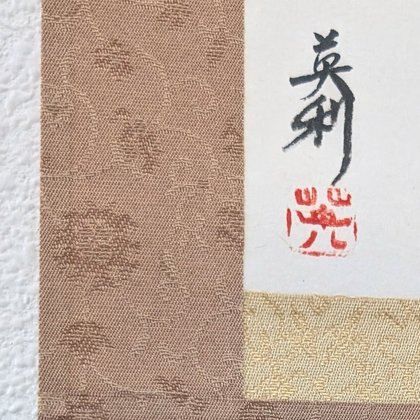


The scrolls are 12 1/4" W × 43" H (31 × 109 cm), with woven damask borders and layered Japanese paper, designed to last generations. The scrolls themselves are made by a scroll maker in Gifu, Japan, and we have worked with them for over two decades.
Eri Takase was born and raised in Osaka, Japan, and holds the rank of Shihan, the highest rank in Japanese calligraphy, from the Bokuteki-kai and the Bunka-shodo. About Master Takase


