



Jiun · 自運 · VD5J
Jiun (自運) is the calligrapher's word for writing from one's own invention. As a Shihan, Master Takase has a hand of her own, and these designs are that hand: she draws freely on the classic scripts to create exactly the look she wants.
放下著
hōgejaku
Put It Down
Put it down: a Zen command to let go of all attachment.
Master Takase creates this beautiful scroll when your order is placed, personally preparing the ink and brushing your art, which proudly bears her signature and seal. This is an original work of art.
Description
放下著 (hōgejaku): put it down, a Zen command to let go of all attachment.
In the phrase, 放 is to let go and 下 is down. Together, 放下 is to put down or throw away. 著 after the verb makes a command: put it down!
In the story the Chan books tell of the master Zhaozhou, a monk who brings not one thing asks what there is to put down. The answer is Carry it off. In some tellings the monk has an insight at these words.
The master Yuanwu Keqin wrote that the dharma eye picked out the monk's great sickness for him: his not one thing. Dahui Zonggao carried that reading into a sentence: put it down to where there is nothing left to put down, and do not accept even these words.
Other masters read 放下著 another way. Hongzhi Zhengjue, before telling the story, quotes an old saying: do not bring it, and if you have brought it, toss it out. In Japan, Musō Soseki, asked how it is when one brings not one thing, turned the question on the questioner: the moment there is an I, that is the karma of rebirth.
In a letter printed with Dahui's answer, the vice-minister Zeng writes that Yuanwu had set him two cases to work on. One of the two was Zhaozhou's put it down.
A sutra translated into Chinese in the third century tells of a Brahmin who brings the Buddha a flowering tree in each hand. Told to let go, he sets both down and asks what more there is to let go. The Buddha meant what is before, what is after and what is in between. Chan books of the twelfth century retell the sutra with 放下著 for its own word, 放捨.
Dōgen set Zhaozhou's story among the three hundred cases he collected in Chinese, whose preface he dated 1235. A collection of kōans used in Japanese Rinzai training, known from an edition of 1689, also has Zhaozhou's story as a case. Its translator, Thomas Kirchner, writes that Rinzai practitioners who advance in kōan work must, sooner or later, examine the collection.
The Zenrin kushū, the phrase book of Zen lines that Japanese calligraphers and tea men draw on, enters 放下著 in its print of 1688. John Stevens's Sacred Calligraphy of the East (1988) prints a brushed 放下著 from the Eisei Bunko, the Hosokawa family's collection, and places it among the works of Takuan Sōhō.
A collection on the way of tea of 1936 glosses 放下著 with 著 as a particle. Books on the Zen phrases and scrolls of the tea room, of 1994 and 1997, head entries with it. Fosco Maraini's Meeting with Japan (1959) tells of the phrase on a hanging in a restaurant pavilion's alcove, with nothing else there but a thistle flower.
In English, D. T. Suzuki gave the command in 1927 as Throw it away! In his Introduction to Zen Buddhism, whose preface is dated 1934, it is Fling it down to the ground, and he adds: even the idea of "having nothing" ought to be done away with. Thomas Cleary gave Put it down in 1988.
The answer the Chan books give to the Tang master Zhaozhou 趙州 when a monk asked what to do once he brought not one thing; the pair of question and answer is quoted, with no one named, in the Chinese 祖堂集 of 952, and the telling that names the monk Yanyang 嚴陽 and Zhaozhou is the oldest read in the record of Huanglong Huinan, who died in 1069.
We want you to be as happy with the meaning as you are with Master Takase's art. To learn more, visit Philology of 放下著.
Delivery
Your scroll is brushed when you order it and completed within 1 to 3 business days. It ships by USPS Priority Mail from Master Takase's studio in Washington State, boxed and ready to hang, with a printed page giving the art's English, romaji and Japanese.
Sending it as a gift? Add your message at checkout and we will include it.
Shipping is calculated at checkout from your address; within the United States it is $13 to $23. We ship worldwide, and any import charges for your country are shown at checkout before you pay.
Every order is covered by our 30-day money-back guarantee. If your scroll arrives damaged, or we made an error, we replace it or refund you in full, including shipping. Refund policy
About Our Scrolls
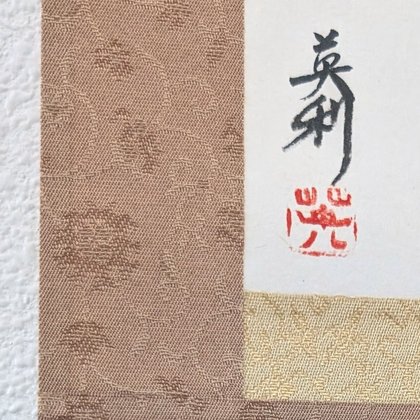
Master Japanese Calligrapher Eri Takase brushes your scroll by hand when you order it. Each scroll bears her red seal, 英利, and her signature.
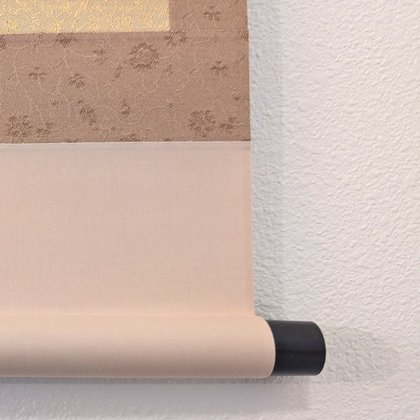
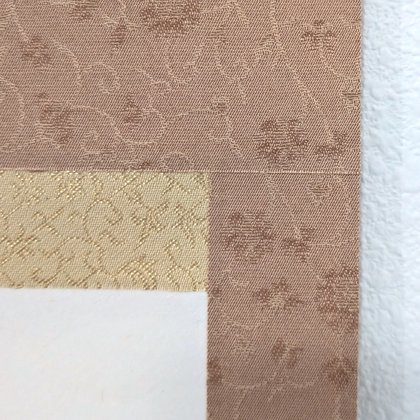
The scrolls are 12 1/4" W × 43" H (31 × 109 cm) with woven damask borders and Japanese paper that are layered so the scroll hangs straight and will not warp over time. The scrolls themselves are made by a scroll maker in Gifu, Japan, and we have worked with them for over two decades.
Eri Takase was born and raised in Osaka, Japan, and holds the rank of Shihan, the highest rank in Japanese calligraphy, from the Bokuteki-kai and the Bunka-shodo. About Master Takase


