





Semi-Cursive · gyōsho 行書 · VS5J
Semi-Cursive or gyōsho (行書) styles are a simplified and softer form of the kaisho styles. Gyōsho styles can be read by most Japanese.
明歴々露堂々
meirekireki rodōdō
Perfectly Clear, with Nothing Hidden
Perfectly clear and distinct, bare to view with nothing hidden: a Zen line for what is plain to see.
Master Takase creates this beautiful scroll when your order is placed, personally preparing the ink and brushing your art, which proudly bears her signature and seal. This is an original work of art.
Description
明歴々露堂々 (meirekireki rodōdō): perfectly clear and distinct, bare to view with nothing hidden.
In the line, 明歴々 is perfectly clear and distinct, 露 is bare and plain to see, and 堂々 is with nothing at all hidden. A reader of modern Japanese meets 堂々 as imposing, and 露 as a noun is dew, an autumn season word; neither is the line's sense.
A tea compendium of 1852, a Zen commentary of 1930 and a tea guide of 1936 read the line's 明 as mei, and so does Urasenke's own textbook of 1980. Sen Sōshitsu XV of Urasenke wrote in 1978 that the line must be read myōrekireki rodōdō for its sense as Zen teaching to come through. Arima Raitei also reads myō, in 1990.
The abbot Changling Shouzhuo set a hundred questions and answered each himself. To Where the lantern hangs on the pillar, say a line! he answered with the line. A monk asked Yuanwu Keqin: Clear and distinct, bare in full view: why can heaven and earth not hold it? Yuanwu answered: The eight-edged club in the vajra-bearer's hand.
A Ming master was asked: Clear and distinct, bare in full view: is there anything more? He answered: That is still making a living in the ghosts' cave. There must be a way clean through, he went on, before the light blazes. The lamp histories give this sermon to Shiche Tongcheng, and the recorded sayings of Chaozong Tongren print it as his. The witnesses do not settle whose it is.
Nanpo Shōmyō, known as Daiō, wrote a verse on his own likeness for the monk Sōi. After the line it goes on: nothing to grab it by, and yet it has its source; heaven and earth cannot hold it. Yuanwu's monk had asked why heaven and earth cannot hold it; Daiō's verse answers by saying so.
Kokan Shiren, his hand too palsied to write, had an attendant take down his last verse: Do not uncover my hands; do not uncover my feet. The body wholly manifest; the man like jade. The verse opens by refusing Zengzi's deathbed words in the Analects, uncover my feet, uncover my hands. Six years later to the day, at Kokan's memorial, Shōkai Reiken preached on that verse. He said of the body wholly manifest that it is clear and distinct, bare in full view.
Tettō Gikō of Daitokuji used the line three times in his recorded sayings, each time beside nowhere in the world is it hidden. Gokei Sōton said it in a winter-solstice sermon that speaks of snow covering a thousand mountains. He said it again over two lay people's pyres, as he lit them.
A compilation of commentaries on Su Shi's poems, dated by the dictionaries to 1534, explains his come home and sweep a room. One of its commentators says to sweep out the thoughts one by one until the mind is empty. In that empty mind, the commentary goes on, enlightenment sees in a flash that all is clear and distinct, bare in full view. A glossary of Zen words printed in 1657 glosses the line as known in a flash.
The Jesuits' dictionary of Japanese, printed at Nagasaki in 1603, enters 明歴々 alone as Mei reqireqi: a thing clear, or that appears manifestly. The entry carries none of the book's marks for words of poetry, of writing or of Buddhism.
A tea compendium of 1852 tells of Sōtoku of Sakai, who cooked his rice and boiled his tea water in one kettle. The monk Seigan wrote out Sōtoku's style name, 自在庵一釜斎, and gave it to him. The monk Kōsetsu, it says, gave him a one-line scroll of the line. A history of Sakai of 1930 names the giver as Kōgetsu Sōgan instead.
The tea records name one scroll of the line as the work of two men, Takuan Sōhō and Kōgetsu Sōgan. A magazine of 1944 describes such a scroll: Takuan signed the upper three characters, and two seals sit under the lower three. A tea book of 1975 gives the lower half to Kōgetsu. Lord Matsudaira of Unshū hung the scroll at a gathering in 1816, and by 1929 it had passed from the Unshū house to collectors. In 1951 one art magazine, writing of what buyers aim for, called it the king of one-line scrolls.
The tea master Hayami Sōtatsu named a book of his from the line in 1800, saying that the meaning of tea is perfectly plain. Just before, he asked what in tea, done with ordinary acts, could be hard even for simple men and women.
In an Othello set in Japan and published in 1893, a guest at a tea gathering admires a Kōgetsu of the line in the alcove. The printed reading beside the line gives 露 as dew. The tea master Sasaki Sanmi offered the line in 1960 for a moon-viewing gathering. The Daitokuji master Tachibana Daiki counted reading it as autumn among the even worse ways of taking it. Sen Sōshitsu XV wrote that in Zen its 露 is not read as dew, and Nishibe Bunjō found it amusing to pair with the moon.
In English, Zen Dust (1966) gives the lower half alone, 露堂堂, as Apparent; perfectly clear. Revealed! Sasaki Sanmi's tea almanac, in its English of 2002, gives Unmistakably clear and proudly seen for a moon-viewing gathering. Victor Sōgen Hori's Zen Sand (2003) gives Brilliant and fully present.
The pair is a Song Chan stock phrase with no single source, first known in the answers of the abbot Changling Shouzhuo, who died early in 1124 or 1125, and in a monk's question to Yuanwu Keqin on the evening he was ordered to Jinshan, in 1127 or a little after; in Japan it is first known in a verse Nanpo Shōmyō inscribed on his own portrait for a disciple, before 1309.
We want you to be as happy with the meaning as you are with Master Takase's art. To learn more, visit Philology of 明歴々露堂々.
Delivery
Your scroll is brushed when you order it and completed within 1 to 3 business days. It ships by USPS Priority Mail from Master Takase's studio in Washington State, boxed and ready to hang, with a printed page giving the art's English, romaji and Japanese.
Sending it as a gift? Add your message at checkout and we will include it.
Shipping is calculated at checkout from your address; within the United States it is $13 to $23. We ship worldwide, and any import charges for your country are shown at checkout before you pay.
Every order is covered by our 30-day money-back guarantee. If your scroll arrives damaged, or we made an error, we replace it or refund you in full, including shipping. Refund policy
About Our Scrolls
Master Japanese Calligrapher Eri Takase brushes your scroll by hand when you order it. Each scroll bears her red seal, 英利, and her signature.
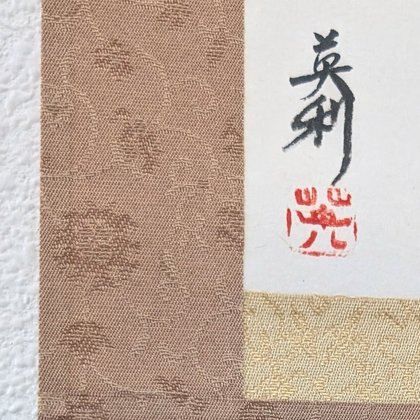


The scrolls are 12 1/4" W × 43" H (31 × 109 cm), with woven damask borders and layered Japanese paper, designed to last generations. The scrolls themselves are made by a scroll maker in Gifu, Japan, and we have worked with them for over two decades.
Eri Takase was born and raised in Osaka, Japan, and holds the rank of Shihan, the highest rank in Japanese calligraphy, from the Bokuteki-kai and the Bunka-shodo. About Master Takase


