





Jiun · 自運 · VD5J
Jiun (自運) is the calligrapher's word for writing from one's own invention. As a Shihan, Master Takase has a hand of her own, and these designs are that hand: she draws freely on the classic scripts to create exactly the look she wants.
一華開五葉
ikka goyō o hiraku
One Flower Opens Five Petals
One flower opens five petals: a line of a Zen verse on handing on the Dharma. Its five petals have been read many ways.
Master Takase creates this beautiful scroll when your order is placed, personally preparing the ink and brushing your art, which proudly bears her signature and seal. This is an original work of art.
Description
一華開五葉 (ikka goyō o hiraku): one flower opens five petals.
In the line, 一華 is a single flower and 五葉 is five leaves growing from one place. The dictionary also gives 五葉 a wider sense, a figure for five things divided from one source. 開 takes 五葉, the five petals, as its object, so the flower is what opens them. What the five are, the line does not say.
As the 景德傳燈錄 prints it, the whole verse runs: I came to this land to pass on the Dharma and save the deluded. One flower opens five petals, and the fruit forms of itself. Read aloud, 一華 is given three ways. A tea writer of 1981 reads ikka, a Zen handbook of 1911 ikke, and the dictionary heads it ichige.
In the Dunhuang Platform Sutra, the sixth patriarch Huineng recites the verse to show that the robe is not to be passed on after him. The frame invites a count of the petals as the five patriarchs after Bodhidharma. A different Dunhuang text has Huineng say: from Huike to me there are exactly five, Huike being Bodhidharma's heir.
The Yuan master Zhongfeng Mingben gathered five of his own writings and, in play, named them one flower, five petals. He meant to throw them into water or fire, and his followers answered with his own teaching: the one flower is illusion, and the five petals are illusion too.
In the dated Chinese texts read, the five-houses reading of the petals begins with a stupa inscription for a master who died in 1381. In his anthology of Chan sayings, prefaced in 1733, the Yongzheng emperor called that reading a gloss that later ages fastened on the verse.
Dōgen wrote in 1243: the layering of the one flower is the five petals; the opening of the five petals is the one flower. Of those who counted the petals as five generations, he asked: after the Sixth Patriarch, is nothing said?
The Southern Song master Wuzhun Shifan wrote of one flower, five petals, open fragrant of themselves. His disciple Mugaku Sogen, who came to Japan in 1279, took the line and added: the rain has passed, and in Fusō the color shines brighter. Fusō is Japan. Rankei Dōryū, on a painting of Bodhidharma, wrote that the flower's fragrance passed to Japan.
At Shōfukuji, a monk told the Japanese master Gokū Keinen that the line was a prophecy of the school's later division into five houses. Gokū answered that it was the last whole word of Bodhidharma, the founder of the school. The Chinese master Gottan Funei then wrote the verse anew, saying there was no Dharma to pass on.
The war chronicle 太平記 carries a petition dated 1345 by the monks of Mount Hiei. The petition sets the four flowers of their Tendai peak against Zen's five petals, which have become monasteries.
The imperial anthology 風雅和歌集, compiled about 1349, sets a court poem by Eifukumon'in no Naishi under the verse's two closing lines. In the poem, autumn is already known in the spring look of one cherry tree just coming into flower.
Ōsen Keisan gave a disciple the name Ichige, as an English catalogue writes it. Gesshū Jukei wrote an essay titled 一華說 that quotes the verse and says a flower with no fruit is a wild flower. Of a flower with both flower and fruit, he asks: is it not the plum?
The records of one-line scrolls by Japanese hands put 開 last, 一華五葉開, as the Zen phrase book of 1688 does. The Ōbaku master Mokuan Shōtō, born in China, is recalled in a book of 1904 as writing 一華開五葉. That is the order the Chinese records give the verse, and the order of this scroll.
A Zen handbook of 1911 lists 一華開五葉結果自然成 under 退禮, after the questions headed 進問, in the exchange at a new abbot's entry into his temple.
Joseph Edkins, in 1880, made Bodhidharma the stem on which the others grew. Philip Yampolsky in 1967 gave One flower opens five petals, / And the fruit ripens of itself, and noted two readings: the five patriarchs after Bodhidharma, and the five branches of Chan. Kazuaki Tanahashi's note of 1985 leads with the houses: Usually interpreted as Bodhidharma's teaching which was divided into the teachings of the Five Schools of Chinese Zen.
The line is the third of a four-line verse that the Chan records put in Bodhidharma's mouth as he hands on the Dharma; its oldest witness read is the 寶林傳, a Tang book listed in a Japanese monk's catalogue of 838, some three centuries after the master it quotes.
We want you to be as happy with the meaning as you are with Master Takase's art. To learn more, visit Philology of 一華開五葉.
Delivery
Your scroll is brushed when you order it and completed within 1 to 3 business days. It ships by USPS Priority Mail from Master Takase's studio in Washington State, boxed and ready to hang, with a printed page giving the art's English, romaji and Japanese.
Sending it as a gift? Add your message at checkout and we will include it.
Shipping is calculated at checkout from your address; within the United States it is $13 to $23. We ship worldwide, and any import charges for your country are shown at checkout before you pay.
Every order is covered by our 30-day money-back guarantee. If your scroll arrives damaged, or we made an error, we replace it or refund you in full, including shipping. Refund policy
About Our Scrolls
Master Japanese Calligrapher Eri Takase brushes your scroll by hand when you order it. Each scroll bears her red seal, 英利, and her signature.
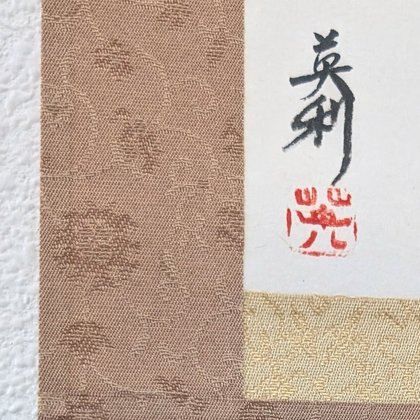


The scrolls are 12 1/4" W × 43" H (31 × 109 cm), with woven damask borders and layered Japanese paper, designed to last generations. The scrolls themselves are made by a scroll maker in Gifu, Japan, and we have worked with them for over two decades.
Eri Takase was born and raised in Osaka, Japan, and holds the rank of Shihan, the highest rank in Japanese calligraphy, from the Bokuteki-kai and the Bunka-shodo. About Master Takase


