


Font Design · VD5J
Font Designs are Master Takase's unique designs. Often she will use her own style or a combination of fonts and, without a classification limit, create exactly the look she wants.
行雲流水
kōun ryūsui
Moving Clouds, Flowing Water
Acting without clinging to anything, calmly leaving things to their natural course, like moving clouds and flowing water.
Master Takase creates this beautiful scroll when your order is placed. Personally preparing the ink and brushing your art that proudly bears her signature and seal. This is an original work of art.
Description
行雲流水 (kōun ryūsui): acting without clinging to anything, calmly leaving things to their natural course, like the clouds that cross the sky and the water that flows.
Neither the cloud nor the water has a shape of its own, and neither stays, yet both keep moving. The phrase is an ease in motion. The デジタル大辞泉 gives as its example a life of moving clouds and flowing water.
A farewell message from a retiring teacher is titled 行雲流水. The novelist Hashimoto Osamu called his magazine column 行雲流水録, and its last installment, in 2013, was titled thinking a little about retiring.
Before 1128 the monk and poet Huihong wrote that a brushed sheet had the ease of moving clouds and flowing water. He had lain more than a month with a fever; he looked at the sheet, and felt the fever leave without a word of farewell.
Seida Tansō's inscription for a memorial stone to Bashō at 金福寺 in Kyoto, written between 1765 and 1785, includes the line moving cloud and flowing water, ten summers and three frosts. Here the words name a poet's life on the road. Yanagawa Seigan's lines for his nephew, printed in 1863, make the phrase a rule for living: the hundred affairs of a human life are like moving clouds and flowing water. Be at ease wherever you find yourself.
In Natsume Sōseki's 吾輩は猫である, Meitei tells a schoolteacher's wife that a literary magazine said her husband's writing was like moving clouds and flowing water. He adds that it went on: just when you think it has come out it vanishes, and once gone it forgets ever to come back. She asks whether that was praise.
The image is Su Shi's, in a letter of 1100 praising the prose of an official, Xie Minshi, as moving clouds and flowing water, without fixed form, going where it ought and stopping where it must; the official history of the Song, completed in 1345, recast the sentence as Su Shi's description of his own writing, which is the form in which it has been quoted since.
We want you to be as happy with the meaning as you are with Master Takase's art. To learn more, visit Philology of 行雲流水.
Delivery
Your scroll is brushed when you order it and completed within 1 to 3 business days. It ships by USPS Priority Mail from Master Takase's studio in Washington State, boxed and ready to hang, with a printed page giving the art's English, romaji and Japanese.
Sending it as a gift? Add your message at checkout and we will include it.
Shipping is calculated at checkout from your address; within the United States it is $13 to $23. We ship worldwide, and any import charges for your country are shown at checkout before you pay.
Every order is covered by our 30-day money-back guarantee. If your scroll arrives damaged, or we made an error, we replace it or refund you in full, including shipping. Refund policy
About Our Scrolls
Master Japanese Calligrapher Eri Takase brushes your scroll by hand when you order it. Each scroll bears her red seal, 英利, and her signature.
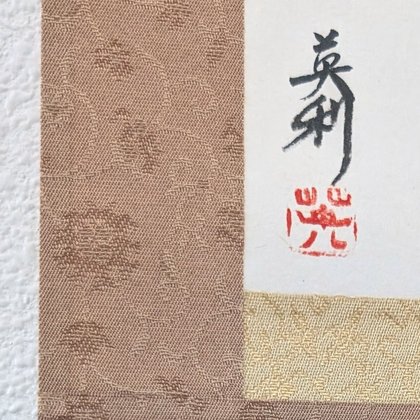
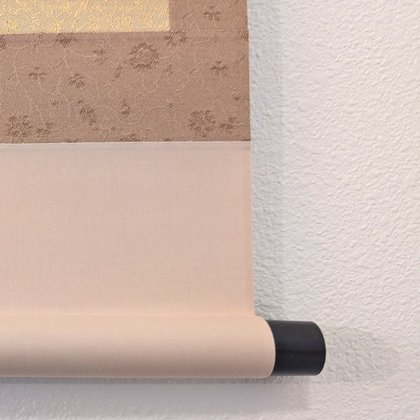
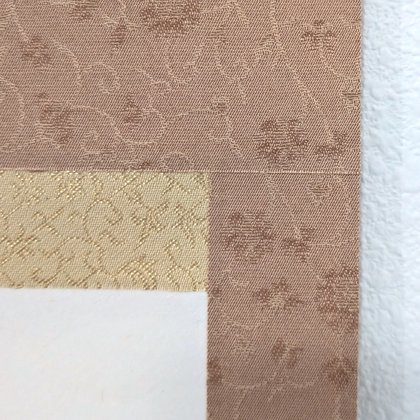
The scrolls are 12 1/4" W × 43" H (31 × 109 cm) with woven damask borders and Japanese paper that are layered so the scroll hangs straight and will not warp over time. The scrolls themselves are made by a scroll maker in Gifu, Japan, and we have worked with them for over two decades.
Eri Takase was born and raised in Osaka, Japan, and holds the rank of Shihan, the highest rank in Japanese calligraphy, from the Bokuteki-kai and the Bunka-shodo. About Master Takase


