




Cursive · sōsho 草書 · VC5J
Cursive or sōsho (草書) styles are the most simplified styles and Master Takase's favorite. While very beautiful, these styles are often difficult to read even by specialists.
山是山水是水
yama wa kore yama, mizu wa kore mizu
Mountains Are Mountains, Waters Are Waters
Mountains are mountains, waters are waters: a Zen line, famous through Qingyuan Weixin's three stages.
Hand-brushed by Master Eri Takase
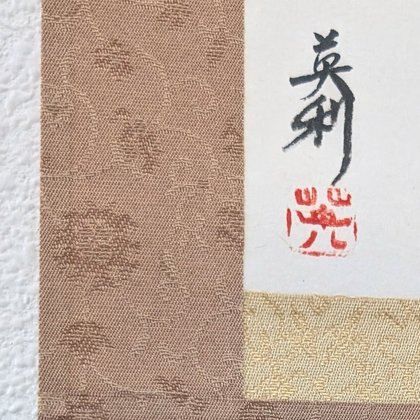
Master Japanese Calligrapher Eri Takase brushes your scroll by hand when you order it. Each scroll bears her red seal, 英利, and her signature.
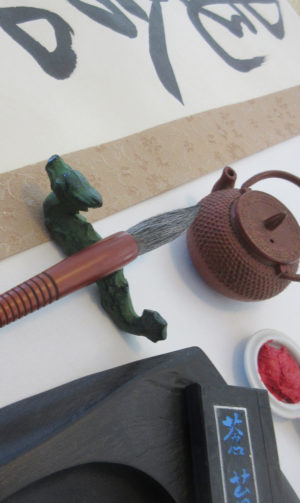
Eri Takase was born and raised in Osaka, Japan, and holds the rank of Shihan, the highest rank in Japanese calligraphy, from the Bokuteki-kai and the Bunka-shodo.
12 1/4" × 43" Japanese Scroll
The scrolls are 12 1/4" W × 43" H (31 × 109 cm), with woven damask borders and layered Japanese paper (washi), designed to last generations. The scrolls themselves are made by a scroll maker in Gifu, Japan, and we have worked with them for over two decades.


Ships in 1-3 days from Washington State
Your scroll is brushed when you order it and completed within 1 to 3 business days.
Your scroll ships from Master Takase's studio in Washington State. Shipping is calculated at checkout. We ship worldwide.
Includes detailed explanation, gift-ready
Your scroll arrives boxed, with a printed insert describing the words in detail.
Sending it as a gift? Add your message at checkout and we will include it with the insert.
30-day money-back guarantee
Every order is covered by our 30-day money-back guarantee. If your scroll arrives damaged, or we made an error, we replace it or refund you in full, including shipping.
Explanation
山 is a mountain and 水 water, in Chinese also a river; 是 is is. Kyoto prints of 1632 and 1635 cut the particle wa into the woodblock, after the 山 and the 水 that open each half. Victor Sogen Hori's English phrase book gives rivers are rivers.
In Yunmen's sermon the line stands beside sky is sky, earth is earth and monks are monks, laymen are laymen. He says mountains are mountains, waters are waters, falls silent, and asks for the hill he calls 案山 to be brought to him.
Qingyuan Weixin tells three views. Thirty years ago he saw mountains as mountains, and after meeting a teacher, as not mountains. Now, at rest, he sees them as before, as nothing but mountains. He asks whether the three views are the same or different.
The 宗門武庫, a Song book of 1186, carries a warning against those who stop at the line. In it the master Zhenjing lists the sky is the sky … mountains are mountains … monks are monks and calls all of it clinging to grass and leaning on trees.
Dōgen dated his essay on mountains and waters, the 山水経, 1240, and took the line as its text. In the English of Arnold Kotler and Kazuaki Tanahashi he writes: These words do not mean mountains are mountains; they mean mountains are mountains. In two manuscript copies, the reading his sentence sets aside is written in kana, yama kore yama, without wa; English cannot carry it.
In the Japanese Zen records read for this history, masters of the thirteenth and fourteenth centuries preach it, Nanpo Shōmyō the three stages whole. In the recorded sayings of Mugaku Sogen, a disciple who says he now sees mountains as mountains is told he has not yet seen the Way.
The Zen phrase book 句雙紙, in its print of 1651, opens its six-character phrases with the line. A handbook of 1936 gives it among the phrases hung in the tea room.
In English the three stages are in print by 1927, in D. T. Suzuki's words: Before a man studies Zen, to him mountains are mountains and waters are waters.
The six characters are a stock statement of the Chinese Chan sermons, read in a sermon of Yunmen (864–949) printed with a preface of 1076 and in the sayings of Huangbo; the three stages they are famous for, mountains, then no mountains, then mountains again, are a later master's, Qingyuan Weixin's, first read in a lamp history of the early 1200s.
Learn More About These Words
We want you to be as happy with the meaning as you are with Master Takase's art. To learn more, visit Philology of 山是山水是水.


