



Font Design · VD5J
Font Designs are Master Takase's unique designs. Often she will use her own style or a combination of fonts and, without a classification limit, create exactly the look she wants.
喫茶去 kissako Have Some Tea
Do have some tea: words of the Zen master Zhaozhou that express that the everyday act of drinking tea is the Buddha's teaching itself.
Master Takase creates this beautiful scroll when your order is placed. Personally preparing the ink and brushing your art that proudly bears her signature and seal. This is an original work of art.
Description
喫茶去 (kissako): do have some tea, words of the Zen master Zhaozhou that express that the everyday act of drinking tea is the Buddha's teaching itself.
Iriya Yoshitaka, a scholar of the Zen records, noted that the words are often seen hanging in tea rooms, usually taken to mean well, have a cup of tea. He read them otherwise, as a rebuke: go to the tea hall over there, drink your tea and come back again. The gentle reading, he wrote, confuses the words with sit a while and have tea, and Japan has handed that reading down from long ago. Whether you take the words as a welcome or as a send-off is yours.
The Zen master Dōgen wrote the story of Zhaozhou's 喫茶去 into his Shōbōgenzō, in a chapter titled Everyday, dated 1243. He closed his comment on it: so the everyday of the buddhas and patriarchs is only drinking tea and eating rice. Nanpo Shōmyō, asked by a monk where Zhaozhou's meaning lies in telling both alike to drink tea, answered: only the one who drinks it knows.
The monk Baisaō, who sold tea in Kyoto, wrote in a verse, as Norman Waddell translates it: I emulate old Chao-chou / "Have a cup of tea!" A tea book of 1852 begins the Zen lineage of tea from Zhaozhou's 喫茶去.
A legend in print by 1898 has the Zen monk Ikkyū smash the tea bowl of Jukō, the tea ceremony's founder. In a telling of 1902, Ikkyū does it as Jukō raises the bowl to drink. As Jukō leaves, Ikkyū asks him about 喫茶去, and Jukō answers: the true face of the green willow and the red flower.
D. T. Suzuki rendered the words Have a cup of tea in 1934. Miura and Sasaki's book of Zen phrases of 1965 gives Kissako! Go drink your tea!
Ordinary speech in the Chinese Zen monasteries of the ninth and tenth centuries, made 趙州's (778–897, as 衣川賢次 gives them) by a story: the oldest telling found for this history, in the 祖堂集 of 952, has him say it to three monks; by the time 汾陽善昭's record was compiled, before 1040, the third is the temple steward, and the 五燈會元 of 1252 fixed the form most often quoted.
We want you to be as happy with the meaning as you are with Master Takase's art. To learn more, visit Philology of 喫茶去.
Delivery
Your scroll is brushed when you order it and completed within 1 to 3 business days. It ships by USPS Priority Mail from Master Takase's studio in Washington State, boxed and ready to hang, with a printed page giving the art's English, romaji and Japanese.
Sending it as a gift? Add your message at checkout and we will include it.
Shipping is calculated at checkout from your address; within the United States it is $13 to $23. We ship worldwide, and any import charges for your country are shown at checkout before you pay.
Every order is covered by our 30-day money-back guarantee. If your scroll arrives damaged, or we made an error, we replace it or refund you in full, including shipping. Refund policy
About Our Scrolls
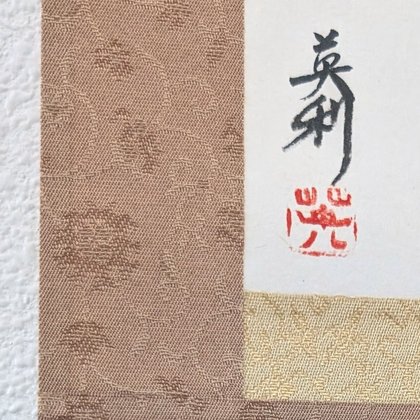
Master Japanese Calligrapher Eri Takase brushes your scroll by hand when you order it. Each scroll bears her red seal, 英利, and her signature.
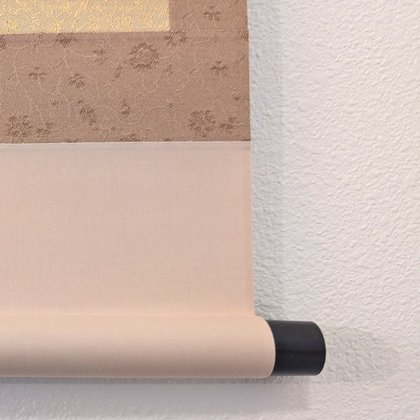
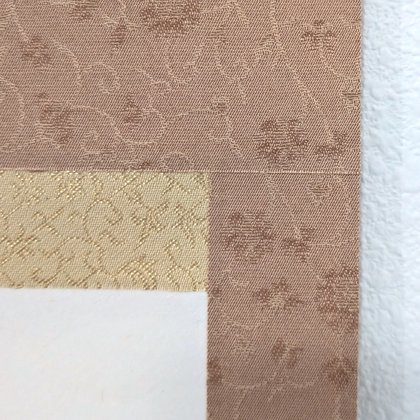
The scrolls are 12 1/4" W × 43" H (31 × 109 cm) with woven damask borders and Japanese paper that are layered so the scroll hangs straight and will not warp over time. The scrolls themselves are made by a scroll maker in Gifu, Japan, and we have worked with them for over two decades.
Eri Takase was born and raised in Osaka, Japan, and holds the rank of Shihan, the highest rank in Japanese calligraphy, from the Bokuteki-kai and the Bunka-shodo. About Master Takase


