





Jiun · 自運 · VD5J
Jiun (自運) is the calligrapher's word for writing from one's own invention. As a Shihan, Master Takase has a hand of her own, and these designs are that hand: she draws freely on the classic scripts to create exactly the look she wants.
一日不作一日不食
ichijitsu nasazareba ichijitsu kurawazu
A Day Without Work Is a Day Without Food
A day without work is a day without food, a saying on the worth of work.
Master Takase creates this beautiful scroll when your order is placed, personally preparing the ink and brushing your art, which proudly bears her signature and seal. This is an original work of art.
Description
一日不作一日不食 (ichijitsu nasazareba ichijitsu kurawazu): a day without work is a day without food, a saying on the worth of work.
In the line, 一日 is one day, 作 is to work, 食 is to eat, and 不 negates each verb. Word for word: a day not worked, a day not eaten. The Chinese names no person and gives no command, so I do not eat, one does not eat and one shall not eat are all readings of the same eight characters.
The Japan Kanji Aptitude Testing Foundation's dictionary heads the line in its Japanese reading, 一日作さざれば一日食らわず. The entry defines the line as not eating on a day on which one has not worked, words that teach the importance of work. In print, 一日 is read ichijitsu, as in the dictionaries, and in books for readers ichinichi as well.
In the Zutang ji, a Chan history, the Tang master Baizhang Huaihai is always ahead of the community at the daily labor. The steward cannot bear it, hides the tools and asks the master to rest. Baizhang says, I have no virtue; how could I let others labor for me? He searches for the tools, and, not finding them, forgets his meal.
Other tellings end the story otherwise. In the Tiansheng guangdeng lu of 1036, the community hides the tools and Baizhang does not eat. In a sermon of the Song master Xutang Zhiyu, who died in 1269, Baizhang is ninety-five, stops eating and dies. Ikkyū Sōjun taught that ending in Japan, and in 1454 named Xutang's record as his source.
In the Shōbōgenzō, Dōgen writes that Baizhang did not eat that day, and reads the fast as regret at not joining the community's work. Kazuaki Tanahashi's English translation of 2010 keeps that reading.
The Shiji, finished about 91 BCE, holds an older proverb of the same shape. At ploughing time, the minister Da Wuwu seizes the bridle of the horse of the marquis Su of Zhao: The ploughing is pressing: a day without work, a hundred days without food. The marquis gets down from his carriage and apologizes.
A Yuan monastery code of 1311, nearly five centuries after Baizhang's death, sets the line before the officer for buildings and works: let him think on it. In 1317 Zhongfeng Mingben's rules for his hermitages lay the line on a whole community. A code compiled by imperial order, finished in 1338, calls the monks to the communal work, excusing the old, the sick and those on duty. Those who attend are told to think of the line.
In 1922, D. T. Suzuki rendered the line No work, no eating and set Paul's If any would not work, neither should he eat beside it in a footnote. The next year the German theologian Rudolf Otto, citing Suzuki, called Paul's sentence itself the motto of Hyakujō, Baizhang's name in Japanese. Paul's sentence is a pairing with the line, not its origin.
A Japanese encyclopedia today says that Baizhang, by tradition, made the words an admonition to himself. A note of 2009 on the Buddhist view of labor calls the words a state of mind one holds within oneself. An essayist of 2013 contrasts them with he who does not work shall not eat: the one who so resolves, the essay says, is oneself and no other.
In English, Paul Reps tells the story in Zen Flesh, Zen Bones (1957) under the title No Work, No Food. The Princeton Dictionary of Buddhism (2014) gives the line as a day without work is a day without food, and says the maxim is attributed to Baizhang.
Who first said the eight characters is not known: the earliest Chan account, of 952, gives them not as Baizhang Huaihai's words but as a saying that arose from his fast on the day his tools were hidden, and a Chinese scholar of about 1200 heard the same words as a common proverb whose source he found in a farmer's saying in the Shiji.
We want you to be as happy with the meaning as you are with Master Takase's art. To learn more, visit Philology of 一日不作一日不食.
Delivery
Your scroll is brushed when you order it and completed within 1 to 3 business days. It ships by USPS Priority Mail from Master Takase's studio in Washington State, boxed and ready to hang, with a printed page giving the art's English, romaji and Japanese.
Sending it as a gift? Add your message at checkout and we will include it.
Shipping is calculated at checkout from your address; within the United States it is $13 to $23. We ship worldwide, and any import charges for your country are shown at checkout before you pay.
Every order is covered by our 30-day money-back guarantee. If your scroll arrives damaged, or we made an error, we replace it or refund you in full, including shipping. Refund policy
About Our Scrolls
Master Japanese Calligrapher Eri Takase brushes your scroll by hand when you order it. Each scroll bears her red seal, 英利, and her signature.
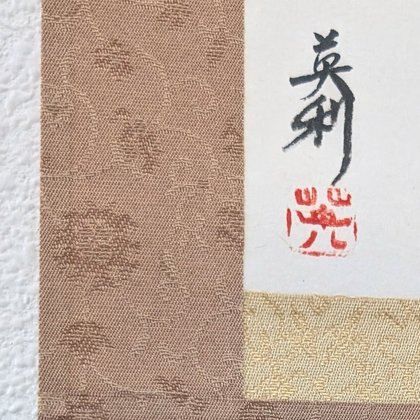


The scrolls are 12 1/4" W × 43" H (31 × 109 cm), with woven damask borders and layered Japanese paper, designed to last generations. The scrolls themselves are made by a scroll maker in Gifu, Japan, and we have worked with them for over two decades.
Eri Takase was born and raised in Osaka, Japan, and holds the rank of Shihan, the highest rank in Japanese calligraphy, from the Bokuteki-kai and the Bunka-shodo. About Master Takase


