




Cursive · sōsho 草書 · VC5J
Cursive or sōsho (草書) styles are the most simplified styles and Master Takase's favorite. While very beautiful, these styles are often difficult to read even by specialists.
久方の光のどけき春の日に
しづ心なく花の散るらむ
hisakata no hikari nodokeki haru no hi ni
shizugokoro naku hana no chiruramu
On a calm spring day of gentle light,
Why do the blossoms fall so restlessly?
A waka of the falling cherry blossoms by Ki no Tomonori: on a calm spring day of gentle light, why do the blossoms fall so restlessly?
Hand-brushed by Master Eri Takase
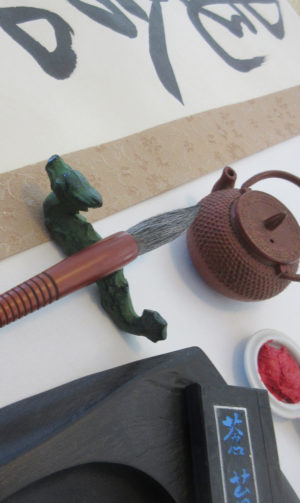
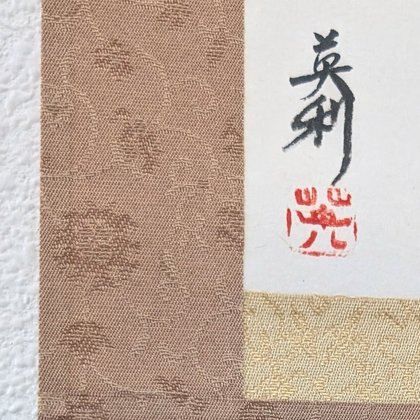
Master Japanese Calligrapher Eri Takase brushes your scroll by hand when you order it. Each scroll bears her red seal, 英利, and her signature.
Eri Takase was born and raised in Osaka, Japan, and holds the rank of Shihan, the highest rank in Japanese calligraphy, from the Bokuteki-kai and the Bunka-shodo.
12 1/4" × 43" Japanese Scroll
The scrolls are 12 1/4" W × 43" H (31 × 109 cm), with woven damask borders and layered Japanese paper (washi), designed to last generations. The scrolls themselves are made by a scroll maker in Gifu, Japan, and we have worked with them for over two decades.


Ships in 1-3 days from Washington State
Your scroll is brushed when you order it and completed within 1 to 3 business days.
Your scroll ships by USPS Priority Mail from Master Takase's studio in Washington State. Shipping is calculated at checkout. We ship worldwide.
Includes detailed explanation, gift-ready
Your scroll arrives boxed, with a printed insert describing the waka in detail.
Sending it as a gift? Add your message at checkout and we will include it with the insert.
30-day money-back guarantee
Every order is covered by our 30-day money-back guarantee. If your scroll arrives damaged, or we made an error, we replace it or refund you in full, including shipping.
Explanation
久方の光のどけき春の日にしづ心なく花の散るらむ (hisakata no hikari nodokeki haru no hi ni shizugokoro naku hana no chiruramu): a waka of the falling cherry blossoms. On a calm spring day of gentle light, why do the blossoms fall so restlessly?
久方の is a pillow word, 枕詞, whose meaning and attachment the 日本国語大辞典 calls unknown. The dictionary quotes this poem under a sense that attaches it to the sun and to light. のどけき is weather that is fine, still and mild, a season word of spring in the same dictionary. しづ心 is a quiet, settled heart. 花 is the cherry, by the poem's heading in the Kokinshū.
In the Kokinshū the poem is number 84, in the second book, the poems of late spring. Tomonori's dates are not known. The 世界大百科事典 gives the same, and still says he did not see the editing through, and died about 907.
The poem's last word, らむ, holds no word for why. The 日本国語大辞典 names this very poem where it says the sense of that らむ cannot be settled. The commentaries we have read, among them a print of 1662 and Kageki's of 1823, read a why into the poem. A commentary on the Hundred Poets, printed in 1662, calls reading the poem with the word why supplied the oral teaching.
Kagawa Kageki's commentary of 1823 begins from the scene: amid such stillness, the blossoms alone are hurried and never at rest. In a poem whose two halves turn like this, he wrote, the doubt is held within it, and does not depend on its particles.
The same 1662 commentary tells that someone asked Lord Tameie whether this unquiet heart was the person's or the blossoms'. He answered that either would serve. Our title gives it to the blossoms, one of the two answers he allowed.
しづ心 is read two ways. The romaji above voices it, shizugokoro, as the 日本国語大辞典 and JMdict head it, and as Kageki argued it should be sung. He also reports that in his day it was read unvoiced, shizu kokoro. デジタル大辞泉 heads it that way, and Donald Keene gives it so.
Helen Craig McCullough's rendering of 1985 reads: On this springtime day / when the celestial orb / diffuses mild light, / why should the cherry blossoms / scatter with unquiet hearts? Her celestial orb takes 久方 as the sun, a view デジタル大辞泉 records. Clay MacCauley's version of 1899 ends: Why, with ceaseless, restless haste / Falls the cherry's new-blown bloom?
Donald Keene observes that, in his romaji of the poem, four of the five lines begin with h, and the fifth with sh.
Whether you take the unquiet heart as the blossoms' or as the person's is yours.
Ki no Tomonori, one of the compilers of the Kokinshū (905–914), which gives him the poem under the heading composed on the cherry blossoms falling; the thirty-third poem of the Hyakunin isshu.
Learn More About This Waka
We want you to be as happy with the meaning as you are with Master Takase's art. To learn more, visit Philology of 久方の光のどけき春の日にしづ心なく花の散るらむ.
Related products

Issa - This dewdrop world, is a dewdrop world, and yet露の世は露の世ながらさりながら tsuyu no yo wa tsuyu no yo nagara sari nagara

Issa - Snail, ever so slowly climb, Mt Fuji蝸牛そろそろ登れ富士の山 katatsuburi sorosoro nobore fuji no yama

Bashō - How admirable, to see lightning, and not think life is fleeting稲妻にさとらぬ人の貴さよ inazuma ni satoranu hito no tattosa yo
