




Block · kaisho 楷書 · VB5J
Block or kaisho (楷書) styles are the most common and recognizable styles. Block styles are easily read and are noted for their angular form and their vertical and horizontal lines.
願はくは花の下にて春死なむ
その如月の望月のころ
negawaku wa hana no shita nite haru shinamu
sono kisaragi no mochizuki no koro
Let me die in spring, under the blossoms,
at the full moon of the second month
Saigyō's waka of a wish: to die in spring, under the blossoms, at the full moon of the second month.
Hand-brushed by Master Eri Takase
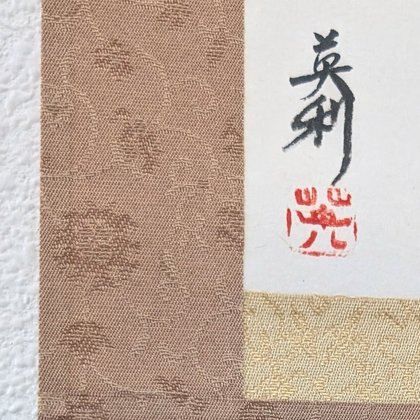
Master Japanese Calligrapher Eri Takase brushes your scroll by hand when you order it. Each scroll bears her red seal, 英利, and her signature.
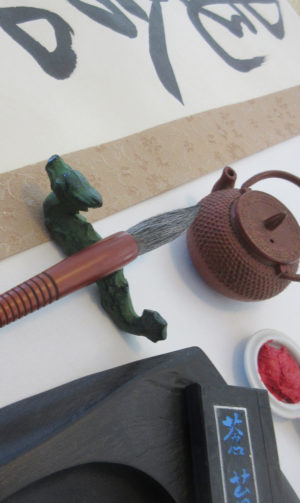
Eri Takase was born and raised in Osaka, Japan, and holds the rank of Shihan, the highest rank in Japanese calligraphy, from the Bokuteki-kai and the Bunka-shodo.
12 1/4" × 43" Japanese Scroll
The scrolls are 12 1/4" W × 43" H (31 × 109 cm), with woven damask borders and layered Japanese paper (washi), designed to last generations. The scrolls themselves are made by a scroll maker in Gifu, Japan, and we have worked with them for over two decades.


Ships in 1-3 days from Washington State
Your scroll is brushed when you order it and completed within 1 to 3 business days.
Your scroll ships from Master Takase's studio in Washington State. Shipping is calculated at checkout. We ship worldwide.
Includes detailed explanation, gift-ready
Your scroll arrives boxed, with a printed insert describing the waka in detail.
Sending it as a gift? Add your message at checkout and we will include it with the insert.
30-day money-back guarantee
Every order is covered by our 30-day money-back guarantee. If your scroll arrives damaged, or we made an error, we replace it or refund you in full, including shipping.
Explanation
Word for word: 願はくは, what I wish is; 花の下にて, under the blossoms; 春死なむ, let me die in spring; その如月の望月のころ, around that full moon of the second month.
The 日本国語大辞典 gives 花の下 as under a tree in bloom, the blossoms' shade, a season word for spring. Of the readings read for the poem's history, all but one that name the tree take the blossoms as cherry.
如月 is the second month of the old lunar calendar, about March by the solar one. 望月 is the moon of the fifteenth night, the full moon.
The fifteenth of the second month is the day the Buddha's passing is kept, the service called 涅槃会 (nehan-e). The poem does not name the Buddha: the date does.
Fujiwara no Shunzei, judging the poem, found its form not beautiful. Yet in this kind, he said, the upper and lower halves agree and it sounds very fine. He judged the round a draw.
Saigyō died on the sixteenth of the second month, at the mountain temple of Hirokawa. Fujiwara no Teika noted that the sixteenth was that year's full-moon day. Shunzei wrote that Saigyō's death on that day moved him as a rare thing.
A collection of tales of 1254 tells Saigyō's death more neatly, with the fifteenth, the Buddha's own day. Shunzei, Jien and Teika, who wrote of the death, give the sixteenth.
It has been called his death poem, the famous death poem in a dictionary of 1922. Yet it was already a finished poem when Shunzei judged it, about three years before Saigyō died.
The house reads 下 as shita. Among the copies of Saigyō's collections that write the word out in kana, all but one read shita, as the 1982 edition transcribes them. Saigyō's poem-match as printed, Shunzei, and the monk Jien as an Edo encyclopedia quotes him read moto. Both readings are old, and the character 下 leaves the reading open.
In 1684 Bashō closed a sequence of linked verse with on that full-moon day, I too, the same, and Kōda Rohan, in 1924, glosses the link with this poem.
The poem was taken into the imperial anthology Shokukokin wakashū of 1265.
Saigyō 西行 (1118–1190), monk and poet; the poem stands in his collections of his own verse and in his own poem-match 『御裳濯河歌合』, judged by Fujiwara no Shunzei about 1187.
Learn More About This Waka
We want you to be as happy with the meaning as you are with Master Takase's art. To learn more, visit Philology of 願はくは花の下にて春死なむその如月の望月のころ.
Related products

Issa - This dewdrop world, is a dewdrop world, and yet露の世は露の世ながらさりながら tsuyu no yo wa tsuyu no yo nagara sari nagara

Issa - Snail, ever so slowly climb, Mt Fuji蝸牛そろそろ登れ富士の山 katatsuburi sorosoro nobore fuji no yama

Bashō - How admirable, to see lightning, and not think life is fleeting稲妻にさとらぬ人の貴さよ inazuma ni satoranu hito no tattosa yo
