




Cursive · sōsho 草書 · VC5J
Cursive or sōsho (草書) styles are the most simplified styles and Master Takase's favorite. While very beautiful, these styles are often difficult to read even by specialists.
天の原ふりさけ見れば春日なる
三笠の山に出でし月かも
ama no hara furisake mireba kasuga naru
mikasa no yama ni ideshi tsuki kamo
Looking up far across the sky,
The moon that rose over Mount Mikasa at Kasuga
A waka of the moon attributed to Abe no Nakamaro: looking up far across the sky, the moon that rose over Mount Mikasa at Kasuga.
Hand-brushed by Master Eri Takase
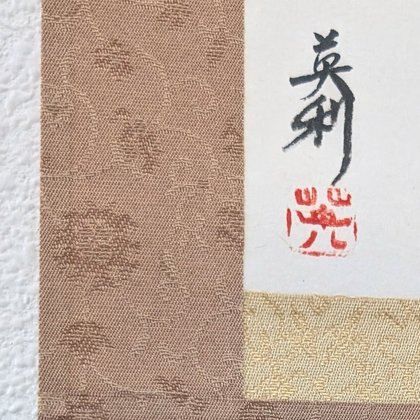
Master Japanese Calligrapher Eri Takase brushes your scroll by hand when you order it. Each scroll bears her red seal, 英利, and her signature.
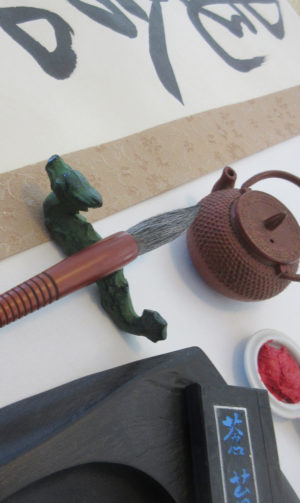
Eri Takase was born and raised in Osaka, Japan, and holds the rank of Shihan, the highest rank in Japanese calligraphy, from the Bokuteki-kai and the Bunka-shodo.
12 1/4" × 43" Japanese Scroll
The scrolls are 12 1/4" W × 43" H (31 × 109 cm), with woven damask borders and layered Japanese paper (washi), designed to last generations. The scrolls themselves are made by a scroll maker in Gifu, Japan, and we have worked with them for over two decades.


Ships in 1-3 days from Washington State
Your scroll is brushed when you order it and completed within 1 to 3 business days.
Your scroll ships by USPS Priority Mail from Master Takase's studio in Washington State. Shipping is calculated at checkout. We ship worldwide.
Includes detailed explanation, gift-ready
Your scroll arrives boxed, with a printed insert describing the waka in detail.
Sending it as a gift? Add your message at checkout and we will include it with the insert.
30-day money-back guarantee
Every order is covered by our 30-day money-back guarantee. If your scroll arrives damaged, or we made an error, we replace it or refund you in full, including shipping.
Explanation
天の原ふりさけ見れば春日なる三笠の山に出でし月かも (ama no hara furisake mireba kasuga naru mikasa no yama ni ideshi tsuki kamo): a waka of the moon attributed to Abe no Nakamaro, looking up far across the sky to the moon that rose over Mount Mikasa at Kasuga.
天の原 is the wide expanse of the sky in デジタル大辞泉, and the sky or the heavens in JMdict; its words are, literally, the plain of heaven. ふりさけ見る is to look up far into the distance, and the 日本国語大辞典 quotes this poem for it. Mount Mikasa stands in the east of Nara city, behind Nara Park, with the Kasuga Shrine at its foot. In 出でし, the moon that rose, the past form き marks what the speaker saw or heard directly, in the 日本国語大辞典's definition.
The Kokinshū, ordered by imperial command, opens its book of travel poems with this waka. The poem stands under the heading composed on seeing the moon in China and the name of Abe no Nakamaro.
A note under the poem in the Kokinshū tells that Nakamaro, sent to China to study, could not come home for many years. In the note, when envoys went there again from Japan, he set out home with them. The people of that country gave him a farewell on the shore at a place the note calls Meishū. The note says that when night came he saw the moon rise, very lovely, and made the poem: so it is told.
Ki no Tsurayuki's Tosa nikki of 935 tells the story again, with a different opening line in its 1892 typeset: 青海原, literally the blue sea plain. Nakamaro writes out the poem's sense in what the diary calls men's letters, and tells it to one who carried the Japanese language. The diary's 1892 editor reads the men's letters as Chinese characters, and the listener as an interpreter. In the diary the people of China praise the poem far beyond what he expected. The diary adds: China and this land are different, but the moon's light must be the same, and so perhaps people's hearts are the same too.
Abe no Nakamaro served the Tang emperor Xuanzong under a Chinese name, 朝衡 in the 日本国語大辞典. The reference works read for the poem's history differ on the year and the port of his voyage home. The 世界大百科事典 gives three views: made on leaving Tang in 752, made in Chang'an from homesickness, or an old poem attached to him later.
The last word, かも, can ask with wonder or can exclaim, and the English has gone both ways. Clay MacCauley's version of 1899 asks: Is the moon the same / That on Mount Mikasa rose, / In the land of Kasuga? Helen Craig McCullough's of 1985 affirms: I see the same moon / that came up over the hill / of Mikasa at Kasuga. デジタル大辞泉 sets this poem under the かも of exclamation; the 日本国語大辞典 gives the word both senses.
The same is in both verse renderings, and the poem has no word for it. It is the Tosa nikki that says the moon's light must be the same.
The poem is the seventh of the Hyakunin isshu, the anthology of one poem each by a hundred poets.
Whether you take the poem's last word as a question or as an exclamation is yours.
Abe no Nakamaro, a Japanese student who went to Tang China in 717 and died there in 770; the Kokinshū (905–914) gives it to him and tells, as a story handed down, that he made it at his farewell on the shore before sailing home.
Learn More About This Waka
We want you to be as happy with the meaning as you are with Master Takase's art. To learn more, visit Philology of 天の原ふりさけ見れば春日なる三笠の山に出でし月かも.
Related products

Issa - This dewdrop world, is a dewdrop world, and yet露の世は露の世ながらさりながら tsuyu no yo wa tsuyu no yo nagara sari nagara

Issa - Snail, ever so slowly climb, Mt Fuji蝸牛そろそろ登れ富士の山 katatsuburi sorosoro nobore fuji no yama

Bashō - How admirable, to see lightning, and not think life is fleeting稲妻にさとらぬ人の貴さよ inazuma ni satoranu hito no tattosa yo
