



Font Design · VD5J
Font Designs are Master Takase's unique designs. Often she will use her own style or a combination of fonts and, without a classification limit, create exactly the look she wants.
切磋琢磨
sessa takuma
Polish One Another
Effort upon effort to learn and cultivate virtue, and friends who encourage and compete with one another to improve.
Master Takase creates this beautiful scroll when your order is placed. Personally preparing the ink and brushing your art that proudly bears her signature and seal. This is an original work of art.
Description
切磋琢磨 (sessa takuma): effort upon effort to learn and cultivate virtue, and friends encouraging and competing with one another to improve.
The 日本国語大辞典 gives the same two senses: polishing one's learning, virtue or art, and companions encouraging and competing so that each improves. Word for word, the four characters name four crafts: cutting bone, filing ivory, carving jade and grinding stone. Whether it is for a graduate or for friends who push each other on is yours.
In the winter of 1825 to 1826, four friends made a book of their verse and prose. They called it 切磋編, the Book of Cutting and Polishing. Its preface says that learning prizes not cutting and polishing by oneself, but friends cutting and polishing one another.
In 1864 the rules of the Yoshii domain's school called cutting and polishing the way of friends. In debate, the rules allowed voices to rise a little, so long as each yielded to what was right. In Nakajima Atsushi's story 山月記 (1942), a poet turned tiger confesses that he did not seek out fellow poets to cut and polish one another.
Chinese: four verbs from a song in the Book of Songs, which praises a lord as cut, filed, carved and polished, and which Confucius's pupil Zigong quotes in the Analects; one word by the first century, in Wang Chong; the sense of companions polishing one another in the Tiantai master Zhiyi's 摩訶止觀 (594), glossed by his commentator Zhanran (765). In Japan, the 日本国語大辞典's earliest example of the word is a letter of Saichō, the founder of the Tendai school in Japan, to a companion who did not come back.
We want you to be as happy with the meaning as you are with Master Takase's art. To learn more, visit Philology of 切磋琢磨.
Delivery
Your scroll is brushed when you order it and completed within 1 to 3 business days. It ships by USPS Priority Mail from Master Takase's studio in Washington State, boxed and ready to hang, with a printed page giving the art's English, romaji and Japanese.
Sending it as a gift? Add your message at checkout and we will include it.
Shipping is calculated at checkout from your address; within the United States it is $13 to $23. We ship worldwide, and any import charges for your country are shown at checkout before you pay.
Every order is covered by our 30-day money-back guarantee. If your scroll arrives damaged, or we made an error, we replace it or refund you in full, including shipping. Refund policy
About Our Scrolls
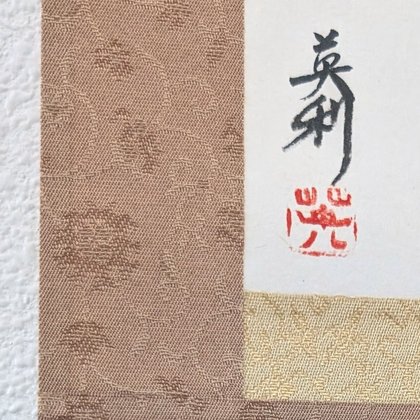
Master Japanese Calligrapher Eri Takase brushes your scroll by hand when you order it. Each scroll bears her red seal, 英利, and her signature.
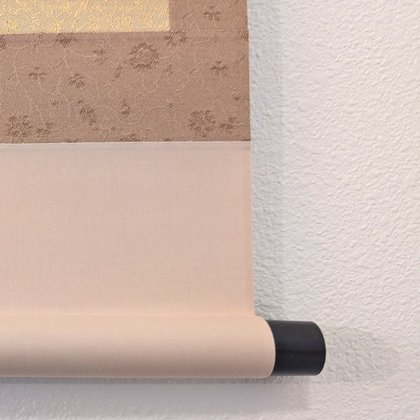
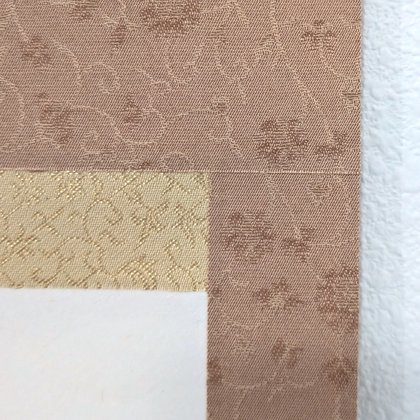
The scrolls are 12 1/4" W × 43" H (31 × 109 cm) with woven damask borders and Japanese paper that are layered so the scroll hangs straight and will not warp over time. The scrolls themselves are made by a scroll maker in Gifu, Japan, and we have worked with them for over two decades.
Eri Takase was born and raised in Osaka, Japan, and holds the rank of Shihan, the highest rank in Japanese calligraphy, from the Bokuteki-kai and the Bunka-shodo. About Master Takase


