





Cursive · sōsho 草書 · VC5J
Cursive or sōsho (草書) styles are the most simplified styles and Master Takase's favorite. While very beautiful, these styles are often difficult to read even by specialists.
不撓不屈
futō fukutsu
Indomitable
Indomitable: never losing heart, whatever the hardship.
Master Takase creates this beautiful scroll when your order is placed, personally preparing the ink and brushing your art, which proudly bears her signature and seal. This is an original work of art.
Description
不撓不屈 (futō fukutsu): never losing heart, whatever the hardship. The Daijisen dictionary's example pairs the word with seishin, spirit: a spirit unbending and unbowed.
The word has two halves: futō, not bending, and fukutsu, not bowing, not giving in. The verb behind 撓, tawamu, is to bend under a weight; said of the heart, one dictionary gives it to lose heart, another to weaken.
Wang Yangming wrote of the bamboo beside his hut when he was in exile. When the wind stops and its sounds fall still, the bamboo stands upright and alone, unbending and unbowed, with the bearing of a gentleman. His disciples answered that he was speaking of himself.
In an essay, the scholar Noda Tekiho used the word for the bamboo in his garden: proud and rugged, it neither bends nor bows. A Chinese reader who kept the papers of a ship that had drifted to Japan in 1826 marked the line with his dots. The essay does not name Wang Yangming; its bamboo is close to his.
A composition primer of 1878 glossed the word for its pupils as not slackening and not giving way. The reading was not yet settled: a book of 1879 printed futō fukutsu beside the characters, and a book of 1880 printed fukyō fukutsu. In the Freedom and People's Rights movement it was a word for the argument itself. One tract of 1880 urges its readers to argue loudly, unbending and unbowed, until the sleepers' ears are startled.
When the young wrestler Takanohana was made ōzeki in 1993, he promised to devote himself to sumo in a spirit unbending and unbowed. Today 不撓不屈 is the title of a novel and of a film of 2006.
Satow's English-Japanese dictionary of 1904 gave the word under Tenacious, read fugyō-fukutsu, and its edition of 1919 added futō. A Japanese-English dictionary of 1928 rendered it indomitableness, with the example indomitable spirit. Indomitable spirit is one English for the word with seishin; dictionaries give the same English to other Japanese words as well.
A literary Chinese phrase, in this order from a judge's postscript of 1211 and Wang Yangming's essay on the bamboo of 1508, and in the other order, 不屈不撓, from the Yuan; in Japan first read in Noda Tekiho's kanbun essay on planting bamboo, written by spring 1826, and a common word from 1878.
We want you to be as happy with the meaning as you are with Master Takase's art. To learn more, visit Philology of 不撓不屈.
Delivery
Your scroll is brushed when you order it and completed within 1 to 3 business days. It ships by USPS Priority Mail from Master Takase's studio in Washington State, boxed and ready to hang, with a printed page giving the art's English, romaji and Japanese.
Sending it as a gift? Add your message at checkout and we will include it.
Shipping is calculated at checkout from your address; within the United States it is $13 to $23. We ship worldwide, and any import charges for your country are shown at checkout before you pay.
Every order is covered by our 30-day money-back guarantee. If your scroll arrives damaged, or we made an error, we replace it or refund you in full, including shipping. Refund policy
About Our Scrolls
Master Japanese Calligrapher Eri Takase brushes your scroll by hand when you order it. Each scroll bears her red seal, 英利, and her signature.
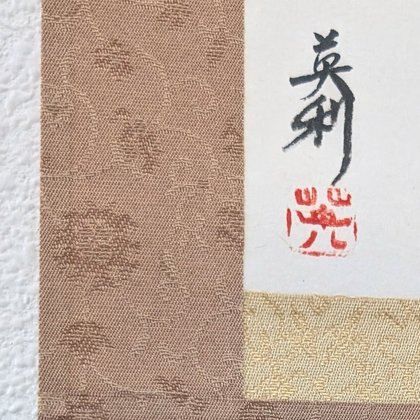


The scrolls are 12 1/4" W × 43" H (31 × 109 cm), with woven damask borders and layered Japanese paper, designed to last generations. The scrolls themselves are made by a scroll maker in Gifu, Japan, and we have worked with them for over two decades.
Eri Takase was born and raised in Osaka, Japan, and holds the rank of Shihan, the highest rank in Japanese calligraphy, from the Bokuteki-kai and the Bunka-shodo. About Master Takase


